

 搜索
搜索
第236页
- 第1页
- 第2页
- 第3页
- 第4页
- 第5页
- 第6页
- 第7页
- 第8页
- 第9页
- 第10页
- 第11页
- 第12页
- 第13页
- 第14页
- 第15页
- 第16页
- 第17页
- 第18页
- 第19页
- 第20页
- 第21页
- 第22页
- 第23页
- 第24页
- 第25页
- 第26页
- 第27页
- 第28页
- 第29页
- 第30页
- 第31页
- 第32页
- 第33页
- 第34页
- 第35页
- 第36页
- 第37页
- 第38页
- 第39页
- 第40页
- 第41页
- 第42页
- 第43页
- 第44页
- 第45页
- 第46页
- 第47页
- 第48页
- 第49页
- 第50页
- 第51页
- 第52页
- 第53页
- 第54页
- 第55页
- 第56页
- 第57页
- 第58页
- 第59页
- 第60页
- 第61页
- 第62页
- 第63页
- 第64页
- 第65页
- 第66页
- 第67页
- 第68页
- 第69页
- 第70页
- 第71页
- 第72页
- 第73页
- 第74页
- 第75页
- 第76页
- 第77页
- 第78页
- 第79页
- 第80页
- 第81页
- 第82页
- 第83页
- 第84页
- 第85页
- 第86页
- 第87页
- 第88页
- 第89页
- 第90页
- 第91页
- 第92页
- 第93页
- 第94页
- 第95页
- 第96页
- 第97页
- 第98页
- 第99页
- 第100页
- 第101页
- 第102页
- 第103页
- 第104页
- 第105页
- 第106页
- 第107页
- 第108页
- 第109页
- 第110页
- 第111页
- 第112页
- 第113页
- 第114页
- 第115页
- 第116页
- 第117页
- 第118页
- 第119页
- 第120页
- 第121页
- 第122页
- 第123页
- 第124页
- 第125页
- 第126页
- 第127页
- 第128页
- 第129页
- 第130页
- 第131页
- 第132页
- 第133页
- 第134页
- 第135页
- 第136页
- 第137页
- 第138页
- 第139页
- 第140页
- 第141页
- 第142页
- 第143页
- 第144页
- 第145页
- 第146页
- 第147页
- 第148页
- 第149页
- 第150页
- 第151页
- 第152页
- 第153页
- 第154页
- 第155页
- 第156页
- 第157页
- 第158页
- 第159页
- 第160页
- 第161页
- 第162页
- 第163页
- 第164页
- 第165页
- 第166页
- 第167页
- 第168页
- 第169页
- 第170页
- 第171页
- 第172页
- 第173页
- 第174页
- 第175页
- 第176页
- 第177页
- 第178页
- 第179页
- 第180页
- 第181页
- 第182页
- 第183页
- 第184页
- 第185页
- 第186页
- 第187页
- 第188页
- 第189页
- 第190页
- 第191页
- 第192页
- 第193页
- 第194页
- 第195页
- 第196页
- 第197页
- 第198页
- 第199页
- 第200页
- 第201页
- 第202页
- 第203页
- 第204页
- 第205页
- 第206页
- 第207页
- 第208页
- 第209页
- 第210页
- 第211页
- 第212页
- 第213页
- 第214页
- 第215页
- 第216页
- 第217页
- 第218页
- 第219页
- 第220页
- 第221页
- 第222页
- 第223页
- 第224页
- 第225页
- 第226页
- 第227页
- 第228页
- 第229页
- 第230页
- 第231页
- 第232页
- 第233页
- 第234页
- 第235页
- 第236页
- 第237页
1. (北师九下 P3)如图,甲、乙两个自动扶梯,哪一个自动扶梯比较陡?
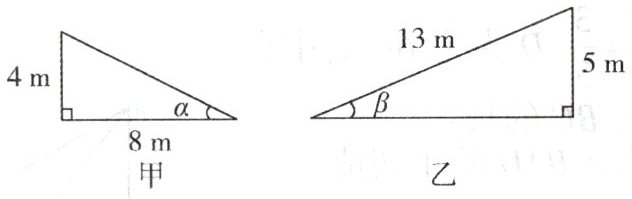
解:由图形甲中数据,可得 $\tan \alpha = \frac{4}{8} = \frac{1}{2}$,
由图形乙中数据,可得另一直角边为 $\sqrt{13^2 - 5^2} = 12(m)$,
故 $\tan \beta = \frac{5}{12} < \tan \alpha = \frac{1}{2}$,故 $\alpha > \beta$,故
解:由图形甲中数据,可得 $\tan \alpha = \frac{4}{8} = \frac{1}{2}$,
由图形乙中数据,可得另一直角边为 $\sqrt{13^2 - 5^2} = 12(m)$,
故 $\tan \beta = \frac{5}{12} < \tan \alpha = \frac{1}{2}$,故 $\alpha > \beta$,故
甲
自动扶梯较陡。
答案:
解:由图形甲中数据,可得 $\tan \alpha = \frac{4}{8} = \frac{1}{2}$,
由图形乙中数据,可得另一直角边为 $\sqrt{13^2 - 5^2} = 12(m)$,
故 $\tan \beta = \frac{5}{12} < \tan \alpha = \frac{1}{2}$,故 $\alpha > \beta$,故甲自动扶梯较陡。
由图形乙中数据,可得另一直角边为 $\sqrt{13^2 - 5^2} = 12(m)$,
故 $\tan \beta = \frac{5}{12} < \tan \alpha = \frac{1}{2}$,故 $\alpha > \beta$,故甲自动扶梯较陡。
2. (人教九下 P84)某型号飞机的机翼形状如图所示. 根据图中数据计算 AB 的长为
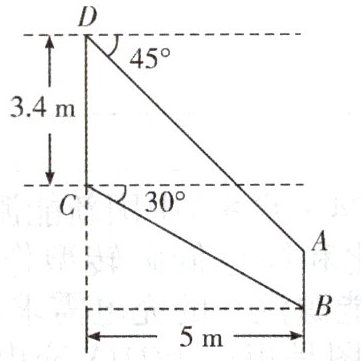
$(\frac{5\sqrt{3}}{3} - 1.6)$
m. (结果保留根号)
答案:
$(\frac{5\sqrt{3}}{3} - 1.6)$
3. (人教九下 P84 教材改编)如图,要想使人安全地攀上斜靠在墙面上的梯子的顶端,梯子与地面所成的角α一般要满足 $ 45 ^ { \circ } \leq \alpha \leq 60 ^ { \circ } $. 现有一架长 6 m 的梯子.
(1)使用这架梯子最高可以安全攀上多高的墙?
(2)当梯子底端距离墙面 $ 3 \sqrt { 3 } $ m 时,α 等于多少度?
(1)使用这架梯子最高可以安全攀上多高的墙?
$3\sqrt{3}m$
(2)当梯子底端距离墙面 $ 3 \sqrt { 3 } $ m 时,α 等于多少度?
$30^{\circ}$
此时人是否能够安全使用这架梯子?不能够
答案:
解:
(1) 当 $\angle BAC = 60^{\circ}$ 时,梯子能安全使用且它的顶端最高,
在 $Rt\triangle ABC$ 中,有 $\sin \angle BAC = \frac{BC}{AB}$,
$\therefore BC = AB \cdot \sin \angle BAC = 6 × \sin 60^{\circ} = 3\sqrt{3}(m)$,
$\therefore$ 使用这架梯子最高可以安全攀上 $3\sqrt{3}m$ 的墙;
(2) 在 $Rt\triangle ABC$ 中,有 $\cos \angle BAC = \frac{AC}{AB} = \frac{3\sqrt{3}}{6} = \frac{\sqrt{3}}{2}$,
$\therefore \angle BAC = 30^{\circ}$,
$\because 30^{\circ} < 45^{\circ}$,
$\therefore$ 当梯子底端距离墙面 $3\sqrt{3}m$ 时,梯子与地面所成的角等于 $30^{\circ}$,这时人不能够安全使用这架梯子。
(1) 当 $\angle BAC = 60^{\circ}$ 时,梯子能安全使用且它的顶端最高,
在 $Rt\triangle ABC$ 中,有 $\sin \angle BAC = \frac{BC}{AB}$,
$\therefore BC = AB \cdot \sin \angle BAC = 6 × \sin 60^{\circ} = 3\sqrt{3}(m)$,
$\therefore$ 使用这架梯子最高可以安全攀上 $3\sqrt{3}m$ 的墙;
(2) 在 $Rt\triangle ABC$ 中,有 $\cos \angle BAC = \frac{AC}{AB} = \frac{3\sqrt{3}}{6} = \frac{\sqrt{3}}{2}$,
$\therefore \angle BAC = 30^{\circ}$,
$\because 30^{\circ} < 45^{\circ}$,
$\therefore$ 当梯子底端距离墙面 $3\sqrt{3}m$ 时,梯子与地面所成的角等于 $30^{\circ}$,这时人不能够安全使用这架梯子。
4. (人教九下 P76)如图,建筑物 BC 上有一旗杆 AB,从与 BC 相距 40 m 的 D 处观测旗杆顶部 A 的仰角为 $ 50 ^ { \circ } $, 观测旗杆底部 B 的仰角为 $ 45 ^ { \circ } $, 求旗杆的高度(结果保留小数点后一位). (参考数据: $ \sin 50 ^ { \circ } \approx 0.766 $, $ \cos 50 ^ { \circ } \approx 0.643 $, $ \tan 50 ^ { \circ } \approx 1.192 $)
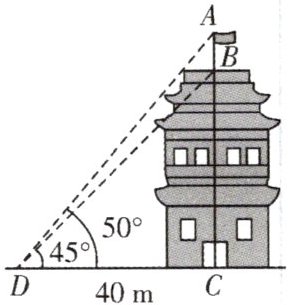
解:由题意,得 $\angle ACD = 90^{\circ}$,$\angle ADC = 50^{\circ}$,$CD = 40m$,
在 $Rt\triangle ACD$ 中,$\tan \angle ADC = \frac{AC}{CD}$,
$\therefore AC = CD \cdot \tan 50^{\circ} \approx 40 × 1.192 = 47.68$,
在 $Rt\triangle BCD$ 中,$\angle BDC = 45^{\circ}$,$\therefore BC = CD = 40$。
$\therefore AB = AC - BC \approx 47.68 - 40 \approx$
答:旗杆的高度约为
解:由题意,得 $\angle ACD = 90^{\circ}$,$\angle ADC = 50^{\circ}$,$CD = 40m$,
在 $Rt\triangle ACD$ 中,$\tan \angle ADC = \frac{AC}{CD}$,
$\therefore AC = CD \cdot \tan 50^{\circ} \approx 40 × 1.192 = 47.68$,
在 $Rt\triangle BCD$ 中,$\angle BDC = 45^{\circ}$,$\therefore BC = CD = 40$。
$\therefore AB = AC - BC \approx 47.68 - 40 \approx$
7.7
(m)。答:旗杆的高度约为
7.7
m。
答案:
解:由题意,得 $\angle ACD = 90^{\circ}$,$\angle ADC = 50^{\circ}$,$CD = 40m$,
在 $Rt\triangle ACD$ 中,$\tan \angle ADC = \frac{AC}{CD}$,
$\therefore AC = CD \cdot \tan 50^{\circ} \approx 40 × 1.192 = 47.68$,
在 $Rt\triangle BCD$ 中,$\angle BDC = 45^{\circ}$,$\therefore BC = CD = 40$。
$\therefore AB = AC - BC \approx 47.68 - 40 \approx 7.7(m)$。
答:旗杆的高度约为 $7.7m$。
在 $Rt\triangle ACD$ 中,$\tan \angle ADC = \frac{AC}{CD}$,
$\therefore AC = CD \cdot \tan 50^{\circ} \approx 40 × 1.192 = 47.68$,
在 $Rt\triangle BCD$ 中,$\angle BDC = 45^{\circ}$,$\therefore BC = CD = 40$。
$\therefore AB = AC - BC \approx 47.68 - 40 \approx 7.7(m)$。
答:旗杆的高度约为 $7.7m$。
5. (人教九下 P85)如图,折叠矩形 ABCD 的一边 AD,使点 D 落在 BC 边的点 F 处. 已知折痕 $ A E = 5 \sqrt { 5 } $ cm, 且 $ \tan \angle E F C = \frac { 3 } { 4 } $.
(1) $ \triangle A F B $ 与 $ \triangle F E C $ 有什么关系?
(2)求矩形 ABCD 的周长.
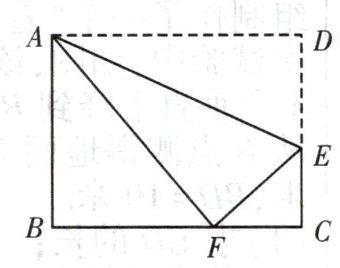
(1) $ \triangle A F B $ 与 $ \triangle F E C $ 有什么关系?
$\triangle AFB \sim \triangle FEC$
(2)求矩形 ABCD 的周长.
36cm
答案:
解:
(1) $\triangle AFB \sim \triangle FEC$。理由如下:
$\because$ 四边形 $ABCD$ 是矩形,$\therefore \angle B = \angle C = \angle D = 90^{\circ}$,
$\therefore \angle BAF + \angle AFB = 90^{\circ}$,
由折叠的性质,得 $\angle AFE = \angle D = 90^{\circ}$,
$\therefore \angle AFB + \angle CFE = 90^{\circ}$。
$\therefore \angle BAF = \angle CFE$,
$\therefore \triangle AFB \sim \triangle FEC$;
(2) 在 $Rt\triangle EFC$ 中,$\tan \angle EFC = \frac{EC}{FC} = \frac{3}{4}$,
设 $EC = 3x cm$,则 $FC = 4x cm$。
$\therefore EF = \sqrt{EC^2 + FC^2} = 5x cm$,
由折叠的性质,得 $DE = EF = 5x cm$,
$\therefore AB = CD = DE + CE = 8x cm$,
在 $Rt\triangle ABF$ 中,$\angle BAF = \angle EFC$,
$\therefore \tan \angle BAF = \frac{BF}{AB} = \frac{3}{4}$,
$\therefore BF = 6x cm$。
$\therefore AF = \sqrt{AB^2 + BF^2} = 10x cm$,
在 $Rt\triangle AEF$ 中,$AE = \sqrt{AF^2 + EF^2} = 5\sqrt{5}x = 5\sqrt{5}$,解得 $x = 1$,
$\therefore AD = BC = AF = 10x = 10cm$,$AB = CD = 8x = 8cm$。
$\therefore$ 矩形 $ABCD$ 的周长为 $10 + 10 + 8 + 8 = 36(cm)$。
(1) $\triangle AFB \sim \triangle FEC$。理由如下:
$\because$ 四边形 $ABCD$ 是矩形,$\therefore \angle B = \angle C = \angle D = 90^{\circ}$,
$\therefore \angle BAF + \angle AFB = 90^{\circ}$,
由折叠的性质,得 $\angle AFE = \angle D = 90^{\circ}$,
$\therefore \angle AFB + \angle CFE = 90^{\circ}$。
$\therefore \angle BAF = \angle CFE$,
$\therefore \triangle AFB \sim \triangle FEC$;
(2) 在 $Rt\triangle EFC$ 中,$\tan \angle EFC = \frac{EC}{FC} = \frac{3}{4}$,
设 $EC = 3x cm$,则 $FC = 4x cm$。
$\therefore EF = \sqrt{EC^2 + FC^2} = 5x cm$,
由折叠的性质,得 $DE = EF = 5x cm$,
$\therefore AB = CD = DE + CE = 8x cm$,
在 $Rt\triangle ABF$ 中,$\angle BAF = \angle EFC$,
$\therefore \tan \angle BAF = \frac{BF}{AB} = \frac{3}{4}$,
$\therefore BF = 6x cm$。
$\therefore AF = \sqrt{AB^2 + BF^2} = 10x cm$,
在 $Rt\triangle AEF$ 中,$AE = \sqrt{AF^2 + EF^2} = 5\sqrt{5}x = 5\sqrt{5}$,解得 $x = 1$,
$\therefore AD = BC = AF = 10x = 10cm$,$AB = CD = 8x = 8cm$。
$\therefore$ 矩形 $ABCD$ 的周长为 $10 + 10 + 8 + 8 = 36(cm)$。
查看更多完整答案,请扫码查看

