

 搜索
搜索
第210页
- 第1页
- 第2页
- 第3页
- 第4页
- 第5页
- 第6页
- 第7页
- 第8页
- 第9页
- 第10页
- 第11页
- 第12页
- 第13页
- 第14页
- 第15页
- 第16页
- 第17页
- 第18页
- 第19页
- 第20页
- 第21页
- 第22页
- 第23页
- 第24页
- 第25页
- 第26页
- 第27页
- 第28页
- 第29页
- 第30页
- 第31页
- 第32页
- 第33页
- 第34页
- 第35页
- 第36页
- 第37页
- 第38页
- 第39页
- 第40页
- 第41页
- 第42页
- 第43页
- 第44页
- 第45页
- 第46页
- 第47页
- 第48页
- 第49页
- 第50页
- 第51页
- 第52页
- 第53页
- 第54页
- 第55页
- 第56页
- 第57页
- 第58页
- 第59页
- 第60页
- 第61页
- 第62页
- 第63页
- 第64页
- 第65页
- 第66页
- 第67页
- 第68页
- 第69页
- 第70页
- 第71页
- 第72页
- 第73页
- 第74页
- 第75页
- 第76页
- 第77页
- 第78页
- 第79页
- 第80页
- 第81页
- 第82页
- 第83页
- 第84页
- 第85页
- 第86页
- 第87页
- 第88页
- 第89页
- 第90页
- 第91页
- 第92页
- 第93页
- 第94页
- 第95页
- 第96页
- 第97页
- 第98页
- 第99页
- 第100页
- 第101页
- 第102页
- 第103页
- 第104页
- 第105页
- 第106页
- 第107页
- 第108页
- 第109页
- 第110页
- 第111页
- 第112页
- 第113页
- 第114页
- 第115页
- 第116页
- 第117页
- 第118页
- 第119页
- 第120页
- 第121页
- 第122页
- 第123页
- 第124页
- 第125页
- 第126页
- 第127页
- 第128页
- 第129页
- 第130页
- 第131页
- 第132页
- 第133页
- 第134页
- 第135页
- 第136页
- 第137页
- 第138页
- 第139页
- 第140页
- 第141页
- 第142页
- 第143页
- 第144页
- 第145页
- 第146页
- 第147页
- 第148页
- 第149页
- 第150页
- 第151页
- 第152页
- 第153页
- 第154页
- 第155页
- 第156页
- 第157页
- 第158页
- 第159页
- 第160页
- 第161页
- 第162页
- 第163页
- 第164页
- 第165页
- 第166页
- 第167页
- 第168页
- 第169页
- 第170页
- 第171页
- 第172页
- 第173页
- 第174页
- 第175页
- 第176页
- 第177页
- 第178页
- 第179页
- 第180页
- 第181页
- 第182页
- 第183页
- 第184页
- 第185页
- 第186页
- 第187页
- 第188页
- 第189页
- 第190页
- 第191页
- 第192页
- 第193页
- 第194页
- 第195页
- 第196页
- 第197页
- 第198页
- 第199页
- 第200页
- 第201页
- 第202页
- 第203页
- 第204页
- 第205页
- 第206页
- 第207页
- 第208页
- 第209页
- 第210页
- 第211页
- 第212页
- 第213页
- 第214页
- 第215页
- 第216页
- 第217页
- 第218页
- 第219页
- 第220页
- 第221页
- 第222页
- 第223页
- 第224页
- 第225页
- 第226页
- 第227页
- 第228页
- 第229页
- 第230页
- 第231页
- 第232页
- 第233页
- 第234页
- 第235页
- 第236页
- 第237页
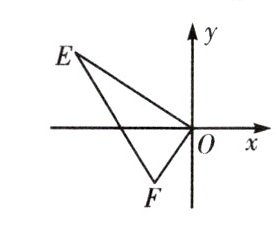
【例题5】如图,点$E的坐标为(-4,2)$,点$F的坐标为(-1,-1)$,以点$O$为位似中心,按相似比$1:2把\triangle EFO$缩小,点$E的对应点E_1$的坐标为(
A.$(-2,1)$
B.$(2,-1)$
C.$(2,-1)或(-2,1)$
D.$(8,-4)或(-8,4)$
C
)A.$(-2,1)$
B.$(2,-1)$
C.$(2,-1)或(-2,1)$
D.$(8,-4)或(-8,4)$
答案:
C 解析:当点$E_{1}$在第二象限时,坐标为$\left( -4×\frac{1}{2},2×\frac{1}{2}\right)$,即$(-2,1)$;当点$E_{1}$在第四象限时,坐标为$\left \lbrack -4×\left( -\frac{1}{2}\right),2×\left( -\frac{1}{2}\right)\right\rbrack$,即$(2,-1)$.故选C.
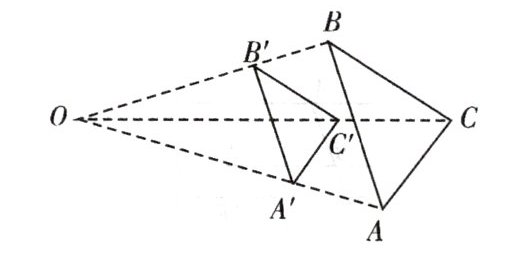
【变式5】如图,$\triangle A'B'C'是\triangle ABC以点O$为位似中心经过位似变换得到的,若$\triangle A'B'C'的面积与\triangle ABC的面积比是4:9$,则$OB':OB= $
$2:3$
。
答案:
$2:3$
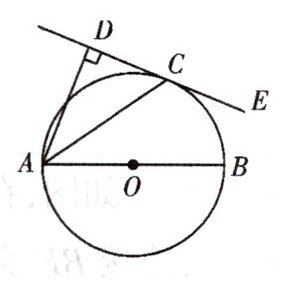
1. 如图,$AB为\odot O$的直径,$C为\odot O$上一点,$AD和过点C$的直线互相垂直,垂足为$D$,且$AC平分\angle DAB$。
(1)求证:$DC为\odot O$的切线;
(2)若$\odot O的半径为6$,$AD= 8$,求$AC$的长。
(1)求证:$DC为\odot O$的切线;
(2)若$\odot O的半径为6$,$AD= 8$,求$AC$的长。
答案:
(1)证明:如图,连接$OC$.
$\because OC=OA$,$\therefore\angle OAC=\angle OCA$,
$\because AC$平分$\angle DAB$,$\therefore\angle OAC=\angle DAC$,
$\therefore\angle DAC=\angle OCA$,$\therefore OC// AD$.
$\because AD\perp CD$,
$\therefore OC\perp CD$,且$OC$为$\odot O$的半径,
即$DC$为$\odot O$的切线;
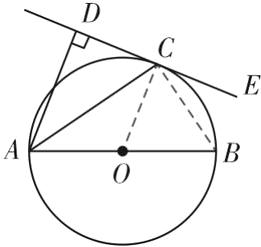
(2)解:如图,连接$BC$.
易得$\triangle ADC\backsim\triangle ACB$,$\therefore\frac{AD}{AC}=\frac{AC}{AB}$.
$\because\odot O$的半径为$6$,
$\therefore AB=12$.
又$\because AD=8$,
$\therefore AC=4\sqrt{6}$.
(1)证明:如图,连接$OC$.
$\because OC=OA$,$\therefore\angle OAC=\angle OCA$,
$\because AC$平分$\angle DAB$,$\therefore\angle OAC=\angle DAC$,
$\therefore\angle DAC=\angle OCA$,$\therefore OC// AD$.
$\because AD\perp CD$,
$\therefore OC\perp CD$,且$OC$为$\odot O$的半径,
即$DC$为$\odot O$的切线;
(2)解:如图,连接$BC$.
易得$\triangle ADC\backsim\triangle ACB$,$\therefore\frac{AD}{AC}=\frac{AC}{AB}$.
$\because\odot O$的半径为$6$,
$\therefore AB=12$.
又$\because AD=8$,
$\therefore AC=4\sqrt{6}$.
2. 如图,直线$y= -x+3交x轴于点A$,交$y轴于点B$,抛物线$y= ax^2+bx+c经过A$,$B$,$C(1,0)$三点。
(1)抛物线的解析式为____;
(2)若点$D的坐标为(-1,0)$,在直线$y= -x+3上有一点P$,使$\triangle ABO与\triangle ADP$相似,求出点$P$的坐标。
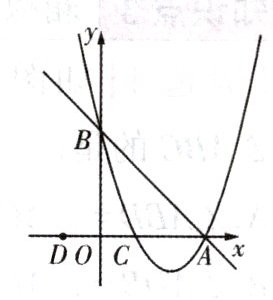
(1)抛物线的解析式为____;
(2)若点$D的坐标为(-1,0)$,在直线$y= -x+3上有一点P$,使$\triangle ABO与\triangle ADP$相似,求出点$P$的坐标。
答案:
(1)$y=x^{2}-4x+3$
(2)解:当$y=0$时,$-x+3=0$,
$\therefore x=3$,$\therefore A(3,0)$,
当$x=0$时,$y=-0+3=3$,$\therefore B(0,3)$,
$\therefore\triangle ABO$为等腰直角三角形,
若$\triangle ABO\backsim\triangle AP_{1}D$,则$\frac{AO}{AD}=\frac{OB}{DP_{1}}$,
$\therefore DP_{1}=AD=4$.$\therefore P_{1}(-1,4)$,
若$\triangle ABO\backsim\triangle ADP_{2}$,
如图,过点$P_{2}$作$P_{2}M\perp x$轴于点$M$,$AD=4$,
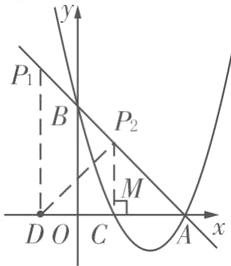
$\because\triangle ABO$为等腰直角三角形,
$\therefore\triangle ADP_{2}$是等腰直角三角形.
由三线合一可得$DM=AM=2=P_{2}M$,即点$M$与点$C$重合.
$\therefore P_{2}(1,2)$.
综上所述,点$P$的坐标为$(-1,4)$或$(1,2)$.
(1)$y=x^{2}-4x+3$
(2)解:当$y=0$时,$-x+3=0$,
$\therefore x=3$,$\therefore A(3,0)$,
当$x=0$时,$y=-0+3=3$,$\therefore B(0,3)$,
$\therefore\triangle ABO$为等腰直角三角形,
若$\triangle ABO\backsim\triangle AP_{1}D$,则$\frac{AO}{AD}=\frac{OB}{DP_{1}}$,
$\therefore DP_{1}=AD=4$.$\therefore P_{1}(-1,4)$,
若$\triangle ABO\backsim\triangle ADP_{2}$,
如图,过点$P_{2}$作$P_{2}M\perp x$轴于点$M$,$AD=4$,
$\because\triangle ABO$为等腰直角三角形,
$\therefore\triangle ADP_{2}$是等腰直角三角形.
由三线合一可得$DM=AM=2=P_{2}M$,即点$M$与点$C$重合.
$\therefore P_{2}(1,2)$.
综上所述,点$P$的坐标为$(-1,4)$或$(1,2)$.
查看更多完整答案,请扫码查看

