

 搜索
搜索
第100页
- 第1页
- 第2页
- 第3页
- 第4页
- 第5页
- 第6页
- 第7页
- 第8页
- 第9页
- 第10页
- 第11页
- 第12页
- 第13页
- 第14页
- 第15页
- 第16页
- 第17页
- 第18页
- 第19页
- 第20页
- 第21页
- 第22页
- 第23页
- 第24页
- 第25页
- 第26页
- 第27页
- 第28页
- 第29页
- 第30页
- 第31页
- 第32页
- 第33页
- 第34页
- 第35页
- 第36页
- 第37页
- 第38页
- 第39页
- 第40页
- 第41页
- 第42页
- 第43页
- 第44页
- 第45页
- 第46页
- 第47页
- 第48页
- 第49页
- 第50页
- 第51页
- 第52页
- 第53页
- 第54页
- 第55页
- 第56页
- 第57页
- 第58页
- 第59页
- 第60页
- 第61页
- 第62页
- 第63页
- 第64页
- 第65页
- 第66页
- 第67页
- 第68页
- 第69页
- 第70页
- 第71页
- 第72页
- 第73页
- 第74页
- 第75页
- 第76页
- 第77页
- 第78页
- 第79页
- 第80页
- 第81页
- 第82页
- 第83页
- 第84页
- 第85页
- 第86页
- 第87页
- 第88页
- 第89页
- 第90页
- 第91页
- 第92页
- 第93页
- 第94页
- 第95页
- 第96页
- 第97页
- 第98页
- 第99页
- 第100页
- 第101页
- 第102页
- 第103页
- 第104页
- 第105页
- 第106页
- 第107页
- 第108页
- 第109页
- 第110页
- 第111页
- 第112页
- 第113页
- 第114页
- 第115页
- 第116页
- 第117页
- 第118页
- 第119页
- 第120页
- 第121页
- 第122页
- 第123页
- 第124页
- 第125页
- 第126页
- 第127页
- 第128页
- 第129页
- 第130页
- 第131页
- 第132页
- 第133页
- 第134页
- 第135页
- 第136页
- 第137页
- 第138页
- 第139页
- 第140页
- 第141页
- 第142页
- 第143页
- 第144页
- 第145页
- 第146页
- 第147页
- 第148页
- 第149页
- 第150页
- 第151页
- 第152页
- 第153页
- 第154页
- 第155页
- 第156页
- 第157页
- 第158页
- 第159页
- 第160页
- 第161页
- 第162页
- 第163页
- 第164页
- 第165页
- 第166页
- 第167页
- 第168页
- 第169页
- 第170页
- 第171页
- 第172页
- 第173页
- 第174页
- 第175页
- 第176页
- 第177页
- 第178页
- 第179页
- 第180页
- 第181页
- 第182页
- 第183页
- 第184页
- 第185页
- 第186页
- 第187页
- 第188页
- 第189页
- 第190页
- 第191页
- 第192页
- 第193页
- 第194页
- 第195页
- 第196页
- 第197页
- 第198页
- 第199页
- 第200页
- 第201页
- 第202页
- 第203页
- 第204页
- 第205页
- 第206页
- 第207页
- 第208页
- 第209页
- 第210页
- 第211页
- 第212页
- 第213页
- 第214页
- 第215页
- 第216页
- 第217页
- 第218页
- 第219页
- 第220页
- 第221页
- 第222页
- 第223页
- 第224页
- 第225页
- 第226页
- 第227页
- 第228页
- 第229页
- 第230页
- 第231页
- 第232页
- 第233页
- 第234页
- 第235页
- 第236页
- 第237页
【例题2】如图,在⊙O中,C,D分别是半径OA,OB的中点,求证:AD= BC.
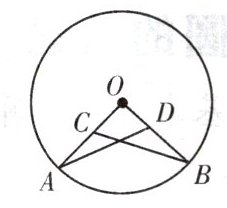
证明:∵OA,OB为⊙O的半径,
∴OA = OB.
∵C,D为OA,OB的中点,
∴OC = OD.
在△AOD与△BOC中,
{ OA = OB,
∠AOD = ∠BOC,
OD = OC,
∴△AOD≌△BOC(SAS),
∴AD = BC.
证明:∵OA,OB为⊙O的半径,
∴OA = OB.
∵C,D为OA,OB的中点,
∴OC = OD.
在△AOD与△BOC中,
{ OA = OB,
∠AOD = ∠BOC,
OD = OC,
∴△AOD≌△BOC(SAS),
∴AD = BC.
答案:
证明:$\because OA$,$OB$为$\odot O$的半径,
$\therefore OA = OB$.
$\because C$,$D$为$OA$,$OB$的中点,
$\therefore OC = OD$.
在$\triangle AOD$与$\triangle BOC$中,
$\left\{ \begin{array} { l } { O A = O B , } \\ { \angle A O D = \angle B O C , } \\ { O D = O C , } \end{array} \right.$
$\therefore \triangle A O D \cong \triangle B O C ( \mathrm { SAS } )$,
$\therefore AD = BC$.
$\therefore OA = OB$.
$\because C$,$D$为$OA$,$OB$的中点,
$\therefore OC = OD$.
在$\triangle AOD$与$\triangle BOC$中,
$\left\{ \begin{array} { l } { O A = O B , } \\ { \angle A O D = \angle B O C , } \\ { O D = O C , } \end{array} \right.$
$\therefore \triangle A O D \cong \triangle B O C ( \mathrm { SAS } )$,
$\therefore AD = BC$.
【变式2】如图,OA,OB是⊙O的两条半径,∠AOB= 90°,AO= 4,则∠A=
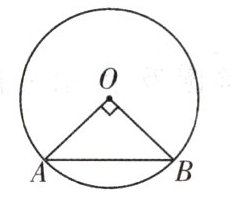
45°
,AB= 4√2
.
答案:
$45 ^ { \circ }$ $4 \sqrt { 2 }$
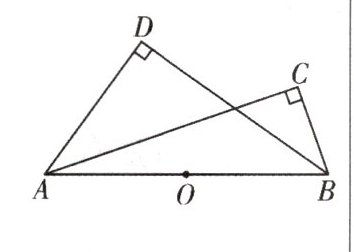
【例题3】(人教九上P81教材改编)如图,△ABC和△ABD都是直角三角形,且∠C= ∠D= 90°,点O是AB的中点. 求证:A,B,C,D四点在同一个圆上,并且圆心为点O.
答案:
证明:如图,连接$OD$,$OC$.
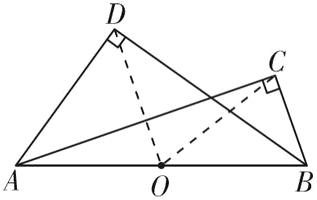
$\because \triangle ADB$和$\triangle ACB$为直角三角形,点$O$是$AB$的中点,
$\therefore OD = \frac { 1 } { 2 } AB = AO = BO$,$OC = \frac { 1 } { 2 } AB = AO = BO$,
即$OC = OD = OA = OB$.
$\therefore$点$A$,$B$,$C$,$D$在同一个圆上,并且圆心为点$O$.
证明:如图,连接$OD$,$OC$.
$\because \triangle ADB$和$\triangle ACB$为直角三角形,点$O$是$AB$的中点,
$\therefore OD = \frac { 1 } { 2 } AB = AO = BO$,$OC = \frac { 1 } { 2 } AB = AO = BO$,
即$OC = OD = OA = OB$.
$\therefore$点$A$,$B$,$C$,$D$在同一个圆上,并且圆心为点$O$.
【变式3】(人教九上P81教材改编)如图,△ABC和△ABD都是直角三角形,且∠C= ∠D= 90°. 求证:A,B,C,D四点在同一个圆上.
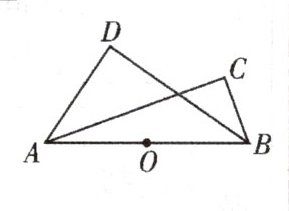
答案:
证明:如图,取$AB$的中点$O$,连接$OC$,$OD$,
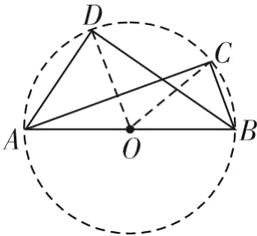
$\because \triangle ABC$和$\triangle ABD$都是直角三角形,
且$\angle ACB = \angle ADB = 90^{\circ}$,
$\therefore DO$,$CO$分别为$Rt\triangle ABD$和$Rt\triangle ABC$斜边上的中线,
$\therefore OA = OB = OC = OD$,
$\therefore A$,$B$,$C$,$D$四点在同一个圆上.
证明:如图,取$AB$的中点$O$,连接$OC$,$OD$,
$\because \triangle ABC$和$\triangle ABD$都是直角三角形,
且$\angle ACB = \angle ADB = 90^{\circ}$,
$\therefore DO$,$CO$分别为$Rt\triangle ABD$和$Rt\triangle ABC$斜边上的中线,
$\therefore OA = OB = OC = OD$,
$\therefore A$,$B$,$C$,$D$四点在同一个圆上.
1.如图,MN为⊙O的弦,下列说法正确的是(
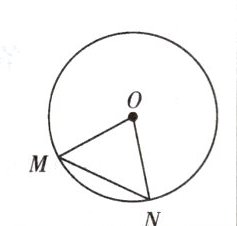
A.△OMN是等边三角形
B.OM= MN
C.当∠M= 50°时,∠MON= 50°
D.$\overset{\frown}{MN}$比弦MN长
D
)A.△OMN是等边三角形
B.OM= MN
C.当∠M= 50°时,∠MON= 50°
D.$\overset{\frown}{MN}$比弦MN长
答案:
D
2.下列说法错误的是(
A.到定点等于定长的所有点的集合是圆
B.矩形的四个顶点共圆
C.过圆心的线段是直径
D.若⊙O的半径为3 cm,则⊙O中最长的弦长为6 cm
C
)A.到定点等于定长的所有点的集合是圆
B.矩形的四个顶点共圆
C.过圆心的线段是直径
D.若⊙O的半径为3 cm,则⊙O中最长的弦长为6 cm
答案:
C
3.如图,⊙O的弦AB与半径OC的延长线交于点D,BD= OA,若∠AOD= 120°,则∠D= ____
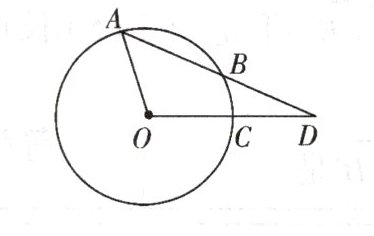
20°
.
答案:
$20^{\circ}$
4.如图,在Rt△ABC中,∠C= 90°,AB= 10. 若以点C为圆心,CB长为半径的圆恰好经过AB的中点D,则AC=
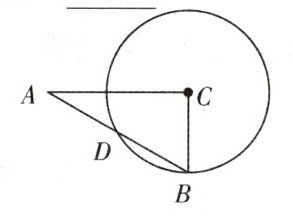
$5 \sqrt { 3 }$
.
答案:
$5 \sqrt { 3 }$
5.(2024·金华模拟)如图,AB是⊙O的直径,CD是⊙O的弦,AB,CD的延长线交于点E,已知AB= 2DE,∠AEC= 20°,求∠AOC的度数.
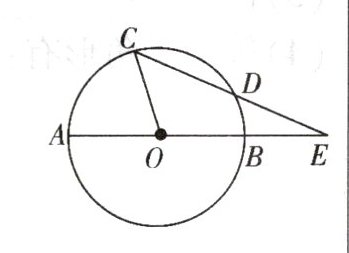
答案:
解:如图,连接$OD$,
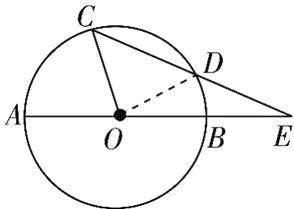
$\because AB = 2DE$,而$AB = 2OD$,
$\therefore OD = DE$,$\therefore \angle DOE = \angle E = 20^{\circ}$,
$\therefore \angle CDO = \angle DOE + \angle E = 40^{\circ}$,
而$OC = OD$,$\therefore \angle C = \angle ODC = 40^{\circ}$,
$\therefore \angle AOC = \angle C + \angle E = 60^{\circ}$.
解:如图,连接$OD$,
$\because AB = 2DE$,而$AB = 2OD$,
$\therefore OD = DE$,$\therefore \angle DOE = \angle E = 20^{\circ}$,
$\therefore \angle CDO = \angle DOE + \angle E = 40^{\circ}$,
而$OC = OD$,$\therefore \angle C = \angle ODC = 40^{\circ}$,
$\therefore \angle AOC = \angle C + \angle E = 60^{\circ}$.
6.如图,AB,CD为⊙O的两条直径,求证:四边形ACBD为矩形.
证明:
证明:
∵AB,CD为⊙O的直径,∴OA = OB = OC = OD,AB = CD.∴四边形ACBD为矩形.
答案:
证明:$\because AB$,$CD$为$\odot O$的直径,
$\therefore OA = OB = OC = OD$,$AB = CD$.
$\therefore$四边形$ACBD$为矩形.
$\therefore OA = OB = OC = OD$,$AB = CD$.
$\therefore$四边形$ACBD$为矩形.
查看更多完整答案,请扫码查看

