

 搜索
搜索
第141页
- 第1页
- 第2页
- 第3页
- 第4页
- 第5页
- 第6页
- 第7页
- 第8页
- 第9页
- 第10页
- 第11页
- 第12页
- 第13页
- 第14页
- 第15页
- 第16页
- 第17页
- 第18页
- 第19页
- 第20页
- 第21页
- 第22页
- 第23页
- 第24页
- 第25页
- 第26页
- 第27页
- 第28页
- 第29页
- 第30页
- 第31页
- 第32页
- 第33页
- 第34页
- 第35页
- 第36页
- 第37页
- 第38页
- 第39页
- 第40页
- 第41页
- 第42页
- 第43页
- 第44页
- 第45页
- 第46页
- 第47页
- 第48页
- 第49页
- 第50页
- 第51页
- 第52页
- 第53页
- 第54页
- 第55页
- 第56页
- 第57页
- 第58页
- 第59页
- 第60页
- 第61页
- 第62页
- 第63页
- 第64页
- 第65页
- 第66页
- 第67页
- 第68页
- 第69页
- 第70页
- 第71页
- 第72页
- 第73页
- 第74页
- 第75页
- 第76页
- 第77页
- 第78页
- 第79页
- 第80页
- 第81页
- 第82页
- 第83页
- 第84页
- 第85页
- 第86页
- 第87页
- 第88页
- 第89页
- 第90页
- 第91页
- 第92页
- 第93页
- 第94页
- 第95页
- 第96页
- 第97页
- 第98页
- 第99页
- 第100页
- 第101页
- 第102页
- 第103页
- 第104页
- 第105页
- 第106页
- 第107页
- 第108页
- 第109页
- 第110页
- 第111页
- 第112页
- 第113页
- 第114页
- 第115页
- 第116页
- 第117页
- 第118页
- 第119页
- 第120页
- 第121页
- 第122页
- 第123页
- 第124页
- 第125页
- 第126页
- 第127页
- 第128页
- 第129页
- 第130页
- 第131页
- 第132页
- 第133页
- 第134页
- 第135页
- 第136页
- 第137页
- 第138页
- 第139页
- 第140页
- 第141页
- 第142页
- 第143页
- 第144页
- 第145页
- 第146页
- 第147页
- 第148页
- 第149页
- 第150页
- 第151页
- 第152页
- 第153页
- 第154页
- 第155页
- 第156页
- 第157页
- 第158页
- 第159页
- 第160页
- 第161页
- 第162页
- 第163页
- 第164页
- 第165页
- 第166页
- 第167页
- 第168页
- 第169页
- 第170页
- 第171页
- 第172页
- 第173页
- 第174页
- 第175页
- 第176页
- 第177页
- 第178页
- 第179页
- 第180页
- 第181页
- 第182页
- 第183页
- 第184页
- 第185页
- 第186页
- 第187页
- 第188页
- 第189页
- 第190页
- 第191页
- 第192页
- 第193页
- 第194页
- 第195页
- 第196页
- 第197页
- 第198页
- 第199页
- 第200页
- 第201页
- 第202页
- 第203页
- 第204页
- 第205页
- 第206页
- 第207页
- 第208页
- 第209页
- 第210页
- 第211页
- 第212页
- 第213页
- 第214页
- 第215页
- 第216页
- 第217页
- 第218页
- 第219页
- 第220页
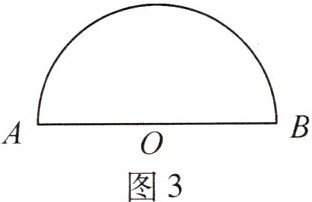
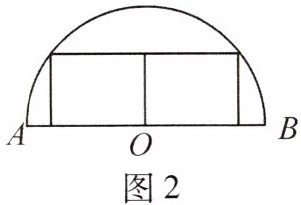
19. (2024·宛城区校级月考)如图,隧道的截面由半径为5 m的半圆构成.
(1)如图1,一辆货车宽5.8 m、高4 m,它能通过该隧道吗?
(2)如图2,如果该隧道内设双行道,一辆宽为4 m、高为2.7 m的货车能通过这个隧道吗?
(3)如图3,如果该隧道内设双行道,为了安全起见,在隧道正中间设有0.6 m的隔离带,则一辆宽为2.8 m,高为4 m的货车____通过隧道.(填“能”或“不能”)
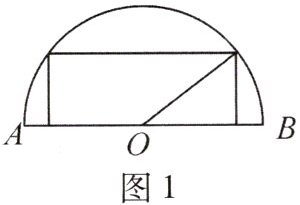
(1)如图1,一辆货车宽5.8 m、高4 m,它能通过该隧道吗?
(2)如图2,如果该隧道内设双行道,一辆宽为4 m、高为2.7 m的货车能通过这个隧道吗?
(3)如图3,如果该隧道内设双行道,为了安全起见,在隧道正中间设有0.6 m的隔离带,则一辆宽为2.8 m,高为4 m的货车____通过隧道.(填“能”或“不能”)
答案:
解:
(1)如图1,设$CD \perp AB$于点D,
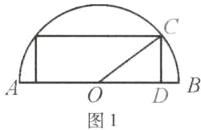
$CD = 4$m.
$\because OC = 5$m,
$\therefore OD = \sqrt{OC^{2} - CD^{2}} = \sqrt{5^{2} - 4^{2}} = 3(m)$.
$\because 3 > \frac{5.8}{2}$,
$\therefore$这辆货车能通过该隧道.
(2)如图2,设$CD \perp AB$于点D,$OD = 4$m,连接OC,
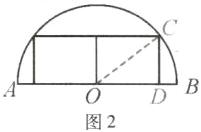
$\because OC = 5$m,
$\therefore CD = \sqrt{OC^{2} - OD^{2}} = \sqrt{5^{2} - 4^{2}} = 3(m)$.
$\because 3 > 2.7$,
$\therefore$这辆货车能通过该隧道.
(3)不能
解:
(1)如图1,设$CD \perp AB$于点D,
$CD = 4$m.
$\because OC = 5$m,
$\therefore OD = \sqrt{OC^{2} - CD^{2}} = \sqrt{5^{2} - 4^{2}} = 3(m)$.
$\because 3 > \frac{5.8}{2}$,
$\therefore$这辆货车能通过该隧道.
(2)如图2,设$CD \perp AB$于点D,$OD = 4$m,连接OC,
$\because OC = 5$m,
$\therefore CD = \sqrt{OC^{2} - OD^{2}} = \sqrt{5^{2} - 4^{2}} = 3(m)$.
$\because 3 > 2.7$,
$\therefore$这辆货车能通过该隧道.
(3)不能
20. (2024·湘潭模拟)已知AB是⊙O的直径,AB = 8,点C在⊙O的半径OA上运动,PC⊥AB,垂足为C,PC = 5,PT为⊙O的切线,切点为T.
(1)如图1,当点C运动到点O时,求PT的长;
(2)如图2,当点C运动到点A时,连接PO,BT. 求证:PO//BT;
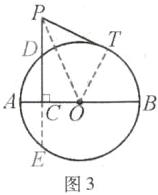
(3)如图3,设$PT^{2}= y$,AC = x,求y与x的函数关系式及y的最小值.
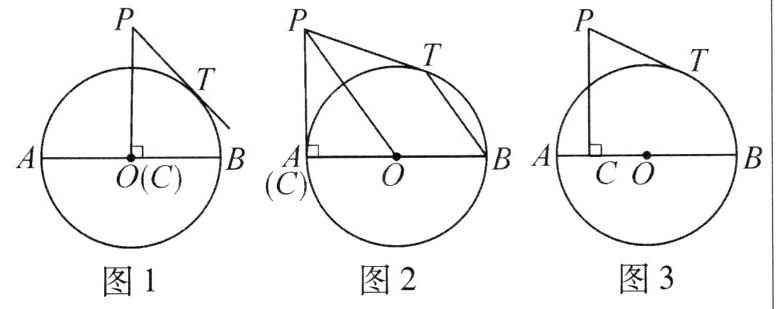
(1)如图1,当点C运动到点O时,求PT的长;
(2)如图2,当点C运动到点A时,连接PO,BT. 求证:PO//BT;
(3)如图3,设$PT^{2}= y$,AC = x,求y与x的函数关系式及y的最小值.
答案:
(1)解:如图1,连接OT,
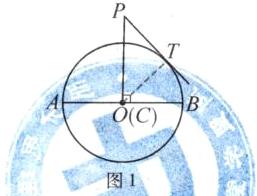
$\because AB = 8$,$\therefore OT = 4$.
$\because PC = 5$,$PT$为$\odot O$的切线,
$\therefore$在$Rt\triangle PTO$中,
$PT = \sqrt{PO^{2} - OT^{2}} = 3$.
(2)证明:如图2,连接OT,
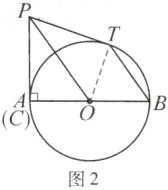
$\because PT$为$\odot O$的切线,$PC \perp AB$,
$\therefore PA = PT$.
$\because PO = PO$,
$\therefore Rt\triangle PAO \cong Rt\triangle PTO(HL)$.
$\therefore \angle POA = \angle POT$.
$\because \angle AOT = 2\angle B$,
$\therefore \angle AOP = \angle B$.
$\therefore PO // BT$.
(3)解:如图3,设PC交$\odot O$于点D,延长PC交$\odot O$于点E,连接OT,OP,
$\because AB = 8$,$\therefore OA = OT = 4$.
$\because AC = x$,
$\therefore OC = OA - AC = 4 - x$.
在$Rt\triangle PCO$中,
$PO^{2} = PC^{2} + OC^{2}$,
在$Rt\triangle PTO$中,
$PO^{2} = PT^{2} + OT^{2}$,
$\therefore PC^{2} + OC^{2} = PT^{2} + OT^{2}$,
即$5^{2} + (4 - x)^{2} = y + 4^{2}$.
$\therefore y = x^{2} - 8x + 25 = (x - 4)^{2} + 9$.
$\therefore$当$x = 4$时,$y_{最小} = 9$.
(1)解:如图1,连接OT,
$\because AB = 8$,$\therefore OT = 4$.
$\because PC = 5$,$PT$为$\odot O$的切线,
$\therefore$在$Rt\triangle PTO$中,
$PT = \sqrt{PO^{2} - OT^{2}} = 3$.
(2)证明:如图2,连接OT,
$\because PT$为$\odot O$的切线,$PC \perp AB$,
$\therefore PA = PT$.
$\because PO = PO$,
$\therefore Rt\triangle PAO \cong Rt\triangle PTO(HL)$.
$\therefore \angle POA = \angle POT$.
$\because \angle AOT = 2\angle B$,
$\therefore \angle AOP = \angle B$.
$\therefore PO // BT$.
(3)解:如图3,设PC交$\odot O$于点D,延长PC交$\odot O$于点E,连接OT,OP,
$\because AB = 8$,$\therefore OA = OT = 4$.
$\because AC = x$,
$\therefore OC = OA - AC = 4 - x$.
在$Rt\triangle PCO$中,
$PO^{2} = PC^{2} + OC^{2}$,
在$Rt\triangle PTO$中,
$PO^{2} = PT^{2} + OT^{2}$,
$\therefore PC^{2} + OC^{2} = PT^{2} + OT^{2}$,
即$5^{2} + (4 - x)^{2} = y + 4^{2}$.
$\therefore y = x^{2} - 8x + 25 = (x - 4)^{2} + 9$.
$\therefore$当$x = 4$时,$y_{最小} = 9$.
查看更多完整答案,请扫码查看

