

 搜索
搜索
第99页
- 第1页
- 第2页
- 第3页
- 第4页
- 第5页
- 第6页
- 第7页
- 第8页
- 第9页
- 第10页
- 第11页
- 第12页
- 第13页
- 第14页
- 第15页
- 第16页
- 第17页
- 第18页
- 第19页
- 第20页
- 第21页
- 第22页
- 第23页
- 第24页
- 第25页
- 第26页
- 第27页
- 第28页
- 第29页
- 第30页
- 第31页
- 第32页
- 第33页
- 第34页
- 第35页
- 第36页
- 第37页
- 第38页
- 第39页
- 第40页
- 第41页
- 第42页
- 第43页
- 第44页
- 第45页
- 第46页
- 第47页
- 第48页
- 第49页
- 第50页
- 第51页
- 第52页
- 第53页
- 第54页
- 第55页
- 第56页
- 第57页
- 第58页
- 第59页
- 第60页
- 第61页
- 第62页
- 第63页
- 第64页
- 第65页
- 第66页
- 第67页
- 第68页
- 第69页
- 第70页
- 第71页
- 第72页
- 第73页
- 第74页
- 第75页
- 第76页
- 第77页
- 第78页
- 第79页
- 第80页
- 第81页
- 第82页
- 第83页
- 第84页
- 第85页
- 第86页
- 第87页
- 第88页
- 第89页
- 第90页
- 第91页
- 第92页
- 第93页
- 第94页
- 第95页
- 第96页
- 第97页
- 第98页
- 第99页
- 第100页
- 第101页
- 第102页
- 第103页
- 第104页
- 第105页
- 第106页
- 第107页
- 第108页
- 第109页
- 第110页
- 第111页
- 第112页
- 第113页
- 第114页
- 第115页
- 第116页
- 第117页
- 第118页
- 第119页
- 第120页
- 第121页
- 第122页
- 第123页
- 第124页
- 第125页
- 第126页
- 第127页
- 第128页
- 第129页
- 第130页
- 第131页
- 第132页
- 第133页
- 第134页
- 第135页
- 第136页
- 第137页
- 第138页
- 第139页
- 第140页
- 第141页
- 第142页
- 第143页
- 第144页
- 第145页
- 第146页
- 第147页
- 第148页
- 第149页
- 第150页
- 第151页
- 第152页
- 第153页
- 第154页
- 第155页
- 第156页
- 第157页
- 第158页
- 第159页
- 第160页
- 第161页
- 第162页
- 第163页
- 第164页
- 第165页
- 第166页
- 第167页
- 第168页
- 第169页
- 第170页
- 第171页
- 第172页
- 第173页
- 第174页
- 第175页
- 第176页
- 第177页
- 第178页
- 第179页
- 第180页
- 第181页
- 第182页
- 第183页
- 第184页
- 第185页
- 第186页
- 第187页
- 第188页
- 第189页
- 第190页
- 第191页
- 第192页
- 第193页
- 第194页
- 第195页
- 第196页
- 第197页
- 第198页
- 第199页
- 第200页
- 第201页
- 第202页
- 第203页
- 第204页
- 第205页
7. (1)已知点P是线段AB的黄金分割点,$PA>PB$,$AB = 4cm$,则$PA =$
(2)若点C为线段AB的黄金分割点,$AB = 8$,则AC的长是(
A. $4\sqrt {5}-4$
B. $9 - 3\sqrt {5}$
C. $3\sqrt {5}-3$或$9 - 3\sqrt {5}$
D. $4\sqrt {5}-4$或$12 - 4\sqrt {5}$
$(2\sqrt{5} - 2)$
cm。(2)若点C为线段AB的黄金分割点,$AB = 8$,则AC的长是(
D
)A. $4\sqrt {5}-4$
B. $9 - 3\sqrt {5}$
C. $3\sqrt {5}-3$或$9 - 3\sqrt {5}$
D. $4\sqrt {5}-4$或$12 - 4\sqrt {5}$
答案:
(1) $(2\sqrt{5} - 2)$
(2) D
(1) $(2\sqrt{5} - 2)$
(2) D
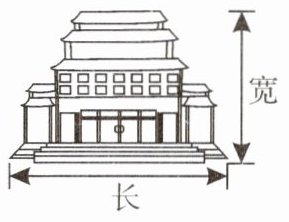
8. (2024·深圳期中)宽与长的比等于$\frac {\sqrt {5}-1}{2}$(约等于0.618)的矩形称为黄金矩形,黄金矩形给我们以协调、匀称的美感,世界上很多著名建筑,为了取得最佳的视觉效果,都采用了黄金矩形的设计。如图所示的建筑也采用了黄金矩形的设计,若它的长约为30m,则它的宽约为(
A. $12.36m$
B. $18.54m$
C. $21.21m$
D. $48.54m$
B
)A. $12.36m$
B. $18.54m$
C. $21.21m$
D. $48.54m$
答案:
B
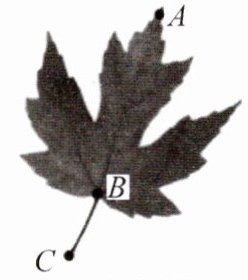
9. (2024·宝安区校级期中)黄金分割广泛存在于艺术、自然、建筑等领域,树叶的叶脉也蕴含着黄金分割(黄金比$=\frac {\sqrt {5}-1}{2}\approx 0.618$)。如图,B为AC的黄金分割点$(AB>BC)$,AC的长为5cm,则AB的长约为(
A. $1.9cm$
B. $2.5cm$
C. $3.1cm$
D. $3.3cm$
C
)A. $1.9cm$
B. $2.5cm$
C. $3.1cm$
D. $3.3cm$
答案:
C
10. (2024·深圳校级开学)黄金分割在日常生活中处处可见,例如主持人在舞台上主持节目时,站在黄金分割点上,观众看上去感觉最好。若舞台长20m,主持人从舞台一侧进入,设他至少走xm时恰好站在舞台的黄金分割点上,则x满足的方程是(
A. $(20 - x)^{2}=20x$
B. $x^{2}=20(20 - x)$
C. $x(20 - x)=20^{2}$
D. 以上都不对
A
)A. $(20 - x)^{2}=20x$
B. $x^{2}=20(20 - x)$
C. $x(20 - x)=20^{2}$
D. 以上都不对
答案:
A
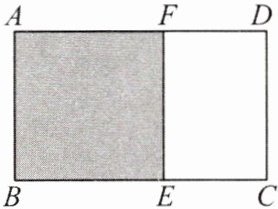
11. (BS九上P96改编)宽与长之比为$\frac {\sqrt {5}-1}{2}:1$的矩形叫做黄金矩形,黄金矩形令人赏心悦目,它给我们以协调、匀称的美感。如图,如果在一个黄金矩形里面画一个正方形,那么留下的矩形还是黄金矩形吗?请证明你的结论。
解:留下的矩形$CDFE$
$\because$四边形$ABEF$是正方形,
$\therefore AB = DC = AF$。
又$\because \frac{AB}{AD} = \frac{\sqrt{5} - 1}{2}$,
$\therefore \frac{AF}{AD} = \frac{\sqrt{5} - 1}{2}$,
即点$F$是线段$AD$的黄金分割点。
$\therefore \frac{FD}{AF} = \frac{AF}{AD} = \frac{\sqrt{5} - 1}{2}$,
即$\frac{FD}{DC} = \frac{\sqrt{5} - 1}{2}$。
$\therefore$矩形$CDFE$是黄金矩形。
解:留下的矩形$CDFE$
是
黄金矩形。证明如下:$\because$四边形$ABEF$是正方形,
$\therefore AB = DC = AF$。
又$\because \frac{AB}{AD} = \frac{\sqrt{5} - 1}{2}$,
$\therefore \frac{AF}{AD} = \frac{\sqrt{5} - 1}{2}$,
即点$F$是线段$AD$的黄金分割点。
$\therefore \frac{FD}{AF} = \frac{AF}{AD} = \frac{\sqrt{5} - 1}{2}$,
即$\frac{FD}{DC} = \frac{\sqrt{5} - 1}{2}$。
$\therefore$矩形$CDFE$是黄金矩形。
答案:
解:留下的矩形$CDFE$是黄金矩形。证明如下:
$\because$四边形$ABEF$是正方形,
$\therefore AB = DC = AF$。
又$\because \frac{AB}{AD} = \frac{\sqrt{5} - 1}{2}$,
$\therefore \frac{AF}{AD} = \frac{\sqrt{5} - 1}{2}$,
即点$F$是线段$AD$的黄金分割点。
$\therefore \frac{FD}{AF} = \frac{AF}{AD} = \frac{\sqrt{5} - 1}{2}$,
即$\frac{FD}{DC} = \frac{\sqrt{5} - 1}{2}$。
$\therefore$矩形$CDFE$是黄金矩形。
$\because$四边形$ABEF$是正方形,
$\therefore AB = DC = AF$。
又$\because \frac{AB}{AD} = \frac{\sqrt{5} - 1}{2}$,
$\therefore \frac{AF}{AD} = \frac{\sqrt{5} - 1}{2}$,
即点$F$是线段$AD$的黄金分割点。
$\therefore \frac{FD}{AF} = \frac{AF}{AD} = \frac{\sqrt{5} - 1}{2}$,
即$\frac{FD}{DC} = \frac{\sqrt{5} - 1}{2}$。
$\therefore$矩形$CDFE$是黄金矩形。
12. 如图,以长为2cm的线段AB为边作正方形ABCD,取AB的中点P,在BA的延长线上取点F,使$PF = PD$,以AF为边作正方形AFEM,点M落在AD上。
(1)试求AM,DM的长;AM=
(2)M是线段AD的黄金分割点吗?请说明理由。
是,理由如下:$\because AM^{2}=(\sqrt{5}-1)^{2}=6-2\sqrt{5}$,$AD\cdot DM=2×(3-\sqrt{5})=6-2\sqrt{5}$,$\therefore AM^{2}=AD\cdot DM$,$\therefore M$是线段$AD$的黄金分割点。
(1)试求AM,DM的长;AM=
$\sqrt{5}-1$
cm,DM=$3-\sqrt{5}$
cm(2)M是线段AD的黄金分割点吗?请说明理由。
是,理由如下:$\because AM^{2}=(\sqrt{5}-1)^{2}=6-2\sqrt{5}$,$AD\cdot DM=2×(3-\sqrt{5})=6-2\sqrt{5}$,$\therefore AM^{2}=AD\cdot DM$,$\therefore M$是线段$AD$的黄金分割点。
答案:
解:
(1) 在$Rt\triangle APD$中,
$AP = 1\mathrm{cm}$,$AD = 2\mathrm{cm}$,
由勾股定理,得
$PD = \sqrt{AD^{2} + AP^{2}}$
$= \sqrt{4 + 1} = \sqrt{5}(\mathrm{cm})$。
$\therefore AM = AF = PF - AP$
$= PD - AP$
$= (\sqrt{5} - 1)(\mathrm{cm})$,
$DM = AD - AM$
$= (3 - \sqrt{5})\mathrm{cm}$。
(2) $\because AM^{2} = (\sqrt{5} - 1)^{2}$
$= 6 - 2\sqrt{5}$,
$AD \cdot DM = 2 \times (3 - \sqrt{5})$
$= 6 - 2\sqrt{5}$,
$\therefore AM^{2} = AD \cdot DM$。
$\therefore M$是线段$AD$的黄金分割点。
(1) 在$Rt\triangle APD$中,
$AP = 1\mathrm{cm}$,$AD = 2\mathrm{cm}$,
由勾股定理,得
$PD = \sqrt{AD^{2} + AP^{2}}$
$= \sqrt{4 + 1} = \sqrt{5}(\mathrm{cm})$。
$\therefore AM = AF = PF - AP$
$= PD - AP$
$= (\sqrt{5} - 1)(\mathrm{cm})$,
$DM = AD - AM$
$= (3 - \sqrt{5})\mathrm{cm}$。
(2) $\because AM^{2} = (\sqrt{5} - 1)^{2}$
$= 6 - 2\sqrt{5}$,
$AD \cdot DM = 2 \times (3 - \sqrt{5})$
$= 6 - 2\sqrt{5}$,
$\therefore AM^{2} = AD \cdot DM$。
$\therefore M$是线段$AD$的黄金分割点。
查看更多完整答案,请扫码查看

