

 搜索
搜索
第130页
- 第2页
- 第3页
- 第4页
- 第5页
- 第6页
- 第7页
- 第8页
- 第9页
- 第10页
- 第11页
- 第12页
- 第13页
- 第14页
- 第15页
- 第16页
- 第17页
- 第18页
- 第19页
- 第20页
- 第21页
- 第22页
- 第23页
- 第24页
- 第25页
- 第26页
- 第27页
- 第28页
- 第29页
- 第30页
- 第31页
- 第32页
- 第33页
- 第34页
- 第35页
- 第36页
- 第37页
- 第38页
- 第39页
- 第40页
- 第41页
- 第42页
- 第43页
- 第44页
- 第45页
- 第46页
- 第47页
- 第48页
- 第49页
- 第50页
- 第51页
- 第52页
- 第53页
- 第54页
- 第55页
- 第56页
- 第57页
- 第58页
- 第59页
- 第60页
- 第61页
- 第62页
- 第63页
- 第64页
- 第65页
- 第66页
- 第67页
- 第68页
- 第69页
- 第70页
- 第71页
- 第72页
- 第73页
- 第74页
- 第75页
- 第76页
- 第77页
- 第78页
- 第79页
- 第80页
- 第81页
- 第82页
- 第83页
- 第84页
- 第85页
- 第86页
- 第87页
- 第88页
- 第89页
- 第90页
- 第91页
- 第92页
- 第93页
- 第94页
- 第95页
- 第96页
- 第97页
- 第98页
- 第99页
- 第100页
- 第101页
- 第102页
- 第103页
- 第104页
- 第105页
- 第106页
- 第107页
- 第108页
- 第109页
- 第110页
- 第111页
- 第112页
- 第113页
- 第114页
- 第115页
- 第116页
- 第117页
- 第118页
- 第119页
- 第120页
- 第121页
- 第122页
- 第123页
- 第124页
- 第125页
- 第126页
- 第127页
- 第128页
- 第129页
- 第130页
- 第131页
- 第132页
- 第133页
- 第134页
- 第135页
- 第136页
- 第137页
- 第138页
- 第139页
- 第140页
- 第141页
- 第142页
- 第143页
- 第144页
- 第145页
- 第146页
- 第147页
- 第148页
- 第149页
- 第150页
- 第151页
- 第152页
- 第153页
- 第154页
- 第155页
- 第156页
- 第157页
- 第158页
- 第159页
- 第160页
- 第161页
- 第162页
- 第163页
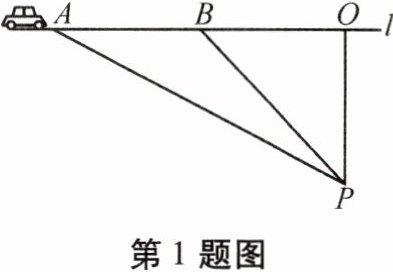
1. 如图,某观测点设在距高速公路(直线$l$)$100m的P$处,一辆轿车由西向东匀速驶来,测得此车从$A处行驶到B处所用的时间为3s$,并测得$\angle AOP = 90^{\circ}$,$\angle APO = 60^{\circ}$,$\angle BPO = 45^{\circ}$,试判断此车是否超过了$25m/s$的限制速度?($\sqrt{3} \approx 1.732$)
答案:
在$Rt\bigtriangleup AOP$中,$\because\angle APO=60^{\circ}$,$\angle AOP=90^{\circ}$,$OP=100m$,
$\therefore AO=OP\cdot\tan60^{\circ}=100\sqrt{3}m$。
在$Rt\bigtriangleup BOP$中,$\because\angle BPO=45^{\circ}$,$\angle BOP=90^{\circ}$,$OP=100m$,
$\therefore BO=OP\cdot\tan45^{\circ}=100m$。
$\therefore AB=AO-BO=(100\sqrt{3}-100)m$。
$\because$此车从$A$处行驶到$B$处所用的时间为$3s$,
$\therefore$此车的速度为$\frac{100\sqrt{3}-100}{3}\approx\frac{173.2-100}{3}\approx24.4m/s$。
$\because 24.4m/s<25m/s$,
$\therefore$此车没有超过$25m/s$的限制速度。
$\therefore AO=OP\cdot\tan60^{\circ}=100\sqrt{3}m$。
在$Rt\bigtriangleup BOP$中,$\because\angle BPO=45^{\circ}$,$\angle BOP=90^{\circ}$,$OP=100m$,
$\therefore BO=OP\cdot\tan45^{\circ}=100m$。
$\therefore AB=AO-BO=(100\sqrt{3}-100)m$。
$\because$此车从$A$处行驶到$B$处所用的时间为$3s$,
$\therefore$此车的速度为$\frac{100\sqrt{3}-100}{3}\approx\frac{173.2-100}{3}\approx24.4m/s$。
$\because 24.4m/s<25m/s$,
$\therefore$此车没有超过$25m/s$的限制速度。
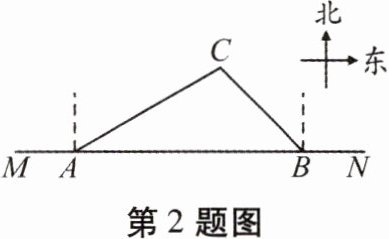
2. 某市要在东西方向的$M$,$N$两地之间修建一条道路.如图,点$C周围180m$范围内为文物保护区,在$MN上的点A处测得点C在点A的北偏东60^{\circ}$方向上,从点$A向东走500m到达点B$处,测得点$C在点B的北偏西45^{\circ}$方向上,则修建的道路$MN$是否穿过文物保护区? 为什么?($\sqrt{3} \approx 1.732$)
答案:
过点$C$作$CD\perp MN$于点$D$。
设$CD=x$米。
在$Rt\triangle ACD$中,$\angle CAD = 30^{\circ}$,则$AD=\frac{CD}{\tan30^{\circ}}=\sqrt{3}x$。
在$Rt\triangle BCD$中,$\angle CBD = 45^{\circ}$,则$BD = CD = x$。
已知$AB = 500$米,因为$AD+BD=AB$,所以$\sqrt{3}x + x = 500$,即$x(\sqrt{3}+1)=500$,解得$x=\frac{500}{\sqrt{3}+1}=\frac{500(\sqrt{3}-1)}{(\sqrt{3}+1)(\sqrt{3}-1)} = 250(\sqrt{3}-1)\approx250×(1.732 - 1)=250×0.732 = 183$(米)。
因为$183>180$,所以修建的道路$MN$不会穿过文物保护区。
设$CD=x$米。
在$Rt\triangle ACD$中,$\angle CAD = 30^{\circ}$,则$AD=\frac{CD}{\tan30^{\circ}}=\sqrt{3}x$。
在$Rt\triangle BCD$中,$\angle CBD = 45^{\circ}$,则$BD = CD = x$。
已知$AB = 500$米,因为$AD+BD=AB$,所以$\sqrt{3}x + x = 500$,即$x(\sqrt{3}+1)=500$,解得$x=\frac{500}{\sqrt{3}+1}=\frac{500(\sqrt{3}-1)}{(\sqrt{3}+1)(\sqrt{3}-1)} = 250(\sqrt{3}-1)\approx250×(1.732 - 1)=250×0.732 = 183$(米)。
因为$183>180$,所以修建的道路$MN$不会穿过文物保护区。
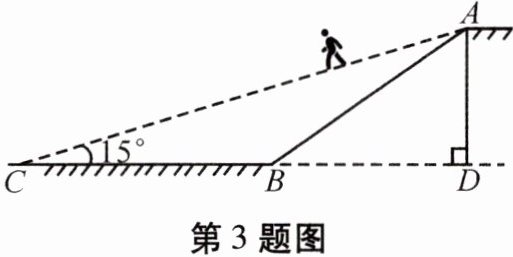
3. 商场为方便消费者购物,准备将原来的阶梯式自动扶梯改造成斜坡式自动扶梯,如图所示,已知原阶梯式自动扶梯$AB长为10m$,扶梯$AB的坡度i = 1:\sqrt{3}$,改造后的斜坡式自动扶梯的坡角$\angle ACB = 15^{\circ}$.
(1)求$AD$的长度;
(2)求改造后的斜坡式自动扶梯$AC$的长度.(结果精确到$0.1m$,参考数据:$\sin 15^{\circ} \approx 0.26$,$\cos 15^{\circ} \approx 0.97$,$\tan 15^{\circ} \approx 0.27$)
(1)求$AD$的长度;
(2)求改造后的斜坡式自动扶梯$AC$的长度.(结果精确到$0.1m$,参考数据:$\sin 15^{\circ} \approx 0.26$,$\cos 15^{\circ} \approx 0.97$,$\tan 15^{\circ} \approx 0.27$)
答案:
(1) 因为扶梯$AB$的坡度$i = 1:\sqrt{3}$,所以$\tan\angle ABD=\frac{AD}{BD}=\frac{1}{\sqrt{3}}=\frac{\sqrt{3}}{3}$,则$\angle ABD = 30^{\circ}$。
在$Rt\triangle ABD$中,$AB = 10m$,根据$30^{\circ}$所对直角边是斜边一半,可得$AD=\frac{1}{2}AB = 5m$。
(2) 由
(1)知$AD = 5m$,且$\angle ACB = 15^{\circ}$,在$Rt\triangle ACD$中,$\sin\angle ACD=\frac{AD}{AC}$,已知$\sin15^{\circ}\approx0.26$,$AD = 5m$,则$AC=\frac{AD}{\sin\angle ACD}=\frac{5}{\sin15^{\circ}}\approx\frac{5}{0.26}\approx19.2m$。
综上,
(1)$AD$的长度为$5m$;
(2)改造后的斜坡式自动扶梯$AC$的长度约为$19.2m$。
(1) 因为扶梯$AB$的坡度$i = 1:\sqrt{3}$,所以$\tan\angle ABD=\frac{AD}{BD}=\frac{1}{\sqrt{3}}=\frac{\sqrt{3}}{3}$,则$\angle ABD = 30^{\circ}$。
在$Rt\triangle ABD$中,$AB = 10m$,根据$30^{\circ}$所对直角边是斜边一半,可得$AD=\frac{1}{2}AB = 5m$。
(2) 由
(1)知$AD = 5m$,且$\angle ACB = 15^{\circ}$,在$Rt\triangle ACD$中,$\sin\angle ACD=\frac{AD}{AC}$,已知$\sin15^{\circ}\approx0.26$,$AD = 5m$,则$AC=\frac{AD}{\sin\angle ACD}=\frac{5}{\sin15^{\circ}}\approx\frac{5}{0.26}\approx19.2m$。
综上,
(1)$AD$的长度为$5m$;
(2)改造后的斜坡式自动扶梯$AC$的长度约为$19.2m$。
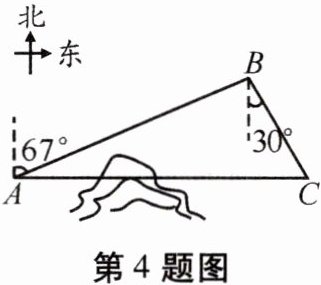
4. 如图,$C地在A$地的正东方向,因有大山阻隔,由$A地到C地需要从B$地绕行.已知$B地位于A地的北偏东67^{\circ}$方向,距离$A地520km$,$C地位于B地的南偏东30^{\circ}$方向,若打通穿山隧道,建成$A$,$C$两地直达高铁,求$A地到C$地之间直线高铁线路的长.(结果精确到$1km$,参考数据:$\sin 67^{\circ} \approx \frac{12}{13}$,$\cos 67^{\circ} \approx \frac{5}{13}$,$\tan 67^{\circ} \approx \frac{12}{5}$,$\sqrt{3} \approx 1.73$)
答案:
解:过点B作BD⊥AC于点D。
在Rt△ABD中,
AD = AB·sin67° = 520×(12/13) = 480 km,
BD = AB·cos67° = 520×(5/13) = 200 km。
在Rt△BCD中,∠CBD = 30°,
CD = BD·tan30° = 200×(1/√3) ≈ 200/1.73 ≈ 115.6 km。
AC = AD + CD = 480 + 115.6 ≈ 596 km。
答:A地到C地之间直线高铁线路的长约为596 km。
在Rt△ABD中,
AD = AB·sin67° = 520×(12/13) = 480 km,
BD = AB·cos67° = 520×(5/13) = 200 km。
在Rt△BCD中,∠CBD = 30°,
CD = BD·tan30° = 200×(1/√3) ≈ 200/1.73 ≈ 115.6 km。
AC = AD + CD = 480 + 115.6 ≈ 596 km。
答:A地到C地之间直线高铁线路的长约为596 km。
查看更多完整答案,请扫码查看

