

 搜索
搜索
第115页
- 第2页
- 第3页
- 第4页
- 第5页
- 第6页
- 第7页
- 第8页
- 第9页
- 第10页
- 第11页
- 第12页
- 第13页
- 第14页
- 第15页
- 第16页
- 第17页
- 第18页
- 第19页
- 第20页
- 第21页
- 第22页
- 第23页
- 第24页
- 第25页
- 第26页
- 第27页
- 第28页
- 第29页
- 第30页
- 第31页
- 第32页
- 第33页
- 第34页
- 第35页
- 第36页
- 第37页
- 第38页
- 第39页
- 第40页
- 第41页
- 第42页
- 第43页
- 第44页
- 第45页
- 第46页
- 第47页
- 第48页
- 第49页
- 第50页
- 第51页
- 第52页
- 第53页
- 第54页
- 第55页
- 第56页
- 第57页
- 第58页
- 第59页
- 第60页
- 第61页
- 第62页
- 第63页
- 第64页
- 第65页
- 第66页
- 第67页
- 第68页
- 第69页
- 第70页
- 第71页
- 第72页
- 第73页
- 第74页
- 第75页
- 第76页
- 第77页
- 第78页
- 第79页
- 第80页
- 第81页
- 第82页
- 第83页
- 第84页
- 第85页
- 第86页
- 第87页
- 第88页
- 第89页
- 第90页
- 第91页
- 第92页
- 第93页
- 第94页
- 第95页
- 第96页
- 第97页
- 第98页
- 第99页
- 第100页
- 第101页
- 第102页
- 第103页
- 第104页
- 第105页
- 第106页
- 第107页
- 第108页
- 第109页
- 第110页
- 第111页
- 第112页
- 第113页
- 第114页
- 第115页
- 第116页
- 第117页
- 第118页
- 第119页
- 第120页
- 第121页
- 第122页
- 第123页
- 第124页
- 第125页
- 第126页
- 第127页
- 第128页
- 第129页
- 第130页
- 第131页
- 第132页
- 第133页
- 第134页
- 第135页
- 第136页
- 第137页
- 第138页
- 第139页
- 第140页
- 第141页
- 第142页
- 第143页
- 第144页
- 第145页
- 第146页
- 第147页
- 第148页
- 第149页
- 第150页
- 第151页
- 第152页
- 第153页
- 第154页
- 第155页
- 第156页
- 第157页
- 第158页
- 第159页
- 第160页
- 第161页
- 第162页
(2024·南宁天桃实验期中)在“车轮为什么是圆的”课题学习中,小青将车轮设计成半径为 2 的正 n 边形,在水平地面上模拟行驶.以 n=3 为例,如图 1,车轮转动一次(以一个顶点为支点旋转),车轮中心的轨迹是 BD,C 为中心轨迹最高点(即$\overset{\frown}{BD}$的中点),转动一次前后中心的连线是 BD(水平线),如图 2,d 为点 C 到 BD 的距离(即 CE 的长).当 n 取 4,5,6 时,车轮中心的轨迹分别如图 3、图 4、图 5.
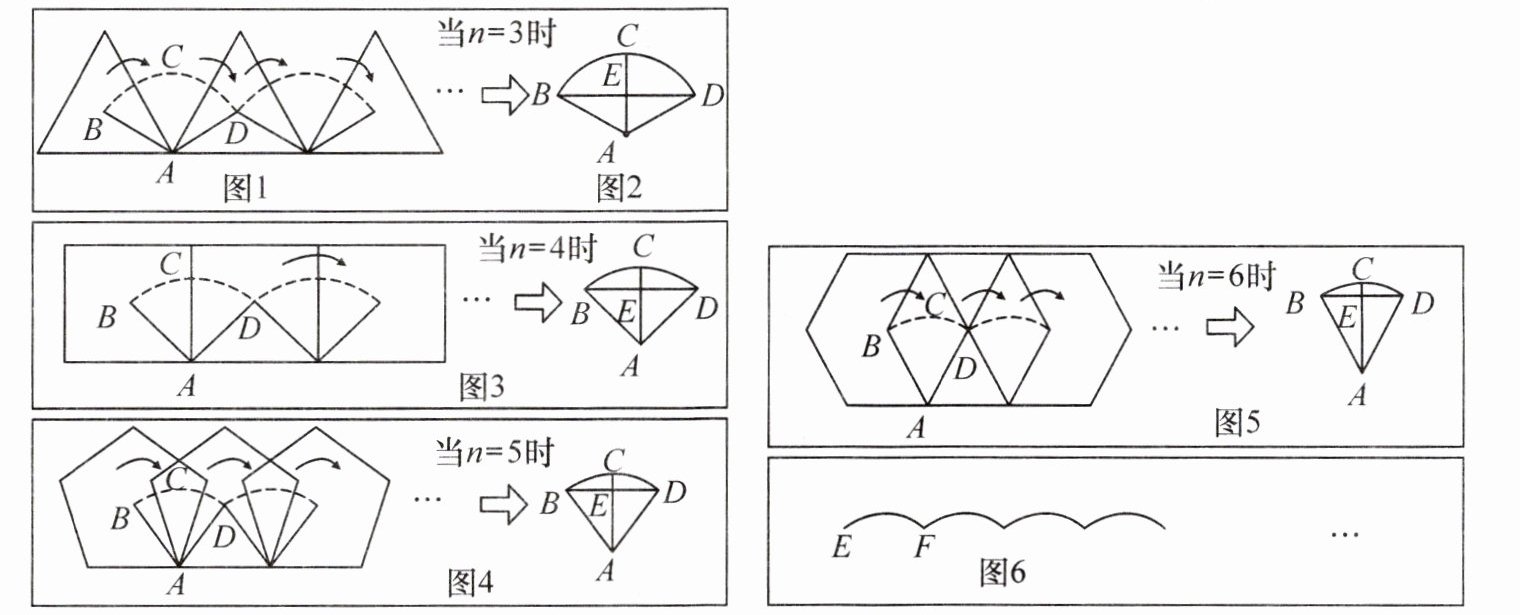
依次类推,当 n 取不同的值时,分别计算出 d 的值(结果精确到 0.001).具体数据如下表:

请协助小青完成以下任务.
(1)当 n=4 时,d 为何值?(参考数据:$\sqrt{2}\approx1.414$)
(2)根据表格数据,d 随 n 的变化情况为
(3)若路面是如图 6 所示的形状,可看成由半径为 2 的一些等弧首尾连接而成,$\overset{\frown}{EF}$的长为$\frac{\pi}{9}$,为确保车轮平稳滚动,则该车轮应设计成边数为几的正多边形?
依次类推,当 n 取不同的值时,分别计算出 d 的值(结果精确到 0.001).具体数据如下表:
请协助小青完成以下任务.
(1)当 n=4 时,d 为何值?(参考数据:$\sqrt{2}\approx1.414$)
(2)根据表格数据,d 随 n 的变化情况为
d随n的增大而减小
;当车轮设计成圆形时,d=0
,这样车辆行驶平稳、没有颠簸感.所以将车轮设计成圆形.(3)若路面是如图 6 所示的形状,可看成由半径为 2 的一些等弧首尾连接而成,$\overset{\frown}{EF}$的长为$\frac{\pi}{9}$,为确保车轮平稳滚动,则该车轮应设计成边数为几的正多边形?
答案:
(1)当$n = 4$时,$\angle BAD = 90^{\circ}$。$\because C$为$BD$的中点,$\therefore\angle BAC = \angle CAD = 45^{\circ}$。$\because AB = AD = AC = 2$,$\therefore AC\perp BD$,$BE = DE$。$\therefore\triangle ABE$为等腰直角三角形。在$Rt\triangle ABE$中,$AE = BE$,$\therefore BE^{2} + AE^{2} = AB^{2}$。$\therefore AE = \sqrt{2}$。$\therefore d = AC - AE = 2 - \sqrt{2} \approx 0.586$。$\therefore$当$n = 4$时,$d \approx 0.586$。
(2)$d$随$n$的增大而减小$0$
(3)设$EF$对应的圆心角为$\alpha^{\circ}$。$\because EF$的长为$\frac{\pi}{9}$,$\therefore\frac{2\pi\alpha}{180} = \frac{\pi}{9}$。$\therefore\alpha = 10$。$\therefore\frac{360}{\alpha} = \frac{360}{10} = 36$。答:该车轮应设计成边数为36的正多边形。
(1)当$n = 4$时,$\angle BAD = 90^{\circ}$。$\because C$为$BD$的中点,$\therefore\angle BAC = \angle CAD = 45^{\circ}$。$\because AB = AD = AC = 2$,$\therefore AC\perp BD$,$BE = DE$。$\therefore\triangle ABE$为等腰直角三角形。在$Rt\triangle ABE$中,$AE = BE$,$\therefore BE^{2} + AE^{2} = AB^{2}$。$\therefore AE = \sqrt{2}$。$\therefore d = AC - AE = 2 - \sqrt{2} \approx 0.586$。$\therefore$当$n = 4$时,$d \approx 0.586$。
(2)$d$随$n$的增大而减小$0$
(3)设$EF$对应的圆心角为$\alpha^{\circ}$。$\because EF$的长为$\frac{\pi}{9}$,$\therefore\frac{2\pi\alpha}{180} = \frac{\pi}{9}$。$\therefore\alpha = 10$。$\therefore\frac{360}{\alpha} = \frac{360}{10} = 36$。答:该车轮应设计成边数为36的正多边形。
查看更多完整答案,请扫码查看

