

 搜索
搜索
第11页
- 第2页
- 第3页
- 第4页
- 第5页
- 第6页
- 第7页
- 第8页
- 第9页
- 第10页
- 第11页
- 第12页
- 第13页
- 第14页
- 第15页
- 第16页
- 第17页
- 第18页
- 第19页
- 第20页
- 第21页
- 第22页
- 第23页
- 第24页
- 第25页
- 第26页
- 第27页
- 第28页
- 第29页
- 第30页
- 第31页
- 第32页
- 第33页
- 第34页
- 第35页
- 第36页
- 第37页
- 第38页
- 第39页
- 第40页
- 第41页
- 第42页
- 第43页
- 第44页
- 第45页
- 第46页
- 第47页
- 第48页
- 第49页
- 第50页
- 第51页
- 第52页
- 第53页
- 第54页
- 第55页
- 第56页
- 第57页
- 第58页
- 第59页
- 第60页
- 第61页
- 第62页
- 第63页
- 第64页
- 第65页
- 第66页
- 第67页
- 第68页
- 第69页
- 第70页
- 第71页
- 第72页
- 第73页
- 第74页
- 第75页
- 第76页
- 第77页
- 第78页
- 第79页
- 第80页
- 第81页
- 第82页
- 第83页
- 第84页
- 第85页
- 第86页
- 第87页
- 第88页
- 第89页
- 第90页
- 第91页
- 第92页
- 第93页
- 第94页
- 第95页
- 第96页
- 第97页
- 第98页
- 第99页
- 第100页
- 第101页
- 第102页
- 第103页
- 第104页
- 第105页
- 第106页
- 第107页
- 第108页
- 第109页
- 第110页
- 第111页
- 第112页
- 第113页
- 第114页
- 第115页
- 第116页
- 第117页
- 第118页
- 第119页
- 第120页
- 第121页
- 第122页
- 第123页
- 第124页
- 第125页
- 第126页
- 第127页
- 第128页
- 第129页
- 第130页
- 第131页
- 第132页
- 第133页
- 第134页
- 第135页
- 第136页
- 第137页
- 第138页
- 第139页
- 第140页
- 第141页
- 第142页
- 第143页
- 第144页
- 第145页
- 第146页
- 第147页
- 第148页
- 第149页
- 第150页
- 第151页
- 第152页
- 第153页
- 第154页
- 第155页
- 第156页
- 第157页
- 第158页
- 第159页
- 第160页
- 第161页
- 第162页
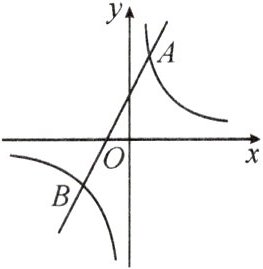
1. 如图,双曲线 $ y_{1}=\frac{k}{x} $($ k $ 为常数,且 $ k \neq 0 $)与直线 $ y_{2}=2x+b $ 交于 $ A(1,m) $ 和 $ B(\frac{1}{2}n,n+2) $ 两点。
(1) 求 $ k $,$ m $ 的值;
(2) 当 $ x>0 $ 时,试比较函数值 $ y_{1} $ 与 $ y_{2} $ 的大小。
(1) 求 $ k $,$ m $ 的值;
(2) 当 $ x>0 $ 时,试比较函数值 $ y_{1} $ 与 $ y_{2} $ 的大小。
答案:
1.解:
(1)
∵点$B\left(\dfrac{1}{2}n,n+2\right)$在直线$y_{2}=2x+b$上,$\therefore n+2=2×\dfrac{1}{2}n+b$. $\therefore b=2$. $\therefore$直线的表达式为$y_{2}=2x+2$. $\because$点$A(1,m)$在直线$y_{2}=2x+2$上,$\therefore m=2+2=4$. $\therefore A(1,4)$. $\because$双曲线$y_{1}=\dfrac{k}{x}$($k$为常数,且$k≠0$)与直线$y_{2}=2x+b$交于$A(1,4)$,$\therefore k=1×4=4$.
(2)由图象可知,当$0<x<1$时,$y_{1}>y_{2}$;当$x=1$时,$y_{1}=y_{2}=4$;当$x>1$时,$y_{1}<y_{2}$.
(1)
∵点$B\left(\dfrac{1}{2}n,n+2\right)$在直线$y_{2}=2x+b$上,$\therefore n+2=2×\dfrac{1}{2}n+b$. $\therefore b=2$. $\therefore$直线的表达式为$y_{2}=2x+2$. $\because$点$A(1,m)$在直线$y_{2}=2x+2$上,$\therefore m=2+2=4$. $\therefore A(1,4)$. $\because$双曲线$y_{1}=\dfrac{k}{x}$($k$为常数,且$k≠0$)与直线$y_{2}=2x+b$交于$A(1,4)$,$\therefore k=1×4=4$.
(2)由图象可知,当$0<x<1$时,$y_{1}>y_{2}$;当$x=1$时,$y_{1}=y_{2}=4$;当$x>1$时,$y_{1}<y_{2}$.
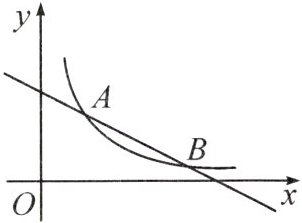
2. 如图,已知反比例函数 $ y=\frac{k}{x}(x>0) $ 的图象与一次函数 $ y=-\frac{1}{2}x+4 $ 的图象交于 $ A $ 和 $ B(6,n) $ 两点。
(1) 求 $ k $ 和 $ n $ 的值;
(2) 若点 $ C(x,y) $ 也在反比例函数 $ y=\frac{k}{x}(x>0) $ 的图象上,求当 $ 2 \leq x \leq 6 $ 时,函数值 $ y $ 的取值范围。
(1) 求 $ k $ 和 $ n $ 的值;
(2) 若点 $ C(x,y) $ 也在反比例函数 $ y=\frac{k}{x}(x>0) $ 的图象上,求当 $ 2 \leq x \leq 6 $ 时,函数值 $ y $ 的取值范围。
答案:
2.解:
(1)将$B(6,n)$代入$y=-\dfrac{1}{2}x+4$,得$n=-\dfrac{1}{2}×6+4=1$,$\therefore$点$B$的坐标为$(6,1)$. $\because$反比例函数$y=\dfrac{k}{x}$的图象经过点$B(6,1)$,$\therefore k=6×1=6$.
(2)$\because k=6>0$,$\therefore$当$x>0$时,$y$随$x$值增大而减小. $\therefore$当$2\leqslant x\leqslant6$时,$1\leqslant y\leqslant3$.
(1)将$B(6,n)$代入$y=-\dfrac{1}{2}x+4$,得$n=-\dfrac{1}{2}×6+4=1$,$\therefore$点$B$的坐标为$(6,1)$. $\because$反比例函数$y=\dfrac{k}{x}$的图象经过点$B(6,1)$,$\therefore k=6×1=6$.
(2)$\because k=6>0$,$\therefore$当$x>0$时,$y$随$x$值增大而减小. $\therefore$当$2\leqslant x\leqslant6$时,$1\leqslant y\leqslant3$.
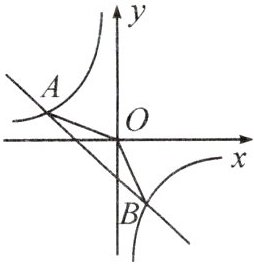
3. 已知 $ A(-4,2) $,$ B(n,-4) $ 是一次函数 $ y=kx+b $ 和反比例函数 $ y=\frac{m}{x} $ 图象的两个交点。
(1) 求一次函数和反比例函数的表达式;
(2) 求 $ \triangle AOB $ 的面积;
(3) 观察图象,直接写出不等式 $ kx+b-\frac{m}{x}>0 $ 的解集。
(1) 求一次函数和反比例函数的表达式;
(2) 求 $ \triangle AOB $ 的面积;
(3) 观察图象,直接写出不等式 $ kx+b-\frac{m}{x}>0 $ 的解集。
答案:
3.解:
(1)把$A(-4,2)$代入$y=\dfrac{m}{x}$,得$m=2×(-4)=-8$,$\therefore$反比例函数的表达式为$y=-\dfrac{8}{x}$. 把$B(n,-4)$代入$y=-\dfrac{8}{x}$,得$-4n=-8$,解得$n=2$. $\therefore$点$B$的坐标为$(2,-4)$. 把$A(-4,2)$,$B(2,-4)$代入$y=kx+b$,得$\begin{cases}-4k+b=2,\\2k+b=-4,\end{cases}$解得$\begin{cases}k=-1,\\b=-2.\end{cases}$ $\therefore$一次函数的表达式为$y=-x-2$.
(2)设直线与$x$轴的交点为$C$,在$y=-x-2$中,令$y=0$,则$x=-2$, $\therefore C(-2,0)$. $\therefore OC=2$. $\therefore S_{\triangle AOB}=S_{\triangle AOC}+S_{\triangle BOC}=\dfrac{1}{2}×2×2+\dfrac{1}{2}×2×4=6$.
(3)不等式$kx+b-\dfrac{m}{x}>0$的解集是$x<-4$或$0<x<2$.
(1)把$A(-4,2)$代入$y=\dfrac{m}{x}$,得$m=2×(-4)=-8$,$\therefore$反比例函数的表达式为$y=-\dfrac{8}{x}$. 把$B(n,-4)$代入$y=-\dfrac{8}{x}$,得$-4n=-8$,解得$n=2$. $\therefore$点$B$的坐标为$(2,-4)$. 把$A(-4,2)$,$B(2,-4)$代入$y=kx+b$,得$\begin{cases}-4k+b=2,\\2k+b=-4,\end{cases}$解得$\begin{cases}k=-1,\\b=-2.\end{cases}$ $\therefore$一次函数的表达式为$y=-x-2$.
(2)设直线与$x$轴的交点为$C$,在$y=-x-2$中,令$y=0$,则$x=-2$, $\therefore C(-2,0)$. $\therefore OC=2$. $\therefore S_{\triangle AOB}=S_{\triangle AOC}+S_{\triangle BOC}=\dfrac{1}{2}×2×2+\dfrac{1}{2}×2×4=6$.
(3)不等式$kx+b-\dfrac{m}{x}>0$的解集是$x<-4$或$0<x<2$.
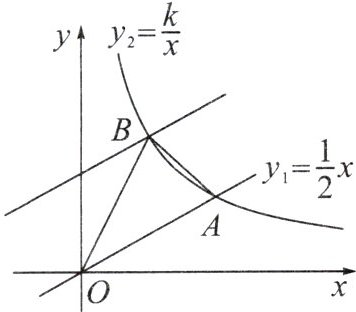
4. (2024·凉山州) 如图,正比例函数 $ y_{1}=\frac{1}{2}x $ 与反比例函数 $ y_{2}=\frac{k}{x}(x>0) $ 的图象交于点 $ A(m,2) $。
(1) 求反比例函数的表达式;
(2) 把直线 $ y_{1}=\frac{1}{2}x $ 向上平移 3 个单位长度后与 $ y_{2}=\frac{k}{x}(x>0) $ 的图象交于点 $ B $,连接 $ AB $,$ OB $,求 $ \triangle AOB $ 的面积。
(1) 求反比例函数的表达式;
(2) 把直线 $ y_{1}=\frac{1}{2}x $ 向上平移 3 个单位长度后与 $ y_{2}=\frac{k}{x}(x>0) $ 的图象交于点 $ B $,连接 $ AB $,$ OB $,求 $ \triangle AOB $ 的面积。
答案:
4.解:
(1)$\because$点$A(m,2)$在正比例函数$y_{1}=\dfrac{1}{2}x$的图象上,$\therefore 2=\dfrac{1}{2}m$,解得$m=4$. $\therefore A(4,2)$. $\because$点$A(4,2)$在反比例函数$y_{2}=\dfrac{k}{x}$的图象上,$\therefore k=4×2=8$. $\therefore$反比例函数的表达式为$y_{2}=\dfrac{8}{x}(x>0)$.
(2)把直线$y_{1}=\dfrac{1}{2}x$向上平移3个单位长度后得到直线$y=\dfrac{1}{2}x+3$. 设平移后的直线与$y$轴交于点$D$,连接$AD$. 由题意,得$D(0,3)$,$BD// AO$. $\therefore S_{\triangle AOB}=S_{\triangle ADO}=\dfrac{1}{2}×3×4=6$.
(1)$\because$点$A(m,2)$在正比例函数$y_{1}=\dfrac{1}{2}x$的图象上,$\therefore 2=\dfrac{1}{2}m$,解得$m=4$. $\therefore A(4,2)$. $\because$点$A(4,2)$在反比例函数$y_{2}=\dfrac{k}{x}$的图象上,$\therefore k=4×2=8$. $\therefore$反比例函数的表达式为$y_{2}=\dfrac{8}{x}(x>0)$.
(2)把直线$y_{1}=\dfrac{1}{2}x$向上平移3个单位长度后得到直线$y=\dfrac{1}{2}x+3$. 设平移后的直线与$y$轴交于点$D$,连接$AD$. 由题意,得$D(0,3)$,$BD// AO$. $\therefore S_{\triangle AOB}=S_{\triangle ADO}=\dfrac{1}{2}×3×4=6$.
查看更多完整答案,请扫码查看

