

 搜索
搜索
第48页
- 第2页
- 第3页
- 第4页
- 第5页
- 第6页
- 第7页
- 第8页
- 第9页
- 第10页
- 第11页
- 第12页
- 第13页
- 第14页
- 第15页
- 第16页
- 第17页
- 第18页
- 第19页
- 第20页
- 第21页
- 第22页
- 第23页
- 第24页
- 第25页
- 第26页
- 第27页
- 第28页
- 第29页
- 第30页
- 第31页
- 第32页
- 第33页
- 第34页
- 第35页
- 第36页
- 第37页
- 第38页
- 第39页
- 第40页
- 第41页
- 第42页
- 第43页
- 第44页
- 第45页
- 第46页
- 第47页
- 第48页
- 第49页
- 第50页
- 第51页
- 第52页
- 第53页
- 第54页
- 第55页
- 第56页
- 第57页
- 第58页
- 第59页
- 第60页
- 第61页
- 第62页
- 第63页
- 第64页
- 第65页
- 第66页
- 第67页
- 第68页
- 第69页
- 第70页
- 第71页
- 第72页
- 第73页
- 第74页
- 第75页
- 第76页
- 第77页
- 第78页
- 第79页
- 第80页
- 第81页
- 第82页
- 第83页
- 第84页
- 第85页
- 第86页
- 第87页
- 第88页
- 第89页
- 第90页
- 第91页
- 第92页
- 第93页
- 第94页
- 第95页
- 第96页
- 第97页
- 第98页
- 第99页
- 第100页
- 第101页
- 第102页
- 第103页
- 第104页
- 第105页
- 第106页
- 第107页
- 第108页
- 第109页
- 第110页
- 第111页
- 第112页
- 第113页
- 第114页
- 第115页
- 第116页
- 第117页
- 第118页
- 第119页
- 第120页
- 第121页
- 第122页
- 第123页
- 第124页
- 第125页
- 第126页
- 第127页
- 第128页
- 第129页
- 第130页
- 第131页
- 第132页
- 第133页
- 第134页
- 第135页
- 第136页
- 第137页
- 第138页
- 第139页
- 第140页
- 第141页
- 第142页
- 第143页
- 第144页
- 第145页
- 第146页
- 第147页
- 第148页
- 第149页
10. (1)(2025·成华)计算:$\sqrt{48}÷\sqrt{3} - \sqrt{\frac{1}{2}}×\sqrt{12} + \sqrt{24}$;
(2)(2024·青白江)计算:$(\sqrt{6} - 2\sqrt{15})×\sqrt{3} - 6\sqrt{\frac{1}{2}}$;
(3)(2024·青白江)计算:$|2 - 3\sqrt{2}| - \sqrt[3]{8}×(4 - \sqrt{72})$;
(4)(2025·锦江)已知$x = \sqrt{3} + 1$,$y = \sqrt{3} - 1$,求代数式$x^2 + 2xy + y^2$的值。
(2)(2024·青白江)计算:$(\sqrt{6} - 2\sqrt{15})×\sqrt{3} - 6\sqrt{\frac{1}{2}}$;
(3)(2024·青白江)计算:$|2 - 3\sqrt{2}| - \sqrt[3]{8}×(4 - \sqrt{72})$;
(4)(2025·锦江)已知$x = \sqrt{3} + 1$,$y = \sqrt{3} - 1$,求代数式$x^2 + 2xy + y^2$的值。
答案:
(1)[解]原式$=\sqrt{16}-\sqrt{6}+2\sqrt{6}=4-\sqrt{6}+2\sqrt{6}=4+\sqrt{6}$。
(2)[解]原式$=\sqrt{18}-2\sqrt{45}-6×\frac{\sqrt{2}}{2}=3\sqrt{2}-6\sqrt{5}-3\sqrt{2}=3\sqrt{2}-3\sqrt{2}-6\sqrt{5}=-6\sqrt{5}$。
(3)[解]原式$=3\sqrt{2}-2-2×(4-6\sqrt{2})=3\sqrt{2}-2-8+12\sqrt{2}=3\sqrt{2}+12\sqrt{2}-2-8=15\sqrt{2}-10$。
(4)[解]$\because x=\sqrt{3}+1,y=\sqrt{3}-1$,
$\therefore x^{2}+2xy+y^{2}=(x+y)^{2}=[(\sqrt{3}+1)+(\sqrt{3}-1)]^{2}=(2\sqrt{3})^{2}=12$。
(1)[解]原式$=\sqrt{16}-\sqrt{6}+2\sqrt{6}=4-\sqrt{6}+2\sqrt{6}=4+\sqrt{6}$。
(2)[解]原式$=\sqrt{18}-2\sqrt{45}-6×\frac{\sqrt{2}}{2}=3\sqrt{2}-6\sqrt{5}-3\sqrt{2}=3\sqrt{2}-3\sqrt{2}-6\sqrt{5}=-6\sqrt{5}$。
(3)[解]原式$=3\sqrt{2}-2-2×(4-6\sqrt{2})=3\sqrt{2}-2-8+12\sqrt{2}=3\sqrt{2}+12\sqrt{2}-2-8=15\sqrt{2}-10$。
(4)[解]$\because x=\sqrt{3}+1,y=\sqrt{3}-1$,
$\therefore x^{2}+2xy+y^{2}=(x+y)^{2}=[(\sqrt{3}+1)+(\sqrt{3}-1)]^{2}=(2\sqrt{3})^{2}=12$。
11. (1)(2025·编写)最简二次根式$\sqrt{3a + 1}与\frac{1}{2}\sqrt{4a - 9}$是同类二次根式,则$a = $
(2)(2025·编写)已知$-1 < a < 0$,化简$\sqrt{(a + \frac{1}{a})^2 - 4}·\sqrt{(a - \frac{1}{a})^2 + 4}$得
10
。(2)(2025·编写)已知$-1 < a < 0$,化简$\sqrt{(a + \frac{1}{a})^2 - 4}·\sqrt{(a - \frac{1}{a})^2 + 4}$得
$-a^{2}+\frac{1}{a^{2}}$
。
答案:
(1)10
(2)$-a^{2}+\frac{1}{a^{2}}$
(1)10
(2)$-a^{2}+\frac{1}{a^{2}}$
12. (1)(2025·编写)计算:$\sqrt{4 + \sqrt{15}} - \sqrt{4 - \sqrt{15}} = $
(2)(2025·武侯)如果$x = \sqrt{3} + 1$,那么代数式$x^2 - 2x + 3$的值为
$\sqrt{6}$
。(2)(2025·武侯)如果$x = \sqrt{3} + 1$,那么代数式$x^2 - 2x + 3$的值为
5
。
答案:
(1)$\sqrt{6}$
(2)5
(1)$\sqrt{6}$
(2)5
13. (2025·编写)已知$x = \sqrt{5} + 2$,$y = \sqrt{5} - 2$,则$x^2 + y^2 + 2xy = $
20
。
答案:
20
14. (2024·青羊)已知$x = \sqrt{5} + \sqrt{7}$,$y = \sqrt{5} - \sqrt{7}$,求下列代数式的值:
(1)$x^2 + y^2$;
(2)$x^2 - xy + y^2$。
(1)$x^2 + y^2$;
(2)$x^2 - xy + y^2$。
答案:
[解]
(1)$\because x=\sqrt{5}+\sqrt{7},y=\sqrt{5}-\sqrt{7}$,
$\therefore x+y=\sqrt{5}+\sqrt{7}+(\sqrt{5}-\sqrt{7})=2\sqrt{5},xy=(\sqrt{5}+\sqrt{7})×(\sqrt{5}-\sqrt{7})=5-7=-2$,
$\therefore x^{2}+y^{2}=(x+y)^{2}-2xy=(2\sqrt{5})^{2}-2×(-2)=20+4=24$。
(2)$\because x+y=2\sqrt{5},xy=-2$,
$\therefore x^{2}-xy+y^{2}=(x+y)^{2}-3xy=(2\sqrt{5})^{2}-3×(-2)=20+6=26$。
(1)$\because x=\sqrt{5}+\sqrt{7},y=\sqrt{5}-\sqrt{7}$,
$\therefore x+y=\sqrt{5}+\sqrt{7}+(\sqrt{5}-\sqrt{7})=2\sqrt{5},xy=(\sqrt{5}+\sqrt{7})×(\sqrt{5}-\sqrt{7})=5-7=-2$,
$\therefore x^{2}+y^{2}=(x+y)^{2}-2xy=(2\sqrt{5})^{2}-2×(-2)=20+4=24$。
(2)$\because x+y=2\sqrt{5},xy=-2$,
$\therefore x^{2}-xy+y^{2}=(x+y)^{2}-3xy=(2\sqrt{5})^{2}-3×(-2)=20+6=26$。
15. (2024·新都)如图,在边长为4的正方形$ABCD$中,点$E$,$F分别在边CD$,$AD$上,连接$BE$,$BF$,$EF$,且有$∠EBF = 45^{\circ}$。将$\triangle DEF沿EF$翻折,若点$D的对应点恰好落在BF$上,求$EF$的长。
答案:
[解]如图,过点 E 作$EH\perp BF$于点 H。
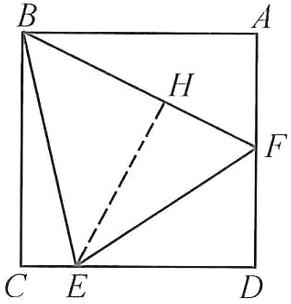
设$DE=x,DF=y$,则$AF=4-y,CE=4-x$。
由题意,得$∠HEF=∠DEF,∠FHE=∠FDE=90^{\circ}$,$\triangle BHE$为等腰直角三角形。
又$\because EF=EF,\therefore\triangle EFH\cong\triangle EFD(AAS)$,
$\therefore BH=HE=ED=x,HF=DF=y,\therefore BF=x+y$。
在$\triangle BHE$中,由勾股定理可得$BE=\sqrt{BH^{2}+EH^{2}}=\sqrt{2}x$,在$\triangle BCE$中,$BC^{2}+CE^{2}=BE^{2}$,
即$4^{2}+(4-x)^{2}=(\sqrt{2}x)^{2}$,解得$x=4\sqrt{3}-4$。
在$\triangle ABF$中,$AB^{2}+AF^{2}=BF^{2}$,即$4^{2}+(4-y)^{2}=(x+y)^{2}$,解得$y=4-\frac{4\sqrt{3}}{3}$,
$\therefore EF=\sqrt{DE^{2}+DF^{2}}=8-\frac{8\sqrt{3}}{3}$。
[解]如图,过点 E 作$EH\perp BF$于点 H。
设$DE=x,DF=y$,则$AF=4-y,CE=4-x$。
由题意,得$∠HEF=∠DEF,∠FHE=∠FDE=90^{\circ}$,$\triangle BHE$为等腰直角三角形。
又$\because EF=EF,\therefore\triangle EFH\cong\triangle EFD(AAS)$,
$\therefore BH=HE=ED=x,HF=DF=y,\therefore BF=x+y$。
在$\triangle BHE$中,由勾股定理可得$BE=\sqrt{BH^{2}+EH^{2}}=\sqrt{2}x$,在$\triangle BCE$中,$BC^{2}+CE^{2}=BE^{2}$,
即$4^{2}+(4-x)^{2}=(\sqrt{2}x)^{2}$,解得$x=4\sqrt{3}-4$。
在$\triangle ABF$中,$AB^{2}+AF^{2}=BF^{2}$,即$4^{2}+(4-y)^{2}=(x+y)^{2}$,解得$y=4-\frac{4\sqrt{3}}{3}$,
$\therefore EF=\sqrt{DE^{2}+DF^{2}}=8-\frac{8\sqrt{3}}{3}$。
查看更多完整答案,请扫码查看

