

 搜索
搜索
第16页
- 第2页
- 第3页
- 第4页
- 第5页
- 第6页
- 第7页
- 第8页
- 第9页
- 第10页
- 第11页
- 第12页
- 第13页
- 第14页
- 第15页
- 第16页
- 第17页
- 第18页
- 第19页
- 第20页
- 第21页
- 第22页
- 第23页
- 第24页
- 第25页
- 第26页
- 第27页
- 第28页
- 第29页
- 第30页
- 第31页
- 第32页
- 第33页
- 第34页
- 第35页
- 第36页
- 第37页
- 第38页
- 第39页
- 第40页
- 第41页
- 第42页
- 第43页
- 第44页
- 第45页
- 第46页
- 第47页
- 第48页
- 第49页
- 第50页
- 第51页
- 第52页
- 第53页
- 第54页
- 第55页
- 第56页
- 第57页
- 第58页
- 第59页
- 第60页
- 第61页
- 第62页
- 第63页
- 第64页
- 第65页
- 第66页
- 第67页
- 第68页
- 第69页
- 第70页
- 第71页
- 第72页
- 第73页
- 第74页
- 第75页
- 第76页
- 第77页
- 第78页
- 第79页
- 第80页
- 第81页
- 第82页
- 第83页
- 第84页
- 第85页
- 第86页
- 第87页
- 第88页
- 第89页
- 第90页
- 第91页
- 第92页
- 第93页
- 第94页
- 第95页
- 第96页
- 第97页
- 第98页
- 第99页
- 第100页
- 第101页
- 第102页
- 第103页
- 第104页
- 第105页
- 第106页
- 第107页
- 第108页
- 第109页
- 第110页
- 第111页
- 第112页
- 第113页
- 第114页
- 第115页
- 第116页
- 第117页
- 第118页
- 第119页
- 第120页
- 第121页
- 第122页
- 第123页
- 第124页
- 第125页
- 第126页
- 第127页
- 第128页
- 第129页
- 第130页
- 第131页
- 第132页
- 第133页
- 第134页
- 第135页
- 第136页
- 第137页
- 第138页
- 第139页
- 第140页
- 第141页
- 第142页
- 第143页
- 第144页
- 第145页
- 第146页
- 第147页
- 第148页
- 第149页
10. (2025·成华)如图1,一架3m长的梯子,斜靠在一面墙上,梯子底端离墙1.8m。
(1)这架梯子的顶端距地面有多高?
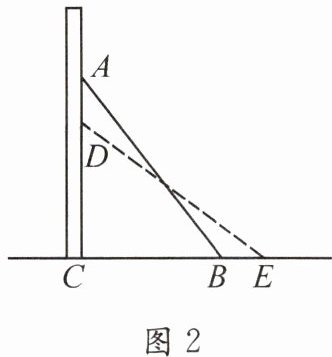
(2)如图2,如果梯子顶端靠墙下移,底端向右移动0.6m至点E处,那么它的顶端A沿墙下移了多少米?
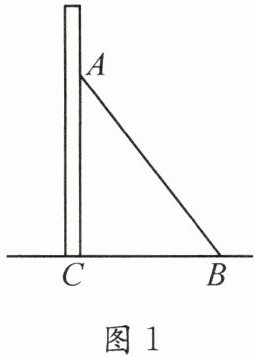
(1)这架梯子的顶端距地面有多高?
(2)如图2,如果梯子顶端靠墙下移,底端向右移动0.6m至点E处,那么它的顶端A沿墙下移了多少米?
答案:
【解】
(1)由题意,得$AB=3\ \text{m}$,$BC=1.8\ \text{m}$,
$\therefore AC^{2}=AB^{2}-BC^{2}=3^{2}-1.8^{2}=5.76$,
$\therefore AC=2.4\ \text{m}$,
即这架梯子的顶端距地面有 2.4 m.
(2)$\because$梯子顶端靠墙下移,底端向右移动 0.6 m 至点$E$处,
$\therefore CE=BC+BE=1.8+0.6=2.4(\text{m})$,
$\therefore CD^{2}=DE^{2}-CE^{2}=3^{2}-2.4^{2}=3.24$,
$\therefore CD=1.8\ \text{m}$,
$\therefore AD=AC-CD=2.4-1.8=0.6(\text{m})$.
即它的顶端$A$沿墙下移了 0.6 m.
(1)由题意,得$AB=3\ \text{m}$,$BC=1.8\ \text{m}$,
$\therefore AC^{2}=AB^{2}-BC^{2}=3^{2}-1.8^{2}=5.76$,
$\therefore AC=2.4\ \text{m}$,
即这架梯子的顶端距地面有 2.4 m.
(2)$\because$梯子顶端靠墙下移,底端向右移动 0.6 m 至点$E$处,
$\therefore CE=BC+BE=1.8+0.6=2.4(\text{m})$,
$\therefore CD^{2}=DE^{2}-CE^{2}=3^{2}-2.4^{2}=3.24$,
$\therefore CD=1.8\ \text{m}$,
$\therefore AD=AC-CD=2.4-1.8=0.6(\text{m})$.
即它的顶端$A$沿墙下移了 0.6 m.
11. (2025·编写)如图是“赵爽弦图”,△ABH,△BCG,△CDF和△DAE均是四个全等的直角三角形,四边形ABCD和四边形EFGH都是正方形。若AB= 15,AH= 9,则四边形EFGH的面积为
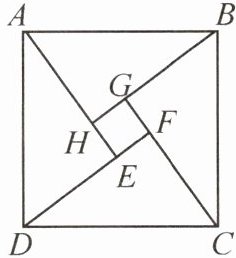
9
。
答案:
9
12. (2025·编写)如图,在一个长方形草坪ABCD上,放着一根长方体的木块。已知AD= 6米,AB= 4米,该木块的较长边与AD平行,横截面是边长为2米的正方形,一只蚂蚁从点A爬过木块到达C处需要走的最短路程是
10
米。
答案:
10
13. (2025·编写)如图,圆柱底面圆的周长为6cm,CD,AB分别是上、下底面的直径,高BC= 12cm,用一条无弹性的丝带从A至C按如图所示的方式缠绕1.5圈,则丝带的最短长度为____
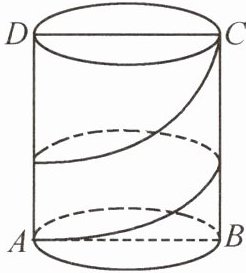
15
cm。
答案:
15
14. (2025·郫都)如图,在点B正北方的A处有一信号接收器($AB^{2}= 120^{2}×2cm^{2}$),点C在点B的北偏东45°的方向,一电子狗P从点B向点C的方向以4cm/s的速度运动并持续向四周发射信号,信号接收器接收信号的有效范围为150cm。
(1)求出点A到线段BC的距离;
(2)请判断点A处是否能接收到信号,并说明理由。若能接收到信号,求出可接收信号的时间。
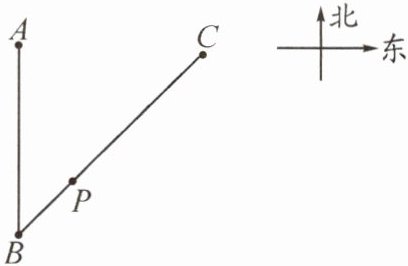
(1)求出点A到线段BC的距离;
(2)请判断点A处是否能接收到信号,并说明理由。若能接收到信号,求出可接收信号的时间。
答案:
【解】
(1)如图,过点$A$作$AH\perp BC$于点$H$.
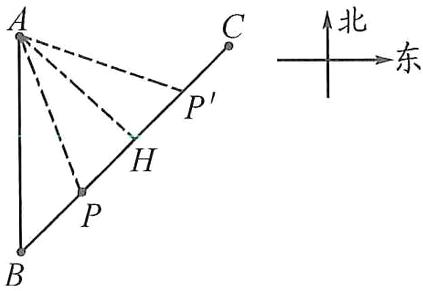
在$Rt\triangle ABH$中,$\because AB^{2}=120^{2}×2\ \text{cm}^{2}$,$\angle B=45^{\circ}$,
$\therefore\triangle ABH$是等腰直角三角形,
$\therefore AH=BH$,$AH^{2}+BH^{2}=120^{2}×2$,
$\therefore AH=BH=120\ \text{cm}$,
即点$A$到线段$BC$的距离为 120 cm.
(2)$\because AH=120\ \text{cm}<150\ \text{cm}$,
$\therefore$点$A$处能接收到信号.
当$AP=150\ \text{cm}$时,$PH^{2}=AP^{2}-AH^{2}=150^{2}-120^{2}=8100$,
$\therefore PH=90\ \text{cm}$.
当$AP'=150\ \text{cm}$时,$HP'=90\ \text{cm}$,
$\therefore PP'=180\ \text{cm}$,
$\therefore$可接收信号的时间为$\frac{180}{4}=45(\text{s})$.
【解】
(1)如图,过点$A$作$AH\perp BC$于点$H$.
在$Rt\triangle ABH$中,$\because AB^{2}=120^{2}×2\ \text{cm}^{2}$,$\angle B=45^{\circ}$,
$\therefore\triangle ABH$是等腰直角三角形,
$\therefore AH=BH$,$AH^{2}+BH^{2}=120^{2}×2$,
$\therefore AH=BH=120\ \text{cm}$,
即点$A$到线段$BC$的距离为 120 cm.
(2)$\because AH=120\ \text{cm}<150\ \text{cm}$,
$\therefore$点$A$处能接收到信号.
当$AP=150\ \text{cm}$时,$PH^{2}=AP^{2}-AH^{2}=150^{2}-120^{2}=8100$,
$\therefore PH=90\ \text{cm}$.
当$AP'=150\ \text{cm}$时,$HP'=90\ \text{cm}$,
$\therefore PP'=180\ \text{cm}$,
$\therefore$可接收信号的时间为$\frac{180}{4}=45(\text{s})$.
查看更多完整答案,请扫码查看

