

 搜索
搜索
第124页
- 第1页
- 第2页
- 第3页
- 第4页
- 第5页
- 第6页
- 第7页
- 第8页
- 第9页
- 第10页
- 第11页
- 第12页
- 第13页
- 第14页
- 第15页
- 第16页
- 第17页
- 第18页
- 第19页
- 第20页
- 第21页
- 第22页
- 第23页
- 第24页
- 第25页
- 第26页
- 第27页
- 第28页
- 第29页
- 第30页
- 第31页
- 第32页
- 第33页
- 第34页
- 第35页
- 第36页
- 第37页
- 第38页
- 第39页
- 第40页
- 第41页
- 第42页
- 第43页
- 第44页
- 第45页
- 第46页
- 第47页
- 第48页
- 第49页
- 第50页
- 第51页
- 第52页
- 第53页
- 第54页
- 第55页
- 第56页
- 第57页
- 第58页
- 第59页
- 第60页
- 第61页
- 第62页
- 第63页
- 第64页
- 第65页
- 第66页
- 第67页
- 第68页
- 第69页
- 第70页
- 第71页
- 第72页
- 第73页
- 第74页
- 第75页
- 第76页
- 第77页
- 第78页
- 第79页
- 第80页
- 第81页
- 第82页
- 第83页
- 第84页
- 第85页
- 第86页
- 第87页
- 第88页
- 第89页
- 第90页
- 第91页
- 第92页
- 第93页
- 第94页
- 第95页
- 第96页
- 第97页
- 第98页
- 第99页
- 第100页
- 第101页
- 第102页
- 第103页
- 第104页
- 第105页
- 第106页
- 第107页
- 第108页
- 第109页
- 第110页
- 第111页
- 第112页
- 第113页
- 第114页
- 第115页
- 第116页
- 第117页
- 第118页
- 第119页
- 第120页
- 第121页
- 第122页
- 第123页
- 第124页
- 第125页
- 第126页
- 第127页
- 第128页
- 第129页
- 第130页
- 第131页
- 第132页
- 第133页
- 第134页
- 第135页
- 第136页
- 第137页
- 第138页
- 第139页
- 第140页
- 第141页
- 第142页
- 第143页
- 第144页
- 第145页
- 第146页
- 第147页
- 第148页
5. 如图,函数$y = 20x$和$y = ax - 40$的图象相交于点$P$,点$P$的纵坐标为40,则关于$x$,$y$的方程组$\begin{cases}20x - y = 0,\\ax - y = 40\end{cases} $的解是
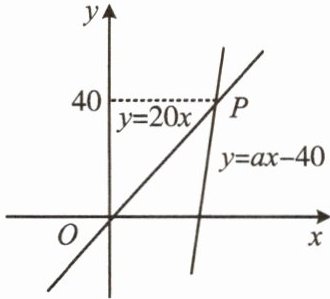
$\left\{\begin{array}{l} x=2,\\ y=40\end{array}\right.$
.
答案:
$\left\{\begin{array}{l} x=2,\\ y=40\end{array}\right.$
6. 用图象法解方程组$\begin{cases}2x - 3y + 3 = 0,\\5x - 3y - 6 = 0.\end{cases} $
答案:
解:由$2x-3y+3=0$,得$y=\frac{2}{3}x+1$;
由$5x-3y-6=0$,得$y=\frac{5}{3}x-2$.
在同一直角坐标系中作出$y=\frac{2}{3}x+1$和$y=\frac{5}{3}x-2$的图象如图所示,观察图象得交点为$(3,3)$,
所以方程组$\left\{\begin{array}{l} 2x-3y+3=0,\\ 5x-3y-6=0\end{array}\right.$的解为$\left\{\begin{array}{l} x=3,\\ y=3.\end{array}\right.$
由$5x-3y-6=0$,得$y=\frac{5}{3}x-2$.
在同一直角坐标系中作出$y=\frac{2}{3}x+1$和$y=\frac{5}{3}x-2$的图象如图所示,观察图象得交点为$(3,3)$,
所以方程组$\left\{\begin{array}{l} 2x-3y+3=0,\\ 5x-3y-6=0\end{array}\right.$的解为$\left\{\begin{array}{l} x=3,\\ y=3.\end{array}\right.$
7. 如图,直线$l_1:y = x + 1与直线l_2:y = mx + n相交于点P(1,b)$.
(1)求$b$的值.
(2)①不解关于$x$,$y的方程组\begin{cases}y = x + 1,\\y = mx + n,\end{cases} $请直接写出它的解.
②不受原题条件限制,若$n eq 1$,则当$m = $
(3)直线$l_3:y = nx + m是否也经过点P$?请说明理由.
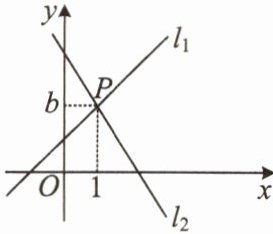
(1)求$b$的值.
2
(2)①不解关于$x$,$y的方程组\begin{cases}y = x + 1,\\y = mx + n,\end{cases} $请直接写出它的解.
$\begin{cases} x=1 \\ y=2 \end{cases}$
②不受原题条件限制,若$n eq 1$,则当$m = $
1
时,方程组$\begin{cases}y = x + 1,\\y = mx + n\end{cases} $无解.(3)直线$l_3:y = nx + m是否也经过点P$?请说明理由.
直线$l_3:y = nx + m$经过点P。理由:将$P(1,2)$代入$y=mx+n$,得$m+n=2$;将$x=1$代入$y=nx+m$,得$y=m+n$。因为$m+n=2$,所以$y=2$,故$P(1,2)$也在直线$y=nx+m$上。
答案:
解:
(1)将$P(1,b)$代入$y=x+1$,得$b=1+1=2$.
(2)①因为点P坐标为$(1,2)$,所以方程组的解是$\left\{\begin{array}{l} x=1,\\ y=2.\end{array}\right.$
②当$m=1$时,方程组$\left\{\begin{array}{l} y=x+1,\\ y=mx+n\end{array}\right.$无解.
故答案为1.
(3)直线$l:y=nx+m$经过点P.
理由:将$P(1,2)$代入$y=mx+n$,得$m+n=2$;将$x=1$代入$y=nx+m$,得$y=m+n$.因为$m+n=2$,所以$y=2$,故$P(1,2)$也在直线$y=nx+m$上.
(1)将$P(1,b)$代入$y=x+1$,得$b=1+1=2$.
(2)①因为点P坐标为$(1,2)$,所以方程组的解是$\left\{\begin{array}{l} x=1,\\ y=2.\end{array}\right.$
②当$m=1$时,方程组$\left\{\begin{array}{l} y=x+1,\\ y=mx+n\end{array}\right.$无解.
故答案为1.
(3)直线$l:y=nx+m$经过点P.
理由:将$P(1,2)$代入$y=mx+n$,得$m+n=2$;将$x=1$代入$y=nx+m$,得$y=m+n$.因为$m+n=2$,所以$y=2$,故$P(1,2)$也在直线$y=nx+m$上.
1. 已知直线$y = - 3x - 4$与直线$y = kx + 2(k \neq 0)$平行,则$k$的值为(
A.$- 3$
B.$3$
C.$- 4$
D.$4$
A
).A.$- 3$
B.$3$
C.$- 4$
D.$4$
答案:
A
2. 下列4条直线中,直线上的每个点的坐标都是二元一次方程$2x - 3y = 6$的解的是(
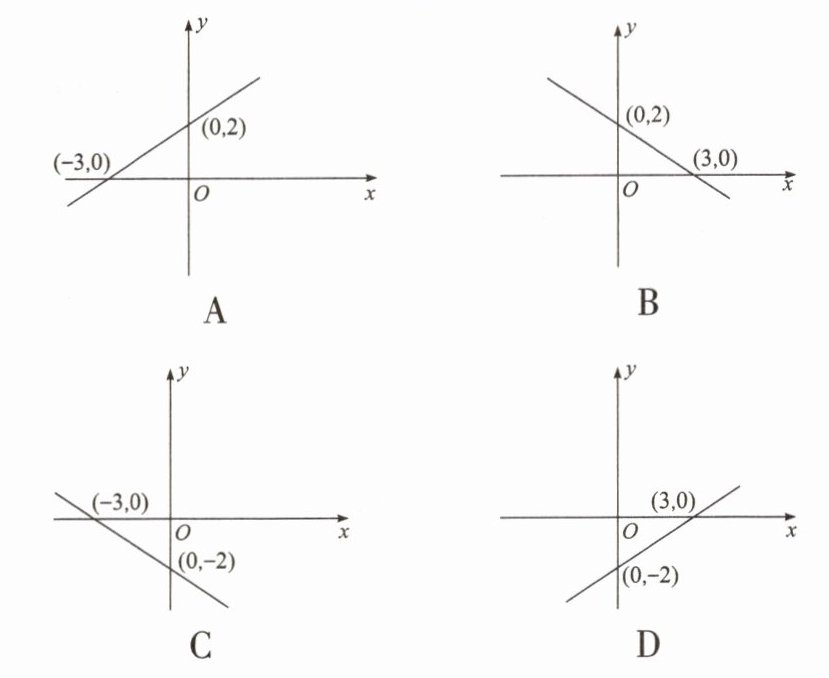
D
).
答案:
D
3. 如图,二元一次方程组$\begin{cases}2x + y = 4,\\x - y = a(a为常数)\end{cases} 中的两个二元一次方程的图象交于点P$,则点$P$坐标为(
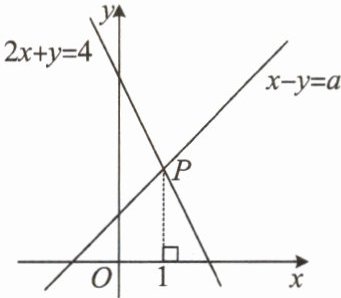
A.$(1,a)$
B.$(1,4)$
C.$(2,1)$
D.$(1,2)$
D
).A.$(1,a)$
B.$(1,4)$
C.$(2,1)$
D.$(1,2)$
答案:
D
4. 已知一次函数$y = k_1x + b_1(k_1 eq 0)和一次函数y_1 = k_2x + b_2(k_2 eq 0)的自变量x与因变量y_1$,$y_2$的部分对应数值如表所示,则关于$x$,$y的二元一次方程组\begin{cases}y = k_1x + b_1,\\y = k_2x + b_2\end{cases} $的解为(
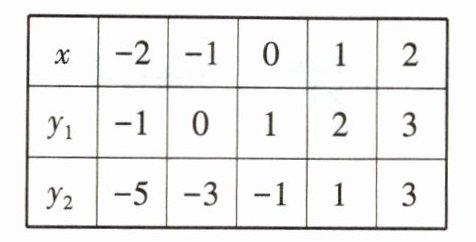
A.$\begin{cases}x = - 5,\\y = - 2\end{cases} $
B.$\begin{cases}x = 4,\\y = 5\end{cases} $
C.$\begin{cases}x = 2,\\y = 3\end{cases} $
D.$\begin{cases}x = - 1,\\y = - 3\end{cases} $
C
).A.$\begin{cases}x = - 5,\\y = - 2\end{cases} $
B.$\begin{cases}x = 4,\\y = 5\end{cases} $
C.$\begin{cases}x = 2,\\y = 3\end{cases} $
D.$\begin{cases}x = - 1,\\y = - 3\end{cases} $
答案:
C
查看更多完整答案,请扫码查看

