

 搜索
搜索
2025年实验班中考数学压轴题
注:目前有些书本章节名称可能整理的还不是很完善,但都是按照顺序排列的,请同学们按照顺序仔细查找。练习册 2025年实验班中考数学压轴题 答案主要是用来给同学们做完题方便对答案用的,请勿直接抄袭。
第131页
- 第1页
- 第2页
- 第3页
- 第4页
- 第5页
- 第6页
- 第7页
- 第8页
- 第9页
- 第10页
- 第11页
- 第12页
- 第13页
- 第14页
- 第15页
- 第16页
- 第17页
- 第18页
- 第19页
- 第20页
- 第21页
- 第22页
- 第23页
- 第24页
- 第25页
- 第26页
- 第27页
- 第28页
- 第29页
- 第30页
- 第31页
- 第32页
- 第33页
- 第34页
- 第35页
- 第36页
- 第37页
- 第38页
- 第39页
- 第40页
- 第41页
- 第42页
- 第43页
- 第44页
- 第45页
- 第46页
- 第47页
- 第48页
- 第49页
- 第50页
- 第51页
- 第52页
- 第53页
- 第54页
- 第55页
- 第56页
- 第57页
- 第58页
- 第59页
- 第60页
- 第61页
- 第62页
- 第63页
- 第64页
- 第65页
- 第66页
- 第67页
- 第68页
- 第69页
- 第70页
- 第71页
- 第72页
- 第73页
- 第74页
- 第75页
- 第76页
- 第77页
- 第78页
- 第79页
- 第80页
- 第81页
- 第82页
- 第83页
- 第84页
- 第85页
- 第86页
- 第87页
- 第88页
- 第89页
- 第90页
- 第91页
- 第92页
- 第93页
- 第94页
- 第95页
- 第96页
- 第97页
- 第98页
- 第99页
- 第100页
- 第101页
- 第102页
- 第103页
- 第104页
- 第105页
- 第106页
- 第107页
- 第108页
- 第109页
- 第110页
- 第111页
- 第112页
- 第113页
- 第114页
- 第115页
- 第116页
- 第117页
- 第118页
- 第119页
- 第120页
- 第121页
- 第122页
- 第123页
- 第124页
- 第125页
- 第126页
- 第127页
- 第128页
- 第129页
- 第130页
- 第131页
- 第132页
- 第133页
- 第134页
- 第135页
- 第136页
- 第137页
- 第138页
- 第139页
- 第140页
- 第141页
- 第142页
- 第143页
- 第144页
- 第145页
- 第146页
- 第147页
- 第148页
- 第149页
- 第150页
- 第151页
- 第152页
- 第153页
- 第154页
- 第155页
- 第156页
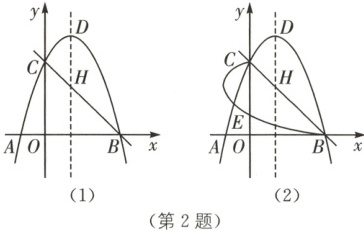
2.(江苏无锡外国语学校)如图(1),在平面直角坐标系中,抛物线$ y = ax^2 + bx + c(a \neq 0) $的图象与$ x $轴交于$ A(-1,0) $,$ B(3,0) $两点,与$ y $轴交于点$ C $,且抛物线的顶点$ D $的坐标为$ (1, 4) $,连接$ BC $,抛物线的对称轴与$ BC $交于点$ H $.
(1)求抛物线的函数解析式;
(2)在抛物线上$ B $,$ D $两点之间的部分(不包含$ B $,$ D $两点),是否存在点$ G $,使得$ S_{\triangle BGH} = 3S_{\triangle DGH} $,若存在,求出点$ G $的坐标,若不存在,请说明理由;
(3)如图(2),将抛物线在$ BC $上方的图象沿$ BC $折叠后与$ y $轴交于点$ E $,$ M $为直线$ x = 1 $上一个动点,在平面内是否存在一个点$ N $,使得以$ B $,$ E $,$ M $,$ N $为顶点的四边形是以$ BE $为对角线的矩形,若存在,求出点$ N $的坐标,若不存在,请说明理由.
(第2题)
(1)求抛物线的函数解析式;
(2)在抛物线上$ B $,$ D $两点之间的部分(不包含$ B $,$ D $两点),是否存在点$ G $,使得$ S_{\triangle BGH} = 3S_{\triangle DGH} $,若存在,求出点$ G $的坐标,若不存在,请说明理由;
(3)如图(2),将抛物线在$ BC $上方的图象沿$ BC $折叠后与$ y $轴交于点$ E $,$ M $为直线$ x = 1 $上一个动点,在平面内是否存在一个点$ N $,使得以$ B $,$ E $,$ M $,$ N $为顶点的四边形是以$ BE $为对角线的矩形,若存在,求出点$ N $的坐标,若不存在,请说明理由.
(第2题)
答案:
2.
(1)设抛物线的函数解析式为$y = a(x - 1)^{2} + 4$,将点$B$的坐标代入,得$0 = a(3 - 1)^{2} + 4$,$\therefore a = - 1$,
$\therefore y = - (x - 1)^{2} + 4 = - x^{2} + 2x + 3$。
(2)如图
(1),过点$G$作$GW\bot x$轴于点$W$,交$BC$于点$Q$。$\because B(3,0)$,$C(0,3)$,$\therefore$直线$BC$的解析式为$y = - x + 3$。
当$x = 1$时,$y = - 1 + 3 = 2$,$\therefore y_{H} = 2$,
$\therefore DH = y_{D} - y_{H} = 2$。
设$G(m, - m^{2} + 2m + 3)$,$Q(m, - m + 3)$,
$\therefore GQ = ( - m^{2} + 2m + 3) - ( - m + 3) = - m^{2} + 3m$,
$\therefore S_{\triangle BGH} = \frac{1}{2}GQ · (x_{B} - x_{H}) = \frac{1}{2}( - m^{2} + 3m) × (3 - 1) = - m^{2} + 3m$。
$\because S_{\triangle DGH} = \frac{1}{2}DH · (x_{G} - x_{H}) = \frac{1}{2} × 2 · (m - 1) = m - 1$,$S_{\triangle BGH} = 3S_{\triangle DGH}$,
$\therefore - m^{2} + 3m = 3(m - 1)$,$\therefore m = \sqrt{3}$或$m = - \sqrt{3}$(舍去),
$\therefore$将$m = \sqrt{3}$代入$G(m, - m^{2} + 2m + 3)$,$\therefore G(\sqrt{3},2\sqrt{3})$。

(3)存在.如图
(2),设点$E$关于$BC$的对称点为$F$,连接$CF$,
$\therefore \angle BCF = \angle BCE = 45^{\circ}$,$CE = CF$,
$\therefore \angle FCE = 90^{\circ}$,$\therefore$点$F$和点$C$关于直线$x = 1$对称,
$\therefore F(2,3)$,$\therefore CE = CF = 2$,$\therefore E(0,1)$。
$\because BE$是以$B$,$E$,$M$,$N$为顶点的矩形的对角线,
$\therefore \angle BME = 90^{\circ}$。设$M(1,n)$,
$\because EM^{2} = 1^{2} + (n - 1)^{2} = n^{2} - 2n + 2$,$BM^{2} = (3 - 1)^{2} + n^{2} = n^{2} + 4$,$BE^{2} = 1^{2} + 3^{2} = 10$,
$\therefore n^{2} - 2n + 2 + n^{2} + 4 = 10$,
解得$n = 2$或$n = - 1$。
当$n = 2$时,$M(1,2)$,$\therefore N(2, - 1)$。
当$n = - 1$时,$M(1, - 1)$,$\therefore N(2,2)$。
综上所述,存在$N(2, - 1)$或$(2,2)$,使得以$B$,$E$,$M$,$N$为顶点的四边形是以$BE$为对角线的矩形。
2.
(1)设抛物线的函数解析式为$y = a(x - 1)^{2} + 4$,将点$B$的坐标代入,得$0 = a(3 - 1)^{2} + 4$,$\therefore a = - 1$,
$\therefore y = - (x - 1)^{2} + 4 = - x^{2} + 2x + 3$。
(2)如图
(1),过点$G$作$GW\bot x$轴于点$W$,交$BC$于点$Q$。$\because B(3,0)$,$C(0,3)$,$\therefore$直线$BC$的解析式为$y = - x + 3$。
当$x = 1$时,$y = - 1 + 3 = 2$,$\therefore y_{H} = 2$,
$\therefore DH = y_{D} - y_{H} = 2$。
设$G(m, - m^{2} + 2m + 3)$,$Q(m, - m + 3)$,
$\therefore GQ = ( - m^{2} + 2m + 3) - ( - m + 3) = - m^{2} + 3m$,
$\therefore S_{\triangle BGH} = \frac{1}{2}GQ · (x_{B} - x_{H}) = \frac{1}{2}( - m^{2} + 3m) × (3 - 1) = - m^{2} + 3m$。
$\because S_{\triangle DGH} = \frac{1}{2}DH · (x_{G} - x_{H}) = \frac{1}{2} × 2 · (m - 1) = m - 1$,$S_{\triangle BGH} = 3S_{\triangle DGH}$,
$\therefore - m^{2} + 3m = 3(m - 1)$,$\therefore m = \sqrt{3}$或$m = - \sqrt{3}$(舍去),
$\therefore$将$m = \sqrt{3}$代入$G(m, - m^{2} + 2m + 3)$,$\therefore G(\sqrt{3},2\sqrt{3})$。
(3)存在.如图
(2),设点$E$关于$BC$的对称点为$F$,连接$CF$,
$\therefore \angle BCF = \angle BCE = 45^{\circ}$,$CE = CF$,
$\therefore \angle FCE = 90^{\circ}$,$\therefore$点$F$和点$C$关于直线$x = 1$对称,
$\therefore F(2,3)$,$\therefore CE = CF = 2$,$\therefore E(0,1)$。
$\because BE$是以$B$,$E$,$M$,$N$为顶点的矩形的对角线,
$\therefore \angle BME = 90^{\circ}$。设$M(1,n)$,
$\because EM^{2} = 1^{2} + (n - 1)^{2} = n^{2} - 2n + 2$,$BM^{2} = (3 - 1)^{2} + n^{2} = n^{2} + 4$,$BE^{2} = 1^{2} + 3^{2} = 10$,
$\therefore n^{2} - 2n + 2 + n^{2} + 4 = 10$,
解得$n = 2$或$n = - 1$。
当$n = 2$时,$M(1,2)$,$\therefore N(2, - 1)$。
当$n = - 1$时,$M(1, - 1)$,$\therefore N(2,2)$。
综上所述,存在$N(2, - 1)$或$(2,2)$,使得以$B$,$E$,$M$,$N$为顶点的四边形是以$BE$为对角线的矩形。
3.如图,在平面直角坐标系$ xOy $中,抛物线$ y = ax^2 - 2ax - 3a(a < 0) $与$ x $轴交于$ A $,$ B $两点(点$ A $在点$ B $的左侧),经过点$ A $的直线$ l:y = kx + b $与$ y $轴负半轴交于点$ C $,与抛物线的另一个交点为$ D $,且$ CD = 4AC $.
(1)求出点$ A $的坐标和点$ D $的横坐标.
(2)点$ E $是直线$ l $上方的抛物线上的动点,若$ \triangle ACE $的面积的最大值为$ \frac{5}{4} $,求$ a $的值.
(3)设$ P $是抛物线对称轴上的一点,点$ Q $在抛物线上,以点$ A $,$ D $,$ P $,$ Q $为顶点的四边形能否成为矩形? 若能,直接写出点$ P $的坐标;若不能,请说明理由.
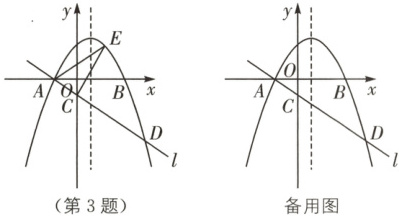
(第3题)
答案见P76
(1)求出点$ A $的坐标和点$ D $的横坐标.
(2)点$ E $是直线$ l $上方的抛物线上的动点,若$ \triangle ACE $的面积的最大值为$ \frac{5}{4} $,求$ a $的值.
(3)设$ P $是抛物线对称轴上的一点,点$ Q $在抛物线上,以点$ A $,$ D $,$ P $,$ Q $为顶点的四边形能否成为矩形? 若能,直接写出点$ P $的坐标;若不能,请说明理由.
(第3题)
答案见P76
答案:
3.
(1)当$y = 0$时,$ax^{2} - 2ax - 3a = 0$,解得$x_{1} = - 1$,$x_{2} = 3$,$\therefore A( - 1,0)$,$B(3,0)$。
$\because$直线$l\colon y = kx + b$过$A( - 1,0)$,$\therefore 0 = - k + b$,即$k = b$,
$\therefore$直线$l\colon y = kx + k$。$\because$抛物线与直线$l$交于点$A$,$D$,
$\therefore ax^{2} - 2ax - 3a = kx + k$,即$ax^{2} - (2a + k)x - 3a - k = 0$。
$\because CD = 4AC$,$\therefore$点$D$的横坐标为$4$。
(2)由
(1)知,点$D$的横坐标为$4$,$\therefore 16a - 8a - 4k - 3a - k = 0$,$\therefore k = a$,$\therefore$直线$l$的解析式为$y = ax + a$。
过点$E$作$EF// y$轴交直线$l$于点$F$,设$E(x,ax^{2} - 2ax - 3a)$,则$F(x,ax + a)$,$EF = ax^{2} - 2ax - 3a - ax - a = ax^{2} - 3ax - 4a$,
$\therefore S_{\triangle ACE} = S_{\triangle AFE} - S_{\triangle CEF} = \frac{1}{2}(ax^{2} - 3ax - 4a)(x + 1) - \frac{1}{2}(ax^{2} - 3ax - 4a)x = \frac{1}{2}a(x - \frac{3}{2})^{2} - \frac{25}{8}a$,$\therefore \triangle ACE$的面积的最大值为$- \frac{25}{8}a$。
$\because \triangle ACE$的面积的最大值为$\frac{5}{4}$,
$\therefore - \frac{25}{8}a = \frac{5}{4}$,解得$a = - \frac{2}{5}$。
(3)以点$A$,$D$,$P$,$Q$为顶点的四边形能成为矩形。
令$ax^{2} - 2ax - 3a = ax + a$,即$ax^{2} - 3ax - 4a = 0$,解得$x_{1} = - 1$,$x_{2} = 4$,$\therefore D(4,5a)$。
$\because$抛物线的对称轴为直线$x = 1$,$\therefore$设$P(1,m)$。
①如图
(1),若$AD$是矩形$ADPQ$的一条边,则易得$Q( - 4,21a)$,$m = 21a + 5a = 26a$,则$P(1,26a)$。
$\because$四边形$ADPQ$是矩形,$\therefore \angle ADP = 90^{\circ}$,
$\therefore AD^{2} + PD^{2} = AP^{2}$,
$\therefore 5^{2} + (5a)^{2} + 3^{2} + (26a - 5a)^{2} = 2^{2} + (26a)^{2}$,即$a^{2} = \frac{1}{7}$
$\because a < 0$,$\therefore a = - \frac{\sqrt{7}}{7}$,$\therefore P(1, - \frac{26\sqrt{7}}{7})$;

②如图
(2),若$AD$是矩形$APDQ$的对角线,则易得$Q(2, - 3a)$,$m = 5a - ( - 3a) = 8a$,则$P(1,8a)$。
$\because$四边形$APDQ$是矩形,$\therefore \angle APD = 90^{\circ}$,
$\therefore AP^{2} + PD^{2} = AD^{2}$,$\therefore ( - 1 - 1)^{2} + (8a)^{2} + (1 - 4)^{2} + (8a - 5a)^{2} = 5^{2} + (5a)^{2}$,即$a^{2} = \frac{1}{4}$ $\because a < 0$,$\therefore a = - \frac{1}{2}$,
$\therefore P(1, - 4)$。综上所述,以点$A$,$D$,$P$,$Q$为顶点的四边形能成为矩形,点$P$的坐标为$(1, - \frac{26\sqrt{7}}{7})$或$(1, - 4)$。
3.
(1)当$y = 0$时,$ax^{2} - 2ax - 3a = 0$,解得$x_{1} = - 1$,$x_{2} = 3$,$\therefore A( - 1,0)$,$B(3,0)$。
$\because$直线$l\colon y = kx + b$过$A( - 1,0)$,$\therefore 0 = - k + b$,即$k = b$,
$\therefore$直线$l\colon y = kx + k$。$\because$抛物线与直线$l$交于点$A$,$D$,
$\therefore ax^{2} - 2ax - 3a = kx + k$,即$ax^{2} - (2a + k)x - 3a - k = 0$。
$\because CD = 4AC$,$\therefore$点$D$的横坐标为$4$。
(2)由
(1)知,点$D$的横坐标为$4$,$\therefore 16a - 8a - 4k - 3a - k = 0$,$\therefore k = a$,$\therefore$直线$l$的解析式为$y = ax + a$。
过点$E$作$EF// y$轴交直线$l$于点$F$,设$E(x,ax^{2} - 2ax - 3a)$,则$F(x,ax + a)$,$EF = ax^{2} - 2ax - 3a - ax - a = ax^{2} - 3ax - 4a$,
$\therefore S_{\triangle ACE} = S_{\triangle AFE} - S_{\triangle CEF} = \frac{1}{2}(ax^{2} - 3ax - 4a)(x + 1) - \frac{1}{2}(ax^{2} - 3ax - 4a)x = \frac{1}{2}a(x - \frac{3}{2})^{2} - \frac{25}{8}a$,$\therefore \triangle ACE$的面积的最大值为$- \frac{25}{8}a$。
$\because \triangle ACE$的面积的最大值为$\frac{5}{4}$,
$\therefore - \frac{25}{8}a = \frac{5}{4}$,解得$a = - \frac{2}{5}$。
(3)以点$A$,$D$,$P$,$Q$为顶点的四边形能成为矩形。
令$ax^{2} - 2ax - 3a = ax + a$,即$ax^{2} - 3ax - 4a = 0$,解得$x_{1} = - 1$,$x_{2} = 4$,$\therefore D(4,5a)$。
$\because$抛物线的对称轴为直线$x = 1$,$\therefore$设$P(1,m)$。
①如图
(1),若$AD$是矩形$ADPQ$的一条边,则易得$Q( - 4,21a)$,$m = 21a + 5a = 26a$,则$P(1,26a)$。
$\because$四边形$ADPQ$是矩形,$\therefore \angle ADP = 90^{\circ}$,
$\therefore AD^{2} + PD^{2} = AP^{2}$,
$\therefore 5^{2} + (5a)^{2} + 3^{2} + (26a - 5a)^{2} = 2^{2} + (26a)^{2}$,即$a^{2} = \frac{1}{7}$
$\because a < 0$,$\therefore a = - \frac{\sqrt{7}}{7}$,$\therefore P(1, - \frac{26\sqrt{7}}{7})$;
②如图
(2),若$AD$是矩形$APDQ$的对角线,则易得$Q(2, - 3a)$,$m = 5a - ( - 3a) = 8a$,则$P(1,8a)$。
$\because$四边形$APDQ$是矩形,$\therefore \angle APD = 90^{\circ}$,
$\therefore AP^{2} + PD^{2} = AD^{2}$,$\therefore ( - 1 - 1)^{2} + (8a)^{2} + (1 - 4)^{2} + (8a - 5a)^{2} = 5^{2} + (5a)^{2}$,即$a^{2} = \frac{1}{4}$ $\because a < 0$,$\therefore a = - \frac{1}{2}$,
$\therefore P(1, - 4)$。综上所述,以点$A$,$D$,$P$,$Q$为顶点的四边形能成为矩形,点$P$的坐标为$(1, - \frac{26\sqrt{7}}{7})$或$(1, - 4)$。
查看更多完整答案,请扫码查看

