

 搜索
搜索
第6页
- 第1页
- 第2页
- 第3页
- 第4页
- 第5页
- 第6页
- 第7页
- 第8页
- 第9页
- 第10页
- 第11页
- 第12页
- 第13页
- 第14页
- 第15页
- 第16页
- 第17页
- 第18页
- 第19页
- 第20页
- 第21页
- 第22页
- 第23页
- 第24页
- 第25页
- 第26页
- 第27页
- 第28页
- 第29页
- 第30页
- 第31页
- 第32页
- 第33页
- 第34页
- 第35页
- 第36页
- 第37页
- 第38页
- 第39页
- 第40页
- 第41页
- 第42页
- 第43页
- 第44页
- 第45页
- 第46页
- 第47页
- 第48页
- 第49页
- 第50页
- 第51页
- 第52页
- 第53页
- 第54页
- 第55页
- 第56页
- 第57页
- 第58页
- 第59页
- 第60页
- 第61页
- 第62页
- 第63页
- 第64页
- 第65页
- 第66页
- 第67页
- 第68页
- 第69页
- 第70页
- 第71页
- 第72页
- 第73页
- 第74页
- 第75页
- 第76页
- 第77页
- 第78页
- 第79页
- 第80页
- 第81页
- 第82页
- 第83页
- 第84页
- 第85页
- 第86页
- 第87页
- 第88页
- 第89页
- 第90页
- 第91页
- 第92页
- 第93页
- 第94页
- 第95页
- 第96页
- 第97页
- 第98页
- 第99页
- 第100页
- 第101页
- 第102页
- 第103页
- 第104页
- 第105页
- 第106页
- 第107页
- 第108页
- 第109页
- 第110页
- 第111页
- 第112页
- 第113页
- 第114页
- 第115页
- 第116页
- 第117页
- 第118页
- 第119页
- 第120页
- 第121页
- 第122页
- 第123页
- 第124页
- 第125页
- 第126页
- 第127页
- 第128页
- 第129页
- 第130页
- 第131页
- 第132页
- 第133页
- 第134页
- 第135页
- 第136页
- 第137页
- 第138页
- 第139页
- 第140页
- 第141页
- 第142页
- 第143页
- 第144页
- 第145页
- 第146页
- 第147页
- 第148页
- 第149页
- 第150页
- 第151页
- 第152页
- 第153页
- 第154页
- 第155页
- 第156页
- 第157页
- 第158页
- 第159页
- 第160页
- 第161页
- 第162页
- 第163页
- 第164页
- 第165页
- 第166页
- 第167页
- 第168页
- 第169页
- 第170页
- 第171页
- 第172页
- 第173页
- 第174页
- 第175页
- 第176页
- 第177页
- 第178页
- 第179页
- 第180页
- 第181页
21. 计算:
(1)(2024山西第16(1)题) (2)$(-1)^{4}\times|-8|+(-2)^{3}\times(\frac{1}{2})^{2}$。
$(-6)\times\frac{1}{3}-(\frac{1}{2})^{-2}+[(-3)+(-1)]$。
(3)$\sqrt[3]{-27}+|-3|-\frac{1}{2}\times(-\frac{1}{4})^{-1}$。 (4)$(-2)\times3+\sqrt{8}\div\sqrt{2}-(-\frac{1}{3})^{0}$。
(1)(2024山西第16(1)题) (2)$(-1)^{4}\times|-8|+(-2)^{3}\times(\frac{1}{2})^{2}$。
$(-6)\times\frac{1}{3}-(\frac{1}{2})^{-2}+[(-3)+(-1)]$。
(3)$\sqrt[3]{-27}+|-3|-\frac{1}{2}\times(-\frac{1}{4})^{-1}$。 (4)$(-2)\times3+\sqrt{8}\div\sqrt{2}-(-\frac{1}{3})^{0}$。
答案:
解:
(1)原式$= -2 - 4 + (-4)$ $= -10$.
(2)原式$= 1\times8 + (-8)\times\frac{1}{4}$ $= 8 + (-2)$ $= 6$.
(3)原式$= -3 + 3 - \frac{1}{2}\times(-4)$ $= 2$.
(4)原式$= -6 + 2 - 1$. $= -5$.
(1)原式$= -2 - 4 + (-4)$ $= -10$.
(2)原式$= 1\times8 + (-8)\times\frac{1}{4}$ $= 8 + (-2)$ $= 6$.
(3)原式$= -3 + 3 - \frac{1}{2}\times(-4)$ $= 2$.
(4)原式$= -6 + 2 - 1$. $= -5$.
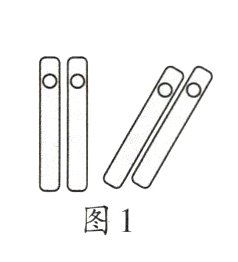
1. 中国人很早就开始使用负数,魏晋时期的数学家刘徽在“正负术”的注文中指出,可将算筹(小棍形状的记数工具)正放着表示正数,斜放着表示负数。 如图1表示(+2)+(-2)。 按照这种表示法,图2表示的是 ( )
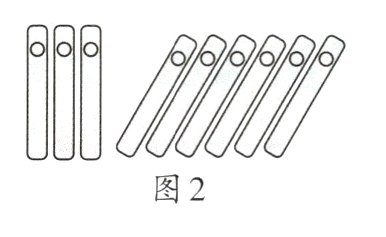
A. (+3)+(+6)
B. (-3)+(-6)
C. (-3)+(+6)
D. (+3)+(-6)
A. (+3)+(+6)
B. (-3)+(-6)
C. (-3)+(+6)
D. (+3)+(-6)
答案:
D
2. 如图,有甲、乙两条数轴。 甲数轴上的三点A,B,C对应的数依次为-4,2,32,乙数轴上的三点D,E,F对应的数依次为0,x,12。
(1)计算A,B,C三点对应的数的和,并求$\frac{AB}{AC}$的值。
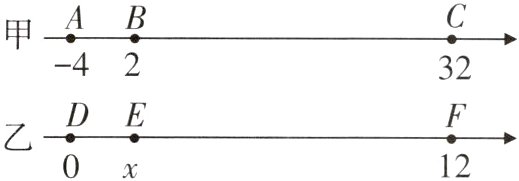
(2)当点A与点D上下对齐时,点B,C恰好分别与点E,F上下对齐,求x的值。
(1)计算A,B,C三点对应的数的和,并求$\frac{AB}{AC}$的值。
(2)当点A与点D上下对齐时,点B,C恰好分别与点E,F上下对齐,求x的值。
答案:
解:
(1)$\because$点$A$,$B$,$C$对应的数依次是$-4$,$2$,$32$,$\therefore A$,$B$,$C$三点对应的数的和为$-4 + 2 + 32 = 30$. $\because AB = 2 - (-4) = 6$,$AC = 32 - (-4) = 36$,$\therefore\frac{AB}{AC}=\frac{6}{36}=\frac{1}{6}$
(2)由数轴得$DE = x - 0 = x$,$DF = 12 - 0 = 12$,由题意得$\frac{AB}{AC}=\frac{DE}{DF}$,$\therefore\frac{1}{6}=\frac{x}{12}$,$\therefore x = 2$.
(1)$\because$点$A$,$B$,$C$对应的数依次是$-4$,$2$,$32$,$\therefore A$,$B$,$C$三点对应的数的和为$-4 + 2 + 32 = 30$. $\because AB = 2 - (-4) = 6$,$AC = 32 - (-4) = 36$,$\therefore\frac{AB}{AC}=\frac{6}{36}=\frac{1}{6}$
(2)由数轴得$DE = x - 0 = x$,$DF = 12 - 0 = 12$,由题意得$\frac{AB}{AC}=\frac{DE}{DF}$,$\therefore\frac{1}{6}=\frac{x}{12}$,$\therefore x = 2$.
查看更多完整答案,请扫码查看

