

 搜索
搜索
第86页
- 第1页
- 第2页
- 第3页
- 第4页
- 第5页
- 第6页
- 第7页
- 第8页
- 第9页
- 第10页
- 第11页
- 第12页
- 第13页
- 第14页
- 第15页
- 第16页
- 第17页
- 第18页
- 第19页
- 第20页
- 第21页
- 第22页
- 第23页
- 第24页
- 第25页
- 第26页
- 第27页
- 第28页
- 第29页
- 第30页
- 第31页
- 第32页
- 第33页
- 第34页
- 第35页
- 第36页
- 第37页
- 第38页
- 第39页
- 第40页
- 第41页
- 第42页
- 第43页
- 第44页
- 第45页
- 第46页
- 第47页
- 第48页
- 第49页
- 第50页
- 第51页
- 第52页
- 第53页
- 第54页
- 第55页
- 第56页
- 第57页
- 第58页
- 第59页
- 第60页
- 第61页
- 第62页
- 第63页
- 第64页
- 第65页
- 第66页
- 第67页
- 第68页
- 第69页
- 第70页
- 第71页
- 第72页
- 第73页
- 第74页
- 第75页
- 第76页
- 第77页
- 第78页
- 第79页
- 第80页
- 第81页
- 第82页
- 第83页
- 第84页
- 第85页
- 第86页
- 第87页
- 第88页
- 第89页
- 第90页
- 第91页
- 第92页
- 第93页
- 第94页
- 第95页
- 第96页
- 第97页
- 第98页
- 第99页
- 第100页
- 第101页
- 第102页
- 第103页
- 第104页
- 第105页
- 第106页
- 第107页
- 第108页
- 第109页
- 第110页
- 第111页
- 第112页
- 第113页
- 第114页
- 第115页
- 第116页
- 第117页
- 第118页
- 第119页
- 第120页
- 第121页
- 第122页
- 第123页
- 第124页
- 第125页
- 第126页
- 第127页
- 第128页
- 第129页
- 第130页
- 第131页
- 第132页
12. (1)小明家新房入户门门框的尺寸如图1所示,一块长3m,宽2.2m的装修木板能否从门框内通过? 请通过计算进行说明.(参考数据:$\sqrt{5}\approx 2.236$)
(2)新房装修完后,要在卧室墙角放一个横截面是一个等腰直角三角形(图2)的立柜,截面如图3,腰长为$\sqrt{2}$m,小明家通往卧室的过道宽为1.05m,这个立柜能通过吗? 请通过计算进行说明.
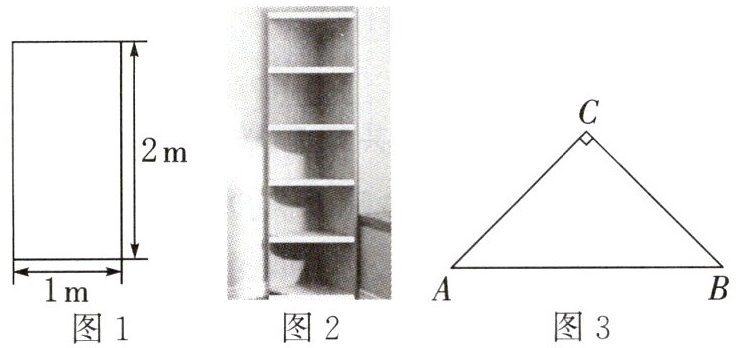
能,理由是:如图,连接 $AC$,则 $AC$ 与 $AB$,$BC$ 构成直角三角形,根据勾股定理得,则 $AC = \sqrt{AB^{2}+BC^{2}} = \sqrt{1^{2}+2^{2}} = \sqrt{5} \approx 2.236$,$\because 2.2$ m $< 2.236$ m,$\therefore$ 该长方形能从内框内通过(将该长方形的宽沿着 $AC$ 斜着进去)
(2)新房装修完后,要在卧室墙角放一个横截面是一个等腰直角三角形(图2)的立柜,截面如图3,腰长为$\sqrt{2}$m,小明家通往卧室的过道宽为1.05m,这个立柜能通过吗? 请通过计算进行说明.
能,理由是:过点 $C$ 作 $CD \perp AB$,则 $\triangle ACD$ 是等腰直角三角形,即 $AD = CD$,$\because AC = \sqrt{2}$,$\therefore CD^{2}+AD^{2}=AC^{2}$,$2CD^{2}=(\sqrt{2})^{2}$,$\because CD^{2}=1$,$CD = 1 < 1.05$,这个立柜能通过过道.
答案:
(1) 能,理由是:如图,连接 $AC$,则 $AC$ 与 $AB$,$BC$ 构成直角三角形,根据勾股定理得,则 $AC = \sqrt{AB^{2}+BC^{2}} = \sqrt{1^{2}+2^{2}} = \sqrt{5} \approx 2.236$,$\because 2.2$ cm $< 2.236$ cm,$\therefore$ 该长方形能从内框内通过(将该长方形的宽沿着 $AC$ 斜着进去);
(2) 能,理由是:过点 $C$ 作 $CD \perp AB$,则 $\triangle ACD$ 是等腰直角三角形,即 $AD = CD$,$\because AC = \sqrt{2}$,$\therefore CD^{2}+AD^{2}=AC^{2}$,$2CD^{2}=(\sqrt{2})^{2}$,$\because CD^{2}=1$,$CD = 1 < 1.05$,这个立柜能通过过道.
(1) 能,理由是:如图,连接 $AC$,则 $AC$ 与 $AB$,$BC$ 构成直角三角形,根据勾股定理得,则 $AC = \sqrt{AB^{2}+BC^{2}} = \sqrt{1^{2}+2^{2}} = \sqrt{5} \approx 2.236$,$\because 2.2$ cm $< 2.236$ cm,$\therefore$ 该长方形能从内框内通过(将该长方形的宽沿着 $AC$ 斜着进去);
(2) 能,理由是:过点 $C$ 作 $CD \perp AB$,则 $\triangle ACD$ 是等腰直角三角形,即 $AD = CD$,$\because AC = \sqrt{2}$,$\therefore CD^{2}+AD^{2}=AC^{2}$,$2CD^{2}=(\sqrt{2})^{2}$,$\because CD^{2}=1$,$CD = 1 < 1.05$,这个立柜能通过过道.
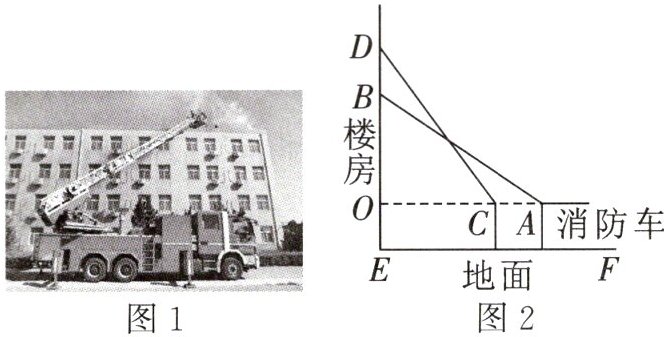
13. (2025春·瑶海区期中)与危险相伴,与烈火为伍,致敬和平年代的英雄,最美的逆行者——中国消防员.云梯消防车是常见的消防器械,云梯最多能伸长到30米,消防车高3米,如图,某栋楼发生火灾,在这栋楼的B处有一老人需要救援,救人时消防车上的云梯伸长至最长,此时消防车的位置A与楼房的距离为24米.
(1)求B处与地面的距离;
(2)完成B处的救援后,消防员发现在B处的上方6米的D处有一小孩没有及时撤离,为了能成功地救出小孩,则消防车从A处向着火的楼房靠近的距离AC为多少米?
(1)求B处与地面的距离;
21米
(2)完成B处的救援后,消防员发现在B处的上方6米的D处有一小孩没有及时撤离,为了能成功地救出小孩,则消防车从A处向着火的楼房靠近的距离AC为多少米?
6米
答案:
(1) 在 $Rt\triangle OAB$ 中,$\because AB = 30$ 米,$OA = 24$ 米,$OE = 3$ 米,$\therefore OB = \sqrt{AB^{2}-OA^{2}} = \sqrt{30^{2}-24^{2}} = 18$(米),$\therefore BE = OB + OE = 18 + 3 = 21$(米),答:$B$ 处与地面的距离是 21 米;
(2) 由题意得 $BD = 6$ 米,$\because CD = 30$ 米,$OD = OB + BD = 18 + 6 = 24$(米),$\therefore OC = \sqrt{CD^{2}-OD^{2}} = \sqrt{30^{2}-24^{2}} = 18$(米),$\therefore AC = OA - OC = 24 - 18 = 6$(米). 答:消防车从 $A$ 处向着火的楼房靠近的距离 $AC$ 为 6 米.
(1) 在 $Rt\triangle OAB$ 中,$\because AB = 30$ 米,$OA = 24$ 米,$OE = 3$ 米,$\therefore OB = \sqrt{AB^{2}-OA^{2}} = \sqrt{30^{2}-24^{2}} = 18$(米),$\therefore BE = OB + OE = 18 + 3 = 21$(米),答:$B$ 处与地面的距离是 21 米;
(2) 由题意得 $BD = 6$ 米,$\because CD = 30$ 米,$OD = OB + BD = 18 + 6 = 24$(米),$\therefore OC = \sqrt{CD^{2}-OD^{2}} = \sqrt{30^{2}-24^{2}} = 18$(米),$\therefore AC = OA - OC = 24 - 18 = 6$(米). 答:消防车从 $A$ 处向着火的楼房靠近的距离 $AC$ 为 6 米.
14. (2023春·商河县期末)如图,在△ABC中,∠C=90°,点P在AC上运动,点D在AB上运动,PD始终保持与PA相等,BD的垂直平分线交BC于点E,交BD于点F,连接DE.
(1)判断DE与PD的位置关系,并说明理由;
(2)若AC=3,BC=4,PA=1,求线段DE的长.
(1) DE与PD的位置关系是
(2) 线段DE的长为
(1)判断DE与PD的位置关系,并说明理由;
(2)若AC=3,BC=4,PA=1,求线段DE的长.
(1) DE与PD的位置关系是
DE⊥DP
,理由如下:∵PD=PA,∴∠A=∠PDA. ∵EF是BD的垂直平分线,∴EB=ED,∴∠B=∠EDB. ∵∠C=90°,∴∠A+∠B=90°,∴∠PDA+∠EDB=90°,∴∠PDE=180°-90°=90°,∴DE⊥DP;(2) 线段DE的长为
19/8
.
答案:
(1) $DE \perp DP$,理由如下:$\because PD = PA$,$\therefore \angle A = \angle PDA$. $\because EF$ 是 $BD$ 的垂直平分线,$\therefore EB = ED$,$\therefore \angle B = \angle EDB$. $\because \angle C = 90^{\circ}$,$\therefore \angle A + \angle B = 90^{\circ}$,$\therefore \angle PDA + \angle EDB = 90^{\circ}$,$\therefore \angle PDE = 180^{\circ} - 90^{\circ} = 90^{\circ}$,$\therefore DE \perp DP$;
(2) 连接 $PE$,设 $DE = x$,则 $EB = ED = x$,$CE = 4 - x$. $\because \angle C = \angle PDE = 90^{\circ}$,$\therefore PC^{2}+CE^{2}=PE^{2}=PD^{2}+DE^{2}$,$\therefore 2^{2}+(4 - x)^{2}=1^{2}+x^{2}$,解得:$x = \frac{19}{8}$,则 $DE = \frac{19}{8}$.
(1) $DE \perp DP$,理由如下:$\because PD = PA$,$\therefore \angle A = \angle PDA$. $\because EF$ 是 $BD$ 的垂直平分线,$\therefore EB = ED$,$\therefore \angle B = \angle EDB$. $\because \angle C = 90^{\circ}$,$\therefore \angle A + \angle B = 90^{\circ}$,$\therefore \angle PDA + \angle EDB = 90^{\circ}$,$\therefore \angle PDE = 180^{\circ} - 90^{\circ} = 90^{\circ}$,$\therefore DE \perp DP$;
(2) 连接 $PE$,设 $DE = x$,则 $EB = ED = x$,$CE = 4 - x$. $\because \angle C = \angle PDE = 90^{\circ}$,$\therefore PC^{2}+CE^{2}=PE^{2}=PD^{2}+DE^{2}$,$\therefore 2^{2}+(4 - x)^{2}=1^{2}+x^{2}$,解得:$x = \frac{19}{8}$,则 $DE = \frac{19}{8}$.
查看更多完整答案,请扫码查看

