

 搜索
搜索
第249页
- 第1页
- 第2页
- 第3页
- 第4页
- 第5页
- 第6页
- 第7页
- 第8页
- 第9页
- 第10页
- 第11页
- 第12页
- 第13页
- 第14页
- 第15页
- 第16页
- 第17页
- 第18页
- 第19页
- 第20页
- 第21页
- 第22页
- 第23页
- 第24页
- 第25页
- 第26页
- 第27页
- 第28页
- 第29页
- 第30页
- 第31页
- 第32页
- 第33页
- 第34页
- 第35页
- 第36页
- 第37页
- 第38页
- 第39页
- 第40页
- 第41页
- 第42页
- 第43页
- 第44页
- 第45页
- 第46页
- 第47页
- 第48页
- 第49页
- 第50页
- 第51页
- 第52页
- 第53页
- 第54页
- 第55页
- 第56页
- 第57页
- 第58页
- 第59页
- 第60页
- 第61页
- 第62页
- 第63页
- 第64页
- 第65页
- 第66页
- 第67页
- 第68页
- 第69页
- 第70页
- 第71页
- 第72页
- 第73页
- 第74页
- 第75页
- 第76页
- 第77页
- 第78页
- 第79页
- 第80页
- 第81页
- 第82页
- 第83页
- 第84页
- 第85页
- 第86页
- 第87页
- 第88页
- 第89页
- 第90页
- 第91页
- 第92页
- 第93页
- 第94页
- 第95页
- 第96页
- 第97页
- 第98页
- 第99页
- 第100页
- 第101页
- 第102页
- 第103页
- 第104页
- 第105页
- 第106页
- 第107页
- 第108页
- 第109页
- 第110页
- 第111页
- 第112页
- 第113页
- 第114页
- 第115页
- 第116页
- 第117页
- 第118页
- 第119页
- 第120页
- 第121页
- 第122页
- 第123页
- 第124页
- 第125页
- 第126页
- 第127页
- 第128页
- 第129页
- 第130页
- 第131页
- 第132页
- 第133页
- 第134页
- 第135页
- 第136页
- 第137页
- 第138页
- 第139页
- 第140页
- 第141页
- 第142页
- 第143页
- 第144页
- 第145页
- 第146页
- 第147页
- 第148页
- 第149页
- 第150页
- 第151页
- 第152页
- 第153页
- 第154页
- 第155页
- 第156页
- 第157页
- 第158页
- 第159页
- 第160页
- 第161页
- 第162页
- 第163页
- 第164页
- 第165页
- 第166页
- 第167页
- 第168页
- 第169页
- 第170页
- 第171页
- 第172页
- 第173页
- 第174页
- 第175页
- 第176页
- 第177页
- 第178页
- 第179页
- 第180页
- 第181页
- 第182页
- 第183页
- 第184页
- 第185页
- 第186页
- 第187页
- 第188页
- 第189页
- 第190页
- 第191页
- 第192页
- 第193页
- 第194页
- 第195页
- 第196页
- 第197页
- 第198页
- 第199页
- 第200页
- 第201页
- 第202页
- 第203页
- 第204页
- 第205页
- 第206页
- 第207页
- 第208页
- 第209页
- 第210页
- 第211页
- 第212页
- 第213页
- 第214页
- 第215页
- 第216页
- 第217页
- 第218页
- 第219页
- 第220页
- 第221页
- 第222页
- 第223页
- 第224页
- 第225页
- 第226页
- 第227页
- 第228页
- 第229页
- 第230页
- 第231页
- 第232页
- 第233页
- 第234页
- 第235页
- 第236页
- 第237页
- 第238页
- 第239页
- 第240页
- 第241页
- 第242页
- 第243页
- 第244页
- 第245页
- 第246页
- 第247页
- 第248页
- 第249页
- 第250页
- 第251页
- 第252页
- 第253页
- 第254页
- 第255页
- 第256页
- 第257页
- 第258页
- 第259页
- 第260页
- 第261页
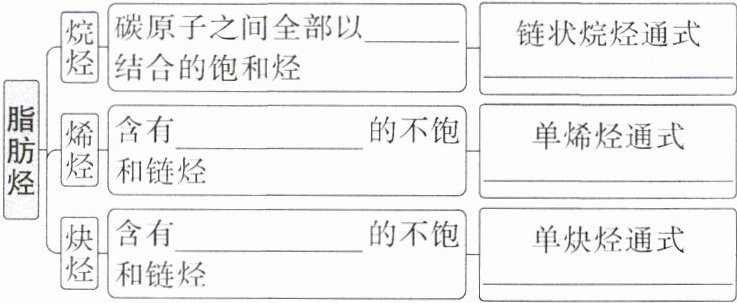
1. 脂肪烃的结构特点及通式
(1) 分子结构及通式
(2) 烯烃的顺反异构
① 通过
② 相同的原子或原子团位于双键
(1) 分子结构及通式
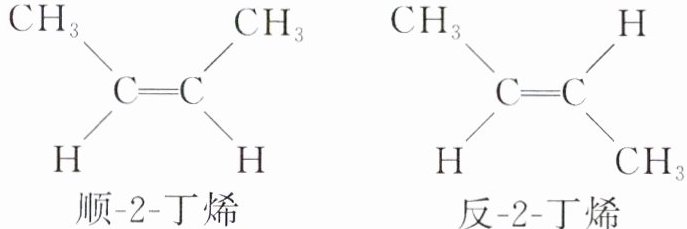
(2) 烯烃的顺反异构
① 通过
碳碳双键
连接的原子或原子团不能绕轴旋转,会导致其空间排列方式
不同,产生顺反异构现象。② 相同的原子或原子团位于双键
同一侧
,称为顺式结构;相同的原子或原子团位于双键两侧
,称为反式结构。例如:
答案:
1.
(1)单键 $\mathrm{C}_{n}\mathrm{H}_{2n+2}(n\geq1)$ 碳碳双键 $\mathrm{C}_{n}\mathrm{H}_{2n}(n\geq2)$ 碳碳三键 $\mathrm{C}_{n}\mathrm{H}_{2n-2}(n\geq2)$ (2)①碳碳双键 排列方式 ②同一侧 两侧
(1)单键 $\mathrm{C}_{n}\mathrm{H}_{2n+2}(n\geq1)$ 碳碳双键 $\mathrm{C}_{n}\mathrm{H}_{2n}(n\geq2)$ 碳碳三键 $\mathrm{C}_{n}\mathrm{H}_{2n-2}(n\geq2)$ (2)①碳碳双键 排列方式 ②同一侧 两侧
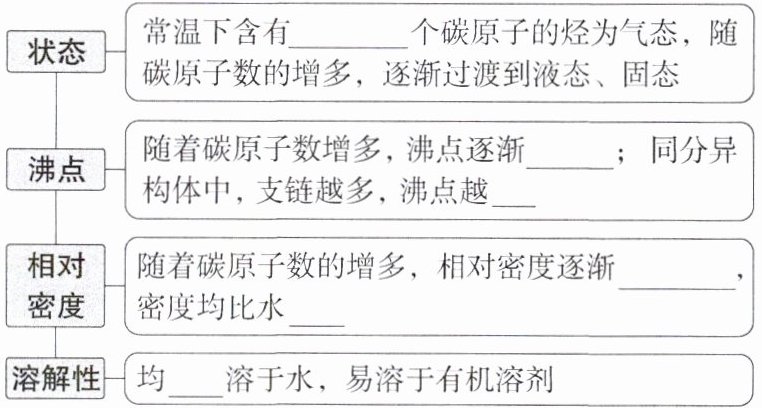
2. 脂肪烃的物理性质
答案:
2.1~4 升高 低 增大 小 难
3. 脂肪烃的化学性质
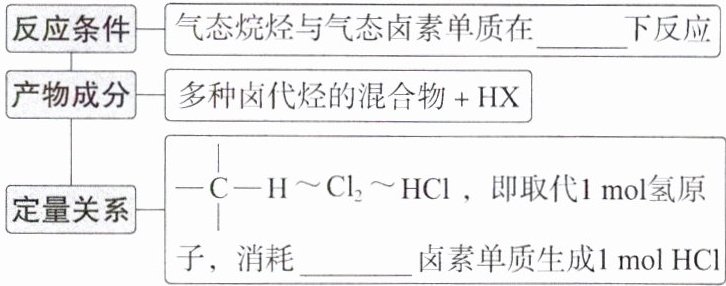
(1) 烷烃的取代反应
① 取代反应:有机物分子中某些原子或原子团被其他
② 烷烃的卤代反应
反应条件:气态烷烃与气态卤素单质在
产物成分:多种卤代烃的混合物 + HX
定量关系:,即取代1 mol氢原子,消耗
(2) 烯烃、炔烃的加成反应
① 加成反应:有机物分子中的____与其他原子或原子团直接结合生成新的化合物的反应。
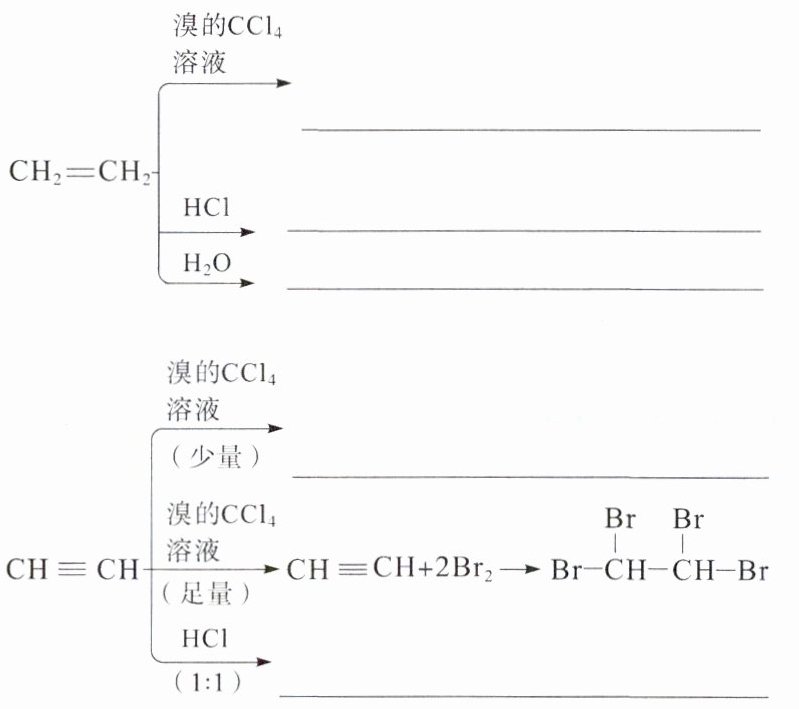
② 烯烃、炔烃的加成反应(写出相关反应的化学方程式)
(3) 烯烃和炔烃的加聚反应
① 丙烯加聚反应的化学方程式为____。
② 乙炔加聚反应的化学方程式为。
(4) 二烯烃的化学性质
① 加成反应
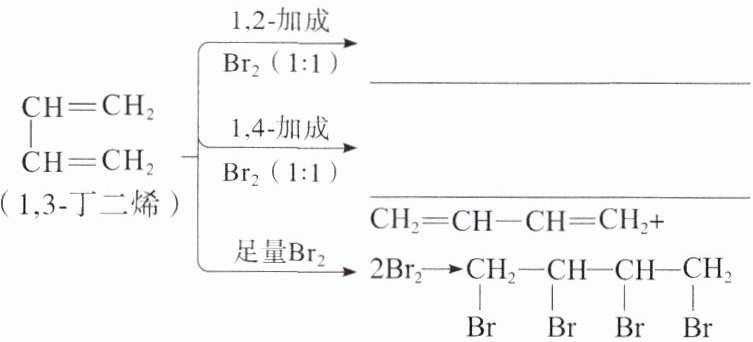
足量Br₂:
② 加聚反应:。
(1) 烷烃的取代反应
① 取代反应:有机物分子中某些原子或原子团被其他
原子或原子团
所替代的反应。② 烷烃的卤代反应
反应条件:气态烷烃与气态卤素单质在
光照
下反应产物成分:多种卤代烃的混合物 + HX
定量关系:,即取代1 mol氢原子,消耗
$1\ \mathrm{mol}$
卤素单质生成1 mol HCl(2) 烯烃、炔烃的加成反应
① 加成反应:有机物分子中的____与其他原子或原子团直接结合生成新的化合物的反应。
② 烯烃、炔烃的加成反应(写出相关反应的化学方程式)
(3) 烯烃和炔烃的加聚反应
① 丙烯加聚反应的化学方程式为____。
② 乙炔加聚反应的化学方程式为。
(4) 二烯烃的化学性质
① 加成反应
足量Br₂:
② 加聚反应:。
答案:
3.
(1)①原子或原子团 ②光照 $1\ \mathrm{mol}$ (2)①不饱和碳原子 ②$\mathrm{CH}_{2}=\mathrm{CH}_{2}+\mathrm{Br}_{2}\longrightarrow \mathrm{CH}_{2}\mathrm{Br}\mathrm{CH}_{2}\mathrm{Br}$ $\mathrm{CH}_{2}=\mathrm{CH}_{2}+\mathrm{HCl}\xrightarrow[\triangle]{催化剂} \mathrm{CH}_{3}\mathrm{CH}_{2}\mathrm{Cl}$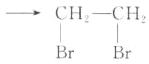 $\mathrm{CH}_{2}=\mathrm{CH}_{2}+\mathrm{H}_{2}\mathrm{O}\xrightarrow[\triangle,加压]{催化剂} \mathrm{CH}_{3}\mathrm{CH}_{2}\mathrm{OH}$ $\mathrm{CH}\equiv\mathrm{CH}+\mathrm{Br}_{2}\longrightarrow \mathrm{CHBr}=\mathrm{CHBr}\longrightarrow \mathrm{CHBr}_{2}-\mathrm{CHBr}_{2}$ $\mathrm{CH}\equiv\mathrm{CH}+\mathrm{HCl}\xrightarrow[\triangle]{催化剂} \mathrm{CH}_{2}=\mathrm{CHCl}$
 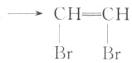 $\mathrm{CH}_{2}=\mathrm{CH}_{2}+\mathrm{HCl}\xrightarrow{催化剂}\mathrm{CH}_{3}-\mathrm{CH}_{2}\mathrm{Cl}$ (3)①$n\mathrm{CH}_{3}-\mathrm{CH}=\mathrm{CH}_{2}\xrightarrow{催化剂} \mathrm{CH}_{2}-\mathrm{CH}_{2}$ (4)①$\mathrm{CH}_{2}=\mathrm{CH}-\mathrm{CH}=\mathrm{CH}_{2}+\mathrm{Br}_{2}\longrightarrow \mathrm{CH}_{2}\mathrm{Br}-\mathrm{CH}=\mathrm{CH}-\mathrm{CH}_{2}\mathrm{Br}$ $\mathrm{CH}_{2}=\mathrm{CH}-\mathrm{CH}=\mathrm{CH}_{2}+\mathrm{Br}_{2}\longrightarrow \mathrm{CH}_{2}\mathrm{Br}-\mathrm{CH}=\mathrm{CH}-\mathrm{CH}_{2}\mathrm{Br}$
3.
(1)①原子或原子团 ②光照 $1\ \mathrm{mol}$ (2)①不饱和碳原子 ②$\mathrm{CH}_{2}=\mathrm{CH}_{2}+\mathrm{Br}_{2}\longrightarrow \mathrm{CH}_{2}\mathrm{Br}\mathrm{CH}_{2}\mathrm{Br}$ $\mathrm{CH}_{2}=\mathrm{CH}_{2}+\mathrm{HCl}\xrightarrow[\triangle]{催化剂} \mathrm{CH}_{3}\mathrm{CH}_{2}\mathrm{Cl}$
$\mathrm{CH}_{2}=\mathrm{CH}_{2}+\mathrm{H}_{2}\mathrm{O}\xrightarrow[\triangle,加压]{催化剂} \mathrm{CH}_{3}\mathrm{CH}_{2}\mathrm{OH}$ $\mathrm{CH}\equiv\mathrm{CH}+\mathrm{Br}_{2}\longrightarrow \mathrm{CHBr}=\mathrm{CHBr}\longrightarrow \mathrm{CHBr}_{2}-\mathrm{CHBr}_{2}$ $\mathrm{CH}\equiv\mathrm{CH}+\mathrm{HCl}\xrightarrow[\triangle]{催化剂} \mathrm{CH}_{2}=\mathrm{CHCl}$ $\mathrm{CH}_{2}=\mathrm{CH}_{2}+\mathrm{HCl}\xrightarrow{催化剂}\mathrm{CH}_{3}-\mathrm{CH}_{2}\mathrm{Cl}$ (3)①$n\mathrm{CH}_{3}-\mathrm{CH}=\mathrm{CH}_{2}\xrightarrow{催化剂} \mathrm{CH}_{2}-\mathrm{CH}_{2}$ (4)①$\mathrm{CH}_{2}=\mathrm{CH}-\mathrm{CH}=\mathrm{CH}_{2}+\mathrm{Br}_{2}\longrightarrow \mathrm{CH}_{2}\mathrm{Br}-\mathrm{CH}=\mathrm{CH}-\mathrm{CH}_{2}\mathrm{Br}$ $\mathrm{CH}_{2}=\mathrm{CH}-\mathrm{CH}=\mathrm{CH}_{2}+\mathrm{Br}_{2}\longrightarrow \mathrm{CH}_{2}\mathrm{Br}-\mathrm{CH}=\mathrm{CH}-\mathrm{CH}_{2}\mathrm{Br}$ 查看更多完整答案,请扫码查看

