

 搜索
搜索
第203页
- 第1页
- 第2页
- 第3页
- 第4页
- 第5页
- 第6页
- 第7页
- 第8页
- 第9页
- 第10页
- 第11页
- 第12页
- 第13页
- 第14页
- 第15页
- 第16页
- 第17页
- 第18页
- 第19页
- 第20页
- 第21页
- 第22页
- 第23页
- 第24页
- 第25页
- 第26页
- 第27页
- 第28页
- 第29页
- 第30页
- 第31页
- 第32页
- 第33页
- 第34页
- 第35页
- 第36页
- 第37页
- 第38页
- 第39页
- 第40页
- 第41页
- 第42页
- 第43页
- 第44页
- 第45页
- 第46页
- 第47页
- 第48页
- 第49页
- 第50页
- 第51页
- 第52页
- 第53页
- 第54页
- 第55页
- 第56页
- 第57页
- 第58页
- 第59页
- 第60页
- 第61页
- 第62页
- 第63页
- 第64页
- 第65页
- 第66页
- 第67页
- 第68页
- 第69页
- 第70页
- 第71页
- 第72页
- 第73页
- 第74页
- 第75页
- 第76页
- 第77页
- 第78页
- 第79页
- 第80页
- 第81页
- 第82页
- 第83页
- 第84页
- 第85页
- 第86页
- 第87页
- 第88页
- 第89页
- 第90页
- 第91页
- 第92页
- 第93页
- 第94页
- 第95页
- 第96页
- 第97页
- 第98页
- 第99页
- 第100页
- 第101页
- 第102页
- 第103页
- 第104页
- 第105页
- 第106页
- 第107页
- 第108页
- 第109页
- 第110页
- 第111页
- 第112页
- 第113页
- 第114页
- 第115页
- 第116页
- 第117页
- 第118页
- 第119页
- 第120页
- 第121页
- 第122页
- 第123页
- 第124页
- 第125页
- 第126页
- 第127页
- 第128页
- 第129页
- 第130页
- 第131页
- 第132页
- 第133页
- 第134页
- 第135页
- 第136页
- 第137页
- 第138页
- 第139页
- 第140页
- 第141页
- 第142页
- 第143页
- 第144页
- 第145页
- 第146页
- 第147页
- 第148页
- 第149页
- 第150页
- 第151页
- 第152页
- 第153页
- 第154页
- 第155页
- 第156页
- 第157页
- 第158页
- 第159页
- 第160页
- 第161页
- 第162页
- 第163页
- 第164页
- 第165页
- 第166页
- 第167页
- 第168页
- 第169页
- 第170页
- 第171页
- 第172页
- 第173页
- 第174页
- 第175页
- 第176页
- 第177页
- 第178页
- 第179页
- 第180页
- 第181页
- 第182页
- 第183页
- 第184页
- 第185页
- 第186页
- 第187页
- 第188页
- 第189页
- 第190页
- 第191页
- 第192页
- 第193页
- 第194页
- 第195页
- 第196页
- 第197页
- 第198页
- 第199页
- 第200页
- 第201页
- 第202页
- 第203页
- 第204页
- 第205页
- 第206页
- 第207页
- 第208页
- 第209页
- 第210页
- 第211页
- 第212页
- 第213页
- 第214页
- 第215页
- 第216页
- 第217页
- 第218页
- 第219页
- 第220页
- 第221页
- 第222页
- 第223页
- 第224页
- 第225页
- 第226页
- 第227页
- 第228页
- 第229页
- 第230页
- 第231页
- 第232页
- 第233页
- 第234页
- 第235页
- 第236页
- 第237页
- 第238页
- 第239页
- 第240页
- 第241页
- 第242页
- 第243页
- 第244页
- 第245页
- 第246页
- 第247页
- 第248页
- 第249页
- 第250页
- 第251页
- 第252页
- 第253页
- 第254页
- 第255页
- 第256页
- 第257页
- 第258页
- 第259页
- 第260页
- 第261页
例1 常温下,在$0.1mol·L^{-1}CH_{3}COOH$稀溶液中存在电离平衡:$CH_{3}COOH\rightleftharpoons H^{+}+CH_{3}COO^{-}$ $\Delta H>0$,关于该电离平衡,下列叙述不正确的是(
A.适当升高温度,平衡正向移动
B.加入少量$CaCO_{3}$粉末,平衡正向移动
C.加入少量$CH_{3}COONa$固体,平衡逆向移动
D.滴加少量$0.1mol·L^{-1}HCl$溶液,溶液中$\frac{c(CH_{3}COO^{-})}{c(CH_{3}COOH)}$增大
D
)A.适当升高温度,平衡正向移动
B.加入少量$CaCO_{3}$粉末,平衡正向移动
C.加入少量$CH_{3}COONa$固体,平衡逆向移动
D.滴加少量$0.1mol·L^{-1}HCl$溶液,溶液中$\frac{c(CH_{3}COO^{-})}{c(CH_{3}COOH)}$增大
答案:
例1 D 解析 醋酸的电离是吸热过程,升高温度,平衡正向移动,电离程度增大,A正确;加入$\mathrm{CaCO_3}$粉末与$\mathrm{H^+}$反应放出$\mathrm{CO_2}$,溶液中$c(\mathrm{H^+})$减小,平衡正向移动,B正确;加入少量$\mathrm{CH_3COONa}$固体,溶液中$c(\mathrm{CH_3COO^-})$增大,平衡逆向移动,C正确;滴加少量$0.1\ \mathrm{mol\cdot L^{-1}}\ \mathrm{HCl}$溶液,$c(\mathrm{H^+})$增大,平衡逆向移动,$c(\mathrm{CH_3COO^-})$减小,$c(\mathrm{CH_3COOH})$增大,故$\frac{c(\mathrm{CH_3COO^-})}{c(\mathrm{CH_3COOH})}$减小,D错误。
[对点训练1] $H_{2}S$水溶液中存在电离平衡$H_{2}S\rightleftharpoons H^{+}+HS^{-}$和$HS^{-}\rightleftharpoons H^{+}+S^{2-}$。若对$H_{2}S$溶液进行以下操作,说法正确的是(
A.加水,平衡向右移动,溶液中氢离子浓度增大
B.通入过量$SO_{2}$气体,平衡向左移动,溶液$pH$增大
C.滴加新制氯水,平衡向左移动,溶液$pH$减小
D.加入少量硫酸铜固体(忽略体积变化),溶液中所有离子浓度都减小
C
)A.加水,平衡向右移动,溶液中氢离子浓度增大
B.通入过量$SO_{2}$气体,平衡向左移动,溶液$pH$增大
C.滴加新制氯水,平衡向左移动,溶液$pH$减小
D.加入少量硫酸铜固体(忽略体积变化),溶液中所有离子浓度都减小
答案:
对点训练1 C 解析 加水促进$\mathrm{H_2S}$的电离,由于溶液体积增大,氢离子浓度减小,A项错误;反应:$2\mathrm{H_2S}+\mathrm{SO_2}=3\mathrm{S}\downarrow+2\mathrm{H_2O}$,pH增大,当$\mathrm{SO_2}$过量,溶液显酸性,因$\mathrm{H_2SO_3}$酸性比$\mathrm{H_2S}$强,故pH减小,B项错误;滴加新制氯水,发生反应$\mathrm{Cl_2}+\mathrm{H_2S}=2\mathrm{HCl}+\mathrm{S}\downarrow$,平衡向左移动,生成了强酸,溶液pH减小,C项正确;加入少量硫酸铜固体,发生反应$\mathrm{H_2S}+\mathrm{Cu^{2+}}=\mathrm{CuS}\downarrow+2\mathrm{H^+}$,$\mathrm{H^+}$浓度增大,D项错误。
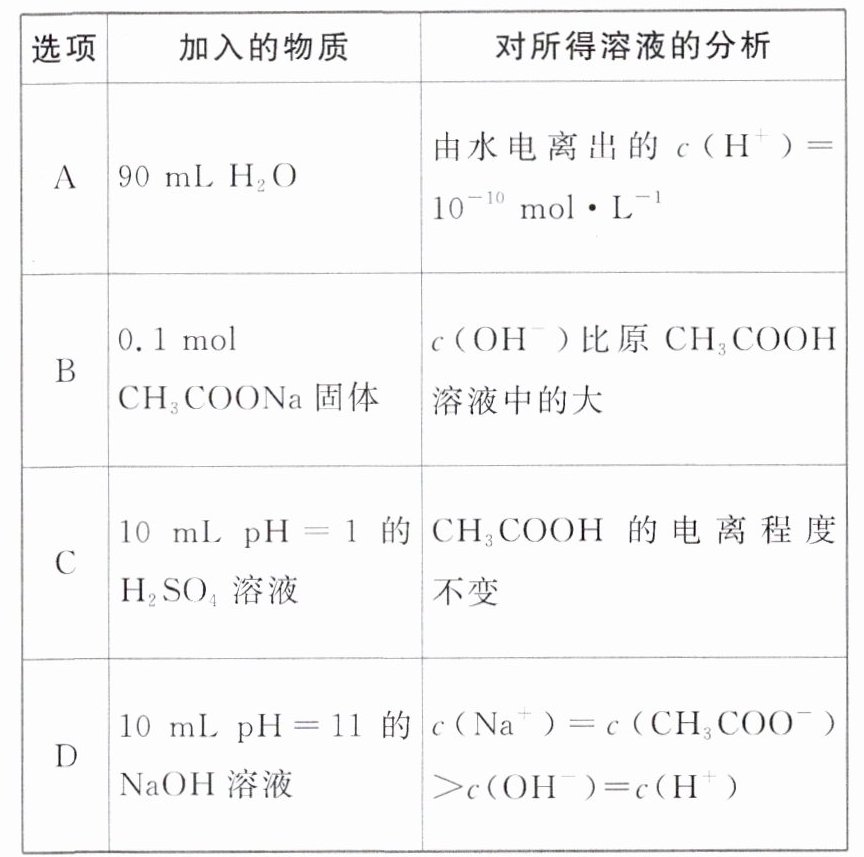
例2(2024·湖南长沙南雅中学高三模拟)室温下,向$10mLpH = 3$的$CH_{3}COOH$溶液中加入下列物质,对所得溶液的分析正确的是(
B
)
答案:
例2 B 解析 向$10\ \mathrm{mL}\ \mathrm{pH}=3$的$\mathrm{CH_3COOH}$溶液中加入$90\ \mathrm{mL}\ \mathrm{H_2O}$,醋酸的电离平衡正向移动,$c(\mathrm{H^+})>10^{-4}\ \mathrm{mol· L^{-1}}$,故由水电离出的$c(\mathrm{H^+})<10^{-10}\ \mathrm{mol· L^{-1}}$,选项A错误;向$10\ \mathrm{mL}\ \mathrm{pH}=3$的$\mathrm{CH_3COOH}$溶液中加入$0.1\ \mathrm{mol}\ \mathrm{CH_3COONa}$固体,醋酸根离子浓度增大,醋酸的电离平衡逆向移动,$c(\mathrm{H^+})$降低,$c(\mathrm{OH^-})$比原$\mathrm{CH_3COOH}$溶液中的大,选项B正确;向$10\ \mathrm{mL}\ \mathrm{pH}=3$的$\mathrm{CH_3COOH}$溶液中加入$10\ \mathrm{mL}\ \mathrm{pH}=1$的$\mathrm{H_2SO_4}$溶液,氢离子浓度增大,抑制醋酸的电离,$\mathrm{CH_3COOH}$的电离程度减小,选项C错误;向$10\ \mathrm{mL}\ \mathrm{pH}=3$的$\mathrm{CH_3COOH}$溶液中加入$10\ \mathrm{mL}\ \mathrm{pH}=11$的$\mathrm{NaOH}$溶液,醋酸过量,所得溶液呈酸性,故$c(\mathrm{CH_3COO^-})>c(\mathrm{Na^+})>c(\mathrm{H^+})>c(\mathrm{OH^-})$,选项D错误。
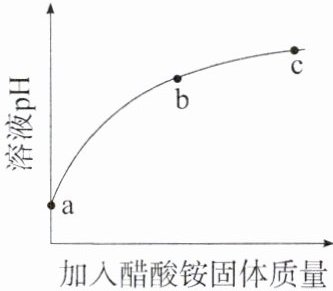
[对点训练2] 常温下,向$0.01mol·L^{-1}$的醋酸溶液中加入醋酸铵固体(其水溶液$pH = 7$),溶液的$pH$随加入醋酸铵固体质量的变化曲线如图所示。下列分析正确的是(
A.$a$点:$pH = 2$
B.$b$点:$c(CH_{3}COO^{-})>c(NH_{4}^{+})$
C.$c$点:$pH$可能大于$7$
D.$a$点到$c$点,溶液$pH$增大是因为醋酸铵水解显碱性
B
)A.$a$点:$pH = 2$
B.$b$点:$c(CH_{3}COO^{-})>c(NH_{4}^{+})$
C.$c$点:$pH$可能大于$7$
D.$a$点到$c$点,溶液$pH$增大是因为醋酸铵水解显碱性
答案:
对点训练2 B 解析 醋酸是弱电解质,$0.01\ \mathrm{mol\cdot L^{-1}}$的醋酸溶液中$c(\mathrm{H^+})<0.01\ \mathrm{mol\cdot L^{-1}}$,则溶液的$\mathrm{pH}>2$,A错误。b、c点为$\mathrm{CH_3COOH}$和$\mathrm{CH_3COONH_4}$的混合溶液,而$\mathrm{CH_3COONH_4}$溶液显中性,$\mathrm{CH_3COOH}$溶液显酸性,则混合溶液的$\mathrm{pH}<7$,即b点溶液中$c(\mathrm{H^+})>c(\mathrm{OH^-})$。结合电荷守恒推知,$c(\mathrm{CH_3COO^-})>c(\mathrm{NH_4^+})$,B正确,C错误。a点到c点,溶液的pH增大,其原因是醋酸是弱电解质,溶液中存在电离平衡:$\mathrm{CH_3COOH}\rightleftharpoons\mathrm{CH_3COO^-}+\mathrm{H^+}$,向醋酸溶液中加入醋酸铵固体,$c(\mathrm{CH_3COO^-})$增大,醋酸的电离平衡逆向移动,则溶液中的$c(\mathrm{H^+})$减小,溶液的pH增大,常温下,醋酸铵的水溶液$\mathrm{pH}=7$,即醋酸铵溶液显中性,D错误。
查看更多完整答案,请扫码查看

