

 搜索
搜索
第27页
- 第1页
- 第2页
- 第3页
- 第4页
- 第5页
- 第6页
- 第7页
- 第8页
- 第9页
- 第10页
- 第11页
- 第12页
- 第13页
- 第14页
- 第15页
- 第16页
- 第17页
- 第18页
- 第19页
- 第20页
- 第21页
- 第22页
- 第23页
- 第24页
- 第25页
- 第26页
- 第27页
- 第28页
- 第29页
- 第30页
- 第31页
- 第32页
- 第33页
- 第34页
- 第35页
- 第36页
- 第37页
- 第38页
- 第39页
- 第40页
- 第41页
- 第42页
- 第43页
- 第44页
- 第45页
- 第46页
- 第47页
- 第48页
- 第49页
- 第50页
- 第51页
- 第52页
- 第53页
- 第54页
- 第55页
- 第56页
- 第57页
- 第58页
- 第59页
- 第60页
- 第61页
- 第62页
- 第63页
- 第64页
- 第65页
- 第66页
- 第67页
- 第68页
- 第69页
- 第70页
- 第71页
- 第72页
- 第73页
- 第74页
- 第75页
- 第76页
- 第77页
- 第78页
- 第79页
- 第80页
- 第81页
- 第82页
- 第83页
- 第84页
- 第85页
- 第86页
- 第87页
- 第88页
- 第89页
- 第90页
- 第91页
- 第92页
- 第93页
- 第94页
- 第95页
- 第96页
- 第97页
- 第98页
- 第99页
- 第100页
- 第101页
- 第102页
- 第103页
- 第104页
- 第105页
- 第106页
- 第107页
- 第108页
- 第109页
- 第110页
- 第111页
- 第112页
- 第113页
- 第114页
- 第115页
- 第116页
- 第117页
- 第118页
- 第119页
- 第120页
- 第121页
- 第122页
- 第123页
- 第124页
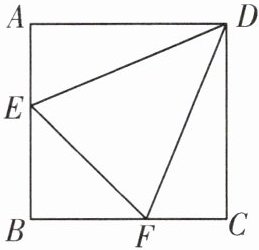
4. 当几何图形中,两个共顶点的角所在角度是公共大角一半的关系,我们称之为“半角模型”,通常用“旋转的观点”看待图形的几何变换,使得两个分散的角变换成为一个三角形,相当于构造出两个三角形全等. 如图,在四边形 ABCD 中,AD = CD,∠A = ∠ADC = ∠BCD = 90°,E,F 分别是 AB,BC 边上的点,且∠EDF = 45°,探究图中线段 EF,AE,FC 之间的数量关系,并加以证明.
答案:
$EF=FC+AE$.理由如下:
如图,将$△DAE$绕点D逆时针旋转$90^{\circ }$得到$△DCM.$
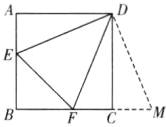
由旋转,得$△DAE\cong △DCM,$
$\therefore DE=DM,AE=CM,∠ADE=∠CDM,∠DCM=∠DAE=90^{\circ },$
$\therefore ∠BCD+∠DCM=180^{\circ },\therefore B,C,M$三点共线.
$\because ∠EDF=45^{\circ },∠ADC=90^{\circ },$
$\therefore ∠ADE+∠FDC=∠ADC-∠EDF=45^{\circ }.$
$\therefore ∠CDM+∠FDC=∠ADE+∠FDC=45^{\circ },$
$\therefore ∠MDF=∠EDF=45^{\circ }.$
在$△DEF$和$△DMF$中,$\left\{\begin{array}{l} DE=DM,\\ ∠EDF=∠MDF,\\ DF=DF,\end{array}\right. $
$\therefore △DEF\cong △DMF(SAS),\therefore EF=MF,$
$\therefore EF=MF=FC+CM=FC+AE.$
$EF=FC+AE$.理由如下:
如图,将$△DAE$绕点D逆时针旋转$90^{\circ }$得到$△DCM.$
由旋转,得$△DAE\cong △DCM,$
$\therefore DE=DM,AE=CM,∠ADE=∠CDM,∠DCM=∠DAE=90^{\circ },$
$\therefore ∠BCD+∠DCM=180^{\circ },\therefore B,C,M$三点共线.
$\because ∠EDF=45^{\circ },∠ADC=90^{\circ },$
$\therefore ∠ADE+∠FDC=∠ADC-∠EDF=45^{\circ }.$
$\therefore ∠CDM+∠FDC=∠ADE+∠FDC=45^{\circ },$
$\therefore ∠MDF=∠EDF=45^{\circ }.$
在$△DEF$和$△DMF$中,$\left\{\begin{array}{l} DE=DM,\\ ∠EDF=∠MDF,\\ DF=DF,\end{array}\right. $
$\therefore △DEF\cong △DMF(SAS),\therefore EF=MF,$
$\therefore EF=MF=FC+CM=FC+AE.$
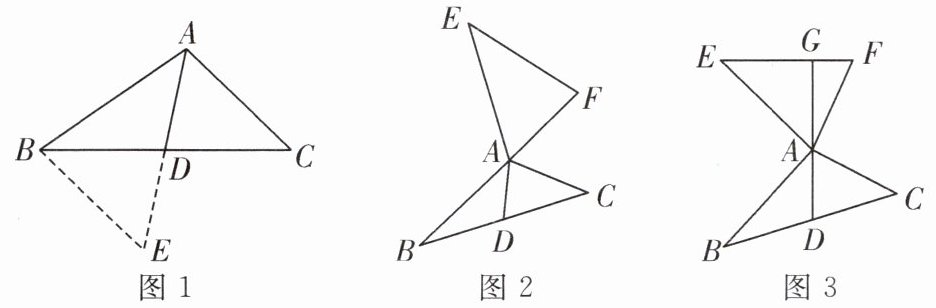
5. (2024·济南历下区期中)【阅读理解】如图 1,△ABC 中,若 AB = 10,AC = 8,求边 BC 上的中线 AD 的取值范围. 小明在组内经过合作交流,得到了如下的解决方法:延长 AD 到点 E,使 DE = AD,连接 BE. 请根据小明的方法思考:
(1)由已知和作图能得到△ADC≌△EDB 的理由是 ( )
A. SSS
B. SAS
C. AAS
D. ASA
(2)利用三角形三边关系可以确定 AE 的取值范围,从而可以得到 AD 的取值范围是 ( )
A. 2 < AD < 18
B. 2 < AD < 9
C. 1 < AD < 18
D. 1 < AD < 9
【方法总结】解题时,条件中若出现“中点”“中线”字样,可以考虑延长中线构造全等三角形,把分散的已知条件和所求证的结论集合到同一个三角形中.
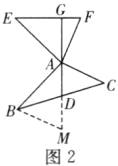
【问题解决】(3)如图 2,AD 是△ABC 的中线,AB = AE,AC = AF,∠BAE + ∠CAF = 180°,试判断线段 AD 与 EF 的数量关系,并说明理由.
(4)如图 3,在(3)的条件下,若∠BAE = ∠CAF = 90°,延长 DA 交 EF 于点 G,AD = 2,AG = 3,则△ABC 的面积为 ______.
(1)由已知和作图能得到△ADC≌△EDB 的理由是 ( )
A. SSS
B. SAS
C. AAS
D. ASA
(2)利用三角形三边关系可以确定 AE 的取值范围,从而可以得到 AD 的取值范围是 ( )
A. 2 < AD < 18
B. 2 < AD < 9
C. 1 < AD < 18
D. 1 < AD < 9
【方法总结】解题时,条件中若出现“中点”“中线”字样,可以考虑延长中线构造全等三角形,把分散的已知条件和所求证的结论集合到同一个三角形中.
【问题解决】(3)如图 2,AD 是△ABC 的中线,AB = AE,AC = AF,∠BAE + ∠CAF = 180°,试判断线段 AD 与 EF 的数量关系,并说明理由.
(4)如图 3,在(3)的条件下,若∠BAE = ∠CAF = 90°,延长 DA 交 EF 于点 G,AD = 2,AG = 3,则△ABC 的面积为 ______.
答案:
(1)B
(2)D
(3)$EF=2AD$.理由如下:
如图1,延长AD到点M,使得$DM=AD$,连接BM,
$\therefore AM=AD+DM=2AD.$
∵AD是$△ABC$的中线,$\therefore BD=CD.$
在$△BDM$和$△CDA$中,$\left\{\begin{array}{l} BD=CD,\\ ∠BDM=∠CDA,\\ DM=DA,\end{array}\right. $
$\therefore △BDM\cong △CDA(SAS),\therefore BM=AC.$
又$\because AC=AF,\therefore BM=AF.$
$\because △BDM\cong △CDA,\therefore ∠MBD=∠ACD,$
$\therefore BM// AC,\therefore ∠ABM+∠BAC=180^{\circ }.$
$\because ∠BAE+∠CAF=180^{\circ },$
$\therefore ∠BAC+∠FAE=360^{\circ }-(∠BAE+∠CAF)=180^{\circ },$
$\therefore ∠ABM=∠FAE.$
在$△ABM$和$△EAF$中,$\left\{\begin{array}{l} AB=EA,\\ ∠ABM=∠EAF,\\ BM=AF,\end{array}\right. $
$\therefore △ABM\cong △EAF(SAS),\therefore AM=EF.$
$\because AM=2AD,\therefore EF=2AD.$
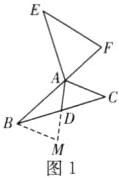
(4)6 解析:如图2,延长AD到点M,使得$DM=AD$,连接BM.由
(3)可得$△ADC\cong △MDB,△ABM\cong △EAF,\therefore ∠BAM=∠E,EF=AM=2AD=2×2=4,S_{△ADC}=S_{△BDM},S_{△ABM}=S_{△AEF}.$
$\because ∠BAE=90^{\circ },∠BAE+∠BAM+∠EAG=180^{\circ },\therefore ∠BAM+∠EAG=180^{\circ }-∠BAE=90^{\circ },\therefore ∠E+∠EAG=90^{\circ }$,即$∠AGE=90^{\circ }$,则$S_{△ABC}=S_{△ABD}+S_{△ACD}=S_{△ABD}+S_{△BDM}=S_{△ABM}=S_{△AEF}=\frac {1}{2}EF\cdot AG=\frac {1}{2}×4×3=6$,即$△ABC$的面积为6.
(1)B
(2)D
(3)$EF=2AD$.理由如下:
如图1,延长AD到点M,使得$DM=AD$,连接BM,
$\therefore AM=AD+DM=2AD.$
∵AD是$△ABC$的中线,$\therefore BD=CD.$
在$△BDM$和$△CDA$中,$\left\{\begin{array}{l} BD=CD,\\ ∠BDM=∠CDA,\\ DM=DA,\end{array}\right. $
$\therefore △BDM\cong △CDA(SAS),\therefore BM=AC.$
又$\because AC=AF,\therefore BM=AF.$
$\because △BDM\cong △CDA,\therefore ∠MBD=∠ACD,$
$\therefore BM// AC,\therefore ∠ABM+∠BAC=180^{\circ }.$
$\because ∠BAE+∠CAF=180^{\circ },$
$\therefore ∠BAC+∠FAE=360^{\circ }-(∠BAE+∠CAF)=180^{\circ },$
$\therefore ∠ABM=∠FAE.$
在$△ABM$和$△EAF$中,$\left\{\begin{array}{l} AB=EA,\\ ∠ABM=∠EAF,\\ BM=AF,\end{array}\right. $
$\therefore △ABM\cong △EAF(SAS),\therefore AM=EF.$
$\because AM=2AD,\therefore EF=2AD.$
(4)6 解析:如图2,延长AD到点M,使得$DM=AD$,连接BM.由
(3)可得$△ADC\cong △MDB,△ABM\cong △EAF,\therefore ∠BAM=∠E,EF=AM=2AD=2×2=4,S_{△ADC}=S_{△BDM},S_{△ABM}=S_{△AEF}.$
$\because ∠BAE=90^{\circ },∠BAE+∠BAM+∠EAG=180^{\circ },\therefore ∠BAM+∠EAG=180^{\circ }-∠BAE=90^{\circ },\therefore ∠E+∠EAG=90^{\circ }$,即$∠AGE=90^{\circ }$,则$S_{△ABC}=S_{△ABD}+S_{△ACD}=S_{△ABD}+S_{△BDM}=S_{△ABM}=S_{△AEF}=\frac {1}{2}EF\cdot AG=\frac {1}{2}×4×3=6$,即$△ABC$的面积为6.
查看更多完整答案,请扫码查看

