

 搜索
搜索
第26页
- 第1页
- 第2页
- 第3页
- 第4页
- 第5页
- 第6页
- 第7页
- 第8页
- 第9页
- 第10页
- 第11页
- 第12页
- 第13页
- 第14页
- 第15页
- 第16页
- 第17页
- 第18页
- 第19页
- 第20页
- 第21页
- 第22页
- 第23页
- 第24页
- 第25页
- 第26页
- 第27页
- 第28页
- 第29页
- 第30页
- 第31页
- 第32页
- 第33页
- 第34页
- 第35页
- 第36页
- 第37页
- 第38页
- 第39页
- 第40页
- 第41页
- 第42页
- 第43页
- 第44页
- 第45页
- 第46页
- 第47页
- 第48页
- 第49页
- 第50页
- 第51页
- 第52页
- 第53页
- 第54页
- 第55页
- 第56页
- 第57页
- 第58页
- 第59页
- 第60页
- 第61页
- 第62页
- 第63页
- 第64页
- 第65页
- 第66页
- 第67页
- 第68页
- 第69页
- 第70页
- 第71页
- 第72页
- 第73页
- 第74页
- 第75页
- 第76页
- 第77页
- 第78页
- 第79页
- 第80页
- 第81页
- 第82页
- 第83页
- 第84页
- 第85页
- 第86页
- 第87页
- 第88页
- 第89页
- 第90页
- 第91页
- 第92页
- 第93页
- 第94页
- 第95页
- 第96页
- 第97页
- 第98页
- 第99页
- 第100页
- 第101页
- 第102页
- 第103页
- 第104页
- 第105页
- 第106页
- 第107页
- 第108页
- 第109页
- 第110页
- 第111页
- 第112页
- 第113页
- 第114页
- 第115页
- 第116页
- 第117页
- 第118页
- 第119页
- 第120页
- 第121页
- 第122页
- 第123页
- 第124页
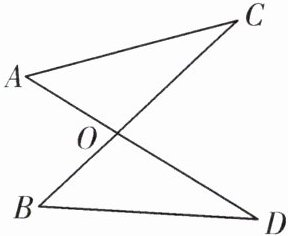
1. (2024·睢宁县期中)如图,AD,BC 相交于点 O,连接 AC,BD,且 AD = BC,AC = BD. 求证:OC = OD.
答案:
连接CD.
在△ADC与△BCD中,$\left\{\begin{array}{l} AD=BC,\\ AC=BD,\\ CD=DC,\end{array}\right. $
$\therefore △ADC\cong △BCD(SSS),\therefore ∠A=∠B.$
在$△AOC$与$△BOD$中,$\left\{\begin{array}{l} ∠A=∠B,\\ ∠AOC=∠BOD,\\ AC=BD,\end{array}\right. $
$\therefore △AOC\cong △BOD(AAS),\therefore OC=OD.$
在△ADC与△BCD中,$\left\{\begin{array}{l} AD=BC,\\ AC=BD,\\ CD=DC,\end{array}\right. $
$\therefore △ADC\cong △BCD(SSS),\therefore ∠A=∠B.$
在$△AOC$与$△BOD$中,$\left\{\begin{array}{l} ∠A=∠B,\\ ∠AOC=∠BOD,\\ AC=BD,\end{array}\right. $
$\therefore △AOC\cong △BOD(AAS),\therefore OC=OD.$
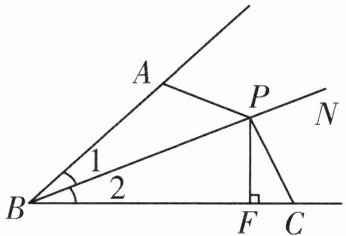
2. 如图,已知∠1 = ∠2,P 为 BN 上的一点,PF⊥BC 于点 F,BA < BF < BC,PA = PC.
(1)求证:∠PCB + ∠PAB = 180°;
(2)线段 BF,BC,AB 之间有何数量关系?写出你的猜想并证明你的结论.
(1)求证:∠PCB + ∠PAB = 180°;
(2)线段 BF,BC,AB 之间有何数量关系?写出你的猜想并证明你的结论.
答案:
(1)过点P作$PE⊥BA$于点E.
$\because PE⊥BA,PF⊥BC,\therefore ∠PEB=∠PFB=90^{\circ }.$
在$△PEB$和$△PFB$中,$\left\{\begin{array}{l} ∠PEB=∠PFB,\\ ∠1=∠2,\\ PB=PB,\end{array}\right. $
$\therefore △PEB\cong △PFB(AAS),\therefore PE=PF.$
在$Rt△PEA$和$Rt△PFC$中,$\left\{\begin{array}{l} PA=PC,\\ PE=PF,\end{array}\right. $
$\therefore Rt△PEA\cong Rt△PFC(HL),\therefore ∠PAE=∠PCB.$
$\because ∠PAB+∠PAE=180^{\circ },\therefore ∠PCB+∠PAB=180^{\circ }.$
(2)$2BF=AB+BC$.证明如下:
$\because Rt△PEA\cong Rt△PFC,\therefore AE=CF.$
$\because Rt△PBE\cong Rt△PBF,\therefore BE=BF,$
$\therefore 2BF=BE+BF=AB+AE+BF=AB+FC+BF=AB+BC.$
(1)过点P作$PE⊥BA$于点E.
$\because PE⊥BA,PF⊥BC,\therefore ∠PEB=∠PFB=90^{\circ }.$
在$△PEB$和$△PFB$中,$\left\{\begin{array}{l} ∠PEB=∠PFB,\\ ∠1=∠2,\\ PB=PB,\end{array}\right. $
$\therefore △PEB\cong △PFB(AAS),\therefore PE=PF.$
在$Rt△PEA$和$Rt△PFC$中,$\left\{\begin{array}{l} PA=PC,\\ PE=PF,\end{array}\right. $
$\therefore Rt△PEA\cong Rt△PFC(HL),\therefore ∠PAE=∠PCB.$
$\because ∠PAB+∠PAE=180^{\circ },\therefore ∠PCB+∠PAB=180^{\circ }.$
(2)$2BF=AB+BC$.证明如下:
$\because Rt△PEA\cong Rt△PFC,\therefore AE=CF.$
$\because Rt△PBE\cong Rt△PBF,\therefore BE=BF,$
$\therefore 2BF=BE+BF=AB+AE+BF=AB+FC+BF=AB+BC.$
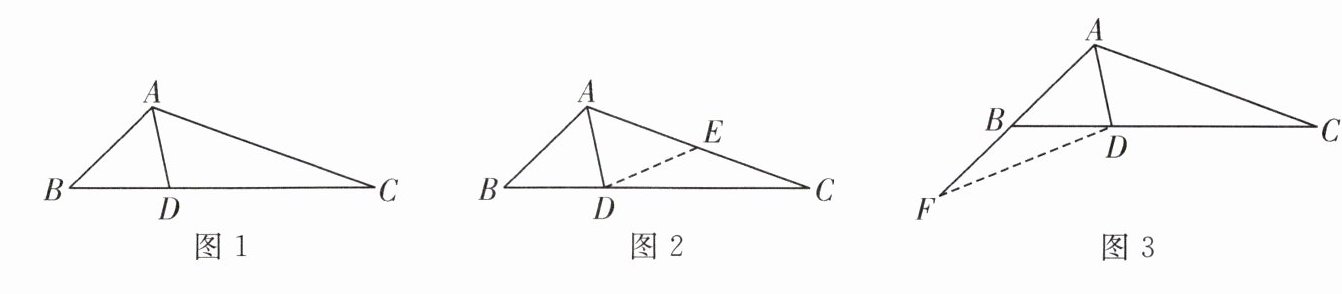
3. 数学习题课上李老师出了这样一道题:“如图 1,在△ABC 中,AD 平分∠BAC,∠B = 2∠C. 求证:AB + BD = AC.”李老师给出了如下两种思路.
思路一(“截长法”):如图 2,在 AC 上截取 AE = AB,连接 DE.
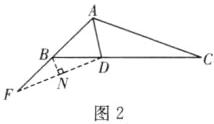
思路二(“补短法”):如图 3,延长 AB 至点 F,使 BF = BD.
请你按照上面两种思路,完成完整的证明.
思路一(“截长法”):如图 2,在 AC 上截取 AE = AB,连接 DE.
思路二(“补短法”):如图 3,延长 AB 至点 F,使 BF = BD.
请你按照上面两种思路,完成完整的证明.
答案:
思路一(“截长法”):
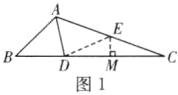
如图1,在AC上截取$AE=AB$,连接DE.
$\because AD$平分$∠BAC,\therefore ∠BAD=∠DAC.$
在$△ABD$和$△AED$中,$\left\{\begin{array}{l} AB=AE,\\ ∠BAD=∠EAD,\\ AD=AD,\end{array}\right. $
$\therefore △ABD\cong △AED(SAS),\therefore ∠B=∠AED,BD=DE.$
又$\because ∠B=2∠C,\therefore ∠AED=2∠C.$
又$\because ∠AED=∠C+∠EDC=2∠C,\therefore ∠C=∠EDC.$
过点E作$EM⊥DC$于点M,则$∠EMD=∠EMC=90^{\circ },$
在$△EMD$和$△EMC$中,$\left\{\begin{array}{l} ∠EDM=∠C,\\ ∠EMD=∠EMC,\\ EM=EM,\end{array}\right. $
$\therefore △EMD\cong △EMC(AAS),\therefore DE=CE,$
$\therefore AB+BD=AE+CE=AC$,即得证.
思路二(“补短法”):
如图2,延长AB至点F,使$BF=BD.$
过点B作$BN⊥DF$于点N,
$\therefore △BNF$和$△BND$都是直角三角形.
在$Rt△BNF\cong Rt△BND$中,$\left\{\begin{array}{l} BF=BD,\\ BN=BN,\end{array}\right. $
$\therefore Rt△BNF\cong Rt△BND(HL),$
$\therefore ∠F=∠BDF,\therefore ∠ABD=∠F+∠BDF=2∠F.$
$\because ∠ABD=2∠C,\therefore ∠F=∠C.$
在$△AFD$和$△ACD$中,$\left\{\begin{array}{l} ∠FAD=∠CAD,\\ ∠F=∠C,\\ AD=AD,\end{array}\right. $
$\therefore △AFD\cong △ACD(AAS),\therefore AC=AF,$
$\therefore AC=AB+BF=AB+BD$,即得证.
思路一(“截长法”):
如图1,在AC上截取$AE=AB$,连接DE.
$\because AD$平分$∠BAC,\therefore ∠BAD=∠DAC.$
在$△ABD$和$△AED$中,$\left\{\begin{array}{l} AB=AE,\\ ∠BAD=∠EAD,\\ AD=AD,\end{array}\right. $
$\therefore △ABD\cong △AED(SAS),\therefore ∠B=∠AED,BD=DE.$
又$\because ∠B=2∠C,\therefore ∠AED=2∠C.$
又$\because ∠AED=∠C+∠EDC=2∠C,\therefore ∠C=∠EDC.$
过点E作$EM⊥DC$于点M,则$∠EMD=∠EMC=90^{\circ },$
在$△EMD$和$△EMC$中,$\left\{\begin{array}{l} ∠EDM=∠C,\\ ∠EMD=∠EMC,\\ EM=EM,\end{array}\right. $
$\therefore △EMD\cong △EMC(AAS),\therefore DE=CE,$
$\therefore AB+BD=AE+CE=AC$,即得证.
思路二(“补短法”):
如图2,延长AB至点F,使$BF=BD.$
过点B作$BN⊥DF$于点N,
$\therefore △BNF$和$△BND$都是直角三角形.
在$Rt△BNF\cong Rt△BND$中,$\left\{\begin{array}{l} BF=BD,\\ BN=BN,\end{array}\right. $
$\therefore Rt△BNF\cong Rt△BND(HL),$
$\therefore ∠F=∠BDF,\therefore ∠ABD=∠F+∠BDF=2∠F.$
$\because ∠ABD=2∠C,\therefore ∠F=∠C.$
在$△AFD$和$△ACD$中,$\left\{\begin{array}{l} ∠FAD=∠CAD,\\ ∠F=∠C,\\ AD=AD,\end{array}\right. $
$\therefore △AFD\cong △ACD(AAS),\therefore AC=AF,$
$\therefore AC=AB+BF=AB+BD$,即得证.
查看更多完整答案,请扫码查看

