

 搜索
搜索
第48页
- 第1页
- 第2页
- 第3页
- 第4页
- 第5页
- 第6页
- 第7页
- 第8页
- 第9页
- 第10页
- 第11页
- 第12页
- 第13页
- 第14页
- 第15页
- 第16页
- 第17页
- 第18页
- 第19页
- 第20页
- 第21页
- 第22页
- 第23页
- 第24页
- 第25页
- 第26页
- 第27页
- 第28页
- 第29页
- 第30页
- 第31页
- 第32页
- 第33页
- 第34页
- 第35页
- 第36页
- 第37页
- 第38页
- 第39页
- 第40页
- 第41页
- 第42页
- 第43页
- 第44页
- 第45页
- 第46页
- 第47页
- 第48页
- 第49页
- 第50页
- 第51页
- 第52页
- 第53页
- 第54页
- 第55页
- 第56页
- 第57页
- 第58页
- 第59页
- 第60页
- 第61页
- 第62页
- 第63页
- 第64页
- 第65页
- 第66页
- 第67页
- 第68页
- 第69页
- 第70页
- 第71页
- 第72页
- 第73页
- 第74页
- 第75页
- 第76页
- 第77页
- 第78页
- 第79页
- 第80页
- 第81页
- 第82页
- 第83页
- 第84页
- 第85页
- 第86页
- 第87页
- 第88页
- 第89页
- 第90页
- 第91页
- 第92页
- 第93页
- 第94页
- 第95页
- 第96页
- 第97页
- 第98页
- 第99页
- 第100页
- 第101页
- 第102页
- 第103页
- 第104页
- 第105页
- 第106页
- 第107页
- 第108页
- 第109页
- 第110页
- 第111页
- 第112页
- 第113页
- 第114页
- 第115页
- 第116页
- 第117页
- 第118页
- 第119页
- 第120页
- 第121页
- 第122页
- 第123页
- 第124页
- 第125页
- 第126页
- 第127页
- 第128页
- 第129页
- 第130页
- 第131页
- 第132页
- 第133页
- 第134页
- 第135页
- 第136页
- 第137页
- 第138页
- 第139页
- 第140页
- 第141页
- 第142页
- 第143页
- 第144页
- 第145页
- 第146页
- 第147页
- 第148页
- 第149页
- 第150页
- 第151页
- 第152页
- 第153页
- 第154页
- 第155页
- 第156页
- 第157页
- 第158页
- 第159页
- 第160页
- 第161页
- 第162页
- 第163页
- 第164页
- 第165页
- 第166页
- 第167页
- 第168页
- 第169页
- 第170页
- 第171页
- 第172页
23. (10分)阅读并完成下列问题:任意给定一个矩形A,是否存在另一矩形B,使它的周长和面积分别是已知矩形周长和面积的一半?
(1)当已知矩形A的两边长分别为6和1时,小亮是这样研究的:
设所求矩形的两边长分别是x和y,由题意可得方程组
$\begin{cases}x + y = \frac{7}{2} \\ xy = 3\end{cases}$
消去y,得$2x^2 - 7x + 6 = 0$.
$\because \Delta = 49 - 48 = 1 > 0$,
$\therefore x_1 =$
$\therefore$满足要求的矩形B存在.
(2)如果已知矩形A的两边长分别为2和1,那么请你仿照小亮的方法研究是否存在满足要求的矩形B;
(3)如果矩形A的两边长分别为m和n,那么请你研究当m,n满足什么条件时,矩形B存在,并说明理由.
(1)当已知矩形A的两边长分别为6和1时,小亮是这样研究的:
设所求矩形的两边长分别是x和y,由题意可得方程组
$\begin{cases}x + y = \frac{7}{2} \\ xy = 3\end{cases}$
消去y,得$2x^2 - 7x + 6 = 0$.
$\because \Delta = 49 - 48 = 1 > 0$,
$\therefore x_1 =$
$\frac{3}{2}$
,$x_2 =$2
.$\therefore$满足要求的矩形B存在.
(2)如果已知矩形A的两边长分别为2和1,那么请你仿照小亮的方法研究是否存在满足要求的矩形B;
(3)如果矩形A的两边长分别为m和n,那么请你研究当m,n满足什么条件时,矩形B存在,并说明理由.
答案:
23.
(1)$\frac{3}{2}$ 2
(2)设所求矩形的两边长分别是$a,b$,由题意,得$\begin{cases}a + b=\frac{3}{2}\\ab = 1\end{cases}$
消去$b$,得$2a^{2}-3a + 2 = 0$.
$\because\Delta=9 - 16 = -7<0$,
$\therefore$此方程无实数根.
$\therefore$不存在满足要求的矩形B.
(3)当$m,n$满足$(m - n)^{2}-4mn\geq0$时,矩形B存在.理由如下:
设所求矩形的两边长分别是$p$和$q$,由题意,得$\begin{cases}p + q=\frac{m + n}{2}\\pq=\frac{mn}{2}\end{cases}$
消去$q$,得$2p^{2}-(m + n)p + mn = 0$.
$\therefore\Delta=[-(m + n)]^{2}-8mn=(m - n)^{2}-4mn$.
当$\Delta\geq0$时,存在满足要求的矩形B,即当$(m - n)^{2}-4mn\geq0$时,矩形B存在.
(1)$\frac{3}{2}$ 2
(2)设所求矩形的两边长分别是$a,b$,由题意,得$\begin{cases}a + b=\frac{3}{2}\\ab = 1\end{cases}$
消去$b$,得$2a^{2}-3a + 2 = 0$.
$\because\Delta=9 - 16 = -7<0$,
$\therefore$此方程无实数根.
$\therefore$不存在满足要求的矩形B.
(3)当$m,n$满足$(m - n)^{2}-4mn\geq0$时,矩形B存在.理由如下:
设所求矩形的两边长分别是$p$和$q$,由题意,得$\begin{cases}p + q=\frac{m + n}{2}\\pq=\frac{mn}{2}\end{cases}$
消去$q$,得$2p^{2}-(m + n)p + mn = 0$.
$\therefore\Delta=[-(m + n)]^{2}-8mn=(m - n)^{2}-4mn$.
当$\Delta\geq0$时,存在满足要求的矩形B,即当$(m - n)^{2}-4mn\geq0$时,矩形B存在.
24. (10分)如图,在边长为12cm的等边三角形ABC中,点P从点A开始沿AB边向点B以1cm/s的速度移动,点Q从点B开始沿BC边向点C以2cm/s的速度移动. 若点P,Q分别从点A,B同时出发,其中任意一点到达终点时,两点同时停止运动. 设运动的时间为x s,求:
(1)6s时,$BP =$
(2)运动几秒时,$\triangle BPQ$是直角三角形?
(3)运动几秒时,$\triangle BPQ$的面积等于$10\sqrt{3}cm^2$?
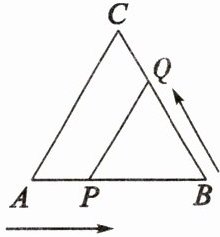
(1)6s时,$BP =$
6
cm,$BQ =$12
cm;(2)运动几秒时,$\triangle BPQ$是直角三角形?
(3)运动几秒时,$\triangle BPQ$的面积等于$10\sqrt{3}cm^2$?
答案:
24.
(1)6 12
(2)$\because\triangle ABC$是等边三角形,
$\therefore AB = BC = 12$cm,$\angle A=\angle B = \angle C = 60^{\circ}$.
由题意可知,$BP=(12 - x)$cm,$BQ = 2x$cm.
当$\angle PQB = 90^{\circ}$时,$\angle BPQ = 30^{\circ}$,
$\therefore BP = 2BQ$.
$\therefore12 - x = 2×2x$.
$\therefore x=\frac{12}{5}$.
当$\angle QPB = 90^{\circ}$时,$\angle PQB = 30^{\circ}$,
$\therefore BQ = 2BP$.
$\therefore2x = 2(12 - x)$.
$\therefore x = 6$.
答:运动6s或$\frac{12}{5}$s时,$\triangle BPQ$是直角三角形.
(3)如图,过点$Q$作$QD\perp AB$于点$D$,
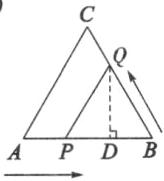
$\therefore\angle QDB = 90^{\circ}$.
$\therefore\angle DQB = 30^{\circ}$.
$\therefore DB=\frac{1}{2}BQ=x$cm.
在$Rt\triangle DBQ$中,由勾股定理,得$DQ=\sqrt{3}x$cm.
$\therefore\frac{(12 - x)×\sqrt{3}x}{2}=10\sqrt{3}$.
解得$x_{1}=10,x_{2}=2$.
$\because$当$x = 10$时,$2x>12$,
$\therefore x = 10$不合题意,应舍去.
$\therefore x = 2$.
答:运动2s时,$\triangle BPQ$的面积等于$10\sqrt{3}$cm².
24.
(1)6 12
(2)$\because\triangle ABC$是等边三角形,
$\therefore AB = BC = 12$cm,$\angle A=\angle B = \angle C = 60^{\circ}$.
由题意可知,$BP=(12 - x)$cm,$BQ = 2x$cm.
当$\angle PQB = 90^{\circ}$时,$\angle BPQ = 30^{\circ}$,
$\therefore BP = 2BQ$.
$\therefore12 - x = 2×2x$.
$\therefore x=\frac{12}{5}$.
当$\angle QPB = 90^{\circ}$时,$\angle PQB = 30^{\circ}$,
$\therefore BQ = 2BP$.
$\therefore2x = 2(12 - x)$.
$\therefore x = 6$.
答:运动6s或$\frac{12}{5}$s时,$\triangle BPQ$是直角三角形.
(3)如图,过点$Q$作$QD\perp AB$于点$D$,
$\therefore\angle QDB = 90^{\circ}$.
$\therefore\angle DQB = 30^{\circ}$.
$\therefore DB=\frac{1}{2}BQ=x$cm.
在$Rt\triangle DBQ$中,由勾股定理,得$DQ=\sqrt{3}x$cm.
$\therefore\frac{(12 - x)×\sqrt{3}x}{2}=10\sqrt{3}$.
解得$x_{1}=10,x_{2}=2$.
$\because$当$x = 10$时,$2x>12$,
$\therefore x = 10$不合题意,应舍去.
$\therefore x = 2$.
答:运动2s时,$\triangle BPQ$的面积等于$10\sqrt{3}$cm².
查看更多完整答案,请扫码查看

