

 搜索
搜索
第96页
- 第1页
- 第2页
- 第3页
- 第4页
- 第5页
- 第6页
- 第7页
- 第8页
- 第9页
- 第10页
- 第11页
- 第12页
- 第13页
- 第14页
- 第15页
- 第16页
- 第17页
- 第18页
- 第19页
- 第20页
- 第21页
- 第22页
- 第23页
- 第24页
- 第25页
- 第26页
- 第27页
- 第28页
- 第29页
- 第30页
- 第31页
- 第32页
- 第33页
- 第34页
- 第35页
- 第36页
- 第37页
- 第38页
- 第39页
- 第40页
- 第41页
- 第42页
- 第43页
- 第44页
- 第45页
- 第46页
- 第47页
- 第48页
- 第49页
- 第50页
- 第51页
- 第52页
- 第53页
- 第54页
- 第55页
- 第56页
- 第57页
- 第58页
- 第59页
- 第60页
- 第61页
- 第62页
- 第63页
- 第64页
- 第65页
- 第66页
- 第67页
- 第68页
- 第69页
- 第70页
- 第71页
- 第72页
- 第73页
- 第74页
- 第75页
- 第76页
- 第77页
- 第78页
- 第79页
- 第80页
- 第81页
- 第82页
- 第83页
- 第84页
- 第85页
- 第86页
- 第87页
- 第88页
- 第89页
- 第90页
- 第91页
- 第92页
- 第93页
- 第94页
- 第95页
- 第96页
- 第97页
- 第98页
- 第99页
- 第100页
- 第101页
- 第102页
- 第103页
- 第104页
- 第105页
- 第106页
- 第107页
- 第108页
- 第109页
- 第110页
- 第111页
- 第112页
- 第113页
- 第114页
- 第115页
- 第116页
- 第117页
- 第118页
- 第119页
- 第120页
- 第121页
- 第122页
- 第123页
- 第124页
- 第125页
- 第126页
- 第127页
- 第128页
- 第129页
- 第130页
- 第131页
7. (西川)定义:对于平面直角坐标系xOy中的不在同一条直线上的三点P,M,N,若满足点M绕点P逆时针旋转$90^{\circ }$后恰好与点N重合,则称点N为点M关于点P的“逆旋点”.请根据以上定义,完成下列填空:
(1)若点M在直线$y= 3x+3$上,点P与原点O重合,且点M关于点P的“逆旋点”N恰好在坐标轴上,则点N的坐标为____;
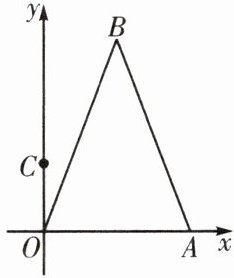
(2)如图,已知点A的坐标为$(\frac {3}{2},0)$,C是y轴上的动点,点B是点A关于点C的“逆旋点”,连接OB,AB,则$OB+AB$的最小值是____.
(1)若点M在直线$y= 3x+3$上,点P与原点O重合,且点M关于点P的“逆旋点”N恰好在坐标轴上,则点N的坐标为____;
(2)如图,已知点A的坐标为$(\frac {3}{2},0)$,C是y轴上的动点,点B是点A关于点C的“逆旋点”,连接OB,AB,则$OB+AB$的最小值是____.
答案:
(1)$(-3,0)$或$(0,-1)$
(2)$\frac{3}{2}\sqrt{5}$ 【解析】
(1)①当点$N$落在$x$轴上时,$OM\perp x$轴,$\therefore$点$M$在$y$轴上,当$x = 0$时,$y = 3x + 3 = 3$,$\therefore M(0,3)$,$\therefore N(-3,0)$.②当点$N$落在$y$轴上时,$OM\perp y$轴,$\therefore$点$M$在$x$轴上,当$y = 0$时,$3x + 3 = 0$,解得$x = -1$,$\therefore M(-1,0)$,$\therefore N(0,-1)$.综上所述,点$N$的坐标为$(-3,0)$或$(0,-1)$.
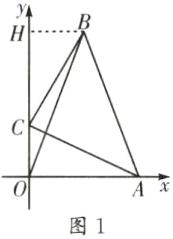
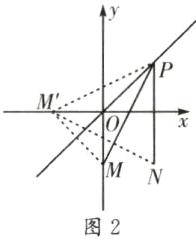
(2)如图1,过点$B$作$BH\perp y$轴于点$H$.设点$C$的坐标为$(0,m)$.$\because\angle ACB = 90^{\circ}$,$\therefore\angle ACO+\angle BCH = 90^{\circ}$.$\because\angle ACO+\angle OAC = 90^{\circ}$,$\therefore\angle BCH=\angle OAC$.又$\because\angle BHC=\angle COA = 90^{\circ}$,$BC = CA$,$\therefore\triangle BCH\cong\triangle CAO(AAS)$,$\therefore OC = HB=m$,$OA = HC=\frac{3}{2}$,$\therefore B(m,\frac{3}{2}+m)$,$\therefore BO+BA=\sqrt{m^{2}+(m+\frac{3}{2})^{2}}+\sqrt{(m-\frac{3}{2})^{2}+(m+\frac{3}{2})^{2}}$,相当于在直线$y = x$上寻找一点$P(m,m)$,使得点$P$到点$M(0,-\frac{3}{2})$,$N(\frac{3}{2},-\frac{3}{2})$的距离和最小.如图2,作点$M$关于直线$y = x$的对称点$M'(-\frac{3}{2},0)$,连接$PM'$,$M'N$,$\therefore M'N=\sqrt{(\frac{3}{2}+\frac{3}{2})^{2}+(\frac{3}{2})^{2}}=\frac{3}{2}\sqrt{5}$.$\because PM + PN=PM'+PN\geqslant M'N$,$\therefore PM + PN$的最小值为$\frac{3}{2}\sqrt{5}$,$\therefore OB + AB$的最小值为$\frac{3}{2}\sqrt{5}$.
(1)$(-3,0)$或$(0,-1)$
(2)$\frac{3}{2}\sqrt{5}$ 【解析】
(1)①当点$N$落在$x$轴上时,$OM\perp x$轴,$\therefore$点$M$在$y$轴上,当$x = 0$时,$y = 3x + 3 = 3$,$\therefore M(0,3)$,$\therefore N(-3,0)$.②当点$N$落在$y$轴上时,$OM\perp y$轴,$\therefore$点$M$在$x$轴上,当$y = 0$时,$3x + 3 = 0$,解得$x = -1$,$\therefore M(-1,0)$,$\therefore N(0,-1)$.综上所述,点$N$的坐标为$(-3,0)$或$(0,-1)$.
(2)如图1,过点$B$作$BH\perp y$轴于点$H$.设点$C$的坐标为$(0,m)$.$\because\angle ACB = 90^{\circ}$,$\therefore\angle ACO+\angle BCH = 90^{\circ}$.$\because\angle ACO+\angle OAC = 90^{\circ}$,$\therefore\angle BCH=\angle OAC$.又$\because\angle BHC=\angle COA = 90^{\circ}$,$BC = CA$,$\therefore\triangle BCH\cong\triangle CAO(AAS)$,$\therefore OC = HB=m$,$OA = HC=\frac{3}{2}$,$\therefore B(m,\frac{3}{2}+m)$,$\therefore BO+BA=\sqrt{m^{2}+(m+\frac{3}{2})^{2}}+\sqrt{(m-\frac{3}{2})^{2}+(m+\frac{3}{2})^{2}}$,相当于在直线$y = x$上寻找一点$P(m,m)$,使得点$P$到点$M(0,-\frac{3}{2})$,$N(\frac{3}{2},-\frac{3}{2})$的距离和最小.如图2,作点$M$关于直线$y = x$的对称点$M'(-\frac{3}{2},0)$,连接$PM'$,$M'N$,$\therefore M'N=\sqrt{(\frac{3}{2}+\frac{3}{2})^{2}+(\frac{3}{2})^{2}}=\frac{3}{2}\sqrt{5}$.$\because PM + PN=PM'+PN\geqslant M'N$,$\therefore PM + PN$的最小值为$\frac{3}{2}\sqrt{5}$,$\therefore OB + AB$的最小值为$\frac{3}{2}\sqrt{5}$.
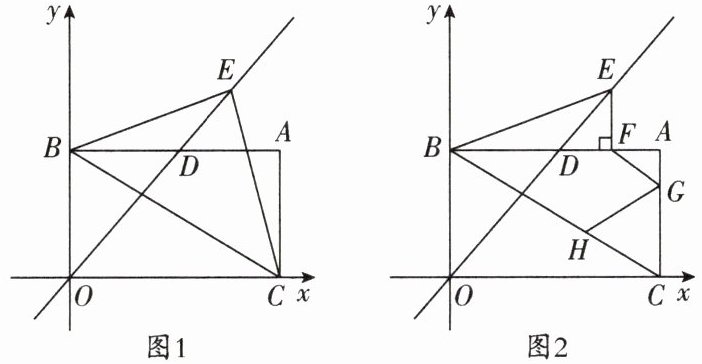
8. (树德实验)如图,在平面直角坐标系中,已知点$A(8,4)$,$AB⊥y$轴于点B,$AC⊥x$轴于点C,直线$y= x$交AB于点D.
(1)直接写出B,C,D三点的坐标;
(2)如图1,若E为OD延长线上一动点,记点E的横坐标为a,$△BCE$的面积为S,求S与a之间的关系式;
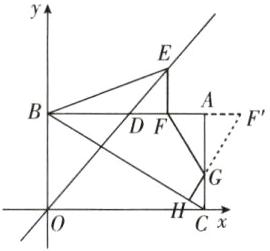
(3)如图2,在(2)的条件下,当$S= 20$时,过点E作$EF⊥AB$于点F,G,H分别为AC,CB上的动点,求$FG+GH$的最小值.
(1)直接写出B,C,D三点的坐标;
(2)如图1,若E为OD延长线上一动点,记点E的横坐标为a,$△BCE$的面积为S,求S与a之间的关系式;
(3)如图2,在(2)的条件下,当$S= 20$时,过点E作$EF⊥AB$于点F,G,H分别为AC,CB上的动点,求$FG+GH$的最小值.
答案:
解:
(1)$B(0,4)$,$C(8,0)$,$D(4,4)$.
(2)由题意,得$E(a,a)$,$\therefore S = S_{\triangle BDE}+S_{\triangle CDE}-S_{\triangle BDC}=4a×\frac{1}{2}+8a×\frac{1}{2}-8×4×\frac{1}{2}=6a - 16$.
(3)当$S = 20$时,$20 = 6a - 16$,解得$a = 6$,$\therefore E(6,6)$.$\because EF\perp AB$于点$F$,$\therefore F(6,4)$.如图,作点$F$关于直线$AC$的对称点$F'(10,4)$,作$F'H\perp BC$于点$H$,交$AC$于点$G$,此时$FG + GH$的值最小.易求得直线$BC$的表达式为$y = -\frac{1}{2}x + 4$,直线$F'H$的表达式为$y = 2x - 16$.由$y = -\frac{1}{2}x + 4$和$y = 2x - 16$,可求得$H(8,0)$,$\therefore F'H = 2\sqrt{5}$,$\therefore FG+GH$的最小值为$2\sqrt{5}$.
解:
(1)$B(0,4)$,$C(8,0)$,$D(4,4)$.
(2)由题意,得$E(a,a)$,$\therefore S = S_{\triangle BDE}+S_{\triangle CDE}-S_{\triangle BDC}=4a×\frac{1}{2}+8a×\frac{1}{2}-8×4×\frac{1}{2}=6a - 16$.
(3)当$S = 20$时,$20 = 6a - 16$,解得$a = 6$,$\therefore E(6,6)$.$\because EF\perp AB$于点$F$,$\therefore F(6,4)$.如图,作点$F$关于直线$AC$的对称点$F'(10,4)$,作$F'H\perp BC$于点$H$,交$AC$于点$G$,此时$FG + GH$的值最小.易求得直线$BC$的表达式为$y = -\frac{1}{2}x + 4$,直线$F'H$的表达式为$y = 2x - 16$.由$y = -\frac{1}{2}x + 4$和$y = 2x - 16$,可求得$H(8,0)$,$\therefore F'H = 2\sqrt{5}$,$\therefore FG+GH$的最小值为$2\sqrt{5}$.
查看更多完整答案,请扫码查看

