

 搜索
搜索
第118页
- 第1页
- 第2页
- 第3页
- 第4页
- 第5页
- 第6页
- 第7页
- 第8页
- 第9页
- 第10页
- 第11页
- 第12页
- 第13页
- 第14页
- 第15页
- 第16页
- 第17页
- 第18页
- 第19页
- 第20页
- 第21页
- 第22页
- 第23页
- 第24页
- 第25页
- 第26页
- 第27页
- 第28页
- 第29页
- 第30页
- 第31页
- 第32页
- 第33页
- 第34页
- 第35页
- 第36页
- 第37页
- 第38页
- 第39页
- 第40页
- 第41页
- 第42页
- 第43页
- 第44页
- 第45页
- 第46页
- 第47页
- 第48页
- 第49页
- 第50页
- 第51页
- 第52页
- 第53页
- 第54页
- 第55页
- 第56页
- 第57页
- 第58页
- 第59页
- 第60页
- 第61页
- 第62页
- 第63页
- 第64页
- 第65页
- 第66页
- 第67页
- 第68页
- 第69页
- 第70页
- 第71页
- 第72页
- 第73页
- 第74页
- 第75页
- 第76页
- 第77页
- 第78页
- 第79页
- 第80页
- 第81页
- 第82页
- 第83页
- 第84页
- 第85页
- 第86页
- 第87页
- 第88页
- 第89页
- 第90页
- 第91页
- 第92页
- 第93页
- 第94页
- 第95页
- 第96页
- 第97页
- 第98页
- 第99页
- 第100页
- 第101页
- 第102页
- 第103页
- 第104页
- 第105页
- 第106页
- 第107页
- 第108页
- 第109页
- 第110页
- 第111页
- 第112页
- 第113页
- 第114页
- 第115页
- 第116页
- 第117页
- 第118页
- 第119页
- 第120页
- 第121页
- 第122页
- 第123页
- 第124页
- 第125页
- 第126页
- 第127页
- 第128页
- 第129页
- 第130页
- 第131页
4. (石室联中)如图,一次函数$y= \frac {5}{12}x+5$的图象分别与x轴、y轴相交于点A,B,且与经过点$C(7,0)的一次函数y= kx+b$的图象相交于点D. 点D的横坐标为12,直线CD与y轴相交于点E.
(1)直线CD的函数表达式为____.
(2)Q为线段DE上的一个动点,连接BQ.
①若直线BQ将$\triangle BDE的面积分为1:2$两部分,求点Q的坐标;
②点Q是否存在某个位置,将$\triangle BQD$沿着直线BQ翻折,使得点D恰好落在直线AB下方的坐标轴上? 若存在,请求出点Q的坐标;若不存在,请说明理由.
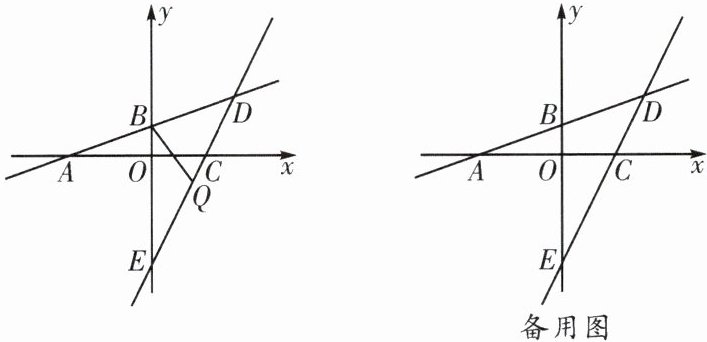
(1)直线CD的函数表达式为____.
(2)Q为线段DE上的一个动点,连接BQ.
①若直线BQ将$\triangle BDE的面积分为1:2$两部分,求点Q的坐标;
②点Q是否存在某个位置,将$\triangle BQD$沿着直线BQ翻折,使得点D恰好落在直线AB下方的坐标轴上? 若存在,请求出点Q的坐标;若不存在,请说明理由.
答案:
解:
(1)$y=2x-14$【解析】$\because$直线$y=\frac {5}{12}x+5$经过点$D$,$\therefore$当$x=12$时,$y=\frac {5}{12}x+5=10$,即点$D(12,10)$.设直线$CD$的表达式为$y=k(x-7)$,将点$D$的坐标代入上式,得$10=k(12-7)$,则$k=2$,故直线$CD$的函数表达式为$y=2x-14$.
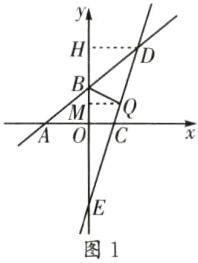
(2)①$\because$直线$BQ$将$\triangle BDE$的面积分为$1:2$两部分,$\therefore S_{\triangle BEQ}=\frac {1}{3}S_{\triangle BDE}$或$S_{\triangle BEQ}=\frac {2}{3}S_{\triangle BDE}$.一次函数$y=\frac {5}{12}x+5$的图象分别与$x$轴、$y$轴相交于点$A$,$B$,则点$A$,$B$的坐标分别为$(-12,0)$,$(0,5)$.由函数$y=2x-14$易得,$E(0,-14)$,$\therefore BE=19$.如图1,过点$D$作$DH⊥y$轴于点$H$,则$DH=12$,$\therefore S_{\triangle BDE}=\frac {1}{2}BE\cdot DH=\frac {1}{2}×19×12=114$,$\therefore S_{\triangle BEQ}=\frac {1}{3}×114=38$或$S_{\triangle BEQ}=\frac {2}{3}×114=76$.设点$Q(t,2t-14)$,由题意知$t>0$,过点$Q$作$QM⊥y$轴于点$M$,则$QM=t$,$\therefore \frac {1}{2}×19×t=38$或$\frac {1}{2}×19×t=76$,解得$t=4$或$t=8$,$\therefore$点$Q$的坐标为$(4,-6)$或$(8,2)$.
②如图2,当点$D$落在$x$轴正半轴上(记为点$D_{1}$)时,过点$D$作$DH⊥y$轴.
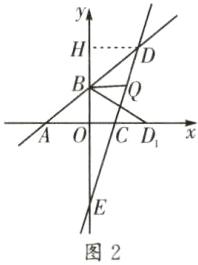
$\because B(0,5)$,$D(12,10)$,$\therefore BH=BO=5$.由翻折得$BD=BD_{1}$.在$Rt\triangle DHB$和$Rt\triangle D_{1}OB$中,$\begin{cases} BH=BO\\ BD=BD_{1} \end{cases}$,$\therefore Rt\triangle DHB\cong Rt\triangle D_{1}OB(HL)$,$\therefore ∠DBH=∠D_{1}BO$.由翻折得$∠DBQ=∠D_{1}BQ$,$\therefore ∠HBQ=∠OBQ=90^{\circ }$,$\therefore BQ// x$轴,$\therefore$点$Q$的纵坐标为$5$.在$y=2x-14$中,当$y=5$时,$x=\frac {19}{2}$,$\therefore Q(\frac {19}{2},5)$.如图3,当点$D$落在$y$轴负半轴上(记为点$D_{2}$)时,
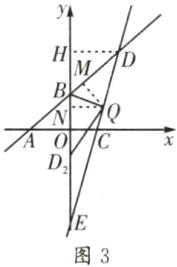
过点$D$作$DH⊥y$轴,过点$Q$作$QM⊥BD$,$QN⊥OB$,垂足分别为$M$,$N$.由翻折得$∠DBQ=∠D_{2}BQ$,$\therefore QM=QN$.由
(2)①知$S_{\triangle BDE}=114$,即$S_{\triangle BQD}+S_{\triangle BQE}=114$,$\therefore \frac {1}{2}BD\cdot QM+\frac {1}{2}BE\cdot QN=114$.在$Rt\triangle BDH$中,由勾股定理,得$BD=\sqrt {BH^{2}+DH^{2}}=\sqrt {5^{2}+12^{2}}=13$,$\therefore \frac {1}{2}×13\cdot QN+\frac {1}{2}×19\cdot QN=114$,解得$QN=\frac {57}{8}$.在$y=2x-14$中,当$x=\frac {57}{8}$时,$y=\frac {1}{4}$,$\therefore Q(\frac {57}{8},\frac {1}{4})$.综上所述,点$Q$的坐标为$(\frac {19}{2},5)$或$(\frac {57}{8},\frac {1}{4})$.
解:
(1)$y=2x-14$【解析】$\because$直线$y=\frac {5}{12}x+5$经过点$D$,$\therefore$当$x=12$时,$y=\frac {5}{12}x+5=10$,即点$D(12,10)$.设直线$CD$的表达式为$y=k(x-7)$,将点$D$的坐标代入上式,得$10=k(12-7)$,则$k=2$,故直线$CD$的函数表达式为$y=2x-14$.
(2)①$\because$直线$BQ$将$\triangle BDE$的面积分为$1:2$两部分,$\therefore S_{\triangle BEQ}=\frac {1}{3}S_{\triangle BDE}$或$S_{\triangle BEQ}=\frac {2}{3}S_{\triangle BDE}$.一次函数$y=\frac {5}{12}x+5$的图象分别与$x$轴、$y$轴相交于点$A$,$B$,则点$A$,$B$的坐标分别为$(-12,0)$,$(0,5)$.由函数$y=2x-14$易得,$E(0,-14)$,$\therefore BE=19$.如图1,过点$D$作$DH⊥y$轴于点$H$,则$DH=12$,$\therefore S_{\triangle BDE}=\frac {1}{2}BE\cdot DH=\frac {1}{2}×19×12=114$,$\therefore S_{\triangle BEQ}=\frac {1}{3}×114=38$或$S_{\triangle BEQ}=\frac {2}{3}×114=76$.设点$Q(t,2t-14)$,由题意知$t>0$,过点$Q$作$QM⊥y$轴于点$M$,则$QM=t$,$\therefore \frac {1}{2}×19×t=38$或$\frac {1}{2}×19×t=76$,解得$t=4$或$t=8$,$\therefore$点$Q$的坐标为$(4,-6)$或$(8,2)$.
②如图2,当点$D$落在$x$轴正半轴上(记为点$D_{1}$)时,过点$D$作$DH⊥y$轴.
$\because B(0,5)$,$D(12,10)$,$\therefore BH=BO=5$.由翻折得$BD=BD_{1}$.在$Rt\triangle DHB$和$Rt\triangle D_{1}OB$中,$\begin{cases} BH=BO\\ BD=BD_{1} \end{cases}$,$\therefore Rt\triangle DHB\cong Rt\triangle D_{1}OB(HL)$,$\therefore ∠DBH=∠D_{1}BO$.由翻折得$∠DBQ=∠D_{1}BQ$,$\therefore ∠HBQ=∠OBQ=90^{\circ }$,$\therefore BQ// x$轴,$\therefore$点$Q$的纵坐标为$5$.在$y=2x-14$中,当$y=5$时,$x=\frac {19}{2}$,$\therefore Q(\frac {19}{2},5)$.如图3,当点$D$落在$y$轴负半轴上(记为点$D_{2}$)时,
过点$D$作$DH⊥y$轴,过点$Q$作$QM⊥BD$,$QN⊥OB$,垂足分别为$M$,$N$.由翻折得$∠DBQ=∠D_{2}BQ$,$\therefore QM=QN$.由
(2)①知$S_{\triangle BDE}=114$,即$S_{\triangle BQD}+S_{\triangle BQE}=114$,$\therefore \frac {1}{2}BD\cdot QM+\frac {1}{2}BE\cdot QN=114$.在$Rt\triangle BDH$中,由勾股定理,得$BD=\sqrt {BH^{2}+DH^{2}}=\sqrt {5^{2}+12^{2}}=13$,$\therefore \frac {1}{2}×13\cdot QN+\frac {1}{2}×19\cdot QN=114$,解得$QN=\frac {57}{8}$.在$y=2x-14$中,当$x=\frac {57}{8}$时,$y=\frac {1}{4}$,$\therefore Q(\frac {57}{8},\frac {1}{4})$.综上所述,点$Q$的坐标为$(\frac {19}{2},5)$或$(\frac {57}{8},\frac {1}{4})$.
1. (锦江区期末)如图,在平面直角坐标系$xOy$中,已知$∠AOB= 90^{\circ}$,$∠A= 60^{\circ}$,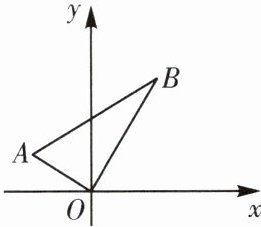 点$A的坐标为(-2\sqrt{3},2)$,若直线$y= -2x+2沿x轴平移m个单位长度后与\triangle AOB$仍有公共点,则$m$的取值范围是______。
点$A的坐标为(-2\sqrt{3},2)$,若直线$y= -2x+2沿x轴平移m个单位长度后与\triangle AOB$仍有公共点,则$m$的取值范围是______。
答案:
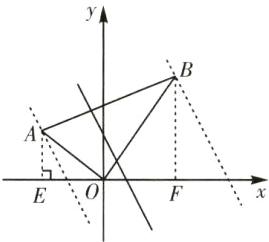
$-2\sqrt{3}\leqslant m\leqslant 2 + 2\sqrt{3}$ [解析]如图,过点A作AE⊥x轴于点E,过点B作BF⊥x轴于点F。
∵A(−2$\sqrt{3}$,2),
∴AE = 2,OE = 2$\sqrt{3}$。根据勾股定理,得$AO=\sqrt{AE^{2}+OE^{2}} = 4$,
∴$AE=\frac{1}{2}AO$,
∴∠AOE = 30°。
∵∠AOB = 90°,∠BAO = 60°,
∴∠ABO = 30°,
∴AB = 2AO = 8,
∴$BO=\sqrt{AB^{2}-AO^{2}} = 4\sqrt{3}$。又∠BOF = 180°−∠AOE−∠AOB = 60°,
∴∠OBF = 30°,
∴$OF=\frac{1}{2}BO = 2\sqrt{3}$,
∴$BF=\sqrt{BO^{2}-OF^{2}} = 6$,
∴B(2$\sqrt{3}$,6)。对于y = −2x + 2,当y = 0时,−2x + 2 = 0,
∴x = 1,
∴直线y = −2x + 2与x轴的交点坐标为(1,0)。设过点A且与直线y = −2x + 2平行的直线的表达式为y = −2x + p,把点A(−2$\sqrt{3}$,2)代入y = −2x + p,得2 = −2×(−2$\sqrt{3}$) + p,
∴p = 2 - 4$\sqrt{3}$,
∴y = −2x + 2 - 4$\sqrt{3}$。当y = 0时,−2x + 2 - 4$\sqrt{3} = 0$,
∴x = 1 - 2$\sqrt{3}$,
∴直线y = −2x + 2 - 4$\sqrt{3}$与x轴的交点坐标为(1 - 2$\sqrt{3}$,0)。设过点B且与直线y = −2x + 2平行的直线的表达式为y = −2x + q,把点B(2$\sqrt{3}$,6)代入y = −2x + q,得6 = −2×2$\sqrt{3}$ + q,
∴q = 6 + 4$\sqrt{3}$,
∴y = −2x + 6 + 4$\sqrt{3}$。当y = 0时,−2x + 6 + 4$\sqrt{3} = 0$,
∴x = 3 + 2$\sqrt{3}$,
∴y = −2x + 6 + 4$\sqrt{3}$与x轴的交点坐标为(3 + 2$\sqrt{3}$,0)。
∵直线y = −2x + 2沿x轴平移m个单位长度后与△AOB仍有公共点,则m的取值范围是$1 - 2\sqrt{3}-1\leqslant m\leqslant3 + 2\sqrt{3}-1$,即$-2\sqrt{3}\leqslant m\leqslant2 + 2\sqrt{3}$。
$-2\sqrt{3}\leqslant m\leqslant 2 + 2\sqrt{3}$ [解析]如图,过点A作AE⊥x轴于点E,过点B作BF⊥x轴于点F。
∵A(−2$\sqrt{3}$,2),
∴AE = 2,OE = 2$\sqrt{3}$。根据勾股定理,得$AO=\sqrt{AE^{2}+OE^{2}} = 4$,
∴$AE=\frac{1}{2}AO$,
∴∠AOE = 30°。
∵∠AOB = 90°,∠BAO = 60°,
∴∠ABO = 30°,
∴AB = 2AO = 8,
∴$BO=\sqrt{AB^{2}-AO^{2}} = 4\sqrt{3}$。又∠BOF = 180°−∠AOE−∠AOB = 60°,
∴∠OBF = 30°,
∴$OF=\frac{1}{2}BO = 2\sqrt{3}$,
∴$BF=\sqrt{BO^{2}-OF^{2}} = 6$,
∴B(2$\sqrt{3}$,6)。对于y = −2x + 2,当y = 0时,−2x + 2 = 0,
∴x = 1,
∴直线y = −2x + 2与x轴的交点坐标为(1,0)。设过点A且与直线y = −2x + 2平行的直线的表达式为y = −2x + p,把点A(−2$\sqrt{3}$,2)代入y = −2x + p,得2 = −2×(−2$\sqrt{3}$) + p,
∴p = 2 - 4$\sqrt{3}$,
∴y = −2x + 2 - 4$\sqrt{3}$。当y = 0时,−2x + 2 - 4$\sqrt{3} = 0$,
∴x = 1 - 2$\sqrt{3}$,
∴直线y = −2x + 2 - 4$\sqrt{3}$与x轴的交点坐标为(1 - 2$\sqrt{3}$,0)。设过点B且与直线y = −2x + 2平行的直线的表达式为y = −2x + q,把点B(2$\sqrt{3}$,6)代入y = −2x + q,得6 = −2×2$\sqrt{3}$ + q,
∴q = 6 + 4$\sqrt{3}$,
∴y = −2x + 6 + 4$\sqrt{3}$。当y = 0时,−2x + 6 + 4$\sqrt{3} = 0$,
∴x = 3 + 2$\sqrt{3}$,
∴y = −2x + 6 + 4$\sqrt{3}$与x轴的交点坐标为(3 + 2$\sqrt{3}$,0)。
∵直线y = −2x + 2沿x轴平移m个单位长度后与△AOB仍有公共点,则m的取值范围是$1 - 2\sqrt{3}-1\leqslant m\leqslant3 + 2\sqrt{3}-1$,即$-2\sqrt{3}\leqslant m\leqslant2 + 2\sqrt{3}$。
查看更多完整答案,请扫码查看

