

 搜索
搜索
第123页
- 第1页
- 第2页
- 第3页
- 第4页
- 第5页
- 第6页
- 第7页
- 第8页
- 第9页
- 第10页
- 第11页
- 第12页
- 第13页
- 第14页
- 第15页
- 第16页
- 第17页
- 第18页
- 第19页
- 第20页
- 第21页
- 第22页
- 第23页
- 第24页
- 第25页
- 第26页
- 第27页
- 第28页
- 第29页
- 第30页
- 第31页
- 第32页
- 第33页
- 第34页
- 第35页
- 第36页
- 第37页
- 第38页
- 第39页
- 第40页
- 第41页
- 第42页
- 第43页
- 第44页
- 第45页
- 第46页
- 第47页
- 第48页
- 第49页
- 第50页
- 第51页
- 第52页
- 第53页
- 第54页
- 第55页
- 第56页
- 第57页
- 第58页
- 第59页
- 第60页
- 第61页
- 第62页
- 第63页
- 第64页
- 第65页
- 第66页
- 第67页
- 第68页
- 第69页
- 第70页
- 第71页
- 第72页
- 第73页
- 第74页
- 第75页
- 第76页
- 第77页
- 第78页
- 第79页
- 第80页
- 第81页
- 第82页
- 第83页
- 第84页
- 第85页
- 第86页
- 第87页
- 第88页
- 第89页
- 第90页
- 第91页
- 第92页
- 第93页
- 第94页
- 第95页
- 第96页
- 第97页
- 第98页
- 第99页
- 第100页
- 第101页
- 第102页
- 第103页
- 第104页
- 第105页
- 第106页
- 第107页
- 第108页
- 第109页
- 第110页
- 第111页
- 第112页
- 第113页
- 第114页
- 第115页
- 第116页
- 第117页
- 第118页
- 第119页
- 第120页
- 第121页
- 第122页
- 第123页
- 第124页
22. (10分)如图,$\odot O$为$\triangle ABC$的内切圆,切点分别为$F$,$G$,$H$,点$D$,$E$分别为$BC$,$AC$上的点,且$DE$为$\odot O$的切线.
(1) 若$∠C=40^{\circ }$,求$∠AOB$的度数;
(2) 若$AC=8$,$AB=6$,$BC=9$,求$\triangle CDE$的周长.
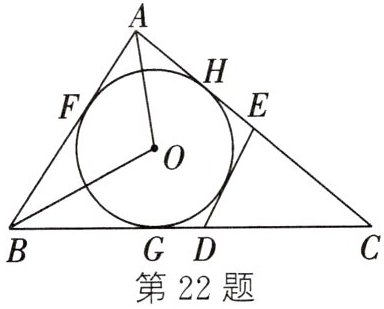
(1) 若$∠C=40^{\circ }$,求$∠AOB$的度数;
(2) 若$AC=8$,$AB=6$,$BC=9$,求$\triangle CDE$的周长.
答案:
解:
(1) $ \because \angle C = 40^\circ $,$\therefore \angle ABC + \angle BAC = 180^\circ - 40^\circ = 140^\circ$. $ \because \odot O $ 为 $ \triangle ABC $ 的内切圆,$\therefore \angle BAO = \angle CAO $,$\angle ABO = \angle CBO $,$\therefore \angle OAB + \angle OBA = \frac{1}{2} \times 140^\circ = 70^\circ$,$\therefore \angle AOB = 180^\circ - 70^\circ = 110^\circ$;
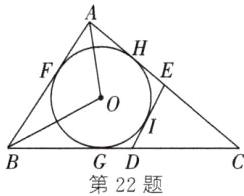
(2) $ \because \odot O $ 为 $ \triangle ABC $ 的内切圆,DE 为 $ \odot O $ 的切线,设切点为 I,$\therefore EH = EI $,$ DI = DG $,$\therefore \triangle CDE $ 的周长为: $ CD + CE + DE = CD + DI + CE + EI = CD + DG + CE + EH = CG + CH $. $ \because AF = AH $,$ BF = BG $,$ CG = CH $,$\therefore CG + CH = (AB + BC + AC) - (AH + AF + BF + BG) = 6 + 9 + 8 - 2AB = 6 + 9 + 8 - 2 \times 6 = 11 $.
解:
(1) $ \because \angle C = 40^\circ $,$\therefore \angle ABC + \angle BAC = 180^\circ - 40^\circ = 140^\circ$. $ \because \odot O $ 为 $ \triangle ABC $ 的内切圆,$\therefore \angle BAO = \angle CAO $,$\angle ABO = \angle CBO $,$\therefore \angle OAB + \angle OBA = \frac{1}{2} \times 140^\circ = 70^\circ$,$\therefore \angle AOB = 180^\circ - 70^\circ = 110^\circ$;
(2) $ \because \odot O $ 为 $ \triangle ABC $ 的内切圆,DE 为 $ \odot O $ 的切线,设切点为 I,$\therefore EH = EI $,$ DI = DG $,$\therefore \triangle CDE $ 的周长为: $ CD + CE + DE = CD + DI + CE + EI = CD + DG + CE + EH = CG + CH $. $ \because AF = AH $,$ BF = BG $,$ CG = CH $,$\therefore CG + CH = (AB + BC + AC) - (AH + AF + BF + BG) = 6 + 9 + 8 - 2AB = 6 + 9 + 8 - 2 \times 6 = 11 $.
23. (10分)如图,在$\triangle ABC$中,经过$A$,$B$两点的$\odot O$与边$BC$交于点$E$,圆心$O$在$BC$上,过点$O$作$OD⊥BC$交$\odot O$于点$D$,连接$AD$交$BC$于点$F$,$AC=FC$.
(1) 求证:$AC$与$\odot O$相切;
证明: $ \because OD \perp BC $,$\therefore \angle DOC = 90^\circ $,$\therefore \angle D + \angle OFD = 90^\circ $. $ \because \angle OFD = \angle AFC $,$\therefore \angle D + \angle AFC = 90^\circ $,在 $ \triangle AFC $ 中,$ AC = FC $,$\therefore \angle CAF = \angle AFC $,$\therefore \angle D + \angle CAF = 90^\circ $,又 $ \because OA = OD $,$\therefore \angle D = \angle OAD $,$\therefore \angle OAD + \angle CAF = 90^\circ $,即 $ \angle OAC = 90^\circ $,$\therefore OA \perp AC $,又 $ \because OA $ 为 $ \odot O $ 的半径,$\therefore AC $ 与 $ \odot O $ 相切.
(2) 若$OA=2$,$∠ABC=30^{\circ }$,求图中阴影部分的面积. (结果保留$π$).
解: $ \because \angle ABC = 30^\circ $,$\therefore \angle AOC = 2\angle ABC = 60^\circ $. $ \because \angle OAC = 90^\circ $,$\therefore \angle C = 30^\circ $,在 $ Rt\triangle AOC $ 中,$ OC = 2OA = 4 $,$ AC = \sqrt{OC^2 - OA^2} = 2\sqrt{3} $,则图中阴影部分的面积为: $ S_{Rt\triangle AOC} - S_{扇形OAE} = \frac{1}{2}OA \cdot AC - \frac{60\pi × OA^2}{360} = \frac{1}{2} × 2 × 2\sqrt{3} - \frac{\pi × 2^2}{6} = 2\sqrt{3} - \frac{2\pi}{3} $,答: 图中阴影部分的面积为 $
(1) 求证:$AC$与$\odot O$相切;
证明: $ \because OD \perp BC $,$\therefore \angle DOC = 90^\circ $,$\therefore \angle D + \angle OFD = 90^\circ $. $ \because \angle OFD = \angle AFC $,$\therefore \angle D + \angle AFC = 90^\circ $,在 $ \triangle AFC $ 中,$ AC = FC $,$\therefore \angle CAF = \angle AFC $,$\therefore \angle D + \angle CAF = 90^\circ $,又 $ \because OA = OD $,$\therefore \angle D = \angle OAD $,$\therefore \angle OAD + \angle CAF = 90^\circ $,即 $ \angle OAC = 90^\circ $,$\therefore OA \perp AC $,又 $ \because OA $ 为 $ \odot O $ 的半径,$\therefore AC $ 与 $ \odot O $ 相切.
(2) 若$OA=2$,$∠ABC=30^{\circ }$,求图中阴影部分的面积. (结果保留$π$).
解: $ \because \angle ABC = 30^\circ $,$\therefore \angle AOC = 2\angle ABC = 60^\circ $. $ \because \angle OAC = 90^\circ $,$\therefore \angle C = 30^\circ $,在 $ Rt\triangle AOC $ 中,$ OC = 2OA = 4 $,$ AC = \sqrt{OC^2 - OA^2} = 2\sqrt{3} $,则图中阴影部分的面积为: $ S_{Rt\triangle AOC} - S_{扇形OAE} = \frac{1}{2}OA \cdot AC - \frac{60\pi × OA^2}{360} = \frac{1}{2} × 2 × 2\sqrt{3} - \frac{\pi × 2^2}{6} = 2\sqrt{3} - \frac{2\pi}{3} $,答: 图中阴影部分的面积为 $
2\sqrt{3} - \frac{2\pi}{3}
$.
答案:
(1) 证明: $ \because OD \perp BC $,$\therefore \angle DOC = 90^\circ $,$\therefore \angle D + \angle OFD = 90^\circ $. $ \because \angle OFD = \angle AFC $,$\therefore \angle D + \angle AFC = 90^\circ $,在 $ \triangle AFC $ 中,$ AC = FC $,$\therefore \angle CAF = \angle AFC $,$\therefore \angle D + \angle CAF = 90^\circ $,又 $ \because OA = OD $,$\therefore \angle D = \angle OAD $,$\therefore \angle OAD + \angle CAF = 90^\circ $,即 $ \angle OAC = 90^\circ $,$\therefore OA \perp AC $,又 $ \because OA $ 为 $ \odot O $ 的半径,$\therefore AC $ 与 $ \odot O $ 相切.
(2) 解: $ \because \angle ABC = 30^\circ $,$\therefore \angle AOC = 2\angle ABC = 60^\circ $. $ \because \angle OAC = 90^\circ $,$\therefore \angle C = 30^\circ $,在 $ Rt\triangle AOC $ 中,$ OC = 2OA = 4 $,$ AC = \sqrt{OC^2 - OA^2} = 2\sqrt{3} $,则图中阴影部分的面积为: $ S_{Rt\triangle AOC} - S_{扇形OAE} = \frac{1}{2}OA \cdot AC - \frac{60\pi \times OA^2}{360} = \frac{1}{2} \times 2 \times 2\sqrt{3} - \frac{\pi \times 2^2}{6} = 2\sqrt{3} - \frac{2\pi}{3} $,答: 图中阴影部分的面积为 $ 2\sqrt{3} - \frac{2\pi}{3} $.
(1) 证明: $ \because OD \perp BC $,$\therefore \angle DOC = 90^\circ $,$\therefore \angle D + \angle OFD = 90^\circ $. $ \because \angle OFD = \angle AFC $,$\therefore \angle D + \angle AFC = 90^\circ $,在 $ \triangle AFC $ 中,$ AC = FC $,$\therefore \angle CAF = \angle AFC $,$\therefore \angle D + \angle CAF = 90^\circ $,又 $ \because OA = OD $,$\therefore \angle D = \angle OAD $,$\therefore \angle OAD + \angle CAF = 90^\circ $,即 $ \angle OAC = 90^\circ $,$\therefore OA \perp AC $,又 $ \because OA $ 为 $ \odot O $ 的半径,$\therefore AC $ 与 $ \odot O $ 相切.
(2) 解: $ \because \angle ABC = 30^\circ $,$\therefore \angle AOC = 2\angle ABC = 60^\circ $. $ \because \angle OAC = 90^\circ $,$\therefore \angle C = 30^\circ $,在 $ Rt\triangle AOC $ 中,$ OC = 2OA = 4 $,$ AC = \sqrt{OC^2 - OA^2} = 2\sqrt{3} $,则图中阴影部分的面积为: $ S_{Rt\triangle AOC} - S_{扇形OAE} = \frac{1}{2}OA \cdot AC - \frac{60\pi \times OA^2}{360} = \frac{1}{2} \times 2 \times 2\sqrt{3} - \frac{\pi \times 2^2}{6} = 2\sqrt{3} - \frac{2\pi}{3} $,答: 图中阴影部分的面积为 $ 2\sqrt{3} - \frac{2\pi}{3} $.
24. (10分)数学解题时类比是发现新问题、新结论的重要方法,是思维发展的重要途径.阅读下面材料,解答相关问题:
材料:对于一个关于$x$的二次三项式$ax^{2}+bx+c(a≠0)$,除了可以利用配方法求该多项式的取值范围外,还可以利用根的判别式解决问题,如下面例子:
例:求代数式$x^{2}+4x+5$的最小值;
| 方法1: | 方法2: |
| --- | --- |
| $x^{2}+4x+5=x^{2}+4x+4+1=(x+2)^{2}+1$. | 设$x^{2}+4x+5=y$. |
| $\because (x+2)^{2}≥0$,$\therefore (x+2)^{2}+1≥1$. | $\therefore$方程$x^{2}+4x+(5-y)=0$有实数根. |
| $\therefore$当$x=-2$时,$(x+2)^{2}+1$的最小值是$1$. | $\therefore b^{2}-4ac=16-4(5-y)≥0$,解得$y≥1$. |
| 则代数式$x^{2}+4x+5$的最小值为$1$. | 则代数式$x^{2}+4x+5$的最小值为$1$. |
请利用上述方法解决下列问题:
(1) 请选择上述一种方法求代数式$-x^{2}+4x-1$的最大值;
解:设$-x^{2}+4x-1=y$,$\therefore$方程$x^{2}-4x+(y+1)=0$有实数根,$\therefore b^{2}-4ac=16-4(y+1)≥0$,解得:$y≤3$,则代数式$-x^{2}+4x-1$的最大值为
(2) 请你根据方法2解决问题:若关于$x$的二次三项式:$x^{2}+ax+4$($a$为常数)的最小值为$-5$,求$a$的值.
解:设$x^{2}+ax+4=y$,$\therefore$方程$x^{2}+ax+(4-y)=0$有实数根,$\therefore b^{2}-4ac=a^{2}-4(4-y)≥0$,解得:$y≥\frac{1}{4}(16-a^{2})$,而$x^{2}+ax+4$($a$为常数)的最小值为$-5$,则$\frac{1}{4}(16-a^{2})=-5$,解得:$a=$
材料:对于一个关于$x$的二次三项式$ax^{2}+bx+c(a≠0)$,除了可以利用配方法求该多项式的取值范围外,还可以利用根的判别式解决问题,如下面例子:
例:求代数式$x^{2}+4x+5$的最小值;
| 方法1: | 方法2: |
| --- | --- |
| $x^{2}+4x+5=x^{2}+4x+4+1=(x+2)^{2}+1$. | 设$x^{2}+4x+5=y$. |
| $\because (x+2)^{2}≥0$,$\therefore (x+2)^{2}+1≥1$. | $\therefore$方程$x^{2}+4x+(5-y)=0$有实数根. |
| $\therefore$当$x=-2$时,$(x+2)^{2}+1$的最小值是$1$. | $\therefore b^{2}-4ac=16-4(5-y)≥0$,解得$y≥1$. |
| 则代数式$x^{2}+4x+5$的最小值为$1$. | 则代数式$x^{2}+4x+5$的最小值为$1$. |
请利用上述方法解决下列问题:
(1) 请选择上述一种方法求代数式$-x^{2}+4x-1$的最大值;
解:设$-x^{2}+4x-1=y$,$\therefore$方程$x^{2}-4x+(y+1)=0$有实数根,$\therefore b^{2}-4ac=16-4(y+1)≥0$,解得:$y≤3$,则代数式$-x^{2}+4x-1$的最大值为
3
;(2) 请你根据方法2解决问题:若关于$x$的二次三项式:$x^{2}+ax+4$($a$为常数)的最小值为$-5$,求$a$的值.
解:设$x^{2}+ax+4=y$,$\therefore$方程$x^{2}+ax+(4-y)=0$有实数根,$\therefore b^{2}-4ac=a^{2}-4(4-y)≥0$,解得:$y≥\frac{1}{4}(16-a^{2})$,而$x^{2}+ax+4$($a$为常数)的最小值为$-5$,则$\frac{1}{4}(16-a^{2})=-5$,解得:$a=$
6或-6
.
答案:
解:
(1) 设 $ -x^2 + 4x - 1 = y $,$\therefore $ 方程 $ x^2 - 4x + (y + 1) = 0 $ 有实数根,$\therefore b^2 - 4ac = 16 - 4(y + 1) \geq 0 $,解得: $ y \leq 3 $,则代数式 $ -x^2 + 4x - 1 $ 的最大值为 3;
(2) 设 $ x^2 + ax + 4 = y $,$\therefore $ 方程 $ x^2 + ax + (4 - y) = 0 $ 有实数根,$\therefore b^2 - 4ac = a^2 - 4(4 - y) \geq 0 $,解得: $ y \geq \frac{1}{4}(16 - a^2) $,而 $ x^2 + ax + 4 $ (a 为常数) 的最小值为 -5,则 $ \frac{1}{4}(16 - a^2) = -5 $,解得: $ a = 6 $ 或 -6.
(1) 设 $ -x^2 + 4x - 1 = y $,$\therefore $ 方程 $ x^2 - 4x + (y + 1) = 0 $ 有实数根,$\therefore b^2 - 4ac = 16 - 4(y + 1) \geq 0 $,解得: $ y \leq 3 $,则代数式 $ -x^2 + 4x - 1 $ 的最大值为 3;
(2) 设 $ x^2 + ax + 4 = y $,$\therefore $ 方程 $ x^2 + ax + (4 - y) = 0 $ 有实数根,$\therefore b^2 - 4ac = a^2 - 4(4 - y) \geq 0 $,解得: $ y \geq \frac{1}{4}(16 - a^2) $,而 $ x^2 + ax + 4 $ (a 为常数) 的最小值为 -5,则 $ \frac{1}{4}(16 - a^2) = -5 $,解得: $ a = 6 $ 或 -6.
查看更多完整答案,请扫码查看

