

 搜索
搜索
第46页
- 第1页
- 第2页
- 第3页
- 第4页
- 第5页
- 第6页
- 第7页
- 第8页
- 第9页
- 第10页
- 第11页
- 第12页
- 第13页
- 第14页
- 第15页
- 第16页
- 第17页
- 第18页
- 第19页
- 第20页
- 第21页
- 第22页
- 第23页
- 第24页
- 第25页
- 第26页
- 第27页
- 第28页
- 第29页
- 第30页
- 第31页
- 第32页
- 第33页
- 第34页
- 第35页
- 第36页
- 第37页
- 第38页
- 第39页
- 第40页
- 第41页
- 第42页
- 第43页
- 第44页
- 第45页
- 第46页
- 第47页
- 第48页
- 第49页
- 第50页
- 第51页
- 第52页
- 第53页
- 第54页
- 第55页
- 第56页
- 第57页
- 第58页
- 第59页
- 第60页
- 第61页
- 第62页
- 第63页
- 第64页
- 第65页
- 第66页
- 第67页
- 第68页
- 第69页
- 第70页
- 第71页
- 第72页
- 第73页
- 第74页
- 第75页
- 第76页
- 第77页
- 第78页
- 第79页
- 第80页
- 第81页
- 第82页
- 第83页
- 第84页
- 第85页
- 第86页
- 第87页
- 第88页
- 第89页
- 第90页
- 第91页
- 第92页
- 第93页
- 第94页
- 第95页
- 第96页
- 第97页
- 第98页
- 第99页
- 第100页
- 第101页
- 第102页
- 第103页
- 第104页
- 第105页
- 第106页
- 第107页
- 第108页
- 第109页
- 第110页
- 第111页
- 第112页
- 第113页
- 第114页
- 第115页
- 第116页
- 第117页
- 第118页
- 第119页
- 第120页
- 第121页
- 第122页
- 第123页
- 第124页
- 第125页
- 第126页
- 第127页
- 第128页
- 第129页
- 第130页
- 第131页
- 第132页
- 第133页
- 第134页
- 第135页
- 第136页
14.(8分)(1)若$|2x-4|+(y+3)^{2}+\sqrt {x+y+z}= 0$,求$x-2y+z$的平方根;
(2)先化简,再求值:$(\sqrt {2x}+\sqrt {y})(\sqrt {2x}-\sqrt {y})-(\sqrt {2x}-\sqrt {y})^{2}$,其中$x= \frac {3}{4},y= \frac {1}{2}$.
$\pm 3$
(2)先化简,再求值:$(\sqrt {2x}+\sqrt {y})(\sqrt {2x}-\sqrt {y})-(\sqrt {2x}-\sqrt {y})^{2}$,其中$x= \frac {3}{4},y= \frac {1}{2}$.
$\sqrt{3}-1$
答案:
[解]
(1)因为$\vert 2x - 4\vert + (y + 3)^{2} + \sqrt{x + y + z} = 0$,所以$2x - 4 = 0$,$y + 3 = 0$,$x + y + z = 0$,所以$x = 2$,$y = -3$,$z = 1$,所以$x - 2y + z = 2 + 6 + 1 = 9$,所以$x - 2y + z$的平方根为$\pm 3$。
(2)原式$ = (\sqrt{2x})^{2} - (\sqrt{y})^{2} - (\sqrt{2x} - \sqrt{y})^{2} = 2x - y - 2x + 2\sqrt{2xy} - y = 2\sqrt{2xy} - 2y$。当$x = \frac{3}{4}$,$y = \frac{1}{2}$时,原式$ = 2 \times \sqrt{2 \times \frac{3}{4} \times \frac{1}{2}} - 2 \times \frac{1}{2} = \sqrt{3} - 1$。
(1)因为$\vert 2x - 4\vert + (y + 3)^{2} + \sqrt{x + y + z} = 0$,所以$2x - 4 = 0$,$y + 3 = 0$,$x + y + z = 0$,所以$x = 2$,$y = -3$,$z = 1$,所以$x - 2y + z = 2 + 6 + 1 = 9$,所以$x - 2y + z$的平方根为$\pm 3$。
(2)原式$ = (\sqrt{2x})^{2} - (\sqrt{y})^{2} - (\sqrt{2x} - \sqrt{y})^{2} = 2x - y - 2x + 2\sqrt{2xy} - y = 2\sqrt{2xy} - 2y$。当$x = \frac{3}{4}$,$y = \frac{1}{2}$时,原式$ = 2 \times \sqrt{2 \times \frac{3}{4} \times \frac{1}{2}} - 2 \times \frac{1}{2} = \sqrt{3} - 1$。
15.(10分)已知$x= \frac {1}{3+2\sqrt {2}},y= \frac {1}{3-2\sqrt {2}}$.
(1)求$x^{2}+y^{2}+xy$的值;
(2)若x的小数部分是m,y的小数部分是n,求$(m+n)^{2026}-\sqrt [3]{(m-n)^{3}}$的值.
(1)求$x^{2}+y^{2}+xy$的值;
35
(2)若x的小数部分是m,y的小数部分是n,求$(m+n)^{2026}-\sqrt [3]{(m-n)^{3}}$的值.
$4\sqrt{2}-4$
答案:
[解]
(1)因为$x = \frac{1}{3 + 2\sqrt{2}} = \frac{3 - 2\sqrt{2}}{(3 + 2\sqrt{2})(3 - 2\sqrt{2})} = 3 - 2\sqrt{2}$,$y = \frac{1}{3 - 2\sqrt{2}} = \frac{3 + 2\sqrt{2}}{(3 + 2\sqrt{2})(3 - 2\sqrt{2})} = 3 + 2\sqrt{2}$,所以$x^{2} + y^{2} + xy = x^{2} + y^{2} + 2xy - xy = (x + y)^{2} - xy = (3 - 2\sqrt{2} + 3 + 2\sqrt{2})^{2} - (3 + 2\sqrt{2})(3 - 2\sqrt{2}) = 6^{2} - (9 - 8) = 36 - 1 = 35$。
(2)因为$4 < 8 < 9$,所以$\sqrt{4} < \sqrt{8} < \sqrt{9}$,即$2 < 2\sqrt{2} < 3$,所以$0 < 3 - 2\sqrt{2} < 1$,$5 < 3 + 2\sqrt{2} < 6$。由
(1)可知,$x = 3 - 2\sqrt{2}$,$y = 3 + 2\sqrt{2}$,所以$0 < x < 1$,$5 < y < 6$。因为$x$的小数部分是$m$,$y$的小数部分是$n$,所以$m = 3 - 2\sqrt{2}$,$n = 3 + 2\sqrt{2} - 5 = 2\sqrt{2} - 2$。所以$(m + n)^{2026} - \sqrt[3]{(m - n)^{3}} = (3 - 2\sqrt{2} + 2\sqrt{2} - 2)^{2026} - \sqrt[3]{(3 - 2\sqrt{2} - 2\sqrt{2} + 2)^{3}} = 1^{2026} - \sqrt[3]{(5 - 4\sqrt{2})^{3}} = 1 - (5 - 4\sqrt{2}) = 1 - 5 + 4\sqrt{2} = 4\sqrt{2} - 4$。
(1)因为$x = \frac{1}{3 + 2\sqrt{2}} = \frac{3 - 2\sqrt{2}}{(3 + 2\sqrt{2})(3 - 2\sqrt{2})} = 3 - 2\sqrt{2}$,$y = \frac{1}{3 - 2\sqrt{2}} = \frac{3 + 2\sqrt{2}}{(3 + 2\sqrt{2})(3 - 2\sqrt{2})} = 3 + 2\sqrt{2}$,所以$x^{2} + y^{2} + xy = x^{2} + y^{2} + 2xy - xy = (x + y)^{2} - xy = (3 - 2\sqrt{2} + 3 + 2\sqrt{2})^{2} - (3 + 2\sqrt{2})(3 - 2\sqrt{2}) = 6^{2} - (9 - 8) = 36 - 1 = 35$。
(2)因为$4 < 8 < 9$,所以$\sqrt{4} < \sqrt{8} < \sqrt{9}$,即$2 < 2\sqrt{2} < 3$,所以$0 < 3 - 2\sqrt{2} < 1$,$5 < 3 + 2\sqrt{2} < 6$。由
(1)可知,$x = 3 - 2\sqrt{2}$,$y = 3 + 2\sqrt{2}$,所以$0 < x < 1$,$5 < y < 6$。因为$x$的小数部分是$m$,$y$的小数部分是$n$,所以$m = 3 - 2\sqrt{2}$,$n = 3 + 2\sqrt{2} - 5 = 2\sqrt{2} - 2$。所以$(m + n)^{2026} - \sqrt[3]{(m - n)^{3}} = (3 - 2\sqrt{2} + 2\sqrt{2} - 2)^{2026} - \sqrt[3]{(3 - 2\sqrt{2} - 2\sqrt{2} + 2)^{3}} = 1^{2026} - \sqrt[3]{(5 - 4\sqrt{2})^{3}} = 1 - (5 - 4\sqrt{2}) = 1 - 5 + 4\sqrt{2} = 4\sqrt{2} - 4$。
16.(12分)情境题·生活应用 现有两块同样大小的长方形木板①,②,甲木工采用如图①所示的方式,在长方形木板①上截出三个面积分别为$4dm^{2},8dm^{2}和18dm^{2}$的正方形木板A,B,C.
(1)木板①中截出的正方形木板A的边长为
(2)求木板①中剩余部分(阴影部分)的面积;
(3)乙木工想采用如图②所示的方式,在长方形木板②上截出两个面积均为$16dm^{2}$的正方形木板,请你判断能否截出,并说明理由.
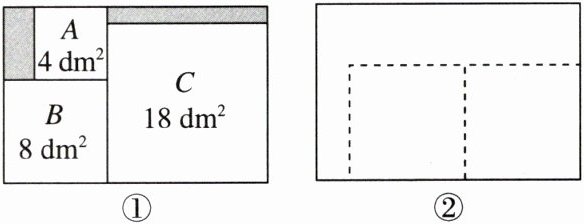
(1)木板①中截出的正方形木板A的边长为
2
dm,B的边长为$2\sqrt{2}$
dm,C的边长为$3\sqrt{2}$
dm;(2)求木板①中剩余部分(阴影部分)的面积;
(3)乙木工想采用如图②所示的方式,在长方形木板②上截出两个面积均为$16dm^{2}$的正方形木板,请你判断能否截出,并说明理由.
答案:
[解]
(1)$2$;$2\sqrt{2}$;$3\sqrt{2}$
(2)因为正方形木板$A$的边长为$2dm$,正方形木板$B$的边长为$2\sqrt{2}dm$,正方形木板$C$的边长为$3\sqrt{2}dm$,所以长方形木板①的长为$5\sqrt{2}dm$,宽为$(2 + 2\sqrt{2})dm$,所以剩余部分(阴影部分)的面积为$5\sqrt{2}(2 + 2\sqrt{2}) - 4 - 8 - 18 = (10\sqrt{2} - 10)(dm^{2})$。
(3)不能截出。
理由:因为$\sqrt{16} = 4(dm)$,$2 \times 4 = 8(dm)$,所以两个正方形木板放在一起的宽为$4dm$,长为$8dm$。由
(2)可得长方形木板的长为$5\sqrt{2}dm$,宽为$(2 + 2\sqrt{2})dm$。因为$2 + 2\sqrt{2} > 4$,但$5\sqrt{2} < 8$,所以不能截出。
(1)$2$;$2\sqrt{2}$;$3\sqrt{2}$
(2)因为正方形木板$A$的边长为$2dm$,正方形木板$B$的边长为$2\sqrt{2}dm$,正方形木板$C$的边长为$3\sqrt{2}dm$,所以长方形木板①的长为$5\sqrt{2}dm$,宽为$(2 + 2\sqrt{2})dm$,所以剩余部分(阴影部分)的面积为$5\sqrt{2}(2 + 2\sqrt{2}) - 4 - 8 - 18 = (10\sqrt{2} - 10)(dm^{2})$。
(3)不能截出。
理由:因为$\sqrt{16} = 4(dm)$,$2 \times 4 = 8(dm)$,所以两个正方形木板放在一起的宽为$4dm$,长为$8dm$。由
(2)可得长方形木板的长为$5\sqrt{2}dm$,宽为$(2 + 2\sqrt{2})dm$。因为$2 + 2\sqrt{2} > 4$,但$5\sqrt{2} < 8$,所以不能截出。
17.(12分)新视角 规律探究题 观察下列一组等式,然后解答问题:$(\sqrt {2}+1)(\sqrt {2}-1)= 1,(\sqrt {3}+\sqrt {2})(\sqrt {3}-\sqrt {2})= 1,(\sqrt {4}+\sqrt {3})(\sqrt {4}-\sqrt {3})= 1,(\sqrt {5}+\sqrt {4})(\sqrt {5}-\sqrt {4})= 1,... $.
(1)利用上面的规律,计算:$\frac {1}{\sqrt {2}+1}+\frac {1}{\sqrt {3}+\sqrt {2}}+\frac {1}{\sqrt {4}+\sqrt {3}}+... +\frac {1}{\sqrt {2025}+\sqrt {2024}}$=
(2)请利用上面的规律,比较$\sqrt {99}-\sqrt {98}与\sqrt {98}-\sqrt {97}$的大小.
(1)利用上面的规律,计算:$\frac {1}{\sqrt {2}+1}+\frac {1}{\sqrt {3}+\sqrt {2}}+\frac {1}{\sqrt {4}+\sqrt {3}}+... +\frac {1}{\sqrt {2025}+\sqrt {2024}}$=
44
;(2)请利用上面的规律,比较$\sqrt {99}-\sqrt {98}与\sqrt {98}-\sqrt {97}$的大小.
$\sqrt{99} - \sqrt{98} < \sqrt{98} - \sqrt{97}$
答案:
[解]
(1)原式$ = \frac{\sqrt{2} - 1}{(\sqrt{2} + 1)(\sqrt{2} - 1)} + \frac{\sqrt{3} - \sqrt{2}}{(\sqrt{3} + \sqrt{2})(\sqrt{3} - \sqrt{2})} + \frac{\sqrt{4} - \sqrt{3}}{(\sqrt{4} + \sqrt{3})(\sqrt{4} - \sqrt{3})} + \cdots + \frac{\sqrt{2025} - \sqrt{2024}}{(\sqrt{2025} + \sqrt{2024})(\sqrt{2025} - \sqrt{2024})} = \sqrt{2} - 1 + \sqrt{3} - \sqrt{2} + \sqrt{4} - \sqrt{3} + \cdots + \sqrt{2025} - \sqrt{2024} = -1 + \sqrt{2025} = 44$。
(2)$\sqrt{99} - \sqrt{98} = \frac{(\sqrt{99} + \sqrt{98})(\sqrt{99} - \sqrt{98})}{\sqrt{99} + \sqrt{98}} = \frac{1}{\sqrt{99} + \sqrt{98}}$,$\sqrt{98} - \sqrt{97} = \frac{(\sqrt{98} + \sqrt{97})(\sqrt{98} - \sqrt{97})}{\sqrt{98} + \sqrt{97}} = \frac{1}{\sqrt{98} + \sqrt{97}}$。因为$\frac{1}{\sqrt{99} + \sqrt{98}} < \frac{1}{\sqrt{98} + \sqrt{97}}$,所以$\sqrt{99} - \sqrt{98} < \sqrt{98} - \sqrt{97}$。
(1)原式$ = \frac{\sqrt{2} - 1}{(\sqrt{2} + 1)(\sqrt{2} - 1)} + \frac{\sqrt{3} - \sqrt{2}}{(\sqrt{3} + \sqrt{2})(\sqrt{3} - \sqrt{2})} + \frac{\sqrt{4} - \sqrt{3}}{(\sqrt{4} + \sqrt{3})(\sqrt{4} - \sqrt{3})} + \cdots + \frac{\sqrt{2025} - \sqrt{2024}}{(\sqrt{2025} + \sqrt{2024})(\sqrt{2025} - \sqrt{2024})} = \sqrt{2} - 1 + \sqrt{3} - \sqrt{2} + \sqrt{4} - \sqrt{3} + \cdots + \sqrt{2025} - \sqrt{2024} = -1 + \sqrt{2025} = 44$。
(2)$\sqrt{99} - \sqrt{98} = \frac{(\sqrt{99} + \sqrt{98})(\sqrt{99} - \sqrt{98})}{\sqrt{99} + \sqrt{98}} = \frac{1}{\sqrt{99} + \sqrt{98}}$,$\sqrt{98} - \sqrt{97} = \frac{(\sqrt{98} + \sqrt{97})(\sqrt{98} - \sqrt{97})}{\sqrt{98} + \sqrt{97}} = \frac{1}{\sqrt{98} + \sqrt{97}}$。因为$\frac{1}{\sqrt{99} + \sqrt{98}} < \frac{1}{\sqrt{98} + \sqrt{97}}$,所以$\sqrt{99} - \sqrt{98} < \sqrt{98} - \sqrt{97}$。
查看更多完整答案,请扫码查看

