

 搜索
搜索
第172页
- 第1页
- 第2页
- 第3页
- 第4页
- 第5页
- 第6页
- 第7页
- 第8页
- 第9页
- 第10页
- 第11页
- 第12页
- 第13页
- 第14页
- 第15页
- 第16页
- 第17页
- 第18页
- 第19页
- 第20页
- 第21页
- 第22页
- 第23页
- 第24页
- 第25页
- 第26页
- 第27页
- 第28页
- 第29页
- 第30页
- 第31页
- 第32页
- 第33页
- 第34页
- 第35页
- 第36页
- 第37页
- 第38页
- 第39页
- 第40页
- 第41页
- 第42页
- 第43页
- 第44页
- 第45页
- 第46页
- 第47页
- 第48页
- 第49页
- 第50页
- 第51页
- 第52页
- 第53页
- 第54页
- 第55页
- 第56页
- 第57页
- 第58页
- 第59页
- 第60页
- 第61页
- 第62页
- 第63页
- 第64页
- 第65页
- 第66页
- 第67页
- 第68页
- 第69页
- 第70页
- 第71页
- 第72页
- 第73页
- 第74页
- 第75页
- 第76页
- 第77页
- 第78页
- 第79页
- 第80页
- 第81页
- 第82页
- 第83页
- 第84页
- 第85页
- 第86页
- 第87页
- 第88页
- 第89页
- 第90页
- 第91页
- 第92页
- 第93页
- 第94页
- 第95页
- 第96页
- 第97页
- 第98页
- 第99页
- 第100页
- 第101页
- 第102页
- 第103页
- 第104页
- 第105页
- 第106页
- 第107页
- 第108页
- 第109页
- 第110页
- 第111页
- 第112页
- 第113页
- 第114页
- 第115页
- 第116页
- 第117页
- 第118页
- 第119页
- 第120页
- 第121页
- 第122页
- 第123页
- 第124页
- 第125页
- 第126页
- 第127页
- 第128页
- 第129页
- 第130页
- 第131页
- 第132页
- 第133页
- 第134页
- 第135页
- 第136页
- 第137页
- 第138页
- 第139页
- 第140页
- 第141页
- 第142页
- 第143页
- 第144页
- 第145页
- 第146页
- 第147页
- 第148页
- 第149页
- 第150页
- 第151页
- 第152页
- 第153页
- 第154页
- 第155页
- 第156页
- 第157页
- 第158页
- 第159页
- 第160页
- 第161页
- 第162页
- 第163页
- 第164页
- 第165页
- 第166页
- 第167页
- 第168页
- 第169页
- 第170页
- 第171页
- 第172页
- 第173页
- 第174页
- 第175页
- 第176页
17. (2025·南充)在矩形ABCD中,$AB = 10$,$AD = 17$,E是线段BC上异于点B的一个动点,连接AE,把$\triangle ABE$沿直线AE折叠,使点B落在点P处。
【初步感知】(1) 如图①,当E为BC的中点时,延长AP交CD于点F,求证:$FP = FC$。
【深入探究】(2) 如图②,点M在线段CD上,$CM = 4$。求在点E的移动过程中,PM长的最小值。
【拓展运用】(3) 如图②,点N在线段AD上,$AN = 4$。点E在移动过程中,点P在矩形内部,当$\triangle PDN$是以DN为斜边的直角三角形时,求BE的长。
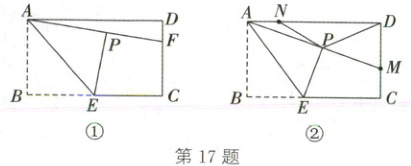
【初步感知】(1) 如图①,当E为BC的中点时,延长AP交CD于点F,求证:$FP = FC$。
【深入探究】(2) 如图②,点M在线段CD上,$CM = 4$。求在点E的移动过程中,PM长的最小值。
【拓展运用】(3) 如图②,点N在线段AD上,$AN = 4$。点E在移动过程中,点P在矩形内部,当$\triangle PDN$是以DN为斜边的直角三角形时,求BE的长。
答案:
(1) 连接$EF$。$\because$四边形$ABCD$为矩形,$\therefore \angle D = \angle B = \angle C = 90°$,$CD = AB = 10$。由折叠,可得$\angle APE = \angle B = 90°$,$PE = BE$,$\therefore \angle FPE = 90°$。$\because E$为$BC$的中点,$\therefore BE = EC$。$\therefore PE = EC$。在$Rt \triangle EPF$和$Rt \triangle ECF$中,$EP = EC$,$EF = EF$,$\therefore Rt \triangle EPF \cong Rt \triangle ECF$。$\therefore FP = FC$。
(2) 由折叠,可得$AP = AB = 10$,$\therefore$点$E$在移动过程中,$AP$的长不变。$\therefore$点$P$在以点$A$为圆心,$10$为半径的$\odot A$的弧上。连接$AM$,当点$P$在线段$AM$上时,$PM$长有最小值。$\because CM = 4$,$\therefore DM = 6$。$\therefore AM = \sqrt{AD^2 + DM^2} = \sqrt{17^2 + 6^2} = \sqrt{325} = 5\sqrt{13}$。$\therefore PM$长的最小值为$AM - AP = 5\sqrt{13} - 10$
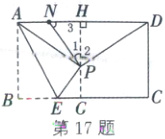
(3) 如图,过点$P$作$PH \perp AD$于点$H$,延长$HP$交$BC$于点$G$,$\therefore \angle NHP = 90°$。$\because \triangle PDN$是以$DN$为斜边的直角三角形,$\therefore \angle NPD = 90°$,即$\angle 1 + \angle 2 = 90°$。$\because \angle 1 + \angle 3 = 90°$,$\therefore \angle 3 = \angle 2$。$\because \angle PHN = \angle DHP = 90°$,$\therefore \triangle PHN \sim \triangle DHP$。$\therefore \frac{HP}{HD} = \frac{HN}{HP}$。$\therefore HP^2 = HN · HD$。$\because AN = 4$,$AD = 17$,$\therefore DN = 13$。设$HN = x$,则$HD = 13 - x$,$AH = x + 4$。$\therefore HP^2 = x(13 - x)$。$\because AP = 10$,$\therefore HP^2 = AP^2 - AH^2$,$\therefore HP^2 = 10^2 - (x + 4)^2$。$\therefore x(13 - x) = 10^2 - (x + 4)^2$,解得$x = 4$。$\therefore HP = 6$,$AH = 8$。$\because$易得四边形$ABGH$为矩形,$\therefore HG = AB = 10$,$BG = AH = 8$。$\therefore PG = 4$。设$BE = m$,则$PE = m$,$GE = 8 - m$。在$Rt \triangle PGE$中,$PE^2 = FG^2 + PG^2$,即$m^2 = (8 - m)^2 + 4^2$,解得$m = 5$。$\therefore BE = 5$。
(1) 连接$EF$。$\because$四边形$ABCD$为矩形,$\therefore \angle D = \angle B = \angle C = 90°$,$CD = AB = 10$。由折叠,可得$\angle APE = \angle B = 90°$,$PE = BE$,$\therefore \angle FPE = 90°$。$\because E$为$BC$的中点,$\therefore BE = EC$。$\therefore PE = EC$。在$Rt \triangle EPF$和$Rt \triangle ECF$中,$EP = EC$,$EF = EF$,$\therefore Rt \triangle EPF \cong Rt \triangle ECF$。$\therefore FP = FC$。
(2) 由折叠,可得$AP = AB = 10$,$\therefore$点$E$在移动过程中,$AP$的长不变。$\therefore$点$P$在以点$A$为圆心,$10$为半径的$\odot A$的弧上。连接$AM$,当点$P$在线段$AM$上时,$PM$长有最小值。$\because CM = 4$,$\therefore DM = 6$。$\therefore AM = \sqrt{AD^2 + DM^2} = \sqrt{17^2 + 6^2} = \sqrt{325} = 5\sqrt{13}$。$\therefore PM$长的最小值为$AM - AP = 5\sqrt{13} - 10$
(3) 如图,过点$P$作$PH \perp AD$于点$H$,延长$HP$交$BC$于点$G$,$\therefore \angle NHP = 90°$。$\because \triangle PDN$是以$DN$为斜边的直角三角形,$\therefore \angle NPD = 90°$,即$\angle 1 + \angle 2 = 90°$。$\because \angle 1 + \angle 3 = 90°$,$\therefore \angle 3 = \angle 2$。$\because \angle PHN = \angle DHP = 90°$,$\therefore \triangle PHN \sim \triangle DHP$。$\therefore \frac{HP}{HD} = \frac{HN}{HP}$。$\therefore HP^2 = HN · HD$。$\because AN = 4$,$AD = 17$,$\therefore DN = 13$。设$HN = x$,则$HD = 13 - x$,$AH = x + 4$。$\therefore HP^2 = x(13 - x)$。$\because AP = 10$,$\therefore HP^2 = AP^2 - AH^2$,$\therefore HP^2 = 10^2 - (x + 4)^2$。$\therefore x(13 - x) = 10^2 - (x + 4)^2$,解得$x = 4$。$\therefore HP = 6$,$AH = 8$。$\because$易得四边形$ABGH$为矩形,$\therefore HG = AB = 10$,$BG = AH = 8$。$\therefore PG = 4$。设$BE = m$,则$PE = m$,$GE = 8 - m$。在$Rt \triangle PGE$中,$PE^2 = FG^2 + PG^2$,即$m^2 = (8 - m)^2 + 4^2$,解得$m = 5$。$\therefore BE = 5$。
18. (2025·长春)如图,在$\triangle ABC$中,$\angle C = 90^{\circ}$,$AC = BC = 4$,D为边AC的中点,E为边AB上一动点,连接DE,将线段ED绕点E顺时针旋转$45^{\circ}$得到线段EF。
(1) 线段AB的长为
(2) 当$EF // AC$时,求AE的长;
(3) 当点F在BC上时,求证:$\triangle ADE \cong \triangle BEF$;
(4) 当点E到BC的距离是点F到BC距离的2倍时,直接写出AE的长。
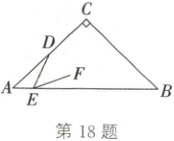
(1) 线段AB的长为
$4\sqrt{2}$
;(2) 当$EF // AC$时,求AE的长;
(3) 当点F在BC上时,求证:$\triangle ADE \cong \triangle BEF$;
(4) 当点E到BC的距离是点F到BC距离的2倍时,直接写出AE的长。
答案:
(1) $4\sqrt{2}$
(2) 如图①,在$\triangle ABC$中,$\angle C = 90^{\circ}$,$AC = BC = 4$,$D$为边$AC$的中点,$\therefore \angle A = \angle B = 45^{\circ}$,$AD = CD = 2$。$\because EF // AC$,$\therefore \angle FEB = \angle A = 45^{\circ}$。$\because$由题意,知$\angle DEF = 45^{\circ}$,$\therefore \angle DEB = 90^{\circ} = \angle AED$。$\therefore AE = AD · \cos 45^{\circ} = 2 × \frac{\sqrt{2}}{2} = \sqrt{2}$。
(3) $\because$将线段$ED$绕点$E$顺时针旋转$45^{\circ}$得到线段$EF$,$\therefore DE = EF$,$\angle DEF = 45^{\circ}$。如图②,$\because \angle A + \angle ADE = \angle DEB = \angle DEF + \angle BEF$,$\angle DEF = \angle A = 45^{\circ}$,$\therefore \angle ADE = \angle BEF$。$\because \angle A = \angle B = 45^{\circ}$,$DE = EF$,$\therefore \triangle ADE \cong \triangle BEF$
(4) 过点$E$作$EG \perp BC$于点$G$,过点$F$作$FQ \perp BC$于点$Q$,过点$D$作$DH \perp AB$于点$H$。① 当点$F$在$BC$的左边时,如图③,过点$F$作$FK \perp EG$于点$K$,$\therefore$易得四边形$FKGQ$为矩形。$\because EG = 2FQ$,$\therefore FQ = GK = EK$。易得$DH = AH = \sqrt{2}$。$\because EG \perp BC$,$\angle B = 45^{\circ}$,$\therefore \angle GEB = \angle B = 45^{\circ}$。$\therefore GB = GE = 2EK$。$\because \angle DEF = 45^{\circ}$,$\therefore \angle DEF + \angle GEB = 90^{\circ}$。$\because \angle DHE + \angle KEF = 90^{\circ}$。$\because \angle DHE = 90^{\circ}$,$\therefore \angle HDE + \angle HED = 90^{\circ}$。$\therefore \angle HDE = \angle KEF$。$\because DE = EF$,$\therefore \triangle DHE \cong \triangle EKF$。$\therefore DH = EK = \sqrt{2}$。$\therefore EG = BG = 2\sqrt{2}$。$\therefore BE = \sqrt{EG^2 + BG^2} = 4$。$\because AB = 4\sqrt{2}$,$\therefore AE = 4\sqrt{2} - 4$。② 当点$F$在$BC$的右边时,如图④,过点$F$作$FK \perp EG$,交$EG$的延长线于点$K$。同理①,可得$EK = DH = \sqrt{2}$。$\therefore$易得四边形$FKGQ$为矩形,$\therefore FQ = GK$。$\because GE = 2FQ$,$\therefore GE = 2GK$。$\therefore EG = \frac{2\sqrt{2}}{3}$。易得$EG = \frac{2\sqrt{2}}{3}$,$BG = \frac{2}{3}$。$\therefore BE = \sqrt{EG^2 + BG^2} = \frac{4}{3}$。$\because AB = 4\sqrt{2}$,$\therefore AE = 4\sqrt{2} - \frac{4}{3}$。综上所述,$AE$的长为$4\sqrt{2} - 4$或$4\sqrt{2} - \frac{4}{3}$。
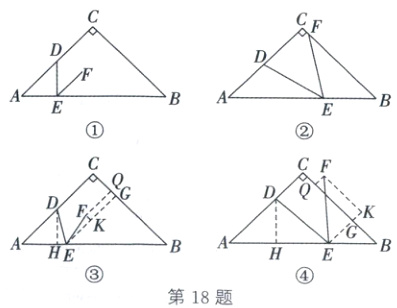
(1) $4\sqrt{2}$
(2) 如图①,在$\triangle ABC$中,$\angle C = 90^{\circ}$,$AC = BC = 4$,$D$为边$AC$的中点,$\therefore \angle A = \angle B = 45^{\circ}$,$AD = CD = 2$。$\because EF // AC$,$\therefore \angle FEB = \angle A = 45^{\circ}$。$\because$由题意,知$\angle DEF = 45^{\circ}$,$\therefore \angle DEB = 90^{\circ} = \angle AED$。$\therefore AE = AD · \cos 45^{\circ} = 2 × \frac{\sqrt{2}}{2} = \sqrt{2}$。
(3) $\because$将线段$ED$绕点$E$顺时针旋转$45^{\circ}$得到线段$EF$,$\therefore DE = EF$,$\angle DEF = 45^{\circ}$。如图②,$\because \angle A + \angle ADE = \angle DEB = \angle DEF + \angle BEF$,$\angle DEF = \angle A = 45^{\circ}$,$\therefore \angle ADE = \angle BEF$。$\because \angle A = \angle B = 45^{\circ}$,$DE = EF$,$\therefore \triangle ADE \cong \triangle BEF$
(4) 过点$E$作$EG \perp BC$于点$G$,过点$F$作$FQ \perp BC$于点$Q$,过点$D$作$DH \perp AB$于点$H$。① 当点$F$在$BC$的左边时,如图③,过点$F$作$FK \perp EG$于点$K$,$\therefore$易得四边形$FKGQ$为矩形。$\because EG = 2FQ$,$\therefore FQ = GK = EK$。易得$DH = AH = \sqrt{2}$。$\because EG \perp BC$,$\angle B = 45^{\circ}$,$\therefore \angle GEB = \angle B = 45^{\circ}$。$\therefore GB = GE = 2EK$。$\because \angle DEF = 45^{\circ}$,$\therefore \angle DEF + \angle GEB = 90^{\circ}$。$\because \angle DHE + \angle KEF = 90^{\circ}$。$\because \angle DHE = 90^{\circ}$,$\therefore \angle HDE + \angle HED = 90^{\circ}$。$\therefore \angle HDE = \angle KEF$。$\because DE = EF$,$\therefore \triangle DHE \cong \triangle EKF$。$\therefore DH = EK = \sqrt{2}$。$\therefore EG = BG = 2\sqrt{2}$。$\therefore BE = \sqrt{EG^2 + BG^2} = 4$。$\because AB = 4\sqrt{2}$,$\therefore AE = 4\sqrt{2} - 4$。② 当点$F$在$BC$的右边时,如图④,过点$F$作$FK \perp EG$,交$EG$的延长线于点$K$。同理①,可得$EK = DH = \sqrt{2}$。$\therefore$易得四边形$FKGQ$为矩形,$\therefore FQ = GK$。$\because GE = 2FQ$,$\therefore GE = 2GK$。$\therefore EG = \frac{2\sqrt{2}}{3}$。易得$EG = \frac{2\sqrt{2}}{3}$,$BG = \frac{2}{3}$。$\therefore BE = \sqrt{EG^2 + BG^2} = \frac{4}{3}$。$\because AB = 4\sqrt{2}$,$\therefore AE = 4\sqrt{2} - \frac{4}{3}$。综上所述,$AE$的长为$4\sqrt{2} - 4$或$4\sqrt{2} - \frac{4}{3}$。
查看更多完整答案,请扫码查看

