

 搜索
搜索
第112页
- 第1页
- 第2页
- 第3页
- 第4页
- 第5页
- 第6页
- 第7页
- 第8页
- 第9页
- 第10页
- 第11页
- 第12页
- 第13页
- 第14页
- 第15页
- 第16页
- 第17页
- 第18页
- 第19页
- 第20页
- 第21页
- 第22页
- 第23页
- 第24页
- 第25页
- 第26页
- 第27页
- 第28页
- 第29页
- 第30页
- 第31页
- 第32页
- 第33页
- 第34页
- 第35页
- 第36页
- 第37页
- 第38页
- 第39页
- 第40页
- 第41页
- 第42页
- 第43页
- 第44页
- 第45页
- 第46页
- 第47页
- 第48页
- 第49页
- 第50页
- 第51页
- 第52页
- 第53页
- 第54页
- 第55页
- 第56页
- 第57页
- 第58页
- 第59页
- 第60页
- 第61页
- 第62页
- 第63页
- 第64页
- 第65页
- 第66页
- 第67页
- 第68页
- 第69页
- 第70页
- 第71页
- 第72页
- 第73页
- 第74页
- 第75页
- 第76页
- 第77页
- 第78页
- 第79页
- 第80页
- 第81页
- 第82页
- 第83页
- 第84页
- 第85页
- 第86页
- 第87页
- 第88页
- 第89页
- 第90页
- 第91页
- 第92页
- 第93页
- 第94页
- 第95页
- 第96页
- 第97页
- 第98页
- 第99页
- 第100页
- 第101页
- 第102页
- 第103页
- 第104页
- 第105页
- 第106页
- 第107页
- 第108页
- 第109页
- 第110页
- 第111页
- 第112页
- 第113页
- 第114页
- 第115页
- 第116页
- 第117页
- 第118页
- 第119页
- 第120页
- 第121页
- 第122页
- 第123页
- 第124页
- 第125页
- 第126页
- 第127页
- 第128页
- 第129页
- 第130页
- 第131页
- 第132页
- 第133页
- 第134页
- 第135页
- 第136页
- 第137页
- 第138页
- 第139页
- 第140页
- 第141页
- 第142页
- 第143页
- 第144页
- 第145页
- 第146页
- 第147页
- 第148页
- 第149页
- 第150页
- 第151页
- 第152页
- 第153页
- 第154页
- 第155页
- 第156页
- 第157页
- 第158页
- 第159页
- 第160页
- 第161页
- 第162页
- 第163页
- 第164页
- 第165页
- 第166页
- 第167页
- 第168页
- 第169页
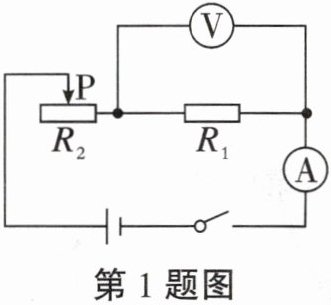
1. 如图所示,电源电压保持6V不变,电流表的量程为0~0.6A,电压表的量程为0~3V,定值电阻的规格为“10Ω 0.5A”,滑动变阻器的规格为“20Ω 1A”。闭合开关,为了保证电路安全,在滑动变阻器滑片移动的过程中,下列说法正确的是(
D
)A. 定值电阻两端允许加的电压最大值为5V B. 电流表允许通过的最大电流为0.5A C. 滑动变阻器接入电路的阻值最小为2Ω D. 滑动变阻器两端允许加的电压最小值为3V
答案:
D
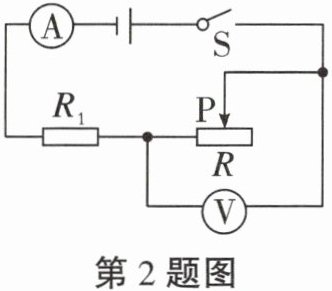
2. 如图所示的电路,电源电压为18V且保持不变,定值电阻$R_1$的阻值为12Ω,滑动变阻器R的规格为“100Ω 1A”,电流表的量程为0~0.6A,电压表的量程为0~15V,该电路工作时,要求各元件均安全。闭合开关S,在滑动变阻器R的滑片P滑动的过程中,电压表示数的变化范围是
10.8~15V
,电流表示数的变化范围是0.25~0.6A
,滑动变阻器R连入电路的阻值范围是18~60Ω
。
答案:
10.8~15V 0.25~0.6A 18~60Ω
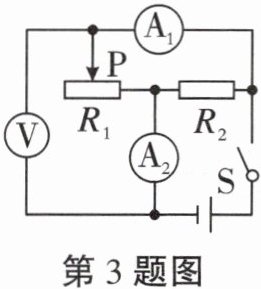
3. 如图所示的电路,电源电压恒定不变,定值电阻$R_2$的阻值为20Ω,电流表$A_1和A_2$的量程均为0~0.6A。闭合开关S,当滑动变阻器$R_1$的滑片从最左端向右移动的过程中,两个电流表的示数之差始终为0.2A,则电压表的示数为
4
V,滑动变阻器$R_1$允许接入电路的最小阻值为10
Ω。
答案:
4 10
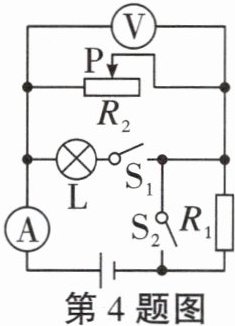
4. 如图所示,小灯泡L的额定电压为12V,定值电阻$R_1$的阻值为8Ω,滑动变阻器$R_2$上标有“40Ω 2A”的字样。闭合$S_1$、$S_2$,小灯泡L正常发光,此时通过小灯泡的电流为0.6A。电流表、电压表的量程分别为0~3A、0~15V,电路均在安全范围内工作。(1)求小灯泡正常发光时的电阻;(2)闭合$S_1$、$S_2$,移动滑动变阻器的滑片,求滑动变阻器允许接入电路的阻值范围;(3)断开$S_1$、$S_2$,若用一个电压可调的电源去替代原来的电源,电流表、电压表的量程分别为0~0.6A、0~3V。通过移动滑动变阻器的滑片,使两个电表均能达到各自的满刻度,且电路正常工作,求电源电压的可调范围。_____
答案:
 解:
解:
(1)小灯泡正常发光时的电阻:$R_L= \frac{U}{I_L}= \frac{12\mathrm{V}}{0.6\mathrm{A}}= 20\Omega$;
(2)闭合$S_1$、$S_2$,L与$R_2$并联,电流表测干路电流,电流表的量程为0~3A,则通过$R_2$的最大电流:$I_R= I-I_L= 3\mathrm{A}-0.6\mathrm{A}= 2.4\mathrm{A}>2\mathrm{A}$,故$R_2$允许通过的最大电流为2A,则滑动变阻器接入电路的最小电阻:$R_小= \frac{U}{I_大}= \frac{12\mathrm{V}}{2\mathrm{A}}= 6\Omega$,故滑动变阻器允许接入电路的阻值范围为6~40Ω;
(3)断开$S_1$、$S_2$,$R_1与R_2$串联,电压表测$R_2$两端电压,当电路中电流表达到最大值$I_1= 0.6\mathrm{A}$,且变阻器接入电路的阻值为0时,电源电压最小,为$U_小= I_1R_1= 0.6\mathrm{A}×8\Omega=4.8\mathrm{V}$,当电压表的示数最大,即$U_2'= 3\mathrm{V}$,且变阻器接入电路的阻值最大为40Ω时,电路中的电流:$I_2'= \frac{U_2'}{R_2}= \frac{3\mathrm{V}}{40\Omega}=0.075\mathrm{A}$,此时电源电压:$U'= U_1+U_2'= I_2'R_1+U_2'= 0.075\mathrm{A}×8\Omega+3\mathrm{V}= 3.6\mathrm{V}<4.8\mathrm{V}$,电流表不能达到最大值,故不符合题意;当$I_1= 0.6\mathrm{A}$,$U_2'= 3\mathrm{V}$时,则电源电压最大,为$U_大= U_1'+U_2'= I_1R_1+U_2'= 0.6\mathrm{A}×8\Omega+3\mathrm{V}= 7.8\mathrm{V}$,综上,电源电压的可调范围为4.8~7.8V。
解:(1)小灯泡正常发光时的电阻:$R_L= \frac{U}{I_L}= \frac{12\mathrm{V}}{0.6\mathrm{A}}= 20\Omega$;
(2)闭合$S_1$、$S_2$,L与$R_2$并联,电流表测干路电流,电流表的量程为0~3A,则通过$R_2$的最大电流:$I_R= I-I_L= 3\mathrm{A}-0.6\mathrm{A}= 2.4\mathrm{A}>2\mathrm{A}$,故$R_2$允许通过的最大电流为2A,则滑动变阻器接入电路的最小电阻:$R_小= \frac{U}{I_大}= \frac{12\mathrm{V}}{2\mathrm{A}}= 6\Omega$,故滑动变阻器允许接入电路的阻值范围为6~40Ω;
(3)断开$S_1$、$S_2$,$R_1与R_2$串联,电压表测$R_2$两端电压,当电路中电流表达到最大值$I_1= 0.6\mathrm{A}$,且变阻器接入电路的阻值为0时,电源电压最小,为$U_小= I_1R_1= 0.6\mathrm{A}×8\Omega=4.8\mathrm{V}$,当电压表的示数最大,即$U_2'= 3\mathrm{V}$,且变阻器接入电路的阻值最大为40Ω时,电路中的电流:$I_2'= \frac{U_2'}{R_2}= \frac{3\mathrm{V}}{40\Omega}=0.075\mathrm{A}$,此时电源电压:$U'= U_1+U_2'= I_2'R_1+U_2'= 0.075\mathrm{A}×8\Omega+3\mathrm{V}= 3.6\mathrm{V}<4.8\mathrm{V}$,电流表不能达到最大值,故不符合题意;当$I_1= 0.6\mathrm{A}$,$U_2'= 3\mathrm{V}$时,则电源电压最大,为$U_大= U_1'+U_2'= I_1R_1+U_2'= 0.6\mathrm{A}×8\Omega+3\mathrm{V}= 7.8\mathrm{V}$,综上,电源电压的可调范围为4.8~7.8V。
查看更多完整答案,请扫码查看

