

 搜索
搜索
2026年金考卷中考试题汇编45套数学山东专版
注:目前有些书本章节名称可能整理的还不是很完善,但都是按照顺序排列的,请同学们按照顺序仔细查找。练习册 2026年金考卷中考试题汇编45套数学山东专版 答案主要是用来给同学们做完题方便对答案用的,请勿直接抄袭。
第41页
- 第1页
- 第2页
- 第3页
- 第4页
- 第5页
- 第6页
- 第7页
- 第8页
- 第9页
- 第10页
- 第11页
- 第12页
- 第13页
- 第14页
- 第15页
- 第16页
- 第17页
- 第18页
- 第19页
- 第20页
- 第21页
- 第22页
- 第23页
- 第24页
- 第25页
- 第26页
- 第27页
- 第28页
- 第29页
- 第30页
- 第31页
- 第32页
- 第33页
- 第34页
- 第35页
- 第36页
- 第37页
- 第38页
- 第39页
- 第40页
- 第41页
- 第42页
- 第43页
- 第44页
- 第45页
- 第46页
- 第47页
- 第48页
- 第49页
- 第50页
- 第51页
- 第52页
- 第53页
- 第54页
- 第55页
- 第56页
- 第57页
- 第58页
- 第59页
- 第60页
- 第61页
- 第62页
- 第63页
- 第64页
- 第65页
- 第66页
- 第67页
- 第68页
- 第69页
- 第70页
- 第71页
- 第72页
- 第73页
- 第74页
- 第75页
- 第76页
- 第77页
- 第78页
- 第79页
- 第80页
- 第81页
- 第82页
- 第83页
- 第84页
- 第85页
- 第86页
- 第87页
- 第88页
- 第89页
- 第90页
- 第91页
- 第92页
- 第93页
- 第94页
- 第95页
- 第96页
- 第97页
- 第98页
- 第99页
- 第100页
- 第101页
- 第102页
- 第103页
- 第104页
- 第105页
- 第106页
- 第107页
- 第108页
- 第109页
- 第110页
- 第111页
- 第112页
- 第113页
- 第114页
- 第115页
- 第116页
- 第117页
- 第118页
- 第119页
- 第120页
21. (本小题满分12分)
如图,某学校教学楼AB和市创业大厦CD之间矗立着一座小山. 为了测得大厦的高度,小伟首先登至小山的最高处E,测得B,D处的俯角分别为68.5°,27.7°;然后操控无人机铅直起飞至比E处高20 m的F处,再次测得这两处的俯角分别为70.8°,33.3°. 已知点A,B,C,D,E,F均在同一平面内,AC为水平地面,AB = 12 m. 请求出大厦CD的高度(结果精确到0.1 m,参考数据见下表).
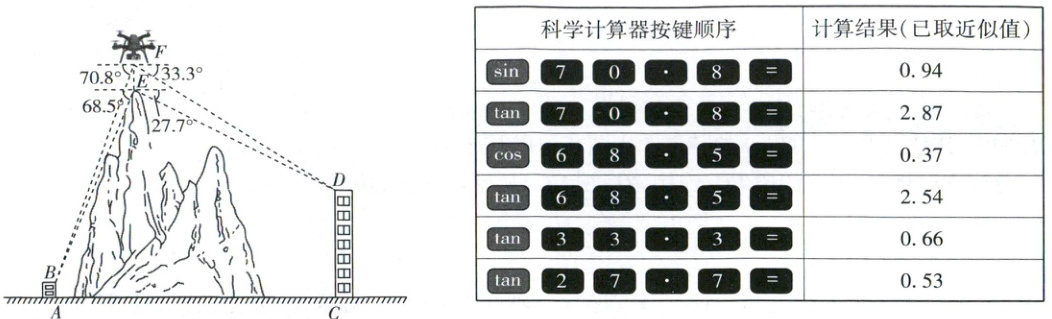
如图,某学校教学楼AB和市创业大厦CD之间矗立着一座小山. 为了测得大厦的高度,小伟首先登至小山的最高处E,测得B,D处的俯角分别为68.5°,27.7°;然后操控无人机铅直起飞至比E处高20 m的F处,再次测得这两处的俯角分别为70.8°,33.3°. 已知点A,B,C,D,E,F均在同一平面内,AC为水平地面,AB = 12 m. 请求出大厦CD的高度(结果精确到0.1 m,参考数据见下表).
答案:
III21 如图,延长$FE$交地面于点$G$,过点$B$作$BM\bot FG$于点$M$,过点$D$作$DN\bot FG$于点$N$,
则四边形$ABMG,CDNG$是矩形,
$\therefore GM=AB=12m$,$CD=NG$.
在$Rt\triangle BME$中,$\angle EBM=68.5^{\circ}$.
$\because \tan\angle EBM=\frac{EM}{BM}$,
$\therefore BM=\frac{EM}{\tan\angle EBM}$.
在$Rt\triangle BMF$中,$\angle FBM=70.8^{\circ}$.
$\because \tan\angle FBM=\frac{FM}{BM}$,
$\therefore BM=\frac{FM}{\tan\angle FBM}$,
$\therefore \frac{EM}{\tan\angle EBM}=\frac{FM}{\tan\angle FBM}$,即$\frac{FM-20}{2.54}\approx\frac{FM}{2.87}$,
解得$FM\approx173.94m$.
同理:$\frac{EN}{\tan\angle EDN}=\frac{FN}{\tan\angle FDN}$,即$\frac{FN-20}{0.53}\approx\frac{FN}{0.66}$,
解得$FN\approx101.54m$,
$\therefore CD=NG=FM+MG-FN\approx173.94+12-101.54=84.4(m)$.
答:大厦$CD$的高度约为$84.4m$.
则四边形$ABMG,CDNG$是矩形,
$\therefore GM=AB=12m$,$CD=NG$.
在$Rt\triangle BME$中,$\angle EBM=68.5^{\circ}$.
$\because \tan\angle EBM=\frac{EM}{BM}$,
$\therefore BM=\frac{EM}{\tan\angle EBM}$.
在$Rt\triangle BMF$中,$\angle FBM=70.8^{\circ}$.
$\because \tan\angle FBM=\frac{FM}{BM}$,
$\therefore BM=\frac{FM}{\tan\angle FBM}$,
$\therefore \frac{EM}{\tan\angle EBM}=\frac{FM}{\tan\angle FBM}$,即$\frac{FM-20}{2.54}\approx\frac{FM}{2.87}$,
解得$FM\approx173.94m$.
同理:$\frac{EN}{\tan\angle EDN}=\frac{FN}{\tan\angle FDN}$,即$\frac{FN-20}{0.53}\approx\frac{FN}{0.66}$,
解得$FN\approx101.54m$,
$\therefore CD=NG=FM+MG-FN\approx173.94+12-101.54=84.4(m)$.
答:大厦$CD$的高度约为$84.4m$.
22. (本小题满分13分)
如图,一条抛物线y = ax² + bx + $\frac{5}{2}$与x轴相交于A(-1,0),B(5,0)两点,与y轴相交于点C.
(1)求抛物线对应的函数表达式.
(2)问在抛物线上是否存在点P,使得∠ABC = $\frac{1}{2}$∠PAB?若存在,求出点P的坐标;若不存在,说明理由.
(3)将射线CB绕点C逆时针旋转一定角度,使其恰好经过抛物线的顶点D,再将抛物线沿直线CD平移,得到一条新的抛物线(其顶点为M). 设这两条抛物线的交点为Q.
①求旋转角度的正切值;
②当∠CQM = 90°时,求原抛物线平移的距离.

如图,一条抛物线y = ax² + bx + $\frac{5}{2}$与x轴相交于A(-1,0),B(5,0)两点,与y轴相交于点C.
(1)求抛物线对应的函数表达式.
(2)问在抛物线上是否存在点P,使得∠ABC = $\frac{1}{2}$∠PAB?若存在,求出点P的坐标;若不存在,说明理由.
(3)将射线CB绕点C逆时针旋转一定角度,使其恰好经过抛物线的顶点D,再将抛物线沿直线CD平移,得到一条新的抛物线(其顶点为M). 设这两条抛物线的交点为Q.
①求旋转角度的正切值;
②当∠CQM = 90°时,求原抛物线平移的距离.
答案:
III22
(1)抛物线$y=ax^{2}+bx+\frac{5}{2}$与$x$轴相交于$A(-1,0),B(5,0)$两点,将点$A,B$的坐标分别代入$y=ax^{2}+bx+\frac{5}{2}$,
得$\begin{cases}a×(-1)^{2}+b×(-1)+\frac{5}{2}=0,\\a×5^{2}+b×5+\frac{5}{2}=0,\end{cases}$
解得$\begin{cases}a=-\frac{1}{2},\\b=2,\end{cases}$
$\therefore$抛物线的函数表达式为$y=-\frac{1}{2}x^{2}+2x+\frac{5}{2}$.
(2)存在.
对于$y=-\frac{1}{2}x^{2}+2x+\frac{5}{2}$,当$x=0$时,$y=\frac{5}{2}$,
$\therefore C(0,\frac{5}{2})$.
如图
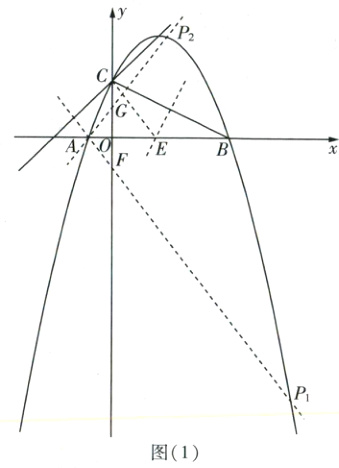
(1),设线段$BC$的垂直平分线交$x$轴于点$E$,连接$CE$,则$CE=BE$,
$\therefore \angle ECB=\angle ABC$,
$\therefore \angle AEC=\angle ABC+\angle BCE=2\angle ABC$.
$\because B(5,0),C(0,\frac{5}{2})$,
$\therefore OB=5,OC=\frac{5}{2}$.
设$OE=m$,则$CE=BE=5-m$,
在$Rt\triangle COE$中,由勾股定理,得$m^{2}+(\frac{5}{2})^{2}=(5-m)^{2}$,
解得$m=\frac{15}{8}$,
$\therefore E(\frac{15}{8},0)$.
设直线$CE$的函数表达式为$y=kx+\frac{5}{2}$,把$E(\frac{15}{8},0)$代入,
得$0=\frac{15}{8}k+\frac{5}{2}$,解得$k=-\frac{4}{3}$,
$\therefore y=-\frac{4}{3}x+\frac{5}{2}$.
过点$A$作$AP_{1}// CE$,交$y$轴于点$F$,交抛物线于点$P_{1}$,则$\angle P_{1}AB=\angle CEA=2\angle ABC$.
设直线$AP_{1}$的函数表达式为$y=-\frac{4}{3}x+n$,把$A(-1,0)$代入,得$0=-\frac{4}{3}×(-1)+n$,解得$n=-\frac{4}{3}$,
$\therefore y=-\frac{4}{3}x-\frac{4}{3}$.
令$-\frac{4}{3}x-\frac{4}{3}=-\frac{1}{2}x^{2}+2x+\frac{5}{2}$,
解得$x_{1}=\frac{23}{3}$,$x_{2}=-1$,
当$x=\frac{23}{3}$时,$y=-\frac{104}{9}$,
$\therefore P_{1}(\frac{23}{3},-\frac{104}{9})$.
对于$y=-\frac{4}{3}x-\frac{4}{3}$,当$x=0$时,$y=-\frac{4}{3}$,
$\therefore F(0,-\frac{4}{3})$.
作点$F$关于$x$轴的对称点$G$,连接$AG$,则$G(0,\frac{4}{3})$,$\angle GAB=2\angle ABC$,
$\therefore$直线$AG$与抛物线的交点也满足题意.
结合点$A$的坐标,同上可得直线$AG$的函数表达式为$y=\frac{4}{3}x+\frac{4}{3}$,设直线$AG$交抛物线$y=-\frac{1}{2}x^{2}+2x+\frac{5}{2}$于点$P_{2}$,
令$-\frac{1}{2}x^{2}+2x+\frac{5}{2}=\frac{4}{3}x+\frac{4}{3}$,
解得$x_{1}=\frac{7}{3}$,$x_{2}=-1$,
当$x=\frac{7}{3}$时,$y=\frac{40}{9}$,
$\therefore P_{2}(\frac{7}{3},\frac{40}{9})$.
综上,点$P$的坐标为$(\frac{23}{3},-\frac{104}{9})$或$(\frac{7}{3},\frac{40}{9})$.
(3)①$\because y=-\frac{1}{2}x^{2}+2x+\frac{5}{2}=-\frac{1}{2}(x-2)^{2}+\frac{9}{2}$,
$\therefore D(2,\frac{9}{2})$.
$\because B(5,0),C(0,\frac{5}{2})$,
$\therefore BC=\sqrt{5^{2}+(\frac{5}{2})^{2}}=\frac{5\sqrt{5}}{2}$,$CD=\sqrt{2^{2}+2^{2}}=2\sqrt{2}$.
易得直线$BC$的函数表达式为$y=-\frac{1}{2}x+\frac{5}{2}$.
如图
(2),连接$BD$,过点$D$作$x$轴的垂线,交$BC$于点$H$,过点$B$作$CD$的垂线,垂足为点$I$.

对于$y=-\frac{1}{2}x+\frac{5}{2}$,当$x=2$时,$y=\frac{3}{2}$,
$\therefore H(2,\frac{3}{2})$,$\therefore DH=3$,
$\therefore S_{\triangle BCD}=\frac{1}{2}OB· DH=\frac{1}{2}CD· BI$,
$\therefore \frac{1}{2}×5×3=\frac{1}{2}×2\sqrt{2}· BI$,$\therefore BI=\frac{15\sqrt{2}}{4}$,
$\therefore CI=\sqrt{(\frac{5\sqrt{5}}{2})^{2}-(\frac{15\sqrt{2}}{4})^{2}}=\frac{5\sqrt{2}}{4}$,
$\therefore \tan\angle BCD=\frac{BI}{CI}=3$.
②过点$D$作$x$轴的垂线,过点$C$作$y$轴的垂线,两垂线交于点$J$,则$DJ=CJ=2$,
$\therefore$抛物线在水平方向和竖直方向上的移动距离相等.
设将抛物线向右和向上分别平移$t(t>0)$个单位,得到新的抛物线,则新抛物线的函数表达式为$y=-\frac{1}{2}(x-2-t)^{2}+\frac{9}{2}+t$,
$\therefore M(2+t,\frac{9}{2}+t)$.
令$-\frac{1}{2}(x-2-t)^{2}+\frac{9}{2}+t=-\frac{1}{2}(x-2)^{2}+\frac{9}{2}$,
解得$x=\frac{t+2}{2}$,
对于$y=-\frac{1}{2}(x-2-t)^{2}+\frac{9}{2}+t$,当$x=\frac{t+2}{2}$时,$y=-\frac{t^{2}}{8}+\frac{t}{2}+4$,
$\therefore Q(\frac{t+2}{2},-\frac{t^{2}}{8}+\frac{t}{2}+4)$.
如图
(3),过点$Q$作$QK\bot y$轴于点$K$,过点$M$作$ML\bot QK$交$QK$的延长线于点$L$,
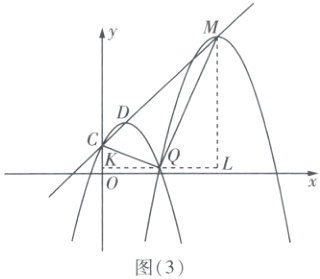
$\therefore \angle CKQ=\angle MLQ=90^{\circ}=\angle CQM$,$CK=\frac{5}{2}-(-\frac{t^{2}}{8}+\frac{t}{2}+4)=-\frac{t^{2}}{8}-\frac{t}{2}-\frac{3}{2}$,$QK=\frac{t+2}{2}$,$QL=\frac{t+2}{2}-\frac{t}{2}=1$,$LM=\frac{9}{2}+t+\frac{t^{2}}{8}-\frac{t}{2}+\frac{1}{2}=\frac{t^{2}}{8}+\frac{t}{2}+\frac{1}{2}$,
$\therefore \angle CQM=90^{\circ}-\angle MQL=\angle QML$,
$\therefore \triangle CKQ\backsim \triangle QLM$(点拨:“一线三直角”相似模型),
$\therefore \frac{CK}{QL}=\frac{QK}{LM}$,
$\therefore CK· LM=QL· QK$,
$\therefore (-\frac{t^{2}}{8}-\frac{t}{2}-\frac{3}{2})· (\frac{t^{2}}{8}+\frac{t}{2}+\frac{1}{2})=(\frac{t+2}{2})^{2}$,
解得$t=2+4\sqrt{2}$或$t=-2$(舍去)或$t=2-4\sqrt{2}$(舍去),
$\therefore$抛物线在水平方向和竖直方向上平移的距离均为$2+4\sqrt{2}$,
$\therefore$抛物线的平移距离为$\sqrt{2}(2+4\sqrt{2})=2\sqrt{2}+8$.
当抛物线沿直线$CD$向左向下移动时,同理可得抛物线的平移距离为$2\sqrt{2}+8$.
综上,抛物线的平移距离为$2\sqrt{2}+8$.
III22
(1)抛物线$y=ax^{2}+bx+\frac{5}{2}$与$x$轴相交于$A(-1,0),B(5,0)$两点,将点$A,B$的坐标分别代入$y=ax^{2}+bx+\frac{5}{2}$,
得$\begin{cases}a×(-1)^{2}+b×(-1)+\frac{5}{2}=0,\\a×5^{2}+b×5+\frac{5}{2}=0,\end{cases}$
解得$\begin{cases}a=-\frac{1}{2},\\b=2,\end{cases}$
$\therefore$抛物线的函数表达式为$y=-\frac{1}{2}x^{2}+2x+\frac{5}{2}$.
(2)存在.
对于$y=-\frac{1}{2}x^{2}+2x+\frac{5}{2}$,当$x=0$时,$y=\frac{5}{2}$,
$\therefore C(0,\frac{5}{2})$.
如图
(1),设线段$BC$的垂直平分线交$x$轴于点$E$,连接$CE$,则$CE=BE$,
$\therefore \angle ECB=\angle ABC$,
$\therefore \angle AEC=\angle ABC+\angle BCE=2\angle ABC$.
$\because B(5,0),C(0,\frac{5}{2})$,
$\therefore OB=5,OC=\frac{5}{2}$.
设$OE=m$,则$CE=BE=5-m$,
在$Rt\triangle COE$中,由勾股定理,得$m^{2}+(\frac{5}{2})^{2}=(5-m)^{2}$,
解得$m=\frac{15}{8}$,
$\therefore E(\frac{15}{8},0)$.
设直线$CE$的函数表达式为$y=kx+\frac{5}{2}$,把$E(\frac{15}{8},0)$代入,
得$0=\frac{15}{8}k+\frac{5}{2}$,解得$k=-\frac{4}{3}$,
$\therefore y=-\frac{4}{3}x+\frac{5}{2}$.
过点$A$作$AP_{1}// CE$,交$y$轴于点$F$,交抛物线于点$P_{1}$,则$\angle P_{1}AB=\angle CEA=2\angle ABC$.
设直线$AP_{1}$的函数表达式为$y=-\frac{4}{3}x+n$,把$A(-1,0)$代入,得$0=-\frac{4}{3}×(-1)+n$,解得$n=-\frac{4}{3}$,
$\therefore y=-\frac{4}{3}x-\frac{4}{3}$.
令$-\frac{4}{3}x-\frac{4}{3}=-\frac{1}{2}x^{2}+2x+\frac{5}{2}$,
解得$x_{1}=\frac{23}{3}$,$x_{2}=-1$,
当$x=\frac{23}{3}$时,$y=-\frac{104}{9}$,
$\therefore P_{1}(\frac{23}{3},-\frac{104}{9})$.
对于$y=-\frac{4}{3}x-\frac{4}{3}$,当$x=0$时,$y=-\frac{4}{3}$,
$\therefore F(0,-\frac{4}{3})$.
作点$F$关于$x$轴的对称点$G$,连接$AG$,则$G(0,\frac{4}{3})$,$\angle GAB=2\angle ABC$,
$\therefore$直线$AG$与抛物线的交点也满足题意.
结合点$A$的坐标,同上可得直线$AG$的函数表达式为$y=\frac{4}{3}x+\frac{4}{3}$,设直线$AG$交抛物线$y=-\frac{1}{2}x^{2}+2x+\frac{5}{2}$于点$P_{2}$,
令$-\frac{1}{2}x^{2}+2x+\frac{5}{2}=\frac{4}{3}x+\frac{4}{3}$,
解得$x_{1}=\frac{7}{3}$,$x_{2}=-1$,
当$x=\frac{7}{3}$时,$y=\frac{40}{9}$,
$\therefore P_{2}(\frac{7}{3},\frac{40}{9})$.
综上,点$P$的坐标为$(\frac{23}{3},-\frac{104}{9})$或$(\frac{7}{3},\frac{40}{9})$.
(3)①$\because y=-\frac{1}{2}x^{2}+2x+\frac{5}{2}=-\frac{1}{2}(x-2)^{2}+\frac{9}{2}$,
$\therefore D(2,\frac{9}{2})$.
$\because B(5,0),C(0,\frac{5}{2})$,
$\therefore BC=\sqrt{5^{2}+(\frac{5}{2})^{2}}=\frac{5\sqrt{5}}{2}$,$CD=\sqrt{2^{2}+2^{2}}=2\sqrt{2}$.
易得直线$BC$的函数表达式为$y=-\frac{1}{2}x+\frac{5}{2}$.
如图
(2),连接$BD$,过点$D$作$x$轴的垂线,交$BC$于点$H$,过点$B$作$CD$的垂线,垂足为点$I$.
对于$y=-\frac{1}{2}x+\frac{5}{2}$,当$x=2$时,$y=\frac{3}{2}$,
$\therefore H(2,\frac{3}{2})$,$\therefore DH=3$,
$\therefore S_{\triangle BCD}=\frac{1}{2}OB· DH=\frac{1}{2}CD· BI$,
$\therefore \frac{1}{2}×5×3=\frac{1}{2}×2\sqrt{2}· BI$,$\therefore BI=\frac{15\sqrt{2}}{4}$,
$\therefore CI=\sqrt{(\frac{5\sqrt{5}}{2})^{2}-(\frac{15\sqrt{2}}{4})^{2}}=\frac{5\sqrt{2}}{4}$,
$\therefore \tan\angle BCD=\frac{BI}{CI}=3$.
②过点$D$作$x$轴的垂线,过点$C$作$y$轴的垂线,两垂线交于点$J$,则$DJ=CJ=2$,
$\therefore$抛物线在水平方向和竖直方向上的移动距离相等.
设将抛物线向右和向上分别平移$t(t>0)$个单位,得到新的抛物线,则新抛物线的函数表达式为$y=-\frac{1}{2}(x-2-t)^{2}+\frac{9}{2}+t$,
$\therefore M(2+t,\frac{9}{2}+t)$.
令$-\frac{1}{2}(x-2-t)^{2}+\frac{9}{2}+t=-\frac{1}{2}(x-2)^{2}+\frac{9}{2}$,
解得$x=\frac{t+2}{2}$,
对于$y=-\frac{1}{2}(x-2-t)^{2}+\frac{9}{2}+t$,当$x=\frac{t+2}{2}$时,$y=-\frac{t^{2}}{8}+\frac{t}{2}+4$,
$\therefore Q(\frac{t+2}{2},-\frac{t^{2}}{8}+\frac{t}{2}+4)$.
如图
(3),过点$Q$作$QK\bot y$轴于点$K$,过点$M$作$ML\bot QK$交$QK$的延长线于点$L$,
$\therefore \angle CKQ=\angle MLQ=90^{\circ}=\angle CQM$,$CK=\frac{5}{2}-(-\frac{t^{2}}{8}+\frac{t}{2}+4)=-\frac{t^{2}}{8}-\frac{t}{2}-\frac{3}{2}$,$QK=\frac{t+2}{2}$,$QL=\frac{t+2}{2}-\frac{t}{2}=1$,$LM=\frac{9}{2}+t+\frac{t^{2}}{8}-\frac{t}{2}+\frac{1}{2}=\frac{t^{2}}{8}+\frac{t}{2}+\frac{1}{2}$,
$\therefore \angle CQM=90^{\circ}-\angle MQL=\angle QML$,
$\therefore \triangle CKQ\backsim \triangle QLM$(点拨:“一线三直角”相似模型),
$\therefore \frac{CK}{QL}=\frac{QK}{LM}$,
$\therefore CK· LM=QL· QK$,
$\therefore (-\frac{t^{2}}{8}-\frac{t}{2}-\frac{3}{2})· (\frac{t^{2}}{8}+\frac{t}{2}+\frac{1}{2})=(\frac{t+2}{2})^{2}$,
解得$t=2+4\sqrt{2}$或$t=-2$(舍去)或$t=2-4\sqrt{2}$(舍去),
$\therefore$抛物线在水平方向和竖直方向上平移的距离均为$2+4\sqrt{2}$,
$\therefore$抛物线的平移距离为$\sqrt{2}(2+4\sqrt{2})=2\sqrt{2}+8$.
当抛物线沿直线$CD$向左向下移动时,同理可得抛物线的平移距离为$2\sqrt{2}+8$.
综上,抛物线的平移距离为$2\sqrt{2}+8$.
查看更多完整答案,请扫码查看

