

 搜索
搜索
第49页
- 第1页
- 第2页
- 第3页
- 第4页
- 第5页
- 第6页
- 第7页
- 第8页
- 第9页
- 第10页
- 第11页
- 第12页
- 第13页
- 第14页
- 第15页
- 第16页
- 第17页
- 第18页
- 第19页
- 第20页
- 第21页
- 第22页
- 第23页
- 第24页
- 第25页
- 第26页
- 第27页
- 第28页
- 第29页
- 第30页
- 第31页
- 第32页
- 第33页
- 第34页
- 第35页
- 第36页
- 第37页
- 第38页
- 第39页
- 第40页
- 第41页
- 第42页
- 第43页
- 第44页
- 第45页
- 第46页
- 第47页
- 第48页
- 第49页
- 第50页
- 第51页
- 第52页
- 第53页
- 第54页
- 第55页
- 第56页
- 第57页
- 第58页
- 第59页
- 第60页
- 第61页
- 第62页
- 第63页
- 第64页
- 第65页
- 第66页
- 第67页
- 第68页
- 第69页
- 第70页
- 第71页
- 第72页
- 第73页
- 第74页
- 第75页
- 第76页
- 第77页
- 第78页
- 第79页
- 第80页
- 第81页
- 第82页
- 第83页
- 第84页
- 第85页
- 第86页
- 第87页
- 第88页
- 第89页
- 第90页
- 第91页
- 第92页
- 第93页
- 第94页
- 第95页
- 第96页
- 第97页
- 第98页
- 第99页
- 第100页
- 第101页
7.(2023·杭州)如图,在$\odot O$中,半径OA,OB互相垂直,点C在劣弧AB上.若$∠ABC= 19^{\circ }$,则$∠BAC=$(
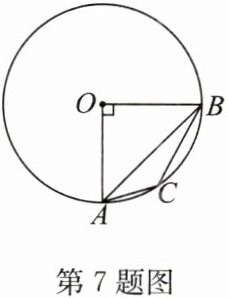
A.$23^{\circ }$
B.$24^{\circ }$
C.$25^{\circ }$
D.$26^{\circ }$
D
)A.$23^{\circ }$
B.$24^{\circ }$
C.$25^{\circ }$
D.$26^{\circ }$
答案:
D
8.如图,正方形ABCD内接于$\odot O$,点P在$\widehat {AB}$上,则$∠BPC$的度数为(
A.$30^{\circ }$
B.$45^{\circ }$
C.$60^{\circ }$
D.$90^{\circ }$
B
)A.$30^{\circ }$
B.$45^{\circ }$
C.$60^{\circ }$
D.$90^{\circ }$
答案:
B
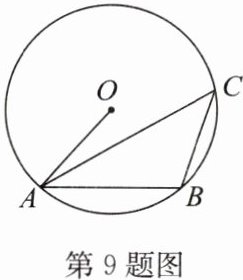
9.如图,A,B,C是半径为1的$\odot O$上的三个点,若$AB= \sqrt {2},∠CAB= 30^{\circ }$,则$∠ABC$的度数为(
A.$95^{\circ }$
B.$100^{\circ }$
C.$105^{\circ }$
D.$110^{\circ }$
C
)A.$95^{\circ }$
B.$100^{\circ }$
C.$105^{\circ }$
D.$110^{\circ }$
答案:
C
10.在半径等于4 cm的圆内有长为$4\sqrt {3}cm$的弦,则此弦所对的圆周角的度数为
$60^{\circ }$或$120^{\circ }$
.
答案:
$60^{\circ }$或$120^{\circ }$
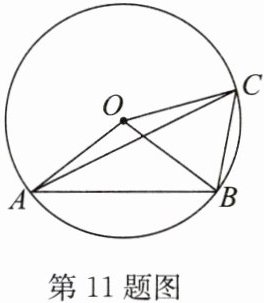
11.(2023·武汉)如图,OA,OB,OC都是$\odot O$的半径,$∠ACB= 2∠BAC.$
(1)求证:$∠AOB= 2∠BOC;$
(2)若$AB= 4,BC= \sqrt {5}$,求$\odot O$的半径.
(1)求证:$∠AOB= 2∠BOC;$
(2)若$AB= 4,BC= \sqrt {5}$,求$\odot O$的半径.
答案:
(1)证明:$\because ∠ACB=\frac {1}{2}∠AOB,∠BAC=\frac {1}{2}∠BOC,∠ACB=2∠BAC,\therefore ∠AOB=2∠BOC;$
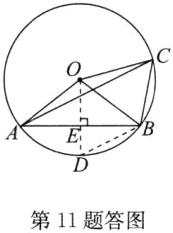
(2)解:如答图,过点O作半径$OD⊥AB$于点E,连接BD,
$\therefore AE=BE,∠DOB=\frac {1}{2}∠AOB,$
又$\because ∠AOB=2∠BOC,$
$\therefore ∠DOB=∠BOC,\therefore BD=BC;$
$\because AB=4,BC=\sqrt {5},\therefore BE=2,DB=\sqrt {5}.$
在$Rt△BDE$中,$∠DEB=90^{\circ },$
$\therefore DE=\sqrt {BD^{2}-BE^{2}}=1,$
在$Rt△BOE$中,$∠OEB=90^{\circ },OB^{2}=(OB - 1)^{2}+2^{2}$,解得$OB=\frac {5}{2}$,即$\odot O$的半径是$\frac {5}{2}$.
(1)证明:$\because ∠ACB=\frac {1}{2}∠AOB,∠BAC=\frac {1}{2}∠BOC,∠ACB=2∠BAC,\therefore ∠AOB=2∠BOC;$
(2)解:如答图,过点O作半径$OD⊥AB$于点E,连接BD,
$\therefore AE=BE,∠DOB=\frac {1}{2}∠AOB,$
又$\because ∠AOB=2∠BOC,$
$\therefore ∠DOB=∠BOC,\therefore BD=BC;$
$\because AB=4,BC=\sqrt {5},\therefore BE=2,DB=\sqrt {5}.$
在$Rt△BDE$中,$∠DEB=90^{\circ },$
$\therefore DE=\sqrt {BD^{2}-BE^{2}}=1,$
在$Rt△BOE$中,$∠OEB=90^{\circ },OB^{2}=(OB - 1)^{2}+2^{2}$,解得$OB=\frac {5}{2}$,即$\odot O$的半径是$\frac {5}{2}$.
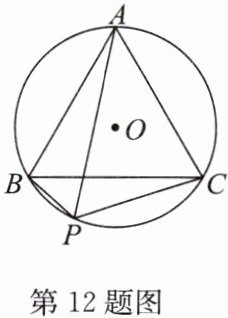
12.如图,已知点A,B,C为$\odot O$上的三个点,且$\triangle ABC$为等边三角形,P为$\widehat {BC}$上一点.求证:$PA= PB+PC.$
答案:
证明:如答图,在PA上截取$PD = PB$,连接BD.
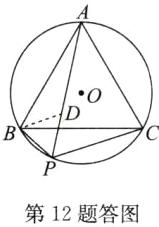
$\because △ABC$是等边三角形,
$\therefore ∠ABC = ∠ACB = 60^{\circ },AB = BC,$
$\therefore ∠BPA = ∠ACB = 60^{\circ },∠APC = ∠ABC = 60^{\circ },$
$\therefore ∠BPC = 120^{\circ }.$
又$\because PD = PB,\therefore △PBD$是等边三角形,
$\therefore ∠BDP = 60^{\circ },BD = PB,\therefore ∠BDA = 120^{\circ }.$
又$\because ∠BAP = ∠BCP,$
$\therefore △ABD\cong △CBP(AAS),$
$\therefore AD = PC,\therefore PA = PD + AD = PB + PC.$
证明:如答图,在PA上截取$PD = PB$,连接BD.
$\because △ABC$是等边三角形,
$\therefore ∠ABC = ∠ACB = 60^{\circ },AB = BC,$
$\therefore ∠BPA = ∠ACB = 60^{\circ },∠APC = ∠ABC = 60^{\circ },$
$\therefore ∠BPC = 120^{\circ }.$
又$\because PD = PB,\therefore △PBD$是等边三角形,
$\therefore ∠BDP = 60^{\circ },BD = PB,\therefore ∠BDA = 120^{\circ }.$
又$\because ∠BAP = ∠BCP,$
$\therefore △ABD\cong △CBP(AAS),$
$\therefore AD = PC,\therefore PA = PD + AD = PB + PC.$
13.如图,$\odot O$中两条互相垂直的弦AB,CD交于点P,AB经过点O,E是AC的中点,连接OE,EP,延长EP交BD于点F.
(1)若$AB= 10,OE= \sqrt {10}$,求AC的长;
(2)求证:$EF⊥BD.$
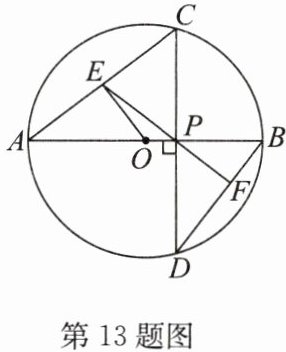
(1)若$AB= 10,OE= \sqrt {10}$,求AC的长;
(2)求证:$EF⊥BD.$
答案:
(1)解:$\because E$是$AC$的中点,
$\therefore OE⊥AC,AC = 2AE,$
$\because AB = 10,\therefore OA=\frac {1}{2}AB = 5,$
在$Rt△AOE$中,$OE = \sqrt{10},$
$\therefore AE=\sqrt{OA^{2}-OE^{2}}=\sqrt{5^{2}-(\sqrt{10})^{2}}=\sqrt{15}$
$\therefore AC = 2AE = 2\sqrt{15},\therefore AC$的长为$2\sqrt{15}$
(2)证明:$\because AB⊥CD,\therefore ∠APC = ∠BPD = 90^{\circ },$
$\therefore ∠DPF + ∠BPF = 90^{\circ },$
$\because E$是$AC$的中点,
$\therefore EP = EC=\frac {1}{2}AC,\therefore ∠EPC = ∠C;$
$\because ∠EPC = ∠DPF,∠B = ∠C,\therefore ∠DPF = ∠B,$
$\therefore ∠B + ∠BPF = 90^{\circ },$
$\therefore ∠BFP = 180^{\circ }-(∠B + ∠BPF)= 90^{\circ },\therefore EF⊥BD.$
(1)解:$\because E$是$AC$的中点,
$\therefore OE⊥AC,AC = 2AE,$
$\because AB = 10,\therefore OA=\frac {1}{2}AB = 5,$
在$Rt△AOE$中,$OE = \sqrt{10},$
$\therefore AE=\sqrt{OA^{2}-OE^{2}}=\sqrt{5^{2}-(\sqrt{10})^{2}}=\sqrt{15}$
$\therefore AC = 2AE = 2\sqrt{15},\therefore AC$的长为$2\sqrt{15}$
(2)证明:$\because AB⊥CD,\therefore ∠APC = ∠BPD = 90^{\circ },$
$\therefore ∠DPF + ∠BPF = 90^{\circ },$
$\because E$是$AC$的中点,
$\therefore EP = EC=\frac {1}{2}AC,\therefore ∠EPC = ∠C;$
$\because ∠EPC = ∠DPF,∠B = ∠C,\therefore ∠DPF = ∠B,$
$\therefore ∠B + ∠BPF = 90^{\circ },$
$\therefore ∠BFP = 180^{\circ }-(∠B + ∠BPF)= 90^{\circ },\therefore EF⊥BD.$
查看更多完整答案,请扫码查看

