

 搜索
搜索
第13页
- 第1页
- 第2页
- 第3页
- 第4页
- 第5页
- 第6页
- 第7页
- 第8页
- 第9页
- 第10页
- 第11页
- 第12页
- 第13页
- 第14页
- 第15页
- 第16页
- 第17页
- 第18页
- 第19页
- 第20页
- 第21页
- 第22页
- 第23页
- 第24页
- 第25页
- 第26页
- 第27页
- 第28页
- 第29页
- 第30页
- 第31页
- 第32页
- 第33页
- 第34页
- 第35页
- 第36页
- 第37页
- 第38页
- 第39页
- 第40页
- 第41页
- 第42页
- 第43页
- 第44页
- 第45页
- 第46页
- 第47页
- 第48页
- 第49页
- 第50页
- 第51页
- 第52页
- 第53页
- 第54页
- 第55页
- 第56页
- 第57页
- 第58页
- 第59页
- 第60页
- 第61页
- 第62页
- 第63页
- 第64页
- 第65页
- 第66页
- 第67页
- 第68页
- 第69页
- 第70页
- 第71页
- 第72页
- 第73页
- 第74页
- 第75页
- 第76页
- 第77页
- 第78页
- 第79页
- 第80页
- 第81页
- 第82页
- 第83页
- 第84页
- 第85页
- 第86页
- 第87页
- 第88页
- 第89页
- 第90页
- 第91页
- 第92页
- 第93页
- 第94页
- 第95页
- 第96页
- 第97页
- 第98页
10. 如图,从一个大正方形中可以裁去面积为$8\text{ cm}^2$和$32\text{ cm}^2$的两个小正方形,则大正方形的边长为 ( )
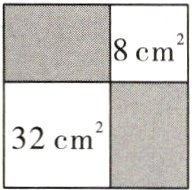
A. $2\sqrt{2}\text{ cm}$
B. $4\sqrt{2}\text{ cm}$
C. $6\sqrt{2}\text{ cm}$
D. $8\sqrt{2}\text{ cm}$
A. $2\sqrt{2}\text{ cm}$
B. $4\sqrt{2}\text{ cm}$
C. $6\sqrt{2}\text{ cm}$
D. $8\sqrt{2}\text{ cm}$
答案:
C
11.(2022苏州相城区期中)设正整数$a$,$m$,$n$满足$\sqrt{a^2 - 4\sqrt{2}}=\sqrt{m}-\sqrt{n}$. 则$a =$________.
答案:
3
12. 计算:
(1)$\frac{1}{2}\sqrt{12}-(3\sqrt{\frac{1}{3}}+\sqrt{2})$.
(2)$\sqrt{12}+\vert\sqrt{3}-3\vert-(\frac{1}{3})^{-1}$.
(3)$4(\sqrt{\frac{1}{2}}+\frac{4}{\sqrt{12}})-\frac{1}{3}(\sqrt{18}-\sqrt{27})$.
(1)$\frac{1}{2}\sqrt{12}-(3\sqrt{\frac{1}{3}}+\sqrt{2})$.
(2)$\sqrt{12}+\vert\sqrt{3}-3\vert-(\frac{1}{3})^{-1}$.
(3)$4(\sqrt{\frac{1}{2}}+\frac{4}{\sqrt{12}})-\frac{1}{3}(\sqrt{18}-\sqrt{27})$.
答案:
解:
(1)原式$=-\sqrt{2}$.
(2)原式$=\sqrt{3}$.
(3)原式$=\sqrt{2}+\frac{11}{3}\sqrt{3}$.
(1)原式$=-\sqrt{2}$.
(2)原式$=\sqrt{3}$.
(3)原式$=\sqrt{2}+\frac{11}{3}\sqrt{3}$.
13. 我们规定运算符号“$\triangle$”的意义是:当$a>b$时,$a\triangle b=a + b$;当$a\leq b$时,$a\triangle b=a - b$,其他运算符号的意义不变,计算:$(\sqrt{3}\triangle\sqrt{2})-2\sqrt{3}\triangle3\sqrt{2}$.
答案:
解:原式$=\sqrt{3}+\sqrt{2}-(2\sqrt{3}-3\sqrt{2})=-\sqrt{3}+4\sqrt{2}$.
14.(拓展应用题)已知$a$,$b$,$c$满足$(a - \sqrt{8})^2+\sqrt{b - 5}+\vert c - 3\sqrt{2}\vert = 0$.
(1)求$a$,$b$,$c$的值.
(2)试问以$a$,$b$,$c$为边长能否构成三角形?若能构成,求出三角形周长;若不能构成三角形,请说明理由.
(1)求$a$,$b$,$c$的值.
(2)试问以$a$,$b$,$c$为边长能否构成三角形?若能构成,求出三角形周长;若不能构成三角形,请说明理由.
答案:
解:
(1)$\because(a - \sqrt{8})^2+\sqrt{b - 5}+|c - 3\sqrt{2}| = 0$,且$(a - \sqrt{8})^2\geq0,\sqrt{b - 5}\geq0,|c - 3\sqrt{2}|\geq0$,$\therefore a - \sqrt{8}=0,b - 5 = 0,c - 3\sqrt{2}=0$. $\therefore a=\sqrt{8}=2\sqrt{2},b = 5,c = 3\sqrt{2}$.
(2)$\because a^2=(2\sqrt{2})^2 = 8,b^2 = 5^2 = 25,c^2=(3\sqrt{2})^2 = 18$,$\therefore a\lt c\lt b$. $\because a + c=2\sqrt{2}+3\sqrt{2}=5\sqrt{2},5\sqrt{2}\gt5,\therefore a + c\gt b$. $\therefore$以$a,b,c$为边长能构成三角形,其周长为$a + b + c=2\sqrt{2}+5+3\sqrt{2}=5+5\sqrt{2}$.
(1)$\because(a - \sqrt{8})^2+\sqrt{b - 5}+|c - 3\sqrt{2}| = 0$,且$(a - \sqrt{8})^2\geq0,\sqrt{b - 5}\geq0,|c - 3\sqrt{2}|\geq0$,$\therefore a - \sqrt{8}=0,b - 5 = 0,c - 3\sqrt{2}=0$. $\therefore a=\sqrt{8}=2\sqrt{2},b = 5,c = 3\sqrt{2}$.
(2)$\because a^2=(2\sqrt{2})^2 = 8,b^2 = 5^2 = 25,c^2=(3\sqrt{2})^2 = 18$,$\therefore a\lt c\lt b$. $\because a + c=2\sqrt{2}+3\sqrt{2}=5\sqrt{2},5\sqrt{2}\gt5,\therefore a + c\gt b$. $\therefore$以$a,b,c$为边长能构成三角形,其周长为$a + b + c=2\sqrt{2}+5+3\sqrt{2}=5+5\sqrt{2}$.
查看更多完整答案,请扫码查看

