

 搜索
搜索
第11页
- 第1页
- 第2页
- 第3页
- 第4页
- 第5页
- 第6页
- 第7页
- 第8页
- 第9页
- 第10页
- 第11页
- 第12页
- 第13页
- 第14页
- 第15页
- 第16页
- 第17页
- 第18页
- 第19页
- 第20页
- 第21页
- 第22页
- 第23页
- 第24页
- 第25页
- 第26页
- 第27页
- 第28页
- 第29页
- 第30页
- 第31页
- 第32页
- 第33页
- 第34页
- 第35页
- 第36页
- 第37页
- 第38页
- 第39页
- 第40页
- 第41页
- 第42页
- 第43页
- 第44页
- 第45页
- 第46页
- 第47页
- 第48页
- 第49页
- 第50页
- 第51页
- 第52页
- 第53页
- 第54页
- 第55页
- 第56页
- 第57页
- 第58页
- 第59页
- 第60页
- 第61页
- 第62页
- 第63页
- 第64页
- 第65页
- 第66页
- 第67页
- 第68页
- 第69页
- 第70页
- 第71页
- 第72页
- 第73页
- 第74页
- 第75页
- 第76页
- 第77页
- 第78页
- 第79页
- 第80页
- 第81页
- 第82页
- 第83页
- 第84页
- 第85页
- 第86页
- 第87页
- 第88页
- 第89页
- 第90页
- 第91页
- 第92页
- 第93页
- 第94页
- 第95页
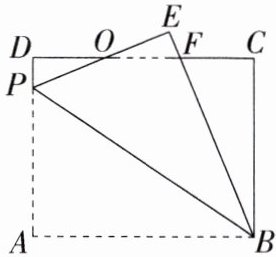
6. 如图,在长方形 ABCD 中,AB = 8,BC = 6,P 为 AD 上一点,将△ABP 沿 BP 翻折得到△EBP,PE 与 CD 相交于点 O,且 OE = OD,BE 与 CD 相交于点 F.
(1)求证:OP = OF.
(2)求 AP 的长.
(1)求证:OP = OF.
(2)求 AP 的长.
答案:
解析
(1) **证明**:$\because$ 四边形 $ABCD$ 是长方形,
$\therefore\angle D=\angle A=\angle C = 90^{\circ}$,
由翻折可知 $EP = AP$,$\angle E=\angle A = 90^{\circ}$,
在 $\triangle ODP$ 和 $\triangle OEF$ 中,$\begin{cases}\angle D=\angle E\\OD = OE\\\angle DOP=\angle EOF\end{cases}$,
$\therefore\triangle ODP\cong\triangle OEF(ASA)$,$\therefore OP = OF$。
(2) 由
(1) 得 $\triangle ODP\cong\triangle OEF$,
$\therefore OP = OF$,$PD = FE$,
$\therefore OD + OF = OE + OP$,$\therefore DF = EP$。
设 $AP = EP = DF = x$,则 $EF = PD = 6 - x$,$CF = CD - DF = AB - DF = 8 - x$,
$\therefore BF = BE - EF = AB - EF = 8-(6 - x)=2 + x$,
在 $Rt\triangle FCB$ 中,根据勾股定理得 $BC^{2}+CF^{2}=BF^{2}$,
$\therefore 6^{2}+(8 - x)^{2}=(2 + x)^{2}$,解得 $x = 4.8$,$\therefore AP = 4.8$。
(1) **证明**:$\because$ 四边形 $ABCD$ 是长方形,
$\therefore\angle D=\angle A=\angle C = 90^{\circ}$,
由翻折可知 $EP = AP$,$\angle E=\angle A = 90^{\circ}$,
在 $\triangle ODP$ 和 $\triangle OEF$ 中,$\begin{cases}\angle D=\angle E\\OD = OE\\\angle DOP=\angle EOF\end{cases}$,
$\therefore\triangle ODP\cong\triangle OEF(ASA)$,$\therefore OP = OF$。
(2) 由
(1) 得 $\triangle ODP\cong\triangle OEF$,
$\therefore OP = OF$,$PD = FE$,
$\therefore OD + OF = OE + OP$,$\therefore DF = EP$。
设 $AP = EP = DF = x$,则 $EF = PD = 6 - x$,$CF = CD - DF = AB - DF = 8 - x$,
$\therefore BF = BE - EF = AB - EF = 8-(6 - x)=2 + x$,
在 $Rt\triangle FCB$ 中,根据勾股定理得 $BC^{2}+CF^{2}=BF^{2}$,
$\therefore 6^{2}+(8 - x)^{2}=(2 + x)^{2}$,解得 $x = 4.8$,$\therefore AP = 4.8$。
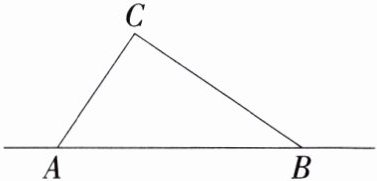
7.(2024 湖南娄底二中期中)如图,台风中心沿直线 AB 从 A 向 B 移动,已知点 C 为一海港,且点 C 与点 A,B 之间的距离分别为 AC = 60 km,BC = 80 km,已知 AB = 100 km,经测量,距离台风中心 50 km 及以内的地区会受到影响.
(1)海港会受到台风影响吗?为什么?
(2)若台风中心的移动速度为 4 km/h,则台风影响该海港持续的时间有多长?
(1)海港会受到台风影响吗?为什么?
(2)若台风中心的移动速度为 4 km/h,则台风影响该海港持续的时间有多长?
答案:
解析
(1) 会受到台风影响,理由:由题可知,$AC = 60\ km$,$BC = 80\ km$,$AB = 100\ km$,
$\because 60^{2}+80^{2}=100^{2}$,$\therefore AC^{2}+BC^{2}=AB^{2}$,
$\therefore\triangle ABC$ 为直角三角形,且 $\angle ACB = 90^{\circ}$。
过点 $C$ 作 $CD\perp AB$ 于点 $D$,如图 1,
$\because S_{\triangle ABC}=\frac{1}{2}AC\cdot BC=\frac{1}{2}AB\cdot CD$,
$\therefore AC\cdot BC = AB\cdot CD$,即 $60×80 = 100CD$,
$\therefore CD = 48\ km<50\ km$。
答:海港 $C$ 会受到台风影响。
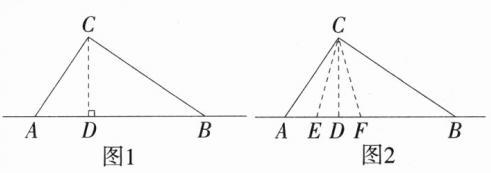
(2) 如图 2,在直线 $AB$ 上取点 $E$ 和 $F$,使 $CE = CF = 50\ km$,
$\therefore$ 当台风中心位于线段 $EF$ 上时,海港 $C$ 都会受到台风影响。
在 $Rt\triangle CDE$ 中,$DE=\sqrt{CE^{2}-CD^{2}} = 14\ km$,
在 $Rt\triangle CDF$ 中,$DF=\sqrt{CF^{2}-CD^{2}} = 14\ km$,
$\therefore EF = DE + DF = 28\ km$,$28\div4 = 7(h)$。
答:台风影响该海港持续的时间为 $7\ h$。
解析
(1) 会受到台风影响,理由:由题可知,$AC = 60\ km$,$BC = 80\ km$,$AB = 100\ km$,
$\because 60^{2}+80^{2}=100^{2}$,$\therefore AC^{2}+BC^{2}=AB^{2}$,
$\therefore\triangle ABC$ 为直角三角形,且 $\angle ACB = 90^{\circ}$。
过点 $C$ 作 $CD\perp AB$ 于点 $D$,如图 1,
$\because S_{\triangle ABC}=\frac{1}{2}AC\cdot BC=\frac{1}{2}AB\cdot CD$,
$\therefore AC\cdot BC = AB\cdot CD$,即 $60×80 = 100CD$,
$\therefore CD = 48\ km<50\ km$。
答:海港 $C$ 会受到台风影响。
(2) 如图 2,在直线 $AB$ 上取点 $E$ 和 $F$,使 $CE = CF = 50\ km$,
$\therefore$ 当台风中心位于线段 $EF$ 上时,海港 $C$ 都会受到台风影响。
在 $Rt\triangle CDE$ 中,$DE=\sqrt{CE^{2}-CD^{2}} = 14\ km$,
在 $Rt\triangle CDF$ 中,$DF=\sqrt{CF^{2}-CD^{2}} = 14\ km$,
$\therefore EF = DE + DF = 28\ km$,$28\div4 = 7(h)$。
答:台风影响该海港持续的时间为 $7\ h$。
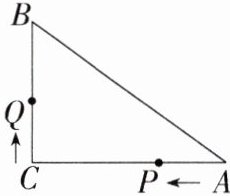
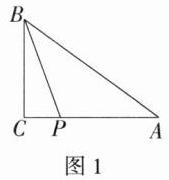
8. 如图所示,在△ABC 中,已知∠C = 90°,AC = 8,BC = 6,P,Q 是△ABC 边上的两个动点,点 P 从点 A 开始沿线段 AC 向点 C 运动,且速度为每秒 1 个单位长度,点 Q 从点 C 开始沿线段 BC 向点 B 运动,且速度为每秒 2 个单位长度,它们同时出发,设运动的时间为 t 秒.
(1)出发 2 秒后,求线段 PQ 的长.
(2)t 为何值时,△APB 是等腰三角形?
(3)若点 Q 运动到点 B 后,沿线段 AB 向点 A 运动,t 为何值时,△CBQ 是等腰三角形?
(1)出发 2 秒后,求线段 PQ 的长.
(2)t 为何值时,△APB 是等腰三角形?
(3)若点 Q 运动到点 B 后,沿线段 AB 向点 A 运动,t 为何值时,△CBQ 是等腰三角形?
答案:
解析
(1) 当 $t = 2$ 时,$CQ = 2×2 = 4$,$CP = 8 - 1×2 = 6$,
在 $Rt\triangle PCQ$ 中,$PQ=\sqrt{CQ^{2}+CP^{2}}=\sqrt{4^{2}+6^{2}} = 2\sqrt{13}$。
(2) 如图 1,当 $\triangle APB$ 是等腰三角形时,由图可知只有 1 种情况,此时 $BP = AP = t$,
则 $CP = 8 - t$。在 $Rt\triangle CPB$ 中,由勾股定理得 $6^{2}+(8 - t)^{2}=t^{2}$,$\therefore t=\frac{25}{4}$。
故当 $t=\frac{25}{4}$ 时,$\triangle APB$ 是等腰三角形。
(3) 点 $Q$ 在边 $BA$ 上运动时,$\triangle CBQ$ 为等腰三角形的情况有三种:
①如图 2,若 $CQ = BQ$,则 $\angle B=\angle BCQ$。$\because\angle B+\angle A=\angle BCQ+\angle ACQ = 90^{\circ}$,$\therefore\angle A=\angle ACQ$,$\therefore CQ = AQ$,
$\therefore BQ = AQ$。在 $Rt\triangle BCA$ 中,$BA=\sqrt{BC^{2}+AC^{2}}=\sqrt{6^{2}+8^{2}} = 10$,$\therefore BQ = 5$,$\therefore 2t - 6 = 5$,$\therefore t=\frac{11}{2}$。
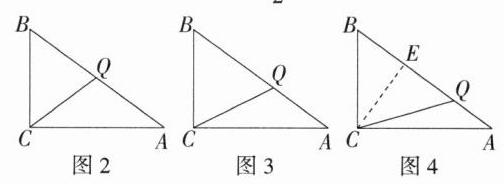
②如图 3,若 $BQ = BC$,则 $2t - 6 = 6$,$\therefore t = 6$。
③如图 4,若 $CQ = CB$,过点 $C$ 作 $CE\perp AB$ 于点 $E$,则 $BE = EQ$,$S_{\triangle ABC}=\frac{1}{2}AC\cdot BC=\frac{1}{2}AB\cdot CE$。
$\because AB=\sqrt{BC^{2}+AC^{2}}=\sqrt{6^{2}+8^{2}} = 10$,
$\therefore\frac{1}{2}×8×6=\frac{1}{2}×10CE$,$\therefore CE=\frac{24}{5}$,
在 $Rt\triangle BCE$ 中,$BE=\sqrt{BC^{2}-CE^{2}}=\sqrt{6^{2}-(\frac{24}{5})^{2}}=\frac{18}{5}$,
$\therefore BQ=\frac{36}{5}$,$\therefore 2t - 6=\frac{36}{5}$,$\therefore t=\frac{33}{5}$。
综上可知,当 $t$ 的值为 $\frac{11}{2}$ 或 $6$ 或 $\frac{33}{5}$ 时,$\triangle CBQ$ 为等腰三角形。
解析
(1) 当 $t = 2$ 时,$CQ = 2×2 = 4$,$CP = 8 - 1×2 = 6$,
在 $Rt\triangle PCQ$ 中,$PQ=\sqrt{CQ^{2}+CP^{2}}=\sqrt{4^{2}+6^{2}} = 2\sqrt{13}$。
(2) 如图 1,当 $\triangle APB$ 是等腰三角形时,由图可知只有 1 种情况,此时 $BP = AP = t$,
则 $CP = 8 - t$。在 $Rt\triangle CPB$ 中,由勾股定理得 $6^{2}+(8 - t)^{2}=t^{2}$,$\therefore t=\frac{25}{4}$。
故当 $t=\frac{25}{4}$ 时,$\triangle APB$ 是等腰三角形。
(3) 点 $Q$ 在边 $BA$ 上运动时,$\triangle CBQ$ 为等腰三角形的情况有三种:
①如图 2,若 $CQ = BQ$,则 $\angle B=\angle BCQ$。$\because\angle B+\angle A=\angle BCQ+\angle ACQ = 90^{\circ}$,$\therefore\angle A=\angle ACQ$,$\therefore CQ = AQ$,
$\therefore BQ = AQ$。在 $Rt\triangle BCA$ 中,$BA=\sqrt{BC^{2}+AC^{2}}=\sqrt{6^{2}+8^{2}} = 10$,$\therefore BQ = 5$,$\therefore 2t - 6 = 5$,$\therefore t=\frac{11}{2}$。
②如图 3,若 $BQ = BC$,则 $2t - 6 = 6$,$\therefore t = 6$。
③如图 4,若 $CQ = CB$,过点 $C$ 作 $CE\perp AB$ 于点 $E$,则 $BE = EQ$,$S_{\triangle ABC}=\frac{1}{2}AC\cdot BC=\frac{1}{2}AB\cdot CE$。
$\because AB=\sqrt{BC^{2}+AC^{2}}=\sqrt{6^{2}+8^{2}} = 10$,
$\therefore\frac{1}{2}×8×6=\frac{1}{2}×10CE$,$\therefore CE=\frac{24}{5}$,
在 $Rt\triangle BCE$ 中,$BE=\sqrt{BC^{2}-CE^{2}}=\sqrt{6^{2}-(\frac{24}{5})^{2}}=\frac{18}{5}$,
$\therefore BQ=\frac{36}{5}$,$\therefore 2t - 6=\frac{36}{5}$,$\therefore t=\frac{33}{5}$。
综上可知,当 $t$ 的值为 $\frac{11}{2}$ 或 $6$ 或 $\frac{33}{5}$ 时,$\triangle CBQ$ 为等腰三角形。
查看更多完整答案,请扫码查看

