

 搜索
搜索
2025年教材帮高中数学选择性必修第二册苏教版
注:目前有些书本章节名称可能整理的还不是很完善,但都是按照顺序排列的,请同学们按照顺序仔细查找。练习册 2025年教材帮高中数学选择性必修第二册苏教版 答案主要是用来给同学们做完题方便对答案用的,请勿直接抄袭。
第33页
- 第1页
- 第2页
- 第3页
- 第4页
- 第5页
- 第6页
- 第7页
- 第8页
- 第9页
- 第10页
- 第11页
- 第12页
- 第13页
- 第14页
- 第15页
- 第16页
- 第17页
- 第18页
- 第19页
- 第20页
- 第21页
- 第22页
- 第23页
- 第24页
- 第25页
- 第26页
- 第27页
- 第28页
- 第29页
- 第30页
- 第31页
- 第32页
- 第33页
- 第34页
- 第35页
- 第36页
- 第37页
- 第38页
- 第39页
- 第40页
- 第41页
- 第42页
- 第43页
- 第44页
- 第45页
- 第46页
- 第47页
- 第48页
- 第49页
- 第50页
- 第51页
- 第52页
- 第53页
- 第54页
- 第55页
- 第56页
- 第57页
- 第58页
- 第59页
- 第60页
- 第61页
- 第62页
- 第63页
- 第64页
- 第65页
- 第66页
- 第67页
- 第68页
- 第69页
- 第70页
- 第71页
- 第72页
- 第73页
- 第74页
- 第75页
- 第76页
- 第77页
- 第78页
- 第79页
- 第80页
- 第81页
- 第82页
- 第83页
- 第84页
- 第85页
- 第86页
- 第87页
- 第88页
- 第89页
- 第90页
- 第91页
- 第92页
- 第93页
- 第94页
- 第95页
- 第96页
- 第97页
- 第98页
- 第99页
- 第100页
- 第101页
- 第102页
- 第103页
- 第104页
- 第105页
- 第106页
- 第107页
- 第108页
- 第109页
- 第110页
- 第111页
- 第112页
- 第113页
- 第114页
- 第115页
- 第116页
- 第117页
- 第118页
- 第119页
- 第120页
- 第121页
- 第122页
- 第123页
- 第124页
- 第125页
- 第126页
- 第127页
- 第128页
- 第129页
- 第130页
- 第131页
- 第132页
- 第133页
- 第134页
- 第135页
- 第136页
- 第137页
- 第138页
- 第139页
- 第140页
- 第141页
- 第142页
- 第143页
- 第144页
- 第145页
- 第146页
- 第147页
- 第148页
- 第149页
- 第150页
- 第151页
- 第152页
- 第153页
- 第154页
1. 长方体 $ABCD - A_1B_1C_1D_1$ 中,$E$,$F$ 分别是面对角线 $BD_1$,$A_1B$ 上的点,且 $D_1E = 2EB_1$,$BF = 2FA_1$. 求证:$EF// AC_1$.
————————————————
————————————————
答案:
1. 如图D6.3-1所示,分别以$DA,DC,DD_{1}$所在的直线为$x$轴、$y$轴、$z$轴建立空间直角坐标系,
设$DA=a,DC=b,DD_{1}=c$,则$A(a,0,0)$,
$C_{1}(0,b,c),D_{1}(0,0,c),B_{1}(a,b,c),B(a,b,0),A_{1}(a,0,c)$。
由$D_{1}E=2EB_{1}$,可得$E(\frac{2}{3}a,\frac{2}{3}b,c)$,
由$BF=2FA_{1}$,可得$F(a,\frac{b}{3},\frac{2}{3}c)$。
$\therefore \overrightarrow{FE}=(-\frac{a}{3},\frac{b}{3},\frac{c}{3}),\overrightarrow{AC_{1}}=(-a,b,c),\therefore \overrightarrow{FE}=\frac{1}{3}\overrightarrow{AC_{1}}$。
又$\overrightarrow{FE}$与$\overrightarrow{AC_{1}}$不共线,$\therefore EF// AC_{1}$。
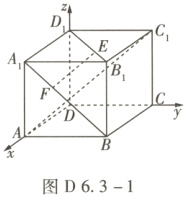
1. 如图D6.3-1所示,分别以$DA,DC,DD_{1}$所在的直线为$x$轴、$y$轴、$z$轴建立空间直角坐标系,
设$DA=a,DC=b,DD_{1}=c$,则$A(a,0,0)$,
$C_{1}(0,b,c),D_{1}(0,0,c),B_{1}(a,b,c),B(a,b,0),A_{1}(a,0,c)$。
由$D_{1}E=2EB_{1}$,可得$E(\frac{2}{3}a,\frac{2}{3}b,c)$,
由$BF=2FA_{1}$,可得$F(a,\frac{b}{3},\frac{2}{3}c)$。
$\therefore \overrightarrow{FE}=(-\frac{a}{3},\frac{b}{3},\frac{c}{3}),\overrightarrow{AC_{1}}=(-a,b,c),\therefore \overrightarrow{FE}=\frac{1}{3}\overrightarrow{AC_{1}}$。
又$\overrightarrow{FE}$与$\overrightarrow{AC_{1}}$不共线,$\therefore EF// AC_{1}$。
例13 [教材改编 P33 例5]如图6.3-18所示的五面体中,四边形 $ABCD$ 是正方形,$DA \perp$ 平面 $ABEF$,$AB// EF$,$AE \perp AF$,$DA = AF = 1$,$AE = \sqrt{3}$,$P$,$Q$ 分别为 $AE$,$BD$ 的中点. 求证:$PQ//$ 平面 $BCE$.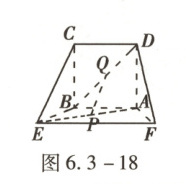
答案:
解析 ▶ [方法1] $\because AE = \sqrt{3}$,$AF = 1$,$AE \perp AF$,$\therefore \angle AEF = 30°$.
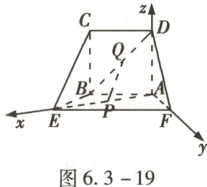
$\because AB// EF$,$\therefore \angle EAB = 30°$. 以 $A$ 为坐标原点,$AE$,$AF$,$AD$ 所在的直线分别为 $x$ 轴、$y$ 轴、$z$ 轴建立空间直角坐标系,如图6.3-19所示,(对本题来说,寻找两两垂直的三条直线进行建系是解题关键)
则 $A(0,0,0)$,$E(\sqrt{3},0,0)$,$B(\frac{\sqrt{3}}{2},-\frac{1}{2},0)$,$D(0,0,1)$,$C(\frac{\sqrt{3}}{2},-\frac{1}{2},1)$.
$\because P$,$Q$ 分别为 $AE$,$BD$ 的中点,
$\therefore P(\frac{\sqrt{3}}{2},0,0)$,$Q(\frac{\sqrt{3}}{4},-\frac{1}{4},\frac{1}{2})$,
$\therefore \overrightarrow{PQ}=(-\frac{\sqrt{3}}{4},-\frac{1}{4},\frac{1}{2})$.
$\because \overrightarrow{EC}=(-\frac{\sqrt{3}}{2},-\frac{1}{2},1)$,$\therefore \overrightarrow{EC}=2\overrightarrow{PQ}$,$\therefore PQ// EC$.
$\because P \notin$ 平面 $BCE$,$ECC \subset$ 平面 $BCE$,
$\therefore PQ//$ 平面 $BCE$.
[方法2] 同方法1,建立空间直角坐标系,如图6.3-19所示,则 $A(0,0,0)$,$E(\sqrt{3},0,0)$,$B(\frac{\sqrt{3}}{2},-\frac{1}{2},0)$,$D(0,0,1)$,$C(\frac{\sqrt{3}}{2},-\frac{1}{2},1)$,$\therefore \overrightarrow{EB}=(-\frac{\sqrt{3}}{2},-\frac{1}{2},0)$,$\overrightarrow{BC}=(0,0,1)$.
设平面 $BCE$ 的法向量为 $\mathbf{n}=(x_1,y_1,z_1)$.
由 $\begin{cases} \mathbf{n} · \overrightarrow{EB}=0, \\ \mathbf{n} · \overrightarrow{BC}=0, \end{cases}$ 得 $\begin{cases} -\frac{\sqrt{3}}{2}x_1 - \frac{1}{2}y_1 = 0, \\ z_1 = 0, \end{cases}$ 令 $x_1 = 1$,得平面 $BCE$ 的一个法向量为 $\mathbf{n}=(1,-\sqrt{3},0)$.
$\because P$,$Q$ 分别为 $AE$,$BD$ 的中点,$\therefore P(\frac{\sqrt{3}}{2},0,0)$,$Q(\frac{\sqrt{3}}{4},-\frac{1}{4},\frac{1}{2})$,$\therefore \overrightarrow{PQ}=(-\frac{\sqrt{3}}{4},-\frac{1}{4},\frac{1}{2})$,
$\therefore \mathbf{n} · \overrightarrow{PQ}=-\frac{\sqrt{3}}{4}+\frac{\sqrt{3}}{4}=0$,$\therefore PQ \perp \mathbf{n}$,
又 $PQ \not\subset$ 平面 $BCE$,$\therefore PQ//$ 平面 $BCE$.
[方法3] $\overrightarrow{PQ}=\overrightarrow{PE}+\overrightarrow{EB}+\overrightarrow{BQ}=\frac{1}{2}\overrightarrow{AE}+\overrightarrow{EB}+\frac{1}{2}\overrightarrow{BD}=\frac{1}{2}(\overrightarrow{AB}+\overrightarrow{BE})+\overrightarrow{EB}+\frac{1}{2}(\overrightarrow{BC}+\overrightarrow{CD})=\frac{1}{2}\overrightarrow{EB}+\frac{1}{2}\overrightarrow{BC}=\frac{1}{2}\overrightarrow{EC}$,$\therefore PQ// EC$.
$\because P \notin$ 平面 $BCE$,$ECC \subset$ 平面 $BCE$,$\therefore PQ//$ 平面 $BCE$.
[方法4] $\overrightarrow{PQ}=\overrightarrow{PE}+\overrightarrow{EB}+\overrightarrow{BQ}=\frac{1}{2}\overrightarrow{AE}+\overrightarrow{EB}+\frac{1}{2}\overrightarrow{BD}=\frac{1}{2}(\overrightarrow{AB}+\overrightarrow{BE})+\overrightarrow{EB}+\frac{1}{2}(\overrightarrow{BC}+\overrightarrow{CD})=\frac{1}{2}\overrightarrow{EB}+\frac{1}{2}\overrightarrow{BC}$,
$\therefore PQ$,$\overrightarrow{EB}$,$\overrightarrow{BC}$ 共面,又 $P \notin$ 平面 $BCE$,$\therefore PQ//$ 平面 $BCE$.
解析 ▶ [方法1] $\because AE = \sqrt{3}$,$AF = 1$,$AE \perp AF$,$\therefore \angle AEF = 30°$.
$\because AB// EF$,$\therefore \angle EAB = 30°$. 以 $A$ 为坐标原点,$AE$,$AF$,$AD$ 所在的直线分别为 $x$ 轴、$y$ 轴、$z$ 轴建立空间直角坐标系,如图6.3-19所示,(对本题来说,寻找两两垂直的三条直线进行建系是解题关键)
则 $A(0,0,0)$,$E(\sqrt{3},0,0)$,$B(\frac{\sqrt{3}}{2},-\frac{1}{2},0)$,$D(0,0,1)$,$C(\frac{\sqrt{3}}{2},-\frac{1}{2},1)$.
$\because P$,$Q$ 分别为 $AE$,$BD$ 的中点,
$\therefore P(\frac{\sqrt{3}}{2},0,0)$,$Q(\frac{\sqrt{3}}{4},-\frac{1}{4},\frac{1}{2})$,
$\therefore \overrightarrow{PQ}=(-\frac{\sqrt{3}}{4},-\frac{1}{4},\frac{1}{2})$.
$\because \overrightarrow{EC}=(-\frac{\sqrt{3}}{2},-\frac{1}{2},1)$,$\therefore \overrightarrow{EC}=2\overrightarrow{PQ}$,$\therefore PQ// EC$.
$\because P \notin$ 平面 $BCE$,$ECC \subset$ 平面 $BCE$,
$\therefore PQ//$ 平面 $BCE$.
[方法2] 同方法1,建立空间直角坐标系,如图6.3-19所示,则 $A(0,0,0)$,$E(\sqrt{3},0,0)$,$B(\frac{\sqrt{3}}{2},-\frac{1}{2},0)$,$D(0,0,1)$,$C(\frac{\sqrt{3}}{2},-\frac{1}{2},1)$,$\therefore \overrightarrow{EB}=(-\frac{\sqrt{3}}{2},-\frac{1}{2},0)$,$\overrightarrow{BC}=(0,0,1)$.
设平面 $BCE$ 的法向量为 $\mathbf{n}=(x_1,y_1,z_1)$.
由 $\begin{cases} \mathbf{n} · \overrightarrow{EB}=0, \\ \mathbf{n} · \overrightarrow{BC}=0, \end{cases}$ 得 $\begin{cases} -\frac{\sqrt{3}}{2}x_1 - \frac{1}{2}y_1 = 0, \\ z_1 = 0, \end{cases}$ 令 $x_1 = 1$,得平面 $BCE$ 的一个法向量为 $\mathbf{n}=(1,-\sqrt{3},0)$.
$\because P$,$Q$ 分别为 $AE$,$BD$ 的中点,$\therefore P(\frac{\sqrt{3}}{2},0,0)$,$Q(\frac{\sqrt{3}}{4},-\frac{1}{4},\frac{1}{2})$,$\therefore \overrightarrow{PQ}=(-\frac{\sqrt{3}}{4},-\frac{1}{4},\frac{1}{2})$,
$\therefore \mathbf{n} · \overrightarrow{PQ}=-\frac{\sqrt{3}}{4}+\frac{\sqrt{3}}{4}=0$,$\therefore PQ \perp \mathbf{n}$,
又 $PQ \not\subset$ 平面 $BCE$,$\therefore PQ//$ 平面 $BCE$.
[方法3] $\overrightarrow{PQ}=\overrightarrow{PE}+\overrightarrow{EB}+\overrightarrow{BQ}=\frac{1}{2}\overrightarrow{AE}+\overrightarrow{EB}+\frac{1}{2}\overrightarrow{BD}=\frac{1}{2}(\overrightarrow{AB}+\overrightarrow{BE})+\overrightarrow{EB}+\frac{1}{2}(\overrightarrow{BC}+\overrightarrow{CD})=\frac{1}{2}\overrightarrow{EB}+\frac{1}{2}\overrightarrow{BC}=\frac{1}{2}\overrightarrow{EC}$,$\therefore PQ// EC$.
$\because P \notin$ 平面 $BCE$,$ECC \subset$ 平面 $BCE$,$\therefore PQ//$ 平面 $BCE$.
[方法4] $\overrightarrow{PQ}=\overrightarrow{PE}+\overrightarrow{EB}+\overrightarrow{BQ}=\frac{1}{2}\overrightarrow{AE}+\overrightarrow{EB}+\frac{1}{2}\overrightarrow{BD}=\frac{1}{2}(\overrightarrow{AB}+\overrightarrow{BE})+\overrightarrow{EB}+\frac{1}{2}(\overrightarrow{BC}+\overrightarrow{CD})=\frac{1}{2}\overrightarrow{EB}+\frac{1}{2}\overrightarrow{BC}$,
$\therefore PQ$,$\overrightarrow{EB}$,$\overrightarrow{BC}$ 共面,又 $P \notin$ 平面 $BCE$,$\therefore PQ//$ 平面 $BCE$.
查看更多完整答案,请扫码查看

