

 搜索
搜索
第9页
- 第1页
- 第2页
- 第3页
- 第4页
- 第5页
- 第6页
- 第7页
- 第8页
- 第9页
- 第10页
- 第11页
- 第12页
- 第13页
- 第14页
- 第15页
- 第16页
- 第17页
- 第18页
- 第19页
- 第20页
- 第21页
- 第22页
- 第23页
- 第24页
- 第25页
- 第26页
- 第27页
- 第28页
- 第29页
- 第30页
- 第31页
- 第32页
- 第33页
- 第34页
- 第35页
- 第36页
- 第37页
- 第38页
- 第39页
- 第40页
- 第41页
- 第42页
- 第43页
- 第44页
- 第45页
- 第46页
- 第47页
- 第48页
- 第49页
- 第50页
- 第51页
- 第52页
- 第53页
- 第54页
- 第55页
- 第56页
- 第57页
- 第58页
- 第59页
- 第60页
- 第61页
- 第62页
- 第63页
- 第64页
- 第65页
- 第66页
- 第67页
- 第68页
- 第69页
- 第70页
- 第71页
- 第72页
- 第73页
- 第74页
- 第75页
- 第76页
- 第77页
- 第78页
- 第79页
- 第80页
- 第81页
- 第82页
- 第83页
- 第84页
- 第85页
- 第86页
- 第87页
- 第88页
- 第89页
- 第90页
- 第91页
- 第92页
- 第93页
- 第94页
- 第95页
- 第96页
- 第97页
- 第98页
- 第99页
- 第100页
- 第101页
- 第102页
- 第103页
- 第104页
- 第105页
- 第106页
- 第107页
- 第108页
- 第109页
- 第110页
- 第111页
- 第112页
- 第113页
- 第114页
- 第115页
- 第116页
- 第117页
- 第118页
- 第119页
- 第120页
- 第121页
- 第122页
- 第123页
- 第124页
- 第125页
8. 用公式法解下列方程:
(1) $2x(x+\sqrt{2})+1 = 0$;
(2) $4x^{2}-3x - 5 = x - 2$;
(3) $3x^{2}-(x + 2)^{2}+2x = 0$.
(1) $2x(x+\sqrt{2})+1 = 0$;
(2) $4x^{2}-3x - 5 = x - 2$;
(3) $3x^{2}-(x + 2)^{2}+2x = 0$.
答案:
$8.(1)x_{1}=x_{2}=-\frac{\sqrt{2}}{2}$
$(2)x_{1}=\frac{3}{2},x_{2}=-\frac{1}{2}$
$(3)x_{1}=2,x_{2}=-1$
$(2)x_{1}=\frac{3}{2},x_{2}=-\frac{1}{2}$
$(3)x_{1}=2,x_{2}=-1$
9. (2023·承德县期末)已知关于 $x$ 的一元二次方程 $mx^{2}-nx + 1 = 0$.
(1) 当 $n = m + 2$ 时,不解方程,判断方程根的情况;
(2) 在(1)的条件下,若 $m = 2$,求解这个方程.
(1) 当 $n = m + 2$ 时,不解方程,判断方程根的情况;
(2) 在(1)的条件下,若 $m = 2$,求解这个方程.
答案:
9.解:
(1)把n=m+2代入方程,得$mx^{2}-(m+2)x+1=0.$
因为$\Delta=[-(m+2)]^{2}-4m=m^{2}+4m+4-4m=m^{2}+4>0,$
所以方程有两个不等的实数根.
(2)当m=2时,方程为$2x^{2}-4x+1=0.$
解得$x_{1}=\frac{2+\sqrt{2}}{2},x_{2}=\frac{2-\sqrt{2}}{2}.$
(1)把n=m+2代入方程,得$mx^{2}-(m+2)x+1=0.$
因为$\Delta=[-(m+2)]^{2}-4m=m^{2}+4m+4-4m=m^{2}+4>0,$
所以方程有两个不等的实数根.
(2)当m=2时,方程为$2x^{2}-4x+1=0.$
解得$x_{1}=\frac{2+\sqrt{2}}{2},x_{2}=\frac{2-\sqrt{2}}{2}.$
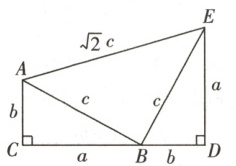
10. 如图,四边形 $ACDE$ 是证明勾股定理时用到的一个图形,$a$,$b$,$c$ 是 $Rt\triangle ABC$ 和 $Rt\triangle BED$ 的三边长,易知 $AE=\sqrt{2}c$,这时我们把形如 $ax^{2}+\sqrt{2}cx + b = 0$ 的一元二次方程称为“勾系一元二次方程”.
(1) 求证:关于 $x$ 的“勾系一元二次方程”$ax^{2}+\sqrt{2}cx + b = 0$ 必有实数根;
(2) 若 $x = - 1$ 是“勾系一元二次方程”$ax^{2}+\sqrt{2}cx + b = 0$ 的一个根,且四边形 $ACDE$ 的周长是 $6\sqrt{2}$. 求$\triangle ABC$ 的面积.
(1) 求证:关于 $x$ 的“勾系一元二次方程”$ax^{2}+\sqrt{2}cx + b = 0$ 必有实数根;
(2) 若 $x = - 1$ 是“勾系一元二次方程”$ax^{2}+\sqrt{2}cx + b = 0$ 的一个根,且四边形 $ACDE$ 的周长是 $6\sqrt{2}$. 求$\triangle ABC$ 的面积.
答案:
10.
(1)证明:由题意,得$\Delta=(\sqrt{2}c)^{2}-4ab=2c^{2}-4ab.\because a^{2}+b^{2}=c^{2},$$\therefore2c^{2}-4ab=2(a^{2}+b^{2})-4ab=2(a-b)^{2}\geq0,$即$\Delta\geq0.\therefore$关于x的“勾系一元二次方程$”ax^{2}+\sqrt{2}cx+b=0$必有实数根.
(2)解:当x=-1时,有$a-\sqrt{2}c+b=0,$即$a+b=\sqrt{2}c.$
$2a+2b+\sqrt{2}c=6\sqrt{2},$即$2(a+b)+\sqrt{2}c=6\sqrt{2},$
$\therefore3\sqrt{2}c=6\sqrt{2}.\therefore c=2.\therefore a^{2}+b^{2}=c^{2}=4,a+b=2\sqrt{2}.$
$\because(a+b)^{2}=a^{2}+2ab+b^{2},$$\therefore ab=2.\therefore S_{\triangle ABC}=\frac{1}{2}ab=1.$
(1)证明:由题意,得$\Delta=(\sqrt{2}c)^{2}-4ab=2c^{2}-4ab.\because a^{2}+b^{2}=c^{2},$$\therefore2c^{2}-4ab=2(a^{2}+b^{2})-4ab=2(a-b)^{2}\geq0,$即$\Delta\geq0.\therefore$关于x的“勾系一元二次方程$”ax^{2}+\sqrt{2}cx+b=0$必有实数根.
(2)解:当x=-1时,有$a-\sqrt{2}c+b=0,$即$a+b=\sqrt{2}c.$
$2a+2b+\sqrt{2}c=6\sqrt{2},$即$2(a+b)+\sqrt{2}c=6\sqrt{2},$
$\therefore3\sqrt{2}c=6\sqrt{2}.\therefore c=2.\therefore a^{2}+b^{2}=c^{2}=4,a+b=2\sqrt{2}.$
$\because(a+b)^{2}=a^{2}+2ab+b^{2},$$\therefore ab=2.\therefore S_{\triangle ABC}=\frac{1}{2}ab=1.$
查看更多完整答案,请扫码查看

