

 搜索
搜索
第98页
- 第1页
- 第2页
- 第3页
- 第4页
- 第5页
- 第6页
- 第7页
- 第8页
- 第9页
- 第10页
- 第11页
- 第12页
- 第13页
- 第14页
- 第15页
- 第16页
- 第17页
- 第18页
- 第19页
- 第20页
- 第21页
- 第22页
- 第23页
- 第24页
- 第25页
- 第26页
- 第27页
- 第28页
- 第29页
- 第30页
- 第31页
- 第32页
- 第33页
- 第34页
- 第35页
- 第36页
- 第37页
- 第38页
- 第39页
- 第40页
- 第41页
- 第42页
- 第43页
- 第44页
- 第45页
- 第46页
- 第47页
- 第48页
- 第49页
- 第50页
- 第51页
- 第52页
- 第53页
- 第54页
- 第55页
- 第56页
- 第57页
- 第58页
- 第59页
- 第60页
- 第61页
- 第62页
- 第63页
- 第64页
- 第65页
- 第66页
- 第67页
- 第68页
- 第69页
- 第70页
- 第71页
- 第72页
- 第73页
- 第74页
- 第75页
- 第76页
- 第77页
- 第78页
- 第79页
- 第80页
- 第81页
- 第82页
- 第83页
- 第84页
- 第85页
- 第86页
- 第87页
- 第88页
- 第89页
- 第90页
- 第91页
- 第92页
- 第93页
- 第94页
- 第95页
- 第96页
- 第97页
- 第98页
- 第99页
- 第100页
- 第101页
- 第102页
- 第103页
- 第104页
- 第105页
10. 已知平面内有$\odot O和点A$,$B$,若$\odot O$的半径是2cm,$OA= 3cm$,$OB= 2cm$,则直线$AB与\odot O$的位置关系是(
A.相离
B.相交
C.相切
D.相交或相切
【点拨】由题意可知点$A在\odot O$外,点$B在\odot O$上,画草图解答.
D
)A.相离
B.相交
C.相切
D.相交或相切
【点拨】由题意可知点$A在\odot O$外,点$B在\odot O$上,画草图解答.
答案:
D
11. 在$\triangle ABC$中,$AB= AC= 4cm$,$\angle BAC= 120^{\circ}$,以点$A为圆心的圆与BC$相切时,此圆的半径是____
2 cm
.
答案:
2 cm$r = \sqrt{3} = d$,
∴圆 and AB 相切;
(3)$r = 2 > d$,
∴圆 and AB intersect.$r = \sqrt{3} = d$,
∴圆 and AB 相切;
(3)$r = \sqrt{3} = d$,
∴圆 and AB intersect.
∴圆 and AB 相切;
(3)$r = 2 > d$,
∴圆 and AB intersect.$r = \sqrt{3} = d$,
∴圆 and AB 相切;
(3)$r = \sqrt{3} = d$,
∴圆 and AB intersect.
12. $\odot O的半径为R$,点$O到直线l的距离为d$,$R$,$d是方程x^{2}-4x+m= 0$的两根,当直线$l与\odot O$相切时,$m$的值为
4
.
答案:
4
13.(易错题)$\triangle ABC$中,$\angle C= 90^{\circ}$,$AC= 3$,$BC= 4$,以点$C$为圆心,$r$为半径作圆,若$\odot C与线段AB$只有一个公共点,则$r$的值是
$2.4$或$3 < r \leq 4$
.
答案:
$r=2.4$或$3 < r \leq 4$
14. 如图,在平面直角坐标系中,点$M$在第一象限,$MN\perp x轴于N$,$MN= 1$,$\odot M交x轴于点A(2,0)$,$B(6,0)$.
(1)求$\odot M$的半径;
(2)判断$\odot M与直线x= 7$的位置关系并说明理由.
(1)求$\odot M$的半径;
(2)判断$\odot M与直线x= 7$的位置关系并说明理由.
答案:
(1) $\sqrt{5}$
(2) 相离
(1) $\sqrt{5}$
(2) 相离
15. 如图,在平面直角坐标系中,以坐标原点为圆心的$\odot O$半径为2.
(1)试判断点$A(-2,2)与\odot O$的位置关系,并证明该结论;
(2)若直线$y= -x+b与\odot O$相离,求$b$的取值范围.
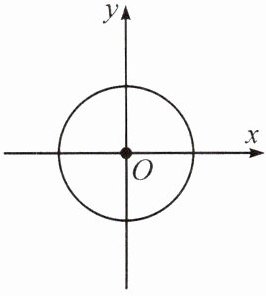
(1)试判断点$A(-2,2)与\odot O$的位置关系,并证明该结论;
(2)若直线$y= -x+b与\odot O$相离,求$b$的取值范围.
答案:
(1)点A在⊙O外。
证明:
∵点A(-2,2),O为坐标原点,
∴OA=$\sqrt{(-2-0)^2+(2-0)^2}=\sqrt{4+4}=\sqrt{8}=2\sqrt{2}$。
∵⊙O半径为2,且$2\sqrt{2}>2$,
∴点A在⊙O外。
(2)解:直线$y=-x+b$可化为$x+y-b=0$。
圆心O(0,0)到直线的距离$d=\frac{|0+0-b|}{\sqrt{1^2+1^2}}=\frac{|b|}{\sqrt{2}}$。
∵直线与⊙O相离,
∴$d>2$,即$\frac{|b|}{\sqrt{2}}>2$,$|b|>2\sqrt{2}$。
∴$b>2\sqrt{2}$或$b<-2\sqrt{2}$。
(1)点A在⊙O外。
证明:
∵点A(-2,2),O为坐标原点,
∴OA=$\sqrt{(-2-0)^2+(2-0)^2}=\sqrt{4+4}=\sqrt{8}=2\sqrt{2}$。
∵⊙O半径为2,且$2\sqrt{2}>2$,
∴点A在⊙O外。
(2)解:直线$y=-x+b$可化为$x+y-b=0$。
圆心O(0,0)到直线的距离$d=\frac{|0+0-b|}{\sqrt{1^2+1^2}}=\frac{|b|}{\sqrt{2}}$。
∵直线与⊙O相离,
∴$d>2$,即$\frac{|b|}{\sqrt{2}}>2$,$|b|>2\sqrt{2}$。
∴$b>2\sqrt{2}$或$b<-2\sqrt{2}$。
查看更多完整答案,请扫码查看

