

 搜索
搜索
2026年江苏13大市中考名卷优选38套英语
注:目前有些书本章节名称可能整理的还不是很完善,但都是按照顺序排列的,请同学们按照顺序仔细查找。练习册 2026年江苏13大市中考名卷优选38套英语 答案主要是用来给同学们做完题方便对答案用的,请勿直接抄袭。
第47页
- 第1页
- 第2页
- 第3页
- 第4页
- 第5页
- 第6页
- 第7页
- 第8页
- 第9页
- 第10页
- 第11页
- 第12页
- 第13页
- 第14页
- 第15页
- 第16页
- 第17页
- 第18页
- 第19页
- 第20页
- 第21页
- 第22页
- 第23页
- 第24页
- 第25页
- 第26页
- 第27页
- 第28页
- 第29页
- 第30页
- 第31页
- 第32页
- 第33页
- 第34页
- 第35页
- 第36页
- 第37页
- 第38页
- 第39页
- 第40页
- 第41页
- 第42页
- 第43页
- 第44页
- 第45页
- 第46页
- 第47页
- 第48页
- 第49页
- 第50页
- 第51页
- 第52页
- 第53页
- 第54页
- 第55页
- 第56页
- 第57页
- 第58页
- 第59页
- 第60页
- 第61页
- 第62页
- 第63页
- 第64页
- 第65页
- 第66页
- 第67页
- 第68页
- 第69页
- 第70页
- 第71页
- 第72页
- 第73页
- 第74页
- 第75页
- 第76页
- 第77页
- 第78页
- 第79页
- 第80页
- 第81页
- 第82页
- 第83页
- 第84页
- 第85页
- 第86页
- 第87页
- 第88页
- 第89页
- 第90页
- 第91页
- 第92页
- 第93页
- 第94页
- 第95页
- 第96页
- 第97页
- 第98页
- 第99页
- 第100页
- 第101页
- 第102页
- 第103页
- 第104页
- 第105页
- 第106页
- 第107页
- 第108页
- 第109页
- 第110页
- 第111页
- 第112页
- 第113页
- 第114页
- 第115页
- 第116页
- 第117页
- 第118页
- 第119页
- 第120页
- 第121页
- 第122页
- 第123页
- 第124页
- 第125页
- 第126页
- 第127页
- 第128页
- 第129页
- 第130页
- 第131页
- 第132页
- 第133页
- 第134页
- 第135页
- 第136页
- 第137页
- 第138页
- 第139页
- 第140页
- 第141页
- 第142页
- 第143页
- 第144页
- 第145页
- 第146页
- 第147页
- 第148页
- 第149页
- 第150页
- 第151页
- 第152页
- 第153页
- 第154页
- 第155页
- 第156页
- 第157页
- 第158页
- 第159页
- 第160页
- 第161页
- 第162页
- 第163页
- 第164页
- 第165页
- 第166页
- 第167页
- 第168页
- 第169页
- 第170页
- 第171页
- 第172页
- 第173页
- 第174页
- 第175页
- 第176页
- 第177页
- 第178页
- 第179页
- 第180页
- 第181页
- 第182页
- 第183页
- 第184页
- 第185页
- 第186页
- 第187页
- 第188页
- 第189页
- 第190页
- 第191页
- 第192页
- 第193页
- 第194页
- 第195页
- 第196页
- 第197页
- 第198页
- 第199页
请认真阅读下面短文,在横线上填入一个适当的单词或括号内单词的正确形式。
On Pingjiang Road in Suzhou, 65-year-old Ms Wu runs a traditional tea house for 30 years. She never expected 44.
It started in 2015 when a German tourist named Klaus walked into her shop. With the help of a phone app, Ms Wu 45.
Seeing how 47.
Soon, her tea house was always crowded with 50.
One of her favourite 52.
Now, her tea house appears in travel guides as “Suzhou’s cultural living room”. For tourists, every cup of tea served is a window on the tea culture of this ancient city.
On Pingjiang Road in Suzhou, 65-year-old Ms Wu runs a traditional tea house for 30 years. She never expected 44.
herself
(oneself) to become a tea master who helped build a cultural bridge.It started in 2015 when a German tourist named Klaus walked into her shop. With the help of a phone app, Ms Wu 45.
patiently
(patient) showed him the way to properly brew(沏) Biluochun, Suzhou’s famous green tea. Klaus returned every day that week and 46. brought
(bring) more friends each time.Seeing how 47.
interested
(interest) they were in Chinese tea, Ms Wu started a weekly activity called “Tea Culture Saturdays”. She showed foreigners 48. how
to brew tea with traditional methods—from choosing the water temperature to 49. following
(follow) tea-making rules. Her daughter Lily, a college student, helped translate.Soon, her tea house was always crowded with 50.
visitors
(visit), including students and business people from many places. “I used to think foreigners wouldn’t understand our tea culture, 51. but
they love it deeply. Some of them even treat their friends with Chinese tea at home,” Ms Wu said.One of her favourite 52.
moments
(moment) was when Sarah, a Canadian, gave her a notebook filled with tea notes written in both English and Chinese. “This is why I keep teaching,” Ms Wu said, showing 53. the
treasured notebook.Now, her tea house appears in travel guides as “Suzhou’s cultural living room”. For tourists, every cup of tea served is a window on the tea culture of this ancient city.
答案:
第五部分
文体:记叙文
文章大意:本文讲述了苏州65岁的吴女士通过经营传统茶馆,意外成为促进中外茶文化交流的桥梁的故事。
44.herself 主语为She,此处应用其反身代词herself指代“她自己”。
45.patiently showed为动词,此处应用patient的副词形式patiently修饰动词。
46.brought 根据returned可知,空处应用bring的过去式brought。
47.interested 该句为how引导的宾语从句,带有感叹色彩,be interested in意为“对……感兴趣”,how后接形容词。
48.how 根据showed foreigners ... to brew tea with traditional methods可知,她展示的是泡茶的“方式”,用“how+动词不定式”做宾语补足语。
49.following 根据from choosing the water temperature可知,介词to后接follow的动名词形式following做宾语。
50.visitors 根据下文including students and business people from many places可知,此处应用visit的名词形式visitor做宾语,且应用其复数形式表泛指。
51.but 前后两句存在转折关系,用but连接。
52.moments 根据上文One of her favourite可知,这里考查“one of+可数名词复数形式”,此处应用moment的复数形式。
53.the 根据上文gave her a notebook filled with tea notes written in both English and Chinese可知,此处应用定冠词the特指“这本”笔记本。
文体:记叙文
文章大意:本文讲述了苏州65岁的吴女士通过经营传统茶馆,意外成为促进中外茶文化交流的桥梁的故事。
44.herself 主语为She,此处应用其反身代词herself指代“她自己”。
45.patiently showed为动词,此处应用patient的副词形式patiently修饰动词。
46.brought 根据returned可知,空处应用bring的过去式brought。
47.interested 该句为how引导的宾语从句,带有感叹色彩,be interested in意为“对……感兴趣”,how后接形容词。
48.how 根据showed foreigners ... to brew tea with traditional methods可知,她展示的是泡茶的“方式”,用“how+动词不定式”做宾语补足语。
49.following 根据from choosing the water temperature可知,介词to后接follow的动名词形式following做宾语。
50.visitors 根据下文including students and business people from many places可知,此处应用visit的名词形式visitor做宾语,且应用其复数形式表泛指。
51.but 前后两句存在转折关系,用but连接。
52.moments 根据上文One of her favourite可知,这里考查“one of+可数名词复数形式”,此处应用moment的复数形式。
53.the 根据上文gave her a notebook filled with tea notes written in both English and Chinese可知,此处应用定冠词the特指“这本”笔记本。
第六部分 阅读表达(共3小题;54题2分,55题2分,56题3分,满分7分)
请认真阅读下面短文,用英语回答短文后的问题,并将答案写在横线上。
Every day, we hear sounds all around us—some soft, some loud. But do you know that loud sounds can harm your hearing?
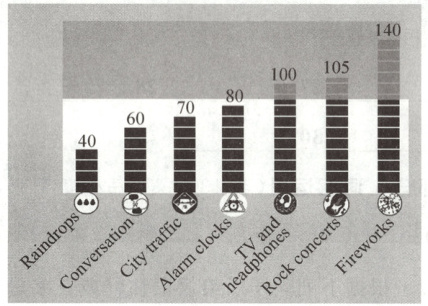
Sounds are measured(测量) in decibels(分贝). Look at the chart—some sounds are safe for our ears, but when a sound goes over 85 decibels, it can be harmful to our hearing. To reduce the risk of hearing loss, we shall pay attention to the loudness of the noise, the distance we are to it and how long we listen to it.
Noise levels can be measured by sound-level meters(噪声计), but you probably don’t always carry one with you. So how can you tell whether noises are too loud or not? Ask yourself: Do you have to raise your voice to be heard? Do you find it hard to hear someone about a meter away from you? Do the noises make your ears hurt or ring for some time? If your answer is YES to any of these, that probably means the noises are too loud.
Headphones are especially tricky. Many people enjoy using them, but they often listen to loud music for too long, or keep the volume(音量) so high that even other people can hear the noise from their headphones. These can lead to hearing loss.
Your hearing is a gift. You need it for learning, communicating, and enjoying the world. Once your hearing is harmed, it may never come back.
54. According to the chart, what sounds can harm your hearing?
55. How can you know if the noises are too loud? (Give 2 examples.)
56. Why is hearing important? What can you do to protect it?
请认真阅读下面短文,用英语回答短文后的问题,并将答案写在横线上。
Every day, we hear sounds all around us—some soft, some loud. But do you know that loud sounds can harm your hearing?
Sounds are measured(测量) in decibels(分贝). Look at the chart—some sounds are safe for our ears, but when a sound goes over 85 decibels, it can be harmful to our hearing. To reduce the risk of hearing loss, we shall pay attention to the loudness of the noise, the distance we are to it and how long we listen to it.
Noise levels can be measured by sound-level meters(噪声计), but you probably don’t always carry one with you. So how can you tell whether noises are too loud or not? Ask yourself: Do you have to raise your voice to be heard? Do you find it hard to hear someone about a meter away from you? Do the noises make your ears hurt or ring for some time? If your answer is YES to any of these, that probably means the noises are too loud.
Headphones are especially tricky. Many people enjoy using them, but they often listen to loud music for too long, or keep the volume(音量) so high that even other people can hear the noise from their headphones. These can lead to hearing loss.
Your hearing is a gift. You need it for learning, communicating, and enjoying the world. Once your hearing is harmed, it may never come back.
54. According to the chart, what sounds can harm your hearing?
TV,headphones,rock concerts,and fireworks.
55. How can you know if the noises are too loud? (Give 2 examples.)
When/If I have to raise my voice to be heard;When/If I find it hard to hear someone about a meter away from me;When/If the noises make my ears hurt or ring for some time.
56. Why is hearing important? What can you do to protect it?
Because we need it for learning,communicating,and enjoying the world. We should not use headphones for too long./We should keep away from the loud noises./We can turn down the music./We can use headphones less.
答案:
第六部分
文体:说明文
文章大意:本文主要介绍了高分贝噪声对听力的危害、如何判断噪声是否过大以及保护听力的重要性。
54.TV,headphones,rock concerts,and fireworks.
根据第二段中“Look at the chart—some sounds are safe for our ears,but when a sound goes over 85 decibels,it can be harmful to our hearing.”可知,有些声音对我们的耳朵是安全的,但是当声音超过85分贝时,它可能对我们的听力有害。结合图表所示,电视和耳机、摇滚音乐会和烟花爆竹的声音都超过了85分贝,因此这些声音都可能损伤我们的听力。
55.When/If I have to raise my voice to be heard;When/If I find it hard to hear someone about a meter away from me;When/If the noises make my ears hurt or ring for some time. 根据第三段中“So how can you tell whether noises are too loud or not ... that probably means the noises are too loud.”可知,如果噪声太大,说话人必须提高声音才能被听到,会听不到一米远的人说话,或者这些噪声会让耳朵疼痛或引起耳鸣。从中任选两个回答即可。
56.Because we need it for learning,communicating,and enjoying the world. We should not use headphones for too long./We should keep away from the loud noises./We can turn down the music./We can use headphones less. 根据最后一段中“You need it for learning,communicating,and enjoying the world.”可知,听力之所以重要是因为我们需要靠它来学习、交流、享受这个世界。本题为开放性试题,答案不唯一,言之有理即可。
文体:说明文
文章大意:本文主要介绍了高分贝噪声对听力的危害、如何判断噪声是否过大以及保护听力的重要性。
54.TV,headphones,rock concerts,and fireworks.
根据第二段中“Look at the chart—some sounds are safe for our ears,but when a sound goes over 85 decibels,it can be harmful to our hearing.”可知,有些声音对我们的耳朵是安全的,但是当声音超过85分贝时,它可能对我们的听力有害。结合图表所示,电视和耳机、摇滚音乐会和烟花爆竹的声音都超过了85分贝,因此这些声音都可能损伤我们的听力。
55.When/If I have to raise my voice to be heard;When/If I find it hard to hear someone about a meter away from me;When/If the noises make my ears hurt or ring for some time. 根据第三段中“So how can you tell whether noises are too loud or not ... that probably means the noises are too loud.”可知,如果噪声太大,说话人必须提高声音才能被听到,会听不到一米远的人说话,或者这些噪声会让耳朵疼痛或引起耳鸣。从中任选两个回答即可。
56.Because we need it for learning,communicating,and enjoying the world. We should not use headphones for too long./We should keep away from the loud noises./We can turn down the music./We can use headphones less. 根据最后一段中“You need it for learning,communicating,and enjoying the world.”可知,听力之所以重要是因为我们需要靠它来学习、交流、享受这个世界。本题为开放性试题,答案不唯一,言之有理即可。
查看更多完整答案,请扫码查看

