

 搜索
搜索
2026年江苏13大市中考名卷优选38套英语
注:目前有些书本章节名称可能整理的还不是很完善,但都是按照顺序排列的,请同学们按照顺序仔细查找。练习册 2026年江苏13大市中考名卷优选38套英语 答案主要是用来给同学们做完题方便对答案用的,请勿直接抄袭。
第35页
- 第1页
- 第2页
- 第3页
- 第4页
- 第5页
- 第6页
- 第7页
- 第8页
- 第9页
- 第10页
- 第11页
- 第12页
- 第13页
- 第14页
- 第15页
- 第16页
- 第17页
- 第18页
- 第19页
- 第20页
- 第21页
- 第22页
- 第23页
- 第24页
- 第25页
- 第26页
- 第27页
- 第28页
- 第29页
- 第30页
- 第31页
- 第32页
- 第33页
- 第34页
- 第35页
- 第36页
- 第37页
- 第38页
- 第39页
- 第40页
- 第41页
- 第42页
- 第43页
- 第44页
- 第45页
- 第46页
- 第47页
- 第48页
- 第49页
- 第50页
- 第51页
- 第52页
- 第53页
- 第54页
- 第55页
- 第56页
- 第57页
- 第58页
- 第59页
- 第60页
- 第61页
- 第62页
- 第63页
- 第64页
- 第65页
- 第66页
- 第67页
- 第68页
- 第69页
- 第70页
- 第71页
- 第72页
- 第73页
- 第74页
- 第75页
- 第76页
- 第77页
- 第78页
- 第79页
- 第80页
- 第81页
- 第82页
- 第83页
- 第84页
- 第85页
- 第86页
- 第87页
- 第88页
- 第89页
- 第90页
- 第91页
- 第92页
- 第93页
- 第94页
- 第95页
- 第96页
- 第97页
- 第98页
- 第99页
- 第100页
- 第101页
- 第102页
- 第103页
- 第104页
- 第105页
- 第106页
- 第107页
- 第108页
- 第109页
- 第110页
- 第111页
- 第112页
- 第113页
- 第114页
- 第115页
- 第116页
- 第117页
- 第118页
- 第119页
- 第120页
- 第121页
- 第122页
- 第123页
- 第124页
- 第125页
- 第126页
- 第127页
- 第128页
- 第129页
- 第130页
- 第131页
- 第132页
- 第133页
- 第134页
- 第135页
- 第136页
- 第137页
- 第138页
- 第139页
- 第140页
- 第141页
- 第142页
- 第143页
- 第144页
- 第145页
- 第146页
- 第147页
- 第148页
- 第149页
- 第150页
- 第151页
- 第152页
- 第153页
- 第154页
- 第155页
- 第156页
- 第157页
- 第158页
- 第159页
- 第160页
- 第161页
- 第162页
- 第163页
- 第164页
- 第165页
- 第166页
- 第167页
- 第168页
- 第169页
- 第170页
- 第171页
- 第172页
- 第173页
- 第174页
- 第175页
- 第176页
- 第177页
- 第178页
- 第179页
- 第180页
- 第181页
- 第182页
- 第183页
- 第184页
- 第185页
- 第186页
- 第187页
- 第188页
- 第189页
- 第190页
- 第191页
- 第192页
- 第193页
- 第194页
- 第195页
- 第196页
- 第197页
- 第198页
- 第199页
A(2025南京秦淮一模)
How do your classmates stay calm during
exams? Why can they fix group work problems
quickly or solve fights with friends? The secret isn't
being "born smart"—they ask themselves simple
questions like, "What should I do next?" or "Is
there a better way?" This skill is called
"metacognition".
Understanding metacognition
Metacognition means "thinking about how you
think". Imagine it as a map for your brain—it helps
you see your learning path clearly. Scientist John
Flavell said, "It's like knowing what you know and
what you don't know." People who use
metacognition well break a big task into small ones
(plan), find mistakes quickly(check), try new ways
if something doesn't work(fix) and use what worked
before in new situations(learn). In this way, people
can work out problems faster with less trouble and
effort.
Real - life examples of metacognition
Preparing for exams. Tom breaks his study into
two parts—30 minutes for notes and 10 minutes for
his problems. Later, he asks, "Can I explain this to
my classmates?" If not, he marks difficult parts or
watches short videos to help himself learn faster.
Working in a group. Lisa divides tasks into
"research" and "writing" and then sets weekly
Friday meetings. When a member is absent, she
calmly gives the tasks to others and uses the group
chat to share their work. In this way, the project
can be finished on time.
Managing moods. When a friend suddenly
changes the outing plan, Mike stops for a moment,
takes a deep breath and asks himself "Am I angry
because of this?" He then sends WeChat messages
to his friend, "Can we meet another day?" This calm
way of dealing with his awful feelings is a better
choice.
Practising metacognition
When you're working, ask yourself questions
like, "What should I do now?", "Is this helpful?" or
"Is there a better way?" Write down good ideas in a
notebook, or try to explain them out. If you can't
explain them clearly, go back and review the parts
you don't understand. When you're trapped, think:
"How will someone else solve this?" Maybe they
will research first, break the task into small ones or
ask for others' help. Try to do what they do!
Why it matters
Metacognition turns "not understanding" into
"clear understanding". Whether solving Maths
problems or facing daily challenges, paying attention
to how you think helps you make better decisions.
Remember: The best learners don't just work hard,
but also use metacognition to work smarter.
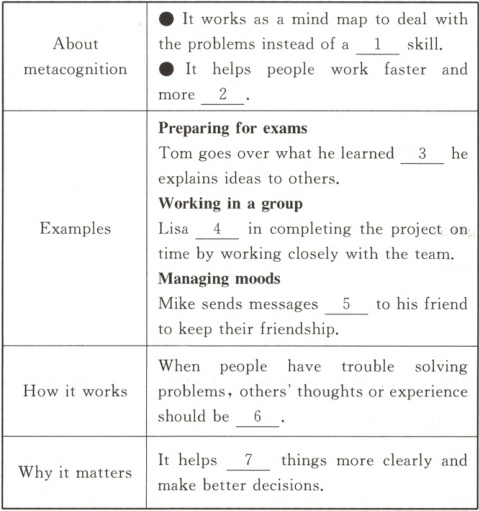
1.
2.
3.
4.
5.
6.
7.
8.
9.
How do your classmates stay calm during
exams? Why can they fix group work problems
quickly or solve fights with friends? The secret isn't
being "born smart"—they ask themselves simple
questions like, "What should I do next?" or "Is
there a better way?" This skill is called
"metacognition".
Understanding metacognition
Metacognition means "thinking about how you
think". Imagine it as a map for your brain—it helps
you see your learning path clearly. Scientist John
Flavell said, "It's like knowing what you know and
what you don't know." People who use
metacognition well break a big task into small ones
(plan), find mistakes quickly(check), try new ways
if something doesn't work(fix) and use what worked
before in new situations(learn). In this way, people
can work out problems faster with less trouble and
effort.
Real - life examples of metacognition
Preparing for exams. Tom breaks his study into
two parts—30 minutes for notes and 10 minutes for
his problems. Later, he asks, "Can I explain this to
my classmates?" If not, he marks difficult parts or
watches short videos to help himself learn faster.
Working in a group. Lisa divides tasks into
"research" and "writing" and then sets weekly
Friday meetings. When a member is absent, she
calmly gives the tasks to others and uses the group
chat to share their work. In this way, the project
can be finished on time.
Managing moods. When a friend suddenly
changes the outing plan, Mike stops for a moment,
takes a deep breath and asks himself "Am I angry
because of this?" He then sends WeChat messages
to his friend, "Can we meet another day?" This calm
way of dealing with his awful feelings is a better
choice.
Practising metacognition
When you're working, ask yourself questions
like, "What should I do now?", "Is this helpful?" or
"Is there a better way?" Write down good ideas in a
notebook, or try to explain them out. If you can't
explain them clearly, go back and review the parts
you don't understand. When you're trapped, think:
"How will someone else solve this?" Maybe they
will research first, break the task into small ones or
ask for others' help. Try to do what they do!
Why it matters
Metacognition turns "not understanding" into
"clear understanding". Whether solving Maths
problems or facing daily challenges, paying attention
to how you think helps you make better decisions.
Remember: The best learners don't just work hard,
but also use metacognition to work smarter.
1.
born
2.
easily
3.
before
4.
succeeds
5.
calmly
6.
considered
7.
understand
8.
Plan, check, fix and learn.
9.
To enhance myself, I’ll cultivate metacognition, break tasks into steps, reflect regularly, communicate effectively, manage emotions, share ideas, and seek help when needed.
答案:
B11 语言运用提优卷(四)
A
文体:说明文
文章大意:本文主要介绍了元认知(metacognition)的概念、重要性以及如何在现实生活中应用和实践元认知技能。
1. born 根据第一段中“The secret isn’t being ‘born smart’”可知,元认知不是一种“天生的”的技能,形容词做定语。
plus解题技巧
同义替换法:not being “born smart”对应 born skill。
2. easily 根据第二段段末“In this way, people can work out problems faster with less trouble and effort.”可知,通过这种方式,人们能够更快地解决问题,同时减少麻烦和少付出努力,说明解决问题更“容易”,副词修饰动词。
3. before 根据第三段中“Tom breaks his study into two parts—30 minutes for notes and 10 minutes for his problems. Later, he asks, ‘Can I explain this to my classmates?’”可知,Tom在给同学解释“之前”复习笔记和问题。
4. succeeds 根据第四段中“In this way, the project can be finished on time.”可知,Lisa“成功”完成任务,时态为一般现在时,主语是第三人称单数,谓语动词用三单。
5. calmly 根据第五段中“He then sends WeChat messages to his friend, ‘Can we meet another day?’ This calm way of dealing with his awful feelings is a better choice.”可知,Mike“冷静地”给他的朋友发信息来处理他糟糕情绪的方式,副词修饰动词。
6. considered 根据第六段中“When you’re trapped, think: ‘How will someone else solve this?’ Maybe they will research first, break the task into small ones or ask for others’ help.”可知,当你陷入困境时,想想别人会怎么解决这个问题。因此当人们在解决问题时遇到困难时,应该“考虑”别人的想法或经验。此处用过去分词与is构成一般现在时的被动语态。
7. understand 根据最后一段中“Metacognition turns ‘not understanding’ into ‘clear understanding’.”可知,元认知有助于更清楚地“理解”事物,help do sth“帮助做某事”,谓语动词用原形。
8. Plan, check, fix and learn. 根据第二段中“People who use metacognition well break a big task into small ones (plan), find mistakes quickly (check), try new ways if something doesn’t work (fix) and use what worked before in new situations (learn).”可知,善于运用元认知的人会将大任务分解成小任务(计划),快速发现错误(检查),如果有些事情行不通时尝试新的方法(修复),并在新的情况下使用以前有效的方法(学习)。
plus解题技巧
归纳概括法:根据“plan”,“check”,“fix”,“learn”四个步骤,直接提炼答案。
9. To enhance myself, I’ll cultivate metacognition, break tasks into steps, reflect regularly, communicate effectively, manage emotions, share ideas, and seek help when needed. (开放性问题,言之有理即可。)
plus拨云见日
术语与实例的对应:metacognition通过“Tom备考”“Lisa团队合作”等实例具象化,理解时需“术语—案例”双向对照。实践步骤的逻辑性:“plan→check→fix→learn”是递进关系,体现“先规划,再修正,最后总结”的科学方法。
A
文体:说明文
文章大意:本文主要介绍了元认知(metacognition)的概念、重要性以及如何在现实生活中应用和实践元认知技能。
1. born 根据第一段中“The secret isn’t being ‘born smart’”可知,元认知不是一种“天生的”的技能,形容词做定语。
plus解题技巧
同义替换法:not being “born smart”对应 born skill。
2. easily 根据第二段段末“In this way, people can work out problems faster with less trouble and effort.”可知,通过这种方式,人们能够更快地解决问题,同时减少麻烦和少付出努力,说明解决问题更“容易”,副词修饰动词。
3. before 根据第三段中“Tom breaks his study into two parts—30 minutes for notes and 10 minutes for his problems. Later, he asks, ‘Can I explain this to my classmates?’”可知,Tom在给同学解释“之前”复习笔记和问题。
4. succeeds 根据第四段中“In this way, the project can be finished on time.”可知,Lisa“成功”完成任务,时态为一般现在时,主语是第三人称单数,谓语动词用三单。
5. calmly 根据第五段中“He then sends WeChat messages to his friend, ‘Can we meet another day?’ This calm way of dealing with his awful feelings is a better choice.”可知,Mike“冷静地”给他的朋友发信息来处理他糟糕情绪的方式,副词修饰动词。
6. considered 根据第六段中“When you’re trapped, think: ‘How will someone else solve this?’ Maybe they will research first, break the task into small ones or ask for others’ help.”可知,当你陷入困境时,想想别人会怎么解决这个问题。因此当人们在解决问题时遇到困难时,应该“考虑”别人的想法或经验。此处用过去分词与is构成一般现在时的被动语态。
7. understand 根据最后一段中“Metacognition turns ‘not understanding’ into ‘clear understanding’.”可知,元认知有助于更清楚地“理解”事物,help do sth“帮助做某事”,谓语动词用原形。
8. Plan, check, fix and learn. 根据第二段中“People who use metacognition well break a big task into small ones (plan), find mistakes quickly (check), try new ways if something doesn’t work (fix) and use what worked before in new situations (learn).”可知,善于运用元认知的人会将大任务分解成小任务(计划),快速发现错误(检查),如果有些事情行不通时尝试新的方法(修复),并在新的情况下使用以前有效的方法(学习)。
plus解题技巧
归纳概括法:根据“plan”,“check”,“fix”,“learn”四个步骤,直接提炼答案。
9. To enhance myself, I’ll cultivate metacognition, break tasks into steps, reflect regularly, communicate effectively, manage emotions, share ideas, and seek help when needed. (开放性问题,言之有理即可。)
plus拨云见日
术语与实例的对应:metacognition通过“Tom备考”“Lisa团队合作”等实例具象化,理解时需“术语—案例”双向对照。实践步骤的逻辑性:“plan→check→fix→learn”是递进关系,体现“先规划,再修正,最后总结”的科学方法。
查看更多完整答案,请扫码查看

