

 搜索
搜索
第50页
- 第1页
- 第2页
- 第3页
- 第4页
- 第5页
- 第6页
- 第7页
- 第8页
- 第9页
- 第10页
- 第11页
- 第12页
- 第13页
- 第14页
- 第15页
- 第16页
- 第17页
- 第18页
- 第19页
- 第20页
- 第21页
- 第22页
- 第23页
- 第24页
- 第25页
- 第26页
- 第27页
- 第28页
- 第29页
- 第30页
- 第31页
- 第32页
- 第33页
- 第34页
- 第35页
- 第36页
- 第37页
- 第38页
- 第39页
- 第40页
- 第41页
- 第42页
- 第43页
- 第44页
- 第45页
- 第46页
- 第47页
- 第48页
- 第49页
- 第50页
- 第51页
- 第52页
- 第53页
- 第54页
- 第55页
- 第56页
- 第57页
- 第58页
- 第59页
- 第60页
- 第61页
- 第62页
- 第63页
- 第64页
- 第65页
- 第66页
- 第67页
- 第68页
- 第69页
- 第70页
- 第71页
- 第72页
- 第73页
- 第74页
- 第75页
- 第76页
- 第77页
- 第78页
- 第79页
- 第80页
- 第81页
- 第82页
- 第83页
- 第84页
- 第85页
- 第86页
- 第87页
- 第88页
- 第89页
- 第90页
- 第91页
- 第92页
- 第93页
- 第94页
- 第95页
- 第96页
- 第97页
- 第98页
- 第99页
13 对于不相等的两个数a,b,定义$min\{ a,b\}$的含义为:当$a\lt b$时,$min\{ a,b\} = a$;当$a>b$时,$min\{ a,b\} = b$.例如:$min\{ 1,-2\} = -2$.已知$min\{ \sqrt {29},a\} = a,min\{ \sqrt {34},b\} = \sqrt {34}$,且a和b为两个连续正整数,则$3a-2b$的值为
3
.
答案:
3 由题意,得$a<\sqrt{29}$,$b>\sqrt{34}$.$\because 5<\sqrt{29}<6$,$5<\sqrt{34}<6$,$a$和$b$为两个连续正整数,$\therefore a=5$,$b=6$,$\therefore 3a-2b=3× 5-2× 6=15-12=3$.
14 一个数值转换器的原理如图所示.
[img]
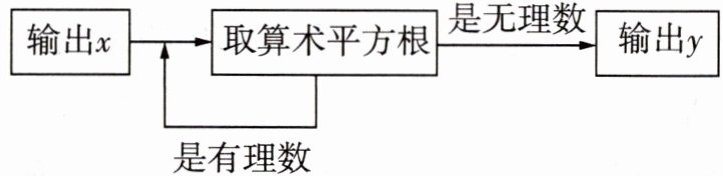
(1)当输入的x值为16时,求输出的y值.
(2)是否存在输入的x值后,始终输不出y值?如果存在,请直接写出所有满足要求的x值;如果不存在,请说明理由.
(3)输入一个两位数x,恰好经过两次取算术平方根才能输出无理数,则这个两位数x是____.
[img]
(1)当输入的x值为16时,求输出的y值.
解:当$x=16$时,$\sqrt{16}=4$(有理数),$\sqrt{4}=2$(有理数),$\sqrt{2}$是无理数,$\therefore y=\sqrt{2}$.
(2)是否存在输入的x值后,始终输不出y值?如果存在,请直接写出所有满足要求的x值;如果不存在,请说明理由.
解:存在.$x=0$或1或负数.
(3)输入一个两位数x,恰好经过两次取算术平方根才能输出无理数,则这个两位数x是____.
25或36或49或64
答案:
解:
(1)当$x=16$时,$\sqrt{16}=4$(有理数),$\sqrt{4}=2$(有理数),$\sqrt{2}$是无理数,$\therefore y=\sqrt{2}$.
(2)存在.$x=0$或1或负数.
(3)25或36或49或64$x=[(\sqrt{5})^{2}]^{2}=25$或$x=[(\sqrt{6})^{2}]^{2}=36$或$x=[(\sqrt{7})^{2}]^{2}=49$或$x=[(\sqrt{8})^{2}]^{2}=64$.
(1)当$x=16$时,$\sqrt{16}=4$(有理数),$\sqrt{4}=2$(有理数),$\sqrt{2}$是无理数,$\therefore y=\sqrt{2}$.
(2)存在.$x=0$或1或负数.
(3)25或36或49或64$x=[(\sqrt{5})^{2}]^{2}=25$或$x=[(\sqrt{6})^{2}]^{2}=36$或$x=[(\sqrt{7})^{2}]^{2}=49$或$x=[(\sqrt{8})^{2}]^{2}=64$.
15 推理能力 定义:若无理数$\sqrt {T}$的被开方数(T为正整数)满足$n^{2}\lt T<(n+1)^{2}$(其中n为正整数),则称无理数$\sqrt {T}$的“共同体区间”为$(n,n+1)$.例如:因为$1^{2}<3<2^{2}$,所以$\sqrt {3}$的“共同体区间”为$(1,2)$.请回答下列问题:
(1)$\sqrt {26}$的“共同体区间”为
(2)若无理数$\sqrt {a}$的“共同体区间”为$(2,3)$,求$\sqrt {a+6}$的“共同体区间”;
(3)若整数x,y满足关系式:$\sqrt {x-3}+|2023+(y-4)^{2}|= 2024$,求$\sqrt {x(y+1)}$的“共同体区间”.
(1)$\sqrt {26}$的“共同体区间”为
(5,6)
;(2)若无理数$\sqrt {a}$的“共同体区间”为$(2,3)$,求$\sqrt {a+6}$的“共同体区间”;
解:$\because$无理数$\sqrt{a}$的“共同体区间”为$(2,3)$,$\therefore 2^{2}<a<3^{2}$,即$4<a<9$,$\therefore 10<a+6<15$,$\therefore 3^{2}<a+6<4^{2}$,$\therefore \sqrt{a+6}$的“共同体区间”为$(3,4)$.
(3)若整数x,y满足关系式:$\sqrt {x-3}+|2023+(y-4)^{2}|= 2024$,求$\sqrt {x(y+1)}$的“共同体区间”.
解:$\because \sqrt{x-3}+\vert 2023+(y-4)^{2}\vert =2024$,$\therefore \left\{\begin{array}{l} \sqrt{x-3}=1,\\ (y-4)^{2}=0\end{array}\right. $或$\left\{\begin{array}{l} \sqrt{x-3}=0,\\ (y-4)^{2}=1,\end{array}\right. $解得$\left\{\begin{array}{l} x=4,\\ y=4\end{array}\right. $或$\left\{\begin{array}{l} x=3,\\ y=5\end{array}\right. $或$\left\{\begin{array}{l} x=3,\\ y=3.\end{array}\right. $当$x=4,y=4$时,$x(y+1)=20$,$\because 4^{2}<20<5^{2}$,$\therefore \sqrt{x(y+1)}$的“共同体区间”为$(4,5)$.当$x=3,y=5$时,$x(y+1)=18$,$\because 4^{2}<18<5^{2}$,$\therefore \sqrt{x(y+1)}$的“共同体区间”为$(4,5)$.当$x=3,y=3$时,$x(y+1)=12$,$\because 3^{2}<12<4^{2}$,$\therefore \sqrt{x(y+1)}$的“共同体区间”为$(3,4)$.综上可知,$\sqrt{x(y+1)}$的“共同体区间”为$(4,5)$或$(3,4)$.
答案:
解:
(1)$(5,6)$$\because 5^{2}<26<6^{2}$,$\therefore \sqrt{26}$的“共同体区间”是$(5,6)$.
(2)$\because$无理数$\sqrt{a}$的“共同体区间”为$(2,3)$,$\therefore 2^{2}<a<3^{2}$,即$4<a<9$,$\therefore 10<a+6<15$,$\therefore 3^{2}<a+6<4^{2}$,$\therefore \sqrt{a+6}$的“共同体区间”为$(3,4)$.
(3)$\because \sqrt{x-3}+\vert 2023+(y-4)^{2}\vert =2024$,$\therefore \left\{\begin{array}{l} \sqrt{x-3}=1,\\ (y-4)^{2}=0\end{array}\right. $或$\left\{\begin{array}{l} \sqrt{x-3}=0,\\ (y-4)^{2}=1,\end{array}\right. $解得$\left\{\begin{array}{l} x=4,\\ y=4\end{array}\right. $或$\left\{\begin{array}{l} x=3,\\ y=5\end{array}\right. $或$\left\{\begin{array}{l} x=3,\\ y=3.\end{array}\right. $当$x=4,y=4$时,$x(y+1)=20$,$\because 4^{2}<20<5^{2}$,$\therefore \sqrt{x(y+1)}$的“共同体区间”为$(4,5)$.当$x=3,y=5$时,$x(y+1)=18$,$\because 4^{2}<18<5^{2}$,$\therefore \sqrt{x(y+1)}$的“共同体区间”为$(4,5)$.当$x=3,y=3$时,$x(y+1)=12$,$\because 3^{2}<12<4^{2}$,$\therefore \sqrt{x(y+1)}$的“共同体区间”为$(3,4)$.综上可知,$\sqrt{x(y+1)}$的“共同体区间”为$(4,5)$或$(3,4)$.
(1)$(5,6)$$\because 5^{2}<26<6^{2}$,$\therefore \sqrt{26}$的“共同体区间”是$(5,6)$.
(2)$\because$无理数$\sqrt{a}$的“共同体区间”为$(2,3)$,$\therefore 2^{2}<a<3^{2}$,即$4<a<9$,$\therefore 10<a+6<15$,$\therefore 3^{2}<a+6<4^{2}$,$\therefore \sqrt{a+6}$的“共同体区间”为$(3,4)$.
(3)$\because \sqrt{x-3}+\vert 2023+(y-4)^{2}\vert =2024$,$\therefore \left\{\begin{array}{l} \sqrt{x-3}=1,\\ (y-4)^{2}=0\end{array}\right. $或$\left\{\begin{array}{l} \sqrt{x-3}=0,\\ (y-4)^{2}=1,\end{array}\right. $解得$\left\{\begin{array}{l} x=4,\\ y=4\end{array}\right. $或$\left\{\begin{array}{l} x=3,\\ y=5\end{array}\right. $或$\left\{\begin{array}{l} x=3,\\ y=3.\end{array}\right. $当$x=4,y=4$时,$x(y+1)=20$,$\because 4^{2}<20<5^{2}$,$\therefore \sqrt{x(y+1)}$的“共同体区间”为$(4,5)$.当$x=3,y=5$时,$x(y+1)=18$,$\because 4^{2}<18<5^{2}$,$\therefore \sqrt{x(y+1)}$的“共同体区间”为$(4,5)$.当$x=3,y=3$时,$x(y+1)=12$,$\because 3^{2}<12<4^{2}$,$\therefore \sqrt{x(y+1)}$的“共同体区间”为$(3,4)$.综上可知,$\sqrt{x(y+1)}$的“共同体区间”为$(4,5)$或$(3,4)$.
【思考】有理数和无理数有什么区别?
答案:
【解析】:
本题主要考察有理数和无理数的定义及其区别。
有理数是可以表示为两个整数的比的数,即形如$\frac{p}{q}$($q \neq 0$)的数,包括整数、有限小数和无限循环小数。
无理数则不能表示为两个整数的比,它们是无限不循环的小数,如$\pi$、$e$等。
【答案】:
有理数是可以表示为两个整数的比的数,包括整数、有限小数和无限循环小数;
无理数则不能表示为两个整数的比,是无限不循环的小数。
本题主要考察有理数和无理数的定义及其区别。
有理数是可以表示为两个整数的比的数,即形如$\frac{p}{q}$($q \neq 0$)的数,包括整数、有限小数和无限循环小数。
无理数则不能表示为两个整数的比,它们是无限不循环的小数,如$\pi$、$e$等。
【答案】:
有理数是可以表示为两个整数的比的数,包括整数、有限小数和无限循环小数;
无理数则不能表示为两个整数的比,是无限不循环的小数。
查看更多完整答案,请扫码查看

