

 搜索
搜索
第97页
- 第1页
- 第2页
- 第3页
- 第4页
- 第5页
- 第6页
- 第7页
- 第8页
- 第9页
- 第10页
- 第11页
- 第12页
- 第13页
- 第14页
- 第15页
- 第16页
- 第17页
- 第18页
- 第19页
- 第20页
- 第21页
- 第22页
- 第23页
- 第24页
- 第25页
- 第26页
- 第27页
- 第28页
- 第29页
- 第30页
- 第31页
- 第32页
- 第33页
- 第34页
- 第35页
- 第36页
- 第37页
- 第38页
- 第39页
- 第40页
- 第41页
- 第42页
- 第43页
- 第44页
- 第45页
- 第46页
- 第47页
- 第48页
- 第49页
- 第50页
- 第51页
- 第52页
- 第53页
- 第54页
- 第55页
- 第56页
- 第57页
- 第58页
- 第59页
- 第60页
- 第61页
- 第62页
- 第63页
- 第64页
- 第65页
- 第66页
- 第67页
- 第68页
- 第69页
- 第70页
- 第71页
- 第72页
- 第73页
- 第74页
- 第75页
- 第76页
- 第77页
- 第78页
- 第79页
- 第80页
- 第81页
- 第82页
- 第83页
- 第84页
- 第85页
- 第86页
- 第87页
- 第88页
- 第89页
- 第90页
- 第91页
- 第92页
- 第93页
- 第94页
- 第95页
- 第96页
- 第97页
- 第98页
- 第99页
- 第100页
- 第101页
- 第102页
- 第103页
- 第104页
- 第105页
- 第106页
- 第107页
- 第108页
- 第109页
- 第110页
- 第111页
- 第112页
- 第113页
- 第114页
- 第115页
- 第116页
- 第117页
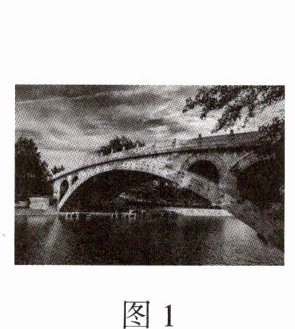
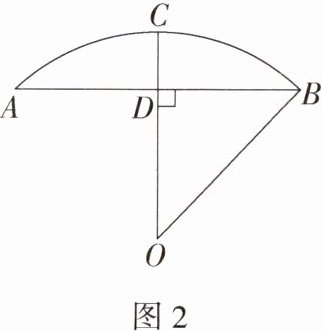
例1 石拱桥是我国古代人民勤劳和智慧的结晶(如图1),隋代建造的赵州桥距今约有1400年历史,是我国古代石拱桥的代表。图2是根据某石拱桥的实物图画出的几何图形,桥的主桥拱是圆弧形,表示为$\overset{\frown}{AB}$。桥的跨度(弧所对的弦长)$AB = 26$m,设$\overset{\frown}{AB}$所在圆的圆心为O,半径$OC\perp AB$,垂足为D。拱高(弧的中点到弦的距离)$CD = 5$m。连接OB。
(1)直接判断AD与BD的数量关系;
(2)求这座石拱桥主桥拱的半径(精确到1m)。
解题思路 (1)根据垂径定理即可得出结论;
(2)设主桥拱半径为R,在Rt$\triangle OBD$中,根据勾股定理列出方程,即可得出答案。
(1)直接判断AD与BD的数量关系;
(2)求这座石拱桥主桥拱的半径(精确到1m)。
解题思路 (1)根据垂径定理即可得出结论;
(2)设主桥拱半径为R,在Rt$\triangle OBD$中,根据勾股定理列出方程,即可得出答案。
答案:
解析
(1)$AD = BD$.
(2)设主桥拱半径为$R\ m$,
由题意可知$AB = 26\ m$,$CD = 5\ m$,
$\therefore BD=\frac{1}{2}AB = 13\ m$,$OD=(R - 5)\ m$.
$\because\angle ODB = 90^{\circ}$,$\therefore OD^{2}+BD^{2}=OB^{2}$,
$\therefore (R - 5)^{2}+13^{2}=R^{2}$,
解得$R = 19.4\approx19$.
答:这座石拱桥主桥拱的半径约为19 m.
(1)$AD = BD$.
(2)设主桥拱半径为$R\ m$,
由题意可知$AB = 26\ m$,$CD = 5\ m$,
$\therefore BD=\frac{1}{2}AB = 13\ m$,$OD=(R - 5)\ m$.
$\because\angle ODB = 90^{\circ}$,$\therefore OD^{2}+BD^{2}=OB^{2}$,
$\therefore (R - 5)^{2}+13^{2}=R^{2}$,
解得$R = 19.4\approx19$.
答:这座石拱桥主桥拱的半径约为19 m.
变式1 已知$\odot O$的半径为7,AB是$\odot O$的弦,点P在弦AB上。若$PA = 4$,$PB = 6$,则OP的长度为( )
A.$\sqrt{14}$
B.4
C.$\sqrt{23}$
D.5
A.$\sqrt{14}$
B.4
C.$\sqrt{23}$
D.5
答案:
D 如图,连接$OB$,过点$O$作$OM\perp AB$于$M$,
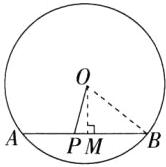
由垂径定理可得$MB=\frac{1}{2}AB=\frac{1}{2}(AP + BP)=5$,$\therefore MP = BP - MB = 6 - 5 = 1$.
在$Rt\triangle OMB$中,$OM^{2}=OB^{2}-MB^{2}=7^{2}-5^{2}=24$. 在$Rt\triangle OPM$中,$OP=\sqrt{OM^{2}+PM^{2}}=\sqrt{24 + 1}=5$.
D 如图,连接$OB$,过点$O$作$OM\perp AB$于$M$,
由垂径定理可得$MB=\frac{1}{2}AB=\frac{1}{2}(AP + BP)=5$,$\therefore MP = BP - MB = 6 - 5 = 1$.
在$Rt\triangle OMB$中,$OM^{2}=OB^{2}-MB^{2}=7^{2}-5^{2}=24$. 在$Rt\triangle OPM$中,$OP=\sqrt{OM^{2}+PM^{2}}=\sqrt{24 + 1}=5$.
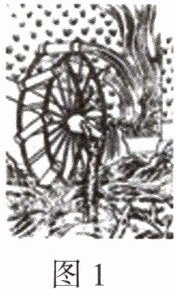
变式2 筒车是我国古代发明的一种水利灌溉工具,明朝科学家徐光启在《农政全书》中用图画描绘了筒车的工作原理,如图1。筒车盛水桶的运行轨道是以轴心O为圆心的圆,如图2。已知圆心O在水面上方,且$\odot O$被水面截得的弦AB长为6米,$\odot O$半径长为4米。若点C为运行轨道的最低点,则点C到弦AB所在直线的距离是( )
A.1米 B.$(4 - \sqrt{7})$米 C.2米 D.$(4 + \sqrt{7})$米
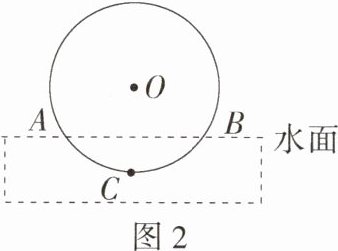
A.1米 B.$(4 - \sqrt{7})$米 C.2米 D.$(4 + \sqrt{7})$米
答案:
B 连接$OC$交$AB$于$D$,连接$OA$,$\because$点$C$为运行轨道的最低点,
$\therefore OC\perp AB$,$\therefore AD=\frac{1}{2}AB = 3$米,
在$Rt\triangle OAD$中,$OD=\sqrt{OA^{2}-AD^{2}}=\sqrt{4^{2}-3^{2}}=\sqrt{7}$(米),
$\therefore$点$C$到弦$AB$所在直线的距离$CD = OC - OD=(4-\sqrt{7})$米.
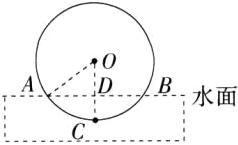
B 连接$OC$交$AB$于$D$,连接$OA$,$\because$点$C$为运行轨道的最低点,
$\therefore OC\perp AB$,$\therefore AD=\frac{1}{2}AB = 3$米,
在$Rt\triangle OAD$中,$OD=\sqrt{OA^{2}-AD^{2}}=\sqrt{4^{2}-3^{2}}=\sqrt{7}$(米),
$\therefore$点$C$到弦$AB$所在直线的距离$CD = OC - OD=(4-\sqrt{7})$米.
例2 如图,AB是$\odot O$的直径,点C是$\odot O$上异于A、B的点,连接AC,BC,点D在BA的延长线上,且$\angle DCA = \angle ABC$,求证:DC是$\odot O$的切线。
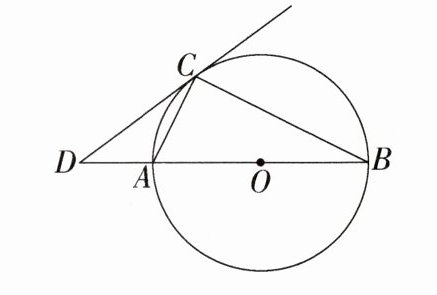
解题思路 连接OC,根据圆周角定理得到$\angle ACB = 90^{\circ}$,根据等量代换得到$\angle DCO = 90^{\circ}$,即可证明DC是$\odot O$的切线。
解题思路 连接OC,根据圆周角定理得到$\angle ACB = 90^{\circ}$,根据等量代换得到$\angle DCO = 90^{\circ}$,即可证明DC是$\odot O$的切线。
答案:
证明 连接$OC$,由题意知$\angle ACB$是直径$AB$所对的圆周角,
$\therefore\angle ACB = 90^{\circ}$.
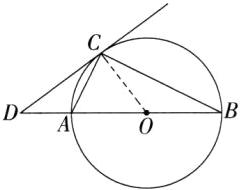
$\because OC$、$OB$是$\odot O$的半径,
$\therefore OC = OB$,$\therefore\angle OCB=\angle ABC$.
又$\because\angle DCA=\angle ABC$,$\therefore\angle DCA=\angle OCB$,
$\therefore\angle DCO=\angle DCA+\angle ACO=\angle OCB+\angle ACO=\angle ACB = 90^{\circ}$,
$\therefore OC\perp DC$. 又$\because OC$是$\odot O$的半径,
$\therefore DC$是$\odot O$的切线.
证明 连接$OC$,由题意知$\angle ACB$是直径$AB$所对的圆周角,
$\therefore\angle ACB = 90^{\circ}$.
$\because OC$、$OB$是$\odot O$的半径,
$\therefore OC = OB$,$\therefore\angle OCB=\angle ABC$.
又$\because\angle DCA=\angle ABC$,$\therefore\angle DCA=\angle OCB$,
$\therefore\angle DCO=\angle DCA+\angle ACO=\angle OCB+\angle ACO=\angle ACB = 90^{\circ}$,
$\therefore OC\perp DC$. 又$\because OC$是$\odot O$的半径,
$\therefore DC$是$\odot O$的切线.
查看更多完整答案,请扫码查看

