

 搜索
搜索
第98页
- 第1页
- 第2页
- 第3页
- 第4页
- 第5页
- 第6页
- 第7页
- 第8页
- 第9页
- 第10页
- 第11页
- 第12页
- 第13页
- 第14页
- 第15页
- 第16页
- 第17页
- 第18页
- 第19页
- 第20页
- 第21页
- 第22页
- 第23页
- 第24页
- 第25页
- 第26页
- 第27页
- 第28页
- 第29页
- 第30页
- 第31页
- 第32页
- 第33页
- 第34页
- 第35页
- 第36页
- 第37页
- 第38页
- 第39页
- 第40页
- 第41页
- 第42页
- 第43页
- 第44页
- 第45页
- 第46页
- 第47页
- 第48页
- 第49页
- 第50页
- 第51页
- 第52页
- 第53页
- 第54页
- 第55页
- 第56页
- 第57页
- 第58页
- 第59页
- 第60页
- 第61页
- 第62页
- 第63页
- 第64页
- 第65页
- 第66页
- 第67页
- 第68页
- 第69页
- 第70页
- 第71页
- 第72页
- 第73页
- 第74页
- 第75页
- 第76页
- 第77页
- 第78页
- 第79页
- 第80页
- 第81页
- 第82页
- 第83页
- 第84页
- 第85页
- 第86页
- 第87页
- 第88页
- 第89页
- 第90页
- 第91页
- 第92页
- 第93页
- 第94页
- 第95页
- 第96页
- 第97页
- 第98页
- 第99页
- 第100页
- 第101页
- 第102页
- 第103页
- 第104页
- 第105页
- 第106页
- 第107页
- 第108页
- 第109页
- 第110页
- 第111页
- 第112页
9. 已知点$A(-1,0)$,$B(5,0)$,$C(x,y)$。请回答下列问题:
(1)若点$C$在第三象限且$\vert x\vert = 5$,$\vert y\vert = 4$,求点$C$的坐标及$\triangle ABC$的面积。
(2)若点$C$在第二、四象限的角平分线上,且$\triangle ABC$的面积为$9$,求点$C$的坐标。
(1)若点$C$在第三象限且$\vert x\vert = 5$,$\vert y\vert = 4$,求点$C$的坐标及$\triangle ABC$的面积。
(2)若点$C$在第二、四象限的角平分线上,且$\triangle ABC$的面积为$9$,求点$C$的坐标。
答案:
(1)
由于点$C$在第三象限,根据坐标系的性质,第三象限的点横坐标和纵坐标均为负。
又因为$\vert x\vert = 5$,$\vert y\vert = 4$,所以点$C$的坐标为$(-5, -4)$。
已知点$A(-1,0)$,$B(5,0)$,所以$AB$的长度为:
$AB = \vert 5 - (-1)\vert = 6$
点$C$到$x$轴的距离为其纵坐标的绝对值,即$4$。
因此,$\triangle ABC$的面积为:
$S_{\triangle ABC} = \frac{1}{2} × AB × 4 = \frac{1}{2} × 6 × 4 = 12$
(2)
由于点$C$在第二、四象限的角平分线上,根据坐标系的性质,该线上的点满足$x = -y$。
设点$C$的坐标为$(x, -x)$。
已知$\triangle ABC$的面积为$9$,且$AB = 6$,所以:
$S_{\triangle ABC} = \frac{1}{2} × AB × \vert -x\vert = 9$
代入$AB = 6$,得:
$\frac{1}{2} × 6 × \vert -x\vert = 9$
解得:
$\vert -x\vert = 3$
即:
$x = \pm 3$
由于点$C$在第二、四象限的角平分线上,所以点$C$的坐标为$(3, -3)$或$(-3, 3)$。
由于点$C$在第三象限,根据坐标系的性质,第三象限的点横坐标和纵坐标均为负。
又因为$\vert x\vert = 5$,$\vert y\vert = 4$,所以点$C$的坐标为$(-5, -4)$。
已知点$A(-1,0)$,$B(5,0)$,所以$AB$的长度为:
$AB = \vert 5 - (-1)\vert = 6$
点$C$到$x$轴的距离为其纵坐标的绝对值,即$4$。
因此,$\triangle ABC$的面积为:
$S_{\triangle ABC} = \frac{1}{2} × AB × 4 = \frac{1}{2} × 6 × 4 = 12$
(2)
由于点$C$在第二、四象限的角平分线上,根据坐标系的性质,该线上的点满足$x = -y$。
设点$C$的坐标为$(x, -x)$。
已知$\triangle ABC$的面积为$9$,且$AB = 6$,所以:
$S_{\triangle ABC} = \frac{1}{2} × AB × \vert -x\vert = 9$
代入$AB = 6$,得:
$\frac{1}{2} × 6 × \vert -x\vert = 9$
解得:
$\vert -x\vert = 3$
即:
$x = \pm 3$
由于点$C$在第二、四象限的角平分线上,所以点$C$的坐标为$(3, -3)$或$(-3, 3)$。
10. 如图所示,已知点$A$的坐标为$(-3,-4)$,点$B$的坐标为$(5,0)$。
(1)试说明$OA = OB$。
(2)求$\triangle AOB$的面积。
(3)求原点$O$到$AB$的距离。
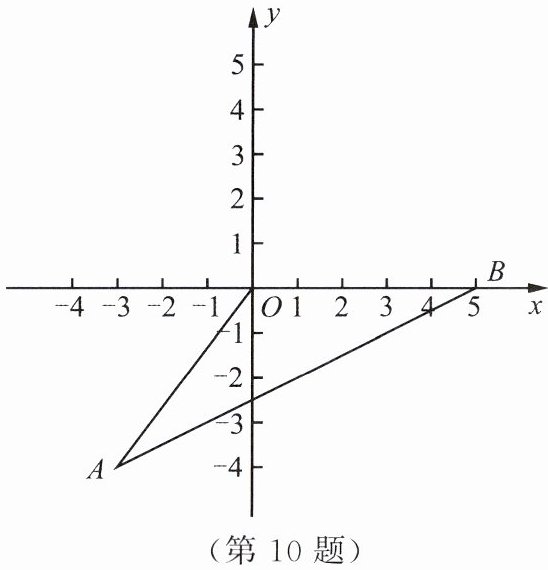
(1)试说明$OA = OB$。
(2)求$\triangle AOB$的面积。
(3)求原点$O$到$AB$的距离。
答案:
(1)点$A$的坐标为$(-3, -4)$,
$\therefore OA = \sqrt{(-3)^2 + (-4)^2} = \sqrt{9 + 16} = \sqrt{25} = 5$,
点$B$的坐标为$(5, 0)$,
$\therefore OB = \sqrt{5^2 + 0^2} = \sqrt{25} = 5$,
$\therefore OA = OB$。
(2)$\triangle AOB$的底$OB$长度为$5$,高为点$A$到$x$轴的距离,即$|-4| = 4$,
$\therefore S_{\triangle AOB} = \frac{1}{2} × OB × 高 = \frac{1}{2} × 5 × 4 = 10$。
(3)设原点$O$到$AB$的距离为$h$,
由面积法,$S_{\triangle AOB} = \frac{1}{2} × AB × h$,
$AB = \sqrt{(5 - (-3))^2 + (0 - (-4))^2} = \sqrt{8^2 + 4^2} = \sqrt{64 + 16} = \sqrt{80} = 4\sqrt{5}$,
$\therefore 10 = \frac{1}{2} × 4\sqrt{5} × h$,
$h = \frac{10 × 2}{4\sqrt{5}} = \frac{20}{4\sqrt{5}} = \frac{5}{\sqrt{5}} = \sqrt{5}$,
$\therefore$原点$O$到$AB$的距离为$\sqrt{5} (或约等于2.24)$。
$\therefore OA = \sqrt{(-3)^2 + (-4)^2} = \sqrt{9 + 16} = \sqrt{25} = 5$,
点$B$的坐标为$(5, 0)$,
$\therefore OB = \sqrt{5^2 + 0^2} = \sqrt{25} = 5$,
$\therefore OA = OB$。
(2)$\triangle AOB$的底$OB$长度为$5$,高为点$A$到$x$轴的距离,即$|-4| = 4$,
$\therefore S_{\triangle AOB} = \frac{1}{2} × OB × 高 = \frac{1}{2} × 5 × 4 = 10$。
(3)设原点$O$到$AB$的距离为$h$,
由面积法,$S_{\triangle AOB} = \frac{1}{2} × AB × h$,
$AB = \sqrt{(5 - (-3))^2 + (0 - (-4))^2} = \sqrt{8^2 + 4^2} = \sqrt{64 + 16} = \sqrt{80} = 4\sqrt{5}$,
$\therefore 10 = \frac{1}{2} × 4\sqrt{5} × h$,
$h = \frac{10 × 2}{4\sqrt{5}} = \frac{20}{4\sqrt{5}} = \frac{5}{\sqrt{5}} = \sqrt{5}$,
$\therefore$原点$O$到$AB$的距离为$\sqrt{5} (或约等于2.24)$。
查看更多完整答案,请扫码查看

