

 搜索
搜索
第42页
- 第1页
- 第2页
- 第3页
- 第4页
- 第5页
- 第6页
- 第7页
- 第8页
- 第9页
- 第10页
- 第11页
- 第12页
- 第13页
- 第14页
- 第15页
- 第16页
- 第17页
- 第18页
- 第19页
- 第20页
- 第21页
- 第22页
- 第23页
- 第24页
- 第25页
- 第26页
- 第27页
- 第28页
- 第29页
- 第30页
- 第31页
- 第32页
- 第33页
- 第34页
- 第35页
- 第36页
- 第37页
- 第38页
- 第39页
- 第40页
- 第41页
- 第42页
- 第43页
- 第44页
- 第45页
- 第46页
- 第47页
- 第48页
- 第49页
- 第50页
- 第51页
- 第52页
- 第53页
- 第54页
- 第55页
- 第56页
- 第57页
- 第58页
- 第59页
- 第60页
- 第61页
- 第62页
- 第63页
- 第64页
- 第65页
- 第66页
- 第67页
- 第68页
- 第69页
- 第70页
- 第71页
- 第72页
- 第73页
- 第74页
- 第75页
- 第76页
- 第77页
- 第78页
- 第79页
- 第80页
- 第81页
- 第82页
- 第83页
- 第84页
- 第85页
- 第86页
- 第87页
- 第88页
- 第89页
- 第90页
- 第91页
- 第92页
- 第93页
- 第94页
- 第95页
- 第96页
- 第97页
- 第98页
14. 新考向 新定义问题 在平面直角坐标系中,对“纵横值”给出如下定义:点$A(x,y)$是函数图象上任意一点,纵坐标$y$与横坐标$x$的差“$y-x$”称为点$A$的“纵横值”. 函数图象上所有点的“纵横值”中的最大值称为函数的“最优纵横值”. 例如:点$A(1,3)$在函数$y=2x+1$图象上,点$A$的“纵横值”为$3-1=2$,函数$y=2x+1$图象上所有点的“纵横值”可以表示为$y-x=2x+1-x=x+1$,当$3\leqslant x\leqslant 6$时,$x+1$的最大值为$6+1=7$,所以函数$y=2x+1(3\leqslant x\leqslant 6)$的“最优纵横值”为7. 根据定义,解答下列问题:
(1)点$B(-6,2)$的“纵横值”为
(2)若二次函数$y=-x^{2}+bx+c$的顶点在直线$x=\frac{3}{2}$上,且“最优纵横值”为5,求$c$的值.
(3)若二次函数$y=-(x-h)^{2}+3$的顶点在直线$y=\frac{1}{2}x+2$上,当$-1\leqslant x\leqslant 3$时,求该二次函数的“纵横值”的取值范围.
(1)点$B(-6,2)$的“纵横值”为
8
.(2)若二次函数$y=-x^{2}+bx+c$的顶点在直线$x=\frac{3}{2}$上,且“最优纵横值”为5,求$c$的值.
(3)若二次函数$y=-(x-h)^{2}+3$的顶点在直线$y=\frac{1}{2}x+2$上,当$-1\leqslant x\leqslant 3$时,求该二次函数的“纵横值”的取值范围.
答案:
14.解:
(1)8
(2)由题意,得$-\frac{b}{2×(-1)}=\frac{3}{2},$解得$b = 3.\therefore y=-x^2 + 3x + c.\therefore y - x=-x^2 + 3x + c - x=-x^2 + 2x + c=-(x - 1)^2 + 1 + c.\because “$最优纵横值”为5,$\therefore1 + c = 5.\therefore c = 4.(3)$由题意,得$-\frac{1}{2}h + 2 = 3,$解得$h = 2.\therefore y=-(x - 2)^2 + 3.\therefore y - x=-(x - 2)^2 + 3 - x=-x^2 + 3x - 1=-(x - \frac{3}{2})^2 + \frac{5}{4}.\therefore $对称轴为直线$x = \frac{3}{2}。$
$\because -1<0,$$\therefore $抛物线开口向下$.\therefore -1\leq x\leq3,$$\therefore $当$x = \frac{3}{2}$时,取得最大值为$\frac{5}{4};$当x = -1时,取得最小值为$ - 5.\therefore “$纵横值”的取值范围为$ - 5\leq y - x\leq\frac{5}{4}。$
(1)8
(2)由题意,得$-\frac{b}{2×(-1)}=\frac{3}{2},$解得$b = 3.\therefore y=-x^2 + 3x + c.\therefore y - x=-x^2 + 3x + c - x=-x^2 + 2x + c=-(x - 1)^2 + 1 + c.\because “$最优纵横值”为5,$\therefore1 + c = 5.\therefore c = 4.(3)$由题意,得$-\frac{1}{2}h + 2 = 3,$解得$h = 2.\therefore y=-(x - 2)^2 + 3.\therefore y - x=-(x - 2)^2 + 3 - x=-x^2 + 3x - 1=-(x - \frac{3}{2})^2 + \frac{5}{4}.\therefore $对称轴为直线$x = \frac{3}{2}。$
$\because -1<0,$$\therefore $抛物线开口向下$.\therefore -1\leq x\leq3,$$\therefore $当$x = \frac{3}{2}$时,取得最大值为$\frac{5}{4};$当x = -1时,取得最小值为$ - 5.\therefore “$纵横值”的取值范围为$ - 5\leq y - x\leq\frac{5}{4}。$
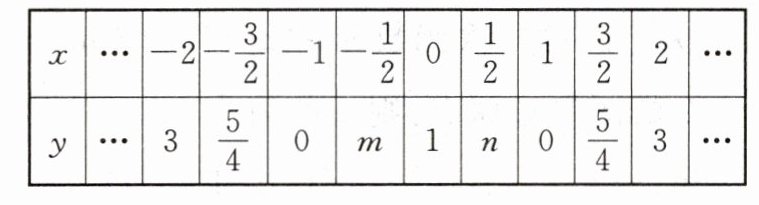
15. 新考向 过程性学习 九年级某班成立了数学学习兴趣小组,该小组对函数$y=|x^{2}-1|$的图象和性质进行探究,过程如下,请你补充完整.
(1)①列表:下表是$x$,$y$的几组对应值,其中$m=$
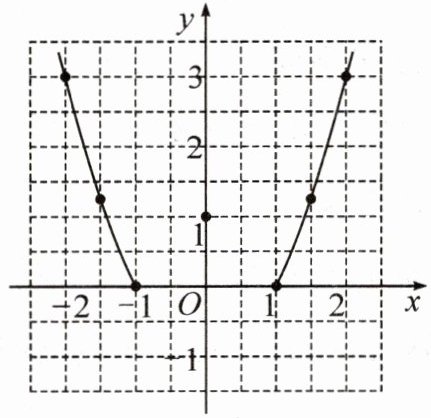
②描点:根据表中的数值描点$(x,y)$,请补充描出点$(-\frac{1}{2},m)$,$(\frac{1}{2},n)$.
③连线:用平滑的曲线顺次连接各点,请把图象补充完整.
(2)请观察图象,直接写出当$y$随$x$的增大而增大时,$x$的取值范围为
(3)除了上述增减性,请你再写出两条该函数的图象特征或性质:
①
②
(4)若点$(m,a)$与$(n,b)$在函数图象上,且$|n|<|m|<1$,则$a$与$b$的大小关系是
 ]
]
(1)①列表:下表是$x$,$y$的几组对应值,其中$m=$
\frac{3}{4}
,$n=$\frac{3}{4}
.②描点:根据表中的数值描点$(x,y)$,请补充描出点$(-\frac{1}{2},m)$,$(\frac{1}{2},n)$.
③连线:用平滑的曲线顺次连接各点,请把图象补充完整.
(2)请观察图象,直接写出当$y$随$x$的增大而增大时,$x$的取值范围为
-1<x<0或x>1
.(3)除了上述增减性,请你再写出两条该函数的图象特征或性质:
①
函数图象是轴对称图形
;②
函数值y都是非负数
.(4)若点$(m,a)$与$(n,b)$在函数图象上,且$|n|<|m|<1$,则$a$与$b$的大小关系是
a<b
. ]
答案:
1. (1)①
当$x =-\frac{1}{2}$时,把$x =-\frac{1}{2}$代入$y=\vert x^{2}-1\vert$中,根据绝对值运算公式$\vert a\vert=\begin{cases}a(a\geq0)\\-a(a\lt0)\end{cases}$,这里$a = x^{2}-1$,$x =-\frac{1}{2}$,则$x^{2}-1=\left(-\frac{1}{2}\right)^{2}-1=\frac{1}{4}-1=-\frac{3}{4}$,所以$y=\vert x^{2}-1\vert=\vert-\frac{3}{4}\vert=\frac{3}{4}$,即$m = \frac{3}{4}$;
当$x=\frac{1}{2}$时,把$x=\frac{1}{2}$代入$y = \vert x^{2}-1\vert$中,$x^{2}-1=\left(\frac{1}{2}\right)^{2}-1=\frac{1}{4}-1=-\frac{3}{4}$,所以$y=\vert x^{2}-1\vert=\vert-\frac{3}{4}\vert=\frac{3}{4}$,即$n=\frac{3}{4}$。
2. (2)
对于函数$y = \vert x^{2}-1\vert=\begin{cases}x^{2}-1(x\geq1或x\leq - 1)\\1 - x^{2}(-1\lt x\lt1)\end{cases}$。
当$y = x^{2}-1(x\geq1或x\leq - 1)$时,二次函数$y = x^{2}-1$的对称轴为$x = 0$,开口向上,在$x\geq1$时,$y$随$x$的增大而增大;当$y=1 - x^{2}(-1\lt x\lt1)$时,二次函数$y = 1 - x^{2}$的对称轴为$x = 0$,开口向下,在$-1\lt x\lt0$时,$y$随$x$的增大而增大。所以$y$随$x$的增大而增大时,$x$的取值范围是$-1\lt x\lt0$或$x\gt1$。
3. (3)
①函数图象是轴对称图形(对称轴为$y$轴)。
②函数值$y$都是非负数(因为$y=\vert x^{2}-1\vert\geq0$)。
4. (4)
因为$\vert n\vert\lt\vert m\vert\lt1$,对于函数$y = 1 - x^{2}(-1\lt x\lt1)$,$y = 1 - x^{2}$,设$f(x)=1 - x^{2}$,根据二次函数的性质,$f(x)$在$(-1,0)$上单调递增,在$(0,1)$上单调递减,且$f(x)$关于$y$轴对称,$y = 1 - x^{2}$的图象是开口向下的抛物线,$\vert x\vert$越大,$y$的值越小。
已知点$(m,a)$与$(n,b)$在函数$y = \vert x^{2}-1\vert$($-1\lt x\lt1$时$y = 1 - x^{2}$)图象上,且$\vert n\vert\lt\vert m\vert\lt1$,所以$a\lt b$。
故答案依次为:(1)①$\frac{3}{4}$,$\frac{3}{4}$;(2)$-1\lt x\lt0$或$x\gt1$;(3)①函数图象是轴对称图形;②函数值$y$都是非负数;(4)$a\lt b$。
当$x =-\frac{1}{2}$时,把$x =-\frac{1}{2}$代入$y=\vert x^{2}-1\vert$中,根据绝对值运算公式$\vert a\vert=\begin{cases}a(a\geq0)\\-a(a\lt0)\end{cases}$,这里$a = x^{2}-1$,$x =-\frac{1}{2}$,则$x^{2}-1=\left(-\frac{1}{2}\right)^{2}-1=\frac{1}{4}-1=-\frac{3}{4}$,所以$y=\vert x^{2}-1\vert=\vert-\frac{3}{4}\vert=\frac{3}{4}$,即$m = \frac{3}{4}$;
当$x=\frac{1}{2}$时,把$x=\frac{1}{2}$代入$y = \vert x^{2}-1\vert$中,$x^{2}-1=\left(\frac{1}{2}\right)^{2}-1=\frac{1}{4}-1=-\frac{3}{4}$,所以$y=\vert x^{2}-1\vert=\vert-\frac{3}{4}\vert=\frac{3}{4}$,即$n=\frac{3}{4}$。
2. (2)
对于函数$y = \vert x^{2}-1\vert=\begin{cases}x^{2}-1(x\geq1或x\leq - 1)\\1 - x^{2}(-1\lt x\lt1)\end{cases}$。
当$y = x^{2}-1(x\geq1或x\leq - 1)$时,二次函数$y = x^{2}-1$的对称轴为$x = 0$,开口向上,在$x\geq1$时,$y$随$x$的增大而增大;当$y=1 - x^{2}(-1\lt x\lt1)$时,二次函数$y = 1 - x^{2}$的对称轴为$x = 0$,开口向下,在$-1\lt x\lt0$时,$y$随$x$的增大而增大。所以$y$随$x$的增大而增大时,$x$的取值范围是$-1\lt x\lt0$或$x\gt1$。
3. (3)
①函数图象是轴对称图形(对称轴为$y$轴)。
②函数值$y$都是非负数(因为$y=\vert x^{2}-1\vert\geq0$)。
4. (4)
因为$\vert n\vert\lt\vert m\vert\lt1$,对于函数$y = 1 - x^{2}(-1\lt x\lt1)$,$y = 1 - x^{2}$,设$f(x)=1 - x^{2}$,根据二次函数的性质,$f(x)$在$(-1,0)$上单调递增,在$(0,1)$上单调递减,且$f(x)$关于$y$轴对称,$y = 1 - x^{2}$的图象是开口向下的抛物线,$\vert x\vert$越大,$y$的值越小。
已知点$(m,a)$与$(n,b)$在函数$y = \vert x^{2}-1\vert$($-1\lt x\lt1$时$y = 1 - x^{2}$)图象上,且$\vert n\vert\lt\vert m\vert\lt1$,所以$a\lt b$。
故答案依次为:(1)①$\frac{3}{4}$,$\frac{3}{4}$;(2)$-1\lt x\lt0$或$x\gt1$;(3)①函数图象是轴对称图形;②函数值$y$都是非负数;(4)$a\lt b$。
查看更多完整答案,请扫码查看

