

 搜索
搜索
2026年金考卷中考45套汇编数学河北专版
注:目前有些书本章节名称可能整理的还不是很完善,但都是按照顺序排列的,请同学们按照顺序仔细查找。练习册 2026年金考卷中考45套汇编数学河北专版 答案主要是用来给同学们做完题方便对答案用的,请勿直接抄袭。
第119页
- 第1页
- 第2页
- 第3页
- 第4页
- 第5页
- 第6页
- 第7页
- 第8页
- 第9页
- 第10页
- 第11页
- 第12页
- 第13页
- 第14页
- 第15页
- 第16页
- 第17页
- 第18页
- 第19页
- 第20页
- 第21页
- 第22页
- 第23页
- 第24页
- 第25页
- 第26页
- 第27页
- 第28页
- 第29页
- 第30页
- 第31页
- 第32页
- 第33页
- 第34页
- 第35页
- 第36页
- 第37页
- 第38页
- 第39页
- 第40页
- 第41页
- 第42页
- 第43页
- 第44页
- 第45页
- 第46页
- 第47页
- 第48页
- 第49页
- 第50页
- 第51页
- 第52页
- 第53页
- 第54页
- 第55页
- 第56页
- 第57页
- 第58页
- 第59页
- 第60页
- 第61页
- 第62页
- 第63页
- 第64页
- 第65页
- 第66页
- 第67页
- 第68页
- 第69页
- 第70页
- 第71页
- 第72页
- 第73页
- 第74页
- 第75页
- 第76页
- 第77页
- 第78页
- 第79页
- 第80页
- 第81页
- 第82页
- 第83页
- 第84页
- 第85页
- 第86页
- 第87页
- 第88页
- 第89页
- 第90页
- 第91页
- 第92页
- 第93页
- 第94页
- 第95页
- 第96页
- 第97页
- 第98页
- 第99页
- 第100页
- 第101页
- 第102页
- 第103页
- 第104页
- 第105页
- 第106页
- 第107页
- 第108页
- 第109页
- 第110页
- 第111页
- 第112页
- 第113页
- 第114页
- 第115页
- 第116页
- 第117页
- 第118页
- 第119页
- 第120页
22. (本小题满分9分)
答案:
(1)
设每年增长率为$x$,由题意得:
$5000(1 + x)^{2} = 7200$
$(1 + x)^{2} = 1.44$
$1 + x = \pm 1.2$
得$x_{1} = 0.2 = 20\%$,$x_{2} = - 2.2$(舍去)。
答:这两年该地投入教育经费的年平均增长率为$20\%$。
(2)
$7200 × (1 + 20\%) = 8640$(万元)
答:预计该地投入教育经费达8640万元。
设每年增长率为$x$,由题意得:
$5000(1 + x)^{2} = 7200$
$(1 + x)^{2} = 1.44$
$1 + x = \pm 1.2$
得$x_{1} = 0.2 = 20\%$,$x_{2} = - 2.2$(舍去)。
答:这两年该地投入教育经费的年平均增长率为$20\%$。
(2)
$7200 × (1 + 20\%) = 8640$(万元)
答:预计该地投入教育经费达8640万元。
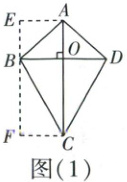
古代数学家刘徽使用“出入相补”原理(割补法),把筝形ABCD(对角线AC垂直平分对角线BD)转化为与之面积相等的矩形AEFC,如图(1)所示,从而得到“筝形的面积等于其对角线乘积之半”.
(1) 操作与发现:嘉嘉将平行四边形纸片ABCD沿EF,GH剪开,如图(2)所示,已知F,H分别是AD,BC的中点,$AB=10\sqrt{2}cm$,$GH=2\sqrt{2}cm$,$∠B=45^{\circ}$.若将三块纸片重新拼接后,恰好能拼成矩形,求A,C之间的距离.
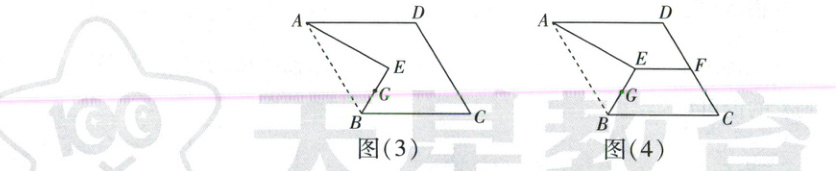
(2) 实践与应用:如图(3),在菱形纸片ABCD中,$∠C=60^{\circ}$.将菱形纸片ABCD剪掉一个三角形后,得到凹五边形AEBCD,其中BE=2,$∠AEB=90^{\circ}$,$∠BAE=30^{\circ}$,G是BE的中点.
① 请用无刻度的直尺和圆规作一条直线,使沿着这条直线剪开凹五边形纸片后,能拼成平行四边形. (保留作图痕迹,不写作法)
② 过点E作$EF// BC$交CD于点F,如图(4),求EF的长.
23. (本小题满分11分)
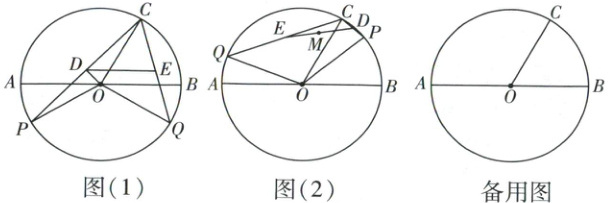
如图,AB是$\odot O$的直径,P为$\odot O$上一动点,将OP绕点O逆时针旋转120°得到线段OQ,点C是AB上方$\odot O$上一点,且$∠BOC=60^{\circ}$,连接CP,CQ,点D,E分别是CP,CQ的中点,连接DE.已知$\odot O$的半径为6.
(1) 点P,Q之间的距离是
(2) 当点P在AB下方,且$DE// AB$时,如图(1).
① 求$\widehat{BQ}$的长.
② 连接OD,求OD的长.
(3) 如图(2),点M是DE的中点,在点P运动的过程中,请直接写出点M与点B之间的最大距离.
24. (本小题满分12分)
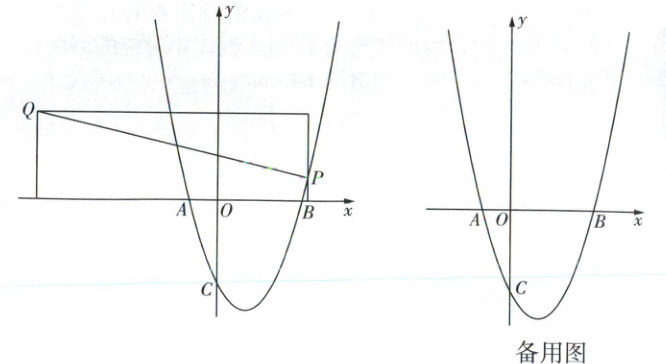
在平面直角坐标系中,抛物线$y=x^{2}+bx+c$与x轴交于点A,B(3,0),与y轴交于点C(0,-3).已知点P为该抛物线上一动点(不与点A重合),且横坐标为m.
(1) 求点A的坐标.
(2) 将抛物线上P,A两点之间的部分(包括端点)记作图象W,当图象W的高度(图象W上的最高点与最低点的纵坐标之差)为5时,求点P的坐标.
(3) 已知动点Q的坐标为(-2m,m).
① 当m>0,且$∠POQ$是锐角时,求m的取值范围.
② 如图,在平面直角坐标系中构造一个各边均与坐标轴垂直的矩形,使点A,P,Q均在矩形的内部或边上,且使该矩形的面积最小.当抛物线在矩形内部的部分所对应的函数值y随x的增大而减小且PQ平分该矩形的面积时,直接写出m的取值范围.
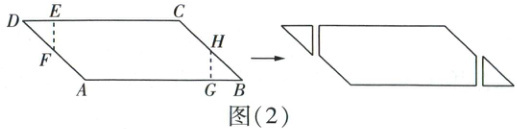
(1) 操作与发现:嘉嘉将平行四边形纸片ABCD沿EF,GH剪开,如图(2)所示,已知F,H分别是AD,BC的中点,$AB=10\sqrt{2}cm$,$GH=2\sqrt{2}cm$,$∠B=45^{\circ}$.若将三块纸片重新拼接后,恰好能拼成矩形,求A,C之间的距离.
(2) 实践与应用:如图(3),在菱形纸片ABCD中,$∠C=60^{\circ}$.将菱形纸片ABCD剪掉一个三角形后,得到凹五边形AEBCD,其中BE=2,$∠AEB=90^{\circ}$,$∠BAE=30^{\circ}$,G是BE的中点.
① 请用无刻度的直尺和圆规作一条直线,使沿着这条直线剪开凹五边形纸片后,能拼成平行四边形. (保留作图痕迹,不写作法)
② 过点E作$EF// BC$交CD于点F,如图(4),求EF的长.
23. (本小题满分11分)
如图,AB是$\odot O$的直径,P为$\odot O$上一动点,将OP绕点O逆时针旋转120°得到线段OQ,点C是AB上方$\odot O$上一点,且$∠BOC=60^{\circ}$,连接CP,CQ,点D,E分别是CP,CQ的中点,连接DE.已知$\odot O$的半径为6.
(1) 点P,Q之间的距离是
6$\sqrt{3}$
_ .(2) 当点P在AB下方,且$DE// AB$时,如图(1).
① 求$\widehat{BQ}$的长.
② 连接OD,求OD的长.
(3) 如图(2),点M是DE的中点,在点P运动的过程中,请直接写出点M与点B之间的最大距离.
24. (本小题满分12分)
在平面直角坐标系中,抛物线$y=x^{2}+bx+c$与x轴交于点A,B(3,0),与y轴交于点C(0,-3).已知点P为该抛物线上一动点(不与点A重合),且横坐标为m.
(1) 求点A的坐标.
(2) 将抛物线上P,A两点之间的部分(包括端点)记作图象W,当图象W的高度(图象W上的最高点与最低点的纵坐标之差)为5时,求点P的坐标.
(3) 已知动点Q的坐标为(-2m,m).
① 当m>0,且$∠POQ$是锐角时,求m的取值范围.
② 如图,在平面直角坐标系中构造一个各边均与坐标轴垂直的矩形,使点A,P,Q均在矩形的内部或边上,且使该矩形的面积最小.当抛物线在矩形内部的部分所对应的函数值y随x的增大而减小且PQ平分该矩形的面积时,直接写出m的取值范围.
答案:
22.
(1)由题意可知$EF\perp CD,GH\perp AB$。
如图
(1)所示,拼成的矩形为矩形$EMGN$。
$\because H$是$BC$的中点,$CN// BG$,
$\therefore NH = HG$。
$\because\angle HGB = 90^{\circ},\angle B = 45^{\circ}$,$\therefore GB = GH = 2\sqrt{2} cm$。
连接$AC$,取$AB$的中点$K$,连接$KH$,
则$AC = 2KH,KB = 5\sqrt{2} cm$,
$\therefore KG = 5\sqrt{2}-2\sqrt{2}=3\sqrt{2}(cm)$。
由勾股定理,得$KH=\sqrt{KG^{2}+HG^{2}}=\sqrt{(3\sqrt{2})^{2}+(2\sqrt{2})^{2}}=\sqrt{26}(cm)$,
$\therefore AC = 2\sqrt{26} cm$。

(2)①如图
(2),直线$GH$即为所求。(作法不唯一,正确即可)

②如图
(3),延长$FE$交$AB$于点$M$。
在$Rt\triangle AEB$中,$\angle BAE = 30^{\circ},BE = 2$,
$\therefore\angle ABE = 60^{\circ},AB = 4$。
$\because$四边形$ABCD$是菱形,$\angle C = 60^{\circ}$,
$\therefore BC = AB = 4,\angle ABC = 120^{\circ}$,
$\therefore\angle EBC = 60^{\circ}$。
$\because MF// BC$,
$\therefore\angle MEB = \angle EBC = 60^{\circ}$,
$\therefore\triangle MBE$是等边三角形,
$\therefore ME = BE = 2$。
$\because MF// BC,MB// FC$,
$\therefore$四边形$MBCF$是平行四边形,
$\therefore MF = BC = 4$,$\therefore EF = 4 - 2 = 2$。

23.
(1)$6\sqrt{3}$
(2)①如图
(1)。连接$PQ$。
$\because OP = OQ,\angle POQ = 120^{\circ}$,
$\therefore\angle OQP = \angle OPQ = 30^{\circ}$。
$\because D,E$分别是$CP,CQ$的中点,
$\therefore DE$是$\triangle PCQ$的中位线,
$\therefore DE// PQ$(依据:三角形的中位线定理)。
又$\because DE// AB$,$\therefore PQ// AB$,
$\therefore\angle BOQ = \angle OQP = 30^{\circ}$,
$\therefore BQ$的长为$\frac{30\pi×6}{180}=\pi$。
②$\because OP = OC,D$是$PC$的中点,$\therefore OD\perp PC$。
如图
(1),过点$Q$作$QH\perp PC$于点$H$,过点$C$作$CG\perp PO$于点$G$。
$\because\angle COQ = \angle BOC+\angle BOQ = 60^{\circ}+30^{\circ}=90^{\circ},\angle POQ = 120^{\circ}$,
$\therefore\angle CPQ=\frac{1}{2}\angle COQ = 45^{\circ},\angle PCQ=\frac{1}{2}\angle POQ = 60^{\circ},CQ = 6\sqrt{2}$,
$\therefore PH = PQ\cos45^{\circ}=3\sqrt{6},CH = CQ\cos60^{\circ}=3\sqrt{2}$,
$\therefore PC = PH + CH = 3\sqrt{6}+3\sqrt{2}$。
$\because OC = OP$,
$\therefore\angle OPC = \angle CPQ-\angle OPQ = 45^{\circ}-30^{\circ}=15^{\circ}$,
$\therefore\angle COG = 2\angle OPC = 30^{\circ}$,$\therefore CG=\frac{1}{2}OC = 3$。
$\because S_{\triangle OPC}=\frac{1}{2}PC· OD=\frac{1}{2}OP· CG$,
$\therefore OD=\frac{OP· CG}{PC}=\frac{6×3}{3\sqrt{6}+3\sqrt{2}}=\frac{3\sqrt{6}-3\sqrt{2}}{2}$(写成$\frac{6}{\sqrt{6}+\sqrt{2}}$也可)。

(3)$3\sqrt{3}+\frac{3}{2}$
解法提示:如图
(2),取$OC$的中点$N$,连接$MN,DN,EN$。
$\because$点$E,V,D$分别是$CQ,OC,CP$的中点,
$\therefore EN// OQ,EN=\frac{1}{2}OQ,DN// OP,DN=\frac{1}{2}OP$,
$\therefore\angle ENC = \angle QOC,\angle CND = \angle COP,EN = DN$,
$\therefore\angle DNE = \angle POQ = 120^{\circ},MN\perp DE$,
$\therefore\angle MDN = 30^{\circ}$,
$\therefore MN=\frac{1}{2}DN=\frac{1}{4}OP=\frac{3}{2}$。
分析可知,当点$P$运动时,点$M$在半径为$\frac{3}{2}$的$\odot N$上运动(关键点:确定点$M$的运动轨迹),如图
(3),连接$BN$并延长交$\odot N$于点$M$,此时点$B$与点$M$之间的距离最大(提示:根据“点圆最值模型”)。
连接$BC$,则$\triangle OBC$是等边三角形。
又$\because N$是$OC$的中点,$\therefore BN\perp OC$,
$\therefore BN=\frac{\sqrt{3}}{2}OB = 3\sqrt{3}$,$\therefore BM = BN + MN = 3\sqrt{3}+\frac{3}{2}$,
$\therefore$点$M$与点$B$之间的最大距离是$3\sqrt{3}+\frac{3}{2}$。


24.
(1)将$C(0,-3),B(3,0)$分别代入$y = x^{2}+bx + c$,
得$\begin{cases}c = -3,\\9 + 3b + c = 0,\end{cases}$解得$\begin{cases}b = -2,\\c = -3,\end{cases}$
$\therefore$抛物线的解析式为$y = x^{2}-2x - 3$。
令$y = 0$,即$x^{2}-2x - 3 = 0$,解得$x_{1}=3,x_{2}=-1$,
$\therefore A(-1,0)$。
(2)$\because y = x^{2}-2x - 3=(x - 1)^{2}-4$,
$\therefore$抛物线的顶点坐标为$(1,-4)$。
根据图象$W$的高度为5,可知分如下两种情况讨论。
①当点$P$在点$A$左侧时,$m<-1$,且点$P$的纵坐标为5。
令$x^{2}-2x - 3 = 5$,解得$x_{1}=4,x_{2}=-2$,
$\therefore$点$P$的坐标为$(-2,5)$。
②当点$P$在点$A$右侧时,$\because$图象$W$的高度为5,结合图象可知$m>3$,此时点$P$的纵坐标为$5 - 4 = 1$。
令$x^{2}-2x - 3 = 1$,解得$x = 1\pm\sqrt{5}$,
$\therefore$点$P$的坐标为$(1+\sqrt{5},1)$。
综上可知,点$P$的坐标为$(-2,5)$或$(1+\sqrt{5},1)$。
(3)①令$x = -2m,y = m$,则$y =-\frac{1}{2}x$,
$\therefore$点$Q$在直线$y =-\frac{1}{2}x$上。
当$0<m<3$时,点$P$在第四象限,点$Q$在第二象限,
$\therefore\angle POQ>90^{\circ}$,不符合题意。
当$m\geqslant3$,且$OP\perp OQ$时,如图
(1),分别过点$P,Q$作$x$轴的垂线,垂足分别为点$H,I$,则$\angle1+\angle2 = 90^{\circ},\angle1+\angle3 = 90^{\circ}$,$\therefore\angle2 = \angle3$。
由题意知$QI = m,OH = m$,$\therefore QI = OH$。
又$\because\angle QIO = \angle OHP$,
$\therefore\triangle CQI\cong\triangle POH$(点拨:“一线三直角”模型),
$\therefore PH = OI$,即$m^{2}-2m - 3 = 2m$,
解得$m_{1}=2+\sqrt{7},m_{2}=2-\sqrt{7}$(舍去),
$\therefore$当$m>0$,且$\angle POQ$是锐角时,$m>2+\sqrt{7}$。

②$\frac{1}{2}\leqslant m\leqslant3$或$\frac{-3-\sqrt{57}}{8}\leqslant m<-1$。
解法提示:$\because$点$A,P,Q$均在矩形的内部或边上,且矩形的面积最小,$PQ$平分矩形的面积,
$\therefore PQ$为矩形的对角线,点$A$在矩形边上或内部。
$\because$抛物线在矩形内部的部分所对应的函数值$y$随$x$的增大而减小,
$\therefore$易知符合题意的情况有两种。
a.当点$Q$在直线$x = -1$上或其左侧,点$P$在$x$轴上或$x$轴下方时,如图
(2),
此时$-2m\leqslant-1$,且$m\leqslant3$,
$\therefore\frac{1}{2}\leqslant m\leqslant3$。
b.当点$P$在直线$x = -1$左侧,点$Q$在抛物线上或其上方时,如图
(3)。
对于$y = x^{2}-2x - 3$,当$x = -2m$时,$y = 4m^{2}+4m - 3$,
$\therefore m<-1$,且$m\geqslant4m^{2}+4m - 3$。
$m\geqslant4m^{2}+4m - 3$可变形为$4m^{2}+3m - 3\leqslant0$。
对于函数$z = 4m^{2}+3m - 3$,
令$z = 0$,得$m=\frac{-3\pm\sqrt{57}}{8}$,
根据函数$z = 4m^{2}+3m - 3$的图象分析可知,当$\frac{-3-\sqrt{57}}{8}\leqslant m\leqslant\frac{-3+\sqrt{57}}{8}$时,$z\leqslant0$,
$\therefore$符合题意的$m$的取值范围是$\frac{-3-\sqrt{57}}{8}\leqslant m<-1$。
综上可知,$m$的取值范围是$\frac{1}{2}\leqslant m\leqslant3$或$\frac{-3-\sqrt{57}}{8}\leqslant m<-1$。


22.
(1)由题意可知$EF\perp CD,GH\perp AB$。
如图
(1)所示,拼成的矩形为矩形$EMGN$。
$\because H$是$BC$的中点,$CN// BG$,
$\therefore NH = HG$。
$\because\angle HGB = 90^{\circ},\angle B = 45^{\circ}$,$\therefore GB = GH = 2\sqrt{2} cm$。
连接$AC$,取$AB$的中点$K$,连接$KH$,
则$AC = 2KH,KB = 5\sqrt{2} cm$,
$\therefore KG = 5\sqrt{2}-2\sqrt{2}=3\sqrt{2}(cm)$。
由勾股定理,得$KH=\sqrt{KG^{2}+HG^{2}}=\sqrt{(3\sqrt{2})^{2}+(2\sqrt{2})^{2}}=\sqrt{26}(cm)$,
$\therefore AC = 2\sqrt{26} cm$。
(2)①如图
(2),直线$GH$即为所求。(作法不唯一,正确即可)
②如图
(3),延长$FE$交$AB$于点$M$。
在$Rt\triangle AEB$中,$\angle BAE = 30^{\circ},BE = 2$,
$\therefore\angle ABE = 60^{\circ},AB = 4$。
$\because$四边形$ABCD$是菱形,$\angle C = 60^{\circ}$,
$\therefore BC = AB = 4,\angle ABC = 120^{\circ}$,
$\therefore\angle EBC = 60^{\circ}$。
$\because MF// BC$,
$\therefore\angle MEB = \angle EBC = 60^{\circ}$,
$\therefore\triangle MBE$是等边三角形,
$\therefore ME = BE = 2$。
$\because MF// BC,MB// FC$,
$\therefore$四边形$MBCF$是平行四边形,
$\therefore MF = BC = 4$,$\therefore EF = 4 - 2 = 2$。
23.
(1)$6\sqrt{3}$
(2)①如图
(1)。连接$PQ$。
$\because OP = OQ,\angle POQ = 120^{\circ}$,
$\therefore\angle OQP = \angle OPQ = 30^{\circ}$。
$\because D,E$分别是$CP,CQ$的中点,
$\therefore DE$是$\triangle PCQ$的中位线,
$\therefore DE// PQ$(依据:三角形的中位线定理)。
又$\because DE// AB$,$\therefore PQ// AB$,
$\therefore\angle BOQ = \angle OQP = 30^{\circ}$,
$\therefore BQ$的长为$\frac{30\pi×6}{180}=\pi$。
②$\because OP = OC,D$是$PC$的中点,$\therefore OD\perp PC$。
如图
(1),过点$Q$作$QH\perp PC$于点$H$,过点$C$作$CG\perp PO$于点$G$。
$\because\angle COQ = \angle BOC+\angle BOQ = 60^{\circ}+30^{\circ}=90^{\circ},\angle POQ = 120^{\circ}$,
$\therefore\angle CPQ=\frac{1}{2}\angle COQ = 45^{\circ},\angle PCQ=\frac{1}{2}\angle POQ = 60^{\circ},CQ = 6\sqrt{2}$,
$\therefore PH = PQ\cos45^{\circ}=3\sqrt{6},CH = CQ\cos60^{\circ}=3\sqrt{2}$,
$\therefore PC = PH + CH = 3\sqrt{6}+3\sqrt{2}$。
$\because OC = OP$,
$\therefore\angle OPC = \angle CPQ-\angle OPQ = 45^{\circ}-30^{\circ}=15^{\circ}$,
$\therefore\angle COG = 2\angle OPC = 30^{\circ}$,$\therefore CG=\frac{1}{2}OC = 3$。
$\because S_{\triangle OPC}=\frac{1}{2}PC· OD=\frac{1}{2}OP· CG$,
$\therefore OD=\frac{OP· CG}{PC}=\frac{6×3}{3\sqrt{6}+3\sqrt{2}}=\frac{3\sqrt{6}-3\sqrt{2}}{2}$(写成$\frac{6}{\sqrt{6}+\sqrt{2}}$也可)。
(3)$3\sqrt{3}+\frac{3}{2}$
解法提示:如图
(2),取$OC$的中点$N$,连接$MN,DN,EN$。
$\because$点$E,V,D$分别是$CQ,OC,CP$的中点,
$\therefore EN// OQ,EN=\frac{1}{2}OQ,DN// OP,DN=\frac{1}{2}OP$,
$\therefore\angle ENC = \angle QOC,\angle CND = \angle COP,EN = DN$,
$\therefore\angle DNE = \angle POQ = 120^{\circ},MN\perp DE$,
$\therefore\angle MDN = 30^{\circ}$,
$\therefore MN=\frac{1}{2}DN=\frac{1}{4}OP=\frac{3}{2}$。
分析可知,当点$P$运动时,点$M$在半径为$\frac{3}{2}$的$\odot N$上运动(关键点:确定点$M$的运动轨迹),如图
(3),连接$BN$并延长交$\odot N$于点$M$,此时点$B$与点$M$之间的距离最大(提示:根据“点圆最值模型”)。
连接$BC$,则$\triangle OBC$是等边三角形。
又$\because N$是$OC$的中点,$\therefore BN\perp OC$,
$\therefore BN=\frac{\sqrt{3}}{2}OB = 3\sqrt{3}$,$\therefore BM = BN + MN = 3\sqrt{3}+\frac{3}{2}$,
$\therefore$点$M$与点$B$之间的最大距离是$3\sqrt{3}+\frac{3}{2}$。
24.
(1)将$C(0,-3),B(3,0)$分别代入$y = x^{2}+bx + c$,
得$\begin{cases}c = -3,\\9 + 3b + c = 0,\end{cases}$解得$\begin{cases}b = -2,\\c = -3,\end{cases}$
$\therefore$抛物线的解析式为$y = x^{2}-2x - 3$。
令$y = 0$,即$x^{2}-2x - 3 = 0$,解得$x_{1}=3,x_{2}=-1$,
$\therefore A(-1,0)$。
(2)$\because y = x^{2}-2x - 3=(x - 1)^{2}-4$,
$\therefore$抛物线的顶点坐标为$(1,-4)$。
根据图象$W$的高度为5,可知分如下两种情况讨论。
①当点$P$在点$A$左侧时,$m<-1$,且点$P$的纵坐标为5。
令$x^{2}-2x - 3 = 5$,解得$x_{1}=4,x_{2}=-2$,
$\therefore$点$P$的坐标为$(-2,5)$。
②当点$P$在点$A$右侧时,$\because$图象$W$的高度为5,结合图象可知$m>3$,此时点$P$的纵坐标为$5 - 4 = 1$。
令$x^{2}-2x - 3 = 1$,解得$x = 1\pm\sqrt{5}$,
$\therefore$点$P$的坐标为$(1+\sqrt{5},1)$。
综上可知,点$P$的坐标为$(-2,5)$或$(1+\sqrt{5},1)$。
(3)①令$x = -2m,y = m$,则$y =-\frac{1}{2}x$,
$\therefore$点$Q$在直线$y =-\frac{1}{2}x$上。
当$0<m<3$时,点$P$在第四象限,点$Q$在第二象限,
$\therefore\angle POQ>90^{\circ}$,不符合题意。
当$m\geqslant3$,且$OP\perp OQ$时,如图
(1),分别过点$P,Q$作$x$轴的垂线,垂足分别为点$H,I$,则$\angle1+\angle2 = 90^{\circ},\angle1+\angle3 = 90^{\circ}$,$\therefore\angle2 = \angle3$。
由题意知$QI = m,OH = m$,$\therefore QI = OH$。
又$\because\angle QIO = \angle OHP$,
$\therefore\triangle CQI\cong\triangle POH$(点拨:“一线三直角”模型),
$\therefore PH = OI$,即$m^{2}-2m - 3 = 2m$,
解得$m_{1}=2+\sqrt{7},m_{2}=2-\sqrt{7}$(舍去),
$\therefore$当$m>0$,且$\angle POQ$是锐角时,$m>2+\sqrt{7}$。
②$\frac{1}{2}\leqslant m\leqslant3$或$\frac{-3-\sqrt{57}}{8}\leqslant m<-1$。
解法提示:$\because$点$A,P,Q$均在矩形的内部或边上,且矩形的面积最小,$PQ$平分矩形的面积,
$\therefore PQ$为矩形的对角线,点$A$在矩形边上或内部。
$\because$抛物线在矩形内部的部分所对应的函数值$y$随$x$的增大而减小,
$\therefore$易知符合题意的情况有两种。
a.当点$Q$在直线$x = -1$上或其左侧,点$P$在$x$轴上或$x$轴下方时,如图
(2),
此时$-2m\leqslant-1$,且$m\leqslant3$,
$\therefore\frac{1}{2}\leqslant m\leqslant3$。
b.当点$P$在直线$x = -1$左侧,点$Q$在抛物线上或其上方时,如图
(3)。
对于$y = x^{2}-2x - 3$,当$x = -2m$时,$y = 4m^{2}+4m - 3$,
$\therefore m<-1$,且$m\geqslant4m^{2}+4m - 3$。
$m\geqslant4m^{2}+4m - 3$可变形为$4m^{2}+3m - 3\leqslant0$。
对于函数$z = 4m^{2}+3m - 3$,
令$z = 0$,得$m=\frac{-3\pm\sqrt{57}}{8}$,
根据函数$z = 4m^{2}+3m - 3$的图象分析可知,当$\frac{-3-\sqrt{57}}{8}\leqslant m\leqslant\frac{-3+\sqrt{57}}{8}$时,$z\leqslant0$,
$\therefore$符合题意的$m$的取值范围是$\frac{-3-\sqrt{57}}{8}\leqslant m<-1$。
综上可知,$m$的取值范围是$\frac{1}{2}\leqslant m\leqslant3$或$\frac{-3-\sqrt{57}}{8}\leqslant m<-1$。
查看更多完整答案,请扫码查看

