

 搜索
搜索
第29页
- 第2页
- 第3页
- 第4页
- 第5页
- 第6页
- 第7页
- 第8页
- 第9页
- 第10页
- 第11页
- 第12页
- 第13页
- 第14页
- 第15页
- 第16页
- 第17页
- 第18页
- 第19页
- 第20页
- 第21页
- 第22页
- 第23页
- 第24页
- 第25页
- 第26页
- 第27页
- 第28页
- 第29页
- 第30页
- 第31页
- 第32页
- 第33页
- 第34页
- 第35页
- 第36页
- 第37页
- 第38页
- 第39页
- 第40页
- 第41页
- 第42页
- 第43页
- 第44页
- 第45页
- 第46页
- 第47页
- 第48页
- 第49页
- 第50页
- 第51页
- 第52页
- 第53页
- 第54页
- 第55页
- 第56页
- 第57页
- 第58页
- 第59页
- 第60页
- 第61页
- 第62页
- 第63页
- 第64页
- 第65页
- 第66页
- 第67页
- 第68页
- 第69页
- 第70页
- 第71页
- 第72页
- 第73页
- 第74页
- 第75页
- 第76页
- 第77页
- 第78页
- 第79页
- 第80页
- 第81页
- 第82页
- 第83页
- 第84页
- 第85页
- 第86页
- 第87页
- 第88页
- 第89页
- 第90页
- 第91页
- 第92页
- 第93页
- 第94页
- 第95页
- 第96页
- 第97页
- 第98页
- 第99页
- 第100页
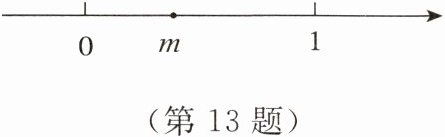
13. 实数$m$在数轴上的对应点的位置如图所示,则化简$|m - 1| + \sqrt{m^2}的结果为\underline{\hspace{5cm}}$。
]
]
1
答案:
1
14. 计算:
(1)$\sqrt{50} + \sqrt{8}$;
(2)$\sqrt{\frac{1}{3}} - \sqrt{27}$;
(3)$(\sqrt{\frac{1}{3}} + \sqrt{3}) × \sqrt{6}$;
(4)$(\sqrt{\frac{3}{2}} - \sqrt{\frac{2}{3}}) × \sqrt{6}$。
(1)$\sqrt{50} + \sqrt{8}$;
(2)$\sqrt{\frac{1}{3}} - \sqrt{27}$;
(3)$(\sqrt{\frac{1}{3}} + \sqrt{3}) × \sqrt{6}$;
(4)$(\sqrt{\frac{3}{2}} - \sqrt{\frac{2}{3}}) × \sqrt{6}$。
答案:
(1) $\sqrt{50} + \sqrt{8} = 5\sqrt{2} + 2\sqrt{2} = 7\sqrt{2}$
(2) $\sqrt{\frac{1}{3}} - \sqrt{27} = \frac{\sqrt{3}}{3} - 3\sqrt{3} = \frac{\sqrt{3}}{3} - \frac{9\sqrt{3}}{3} = -\frac{8\sqrt{3}}{3}$
(3) $(\sqrt{\frac{1}{3}} + \sqrt{3}) × \sqrt{6} = \sqrt{\frac{1}{3}×6} + \sqrt{3×6} = \sqrt{2} + \sqrt{18} = \sqrt{2} + 3\sqrt{2} = 4\sqrt{2}$
(4) $(\sqrt{\frac{3}{2}} - \sqrt{\frac{2}{3}}) × \sqrt{6} = \sqrt{\frac{3}{2}×6} - \sqrt{\frac{2}{3}×6} = \sqrt{9} - \sqrt{4} = 3 - 2 = 1$
(1) $\sqrt{50} + \sqrt{8} = 5\sqrt{2} + 2\sqrt{2} = 7\sqrt{2}$
(2) $\sqrt{\frac{1}{3}} - \sqrt{27} = \frac{\sqrt{3}}{3} - 3\sqrt{3} = \frac{\sqrt{3}}{3} - \frac{9\sqrt{3}}{3} = -\frac{8\sqrt{3}}{3}$
(3) $(\sqrt{\frac{1}{3}} + \sqrt{3}) × \sqrt{6} = \sqrt{\frac{1}{3}×6} + \sqrt{3×6} = \sqrt{2} + \sqrt{18} = \sqrt{2} + 3\sqrt{2} = 4\sqrt{2}$
(4) $(\sqrt{\frac{3}{2}} - \sqrt{\frac{2}{3}}) × \sqrt{6} = \sqrt{\frac{3}{2}×6} - \sqrt{\frac{2}{3}×6} = \sqrt{9} - \sqrt{4} = 3 - 2 = 1$
15.【数学应用】爱动脑筋的小明在做二次根式的化简时,发现一些二次根式的被开方数是二次三项式,而且这些二次三项式正好是完全平方式的结构,于是就可以利用二次根式的性质:$\sqrt{a^2} = \begin{cases} a (a \geq 0) \\ -a (a < 0) \end{cases} $来进一步化简。
比如:$\sqrt{x^2 + 2x + 1} = \sqrt{(x + 1)^2} = |x + 1|$,所以当$x + 1 \geq 0$,即$x \geq -1$时,原式$= x + 1$;当$x + 1 < 0$,即$x < -1$时,原式$= -x - 1$。
(1)仿照上面的例子,请你尝试化简$\sqrt{m^2 - m + \frac{1}{4}}$。
(2)判断甲、乙两人在解决问题“若$a = 9$,求$a + \sqrt{1 - 2a + a^2}$的值”时谁的答案正确,并说明理由。
甲的答案:原式$= a + \sqrt{(1 - a)^2} = a + (1 - a) = 1$;
乙的答案:原式$= a + \sqrt{(1 - a)^2} = a + (a - 1) = 2a - 1 = 2 × 9 - 1 = 17$。
(3)化简并求值:$|x - 1| + \sqrt{4 - 4x + x^2}$,其中$x = \sqrt{5}$。
比如:$\sqrt{x^2 + 2x + 1} = \sqrt{(x + 1)^2} = |x + 1|$,所以当$x + 1 \geq 0$,即$x \geq -1$时,原式$= x + 1$;当$x + 1 < 0$,即$x < -1$时,原式$= -x - 1$。
(1)仿照上面的例子,请你尝试化简$\sqrt{m^2 - m + \frac{1}{4}}$。
(2)判断甲、乙两人在解决问题“若$a = 9$,求$a + \sqrt{1 - 2a + a^2}$的值”时谁的答案正确,并说明理由。
甲的答案:原式$= a + \sqrt{(1 - a)^2} = a + (1 - a) = 1$;
乙的答案:原式$= a + \sqrt{(1 - a)^2} = a + (a - 1) = 2a - 1 = 2 × 9 - 1 = 17$。
(3)化简并求值:$|x - 1| + \sqrt{4 - 4x + x^2}$,其中$x = \sqrt{5}$。
答案:
(1)
$\sqrt{m^2 - m + \frac{1}{4}}=\sqrt{(m - \frac{1}{2})^2}=\vert m - \frac{1}{2}\vert$
当$m-\frac{1}{2}\geq0$,即$m\geq\frac{1}{2}$时,原式$ = m - \frac{1}{2}$;
当$m - \frac{1}{2}\lt0$,即$m\lt\frac{1}{2}$时,原式$=-\left(m - \frac{1}{2}\right)= -m+\frac{1}{2}$。
(2)
乙的答案正确。
理由:
$a + \sqrt{1 - 2a + a^2}=a+\sqrt{(1 - a)^2}$
当$a = 9$时,$1-a=1 - 9=-8\lt0$,根据$\sqrt{a^2}=\begin{cases}a(a\geq0)\\-a(a\lt0)\end{cases}$,则$\sqrt{(1 - a)^2}=a - 1$。
所以原式$=a+(a - 1)=2a - 1$,把$a = 9$代入得$2×9-1 = 17$,甲没有考虑$1 - a$的正负性,所以甲错误,乙正确。
(3)
$\vert x - 1\vert+\sqrt{4 - 4x + x^2}=\vert x - 1\vert+\sqrt{(2 - x)^2}$
当$x=\sqrt{5}$时,$\sqrt{5}\gt2$,$\sqrt{5}\gt1$,则$x - 1\gt0$,$2 - x\lt0$。
所以$\vert x - 1\vert=x - 1$,$\sqrt{(2 - x)^2}=x - 2$。
原式$=(x - 1)+(x - 2)=2x - 3$
把$x = \sqrt{5}$代入得$2\sqrt{5}-3$。
(1)
$\sqrt{m^2 - m + \frac{1}{4}}=\sqrt{(m - \frac{1}{2})^2}=\vert m - \frac{1}{2}\vert$
当$m-\frac{1}{2}\geq0$,即$m\geq\frac{1}{2}$时,原式$ = m - \frac{1}{2}$;
当$m - \frac{1}{2}\lt0$,即$m\lt\frac{1}{2}$时,原式$=-\left(m - \frac{1}{2}\right)= -m+\frac{1}{2}$。
(2)
乙的答案正确。
理由:
$a + \sqrt{1 - 2a + a^2}=a+\sqrt{(1 - a)^2}$
当$a = 9$时,$1-a=1 - 9=-8\lt0$,根据$\sqrt{a^2}=\begin{cases}a(a\geq0)\\-a(a\lt0)\end{cases}$,则$\sqrt{(1 - a)^2}=a - 1$。
所以原式$=a+(a - 1)=2a - 1$,把$a = 9$代入得$2×9-1 = 17$,甲没有考虑$1 - a$的正负性,所以甲错误,乙正确。
(3)
$\vert x - 1\vert+\sqrt{4 - 4x + x^2}=\vert x - 1\vert+\sqrt{(2 - x)^2}$
当$x=\sqrt{5}$时,$\sqrt{5}\gt2$,$\sqrt{5}\gt1$,则$x - 1\gt0$,$2 - x\lt0$。
所以$\vert x - 1\vert=x - 1$,$\sqrt{(2 - x)^2}=x - 2$。
原式$=(x - 1)+(x - 2)=2x - 3$
把$x = \sqrt{5}$代入得$2\sqrt{5}-3$。
查看更多完整答案,请扫码查看

