

 搜索
搜索
第9页
- 第1页
- 第2页
- 第3页
- 第4页
- 第5页
- 第6页
- 第7页
- 第8页
- 第9页
- 第10页
- 第11页
- 第12页
- 第13页
- 第14页
- 第15页
- 第16页
- 第17页
- 第18页
- 第19页
- 第20页
- 第21页
- 第22页
- 第23页
- 第24页
- 第25页
- 第26页
- 第27页
- 第28页
- 第29页
- 第30页
- 第31页
- 第32页
- 第33页
- 第34页
- 第35页
- 第36页
- 第37页
- 第38页
- 第39页
- 第40页
- 第41页
- 第42页
- 第43页
- 第44页
- 第45页
- 第46页
- 第47页
- 第48页
- 第49页
- 第50页
- 第51页
- 第52页
- 第53页
- 第54页
- 第55页
- 第56页
- 第57页
- 第58页
- 第59页
- 第60页
- 第61页
- 第62页
- 第63页
- 第64页
- 第65页
- 第66页
- 第67页
- 第68页
- 第69页
- 第70页
- 第71页
- 第72页
- 第73页
- 第74页
- 第75页
- 第76页
- 第77页
- 第78页
- 第79页
- 第80页
- 第81页
- 第82页
- 第83页
- 第84页
- 第85页
- 第86页
- 第87页
- 第88页
- 第89页
- 第90页
- 第91页
- 第92页
- 第93页
- 第94页
- 第95页
- 第96页
- 第97页
- 第98页
- 第99页
- 第100页
- 第101页
- 第102页
- 第103页
- 第104页
- 第105页
- 第106页
- 第107页
- 第108页
- 第109页
- 第110页
- 第111页
- 第112页
11. (2024·泰州靖江期中)如图所示,均匀木板AB的中点O放在支架上,B端通过滑轮组和重物M连接,木板水平,O点有一电动小车,与木板B端相连的绳刚好伸直但无拉力。已知木板长6 m,两滑轮重均为8 N,电动小车重50 N,若车在木板上匀速行驶的速度为0.6 m/s。车从O点开始向右行驶2 s时,地面对M的支持力为$F_{1}$,再向右行驶2 s时,地面对M的支持力为$F_{2}$,且$F_{1}:F_{2}= 3:2$,不计绳子重力和绳子与滑轮之间的摩擦力。求:
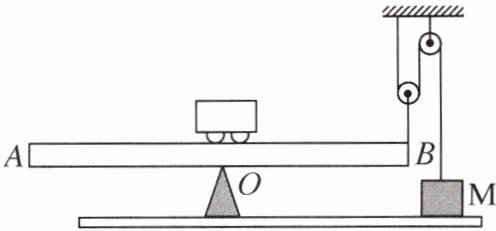
(1)车从O点开始向右行驶2 s时B端受到绳子的拉力。
(2)M的重力。
(1)车从O点开始向右行驶2 s时B端受到绳子的拉力。
(2)M的重力。
答案:
(1)20 N
(2)44 N 提示:
(1)小车从O点向右行驶2 s时,$s=vt=0.6\ \text{m/s}×2\ \text{s}=1.2\ \text{m}$,因$G_{车}× s=F_{B}×\frac{1}{2}L$,即$50\ \text{N}×1.2\ \text{m}=F_{B}×\frac{1}{2}×6\ \text{m}$,解得$F_{B}=20\ \text{N}$。
(2)对于动滑轮,$2F=G_{动}+F_{B}$,$2F=8\ \text{N}+20\ \text{N}$,$F=14\ \text{N}$,对于M,$G_{M}=F_{1}+F=F_{1}+14\ \text{N}$,小车从O点向右行驶4 s时,$s'=vt'=0.6\ \text{m/s}×4\ \text{s}=2.4\ \text{m}$,因$G_{车}× s'=F_{B}'×\frac{1}{2}L$,即$50\ \text{N}×2.4\ \text{m}=F_{B}'×\frac{1}{2}×6\ \text{m}$,解得$F_{B}'=40\ \text{N}$,此时$2F'=G_{动}+F_{B}'=8\ \text{N}+40\ \text{N}$,得$F'=24\ \text{N}$,$G_{M}=F_{2}+F'=F_{2}+24\ \text{N}$,又$F_{1}:F_{2}=3:2$,解得$G_{M}=44\ \text{N}$。
(1)20 N
(2)44 N 提示:
(1)小车从O点向右行驶2 s时,$s=vt=0.6\ \text{m/s}×2\ \text{s}=1.2\ \text{m}$,因$G_{车}× s=F_{B}×\frac{1}{2}L$,即$50\ \text{N}×1.2\ \text{m}=F_{B}×\frac{1}{2}×6\ \text{m}$,解得$F_{B}=20\ \text{N}$。
(2)对于动滑轮,$2F=G_{动}+F_{B}$,$2F=8\ \text{N}+20\ \text{N}$,$F=14\ \text{N}$,对于M,$G_{M}=F_{1}+F=F_{1}+14\ \text{N}$,小车从O点向右行驶4 s时,$s'=vt'=0.6\ \text{m/s}×4\ \text{s}=2.4\ \text{m}$,因$G_{车}× s'=F_{B}'×\frac{1}{2}L$,即$50\ \text{N}×2.4\ \text{m}=F_{B}'×\frac{1}{2}×6\ \text{m}$,解得$F_{B}'=40\ \text{N}$,此时$2F'=G_{动}+F_{B}'=8\ \text{N}+40\ \text{N}$,得$F'=24\ \text{N}$,$G_{M}=F_{2}+F'=F_{2}+24\ \text{N}$,又$F_{1}:F_{2}=3:2$,解得$G_{M}=44\ \text{N}$。
12. 如图所示,物理兴趣小组的同学利用滑轮组吊起一个工件。工件由质量分布均匀的A、B两长方体物块组成,边长分别是a、b,底面积$S_{A}:S_{B}= 3:2$,A与地面的接触面积为$5\ \text{cm}^{2}$。动滑轮重20 N,不计绳重、绳与滑轮之间的摩擦。当小昊同学用50 N的力拉动绳子时,地面受到A的压强为$4× 10^{4}\ \text{Pa}$;当工件被匀速吊起后,A、B恰好能保持水平平衡。求:
(1)当小昊同学用50 N的力拉动绳子时,工件对地面的压力$F_{\text{压}}$。
(2)当工件被匀速吊起后,小昊同学对绳子的拉力$F_{\text{拉}}$。
(3)若A的重力为60 N,则A、B两物块的密度之比$\rho_{A}:\rho_{B}$是多少?

(1)当小昊同学用50 N的力拉动绳子时,工件对地面的压力$F_{\text{压}}$。
(2)当工件被匀速吊起后,小昊同学对绳子的拉力$F_{\text{拉}}$。
(3)若A的重力为60 N,则A、B两物块的密度之比$\rho_{A}:\rho_{B}$是多少?
答案:
(1)20 N
(2)60 N
(3)3:2 提示:
(1)$F_{支}=F_{压}=pS=4×10^{4}\ \text{Pa}×5×10^{-4}\ \text{m}^{2}=20\ \text{N}$。
(2)不计绳重、绳与滑轮之间的摩擦,由$F=\frac{1}{2}(F_{拉1}+G_{动})$得$F_{拉1}=2F-G_{动}=2×50\ \text{N}-20\ \text{N}=80\ \text{N}$,$G_{AB}=F_{支}+F_{拉1}=20\ \text{N}+80\ \text{N}=100\ \text{N}$;工件被匀速吊起后,$F_{拉}'=\frac{1}{2}(G_{AB}+G_{动})=\frac{1}{2}(100\ \text{N}+20\ \text{N})=60\ \text{N}$。
(3)$G_{B}=G_{AB}-G_{A}=100\ \text{N}-60\ \text{N}=40\ \text{N}$,由杠杆平衡条件可知,$G_{A}×\frac{1}{2}a=G_{B}×\frac{1}{2}b$,即$60\ \text{N}×\frac{1}{2}a=40\ \text{N}×\frac{1}{2}b$,解得$a:b=2:3$,因$\rho_{A}=\frac{G_{A}}{V_{A}g}=\frac{G_{A}}{S_{A}ag}$,$\rho_{B}=\frac{G_{B}}{S_{B}bg}$,$S_{A}:S_{B}=3:2$,故$\frac{\rho_{A}}{\rho_{B}}=\frac{G_{A}S_{B}b}{G_{B}S_{A}a}=\frac{60\ \text{N}×2×3}{40\ \text{N}×3×2}=\frac{3}{2}$。
(1)20 N
(2)60 N
(3)3:2 提示:
(1)$F_{支}=F_{压}=pS=4×10^{4}\ \text{Pa}×5×10^{-4}\ \text{m}^{2}=20\ \text{N}$。
(2)不计绳重、绳与滑轮之间的摩擦,由$F=\frac{1}{2}(F_{拉1}+G_{动})$得$F_{拉1}=2F-G_{动}=2×50\ \text{N}-20\ \text{N}=80\ \text{N}$,$G_{AB}=F_{支}+F_{拉1}=20\ \text{N}+80\ \text{N}=100\ \text{N}$;工件被匀速吊起后,$F_{拉}'=\frac{1}{2}(G_{AB}+G_{动})=\frac{1}{2}(100\ \text{N}+20\ \text{N})=60\ \text{N}$。
(3)$G_{B}=G_{AB}-G_{A}=100\ \text{N}-60\ \text{N}=40\ \text{N}$,由杠杆平衡条件可知,$G_{A}×\frac{1}{2}a=G_{B}×\frac{1}{2}b$,即$60\ \text{N}×\frac{1}{2}a=40\ \text{N}×\frac{1}{2}b$,解得$a:b=2:3$,因$\rho_{A}=\frac{G_{A}}{V_{A}g}=\frac{G_{A}}{S_{A}ag}$,$\rho_{B}=\frac{G_{B}}{S_{B}bg}$,$S_{A}:S_{B}=3:2$,故$\frac{\rho_{A}}{\rho_{B}}=\frac{G_{A}S_{B}b}{G_{B}S_{A}a}=\frac{60\ \text{N}×2×3}{40\ \text{N}×3×2}=\frac{3}{2}$。
查看更多完整答案,请扫码查看

