

 搜索
搜索
第16页
- 第1页
- 第2页
- 第3页
- 第4页
- 第5页
- 第6页
- 第7页
- 第8页
- 第9页
- 第10页
- 第11页
- 第12页
- 第13页
- 第14页
- 第15页
- 第16页
- 第17页
- 第18页
- 第19页
- 第20页
- 第21页
- 第22页
- 第23页
- 第24页
- 第25页
- 第26页
- 第27页
- 第28页
- 第29页
- 第30页
- 第31页
- 第32页
- 第33页
- 第34页
- 第35页
- 第36页
- 第37页
- 第38页
- 第39页
- 第40页
- 第41页
- 第42页
- 第43页
- 第44页
- 第45页
- 第46页
- 第47页
- 第48页
- 第49页
- 第50页
- 第51页
- 第52页
- 第53页
- 第54页
- 第55页
- 第56页
- 第57页
- 第58页
- 第59页
- 第60页
- 第61页
- 第62页
- 第63页
- 第64页
- 第65页
- 第66页
- 第67页
- 第68页
- 第69页
- 第70页
- 第71页
- 第72页
- 第73页
- 第74页
- 第75页
- 第76页
- 第77页
- 第78页
- 第79页
- 第80页
- 第81页
- 第82页
- 第83页
- 第84页
- 第85页
- 第86页
- 第87页
- 第88页
- 第89页
- 第90页
- 第91页
- 第92页
- 第93页
- 第94页
- 第95页
- 第96页
- 第97页
- 第98页
- 第99页
- 第100页
- 第101页
- 第102页
- 第103页
- 第104页
- 第105页
- 第106页
- 第107页
- 第108页
- 第109页
- 第110页
- 第111页
- 第112页
- 第113页
- 第114页
- 第115页
- 第116页
- 第117页
- 第118页
- 第119页
- 第120页
- 第121页
- 第122页
- 第123页
- 第124页
- 第125页
- 第126页
- 第127页
- 第128页
- 第129页
- 第130页
- 第131页
- 第132页
- 第133页
- 第134页
- 第135页
- 第136页
- 第137页
- 第138页
- 第139页
- 第140页
- 第141页
- 第142页
- 第143页
- 第144页
- 第145页
- 第146页
- 第147页
- 第148页
9. 已知$x = \frac{1}{2}(\sqrt{7}+\sqrt{5})$,$y = \frac{1}{2}(\sqrt{7}-\sqrt{5})$,求下列各式的值。
(1)$x^{2}-xy + y^{2}$。
(2)$\frac{x}{y}+\frac{y}{x}$。
(1)$x^{2}-xy + y^{2}$。
(2)$\frac{x}{y}+\frac{y}{x}$。
答案:
9.$\because x=\frac{1}{2}(\sqrt{7}+\sqrt{5}),y=\frac{1}{2}(\sqrt{7}-\sqrt{5})$,
$\therefore x + y=\sqrt{7},xy=\frac{1}{2}$.
(1)原式$=(x + y)^{2}-3xy=7-\frac{3}{2}=\frac{11}{2}$.
(2)原式$=\frac{(x + y)^{2}-2xy}{xy}=\frac{7 - 1}{\frac{1}{2}}=12$.
$\therefore x + y=\sqrt{7},xy=\frac{1}{2}$.
(1)原式$=(x + y)^{2}-3xy=7-\frac{3}{2}=\frac{11}{2}$.
(2)原式$=\frac{(x + y)^{2}-2xy}{xy}=\frac{7 - 1}{\frac{1}{2}}=12$.
10. 已知$m = \sqrt{2}+1$,$n = \sqrt{2}-1$,则$\sqrt{m^{2}+n^{2}-3mn}$的值为( )。
A. 9
B. $\sqrt{3}$
C. 3
D. 5
A. 9
B. $\sqrt{3}$
C. 3
D. 5
答案:
10.B
11. 已知等腰三角形的两边长为$2\sqrt{3}$和$5\sqrt{2}$,则此等腰三角形的周长为( )。
A. $4\sqrt{3}+5\sqrt{2}$
B. $2\sqrt{3}+10\sqrt{2}$
C. $4\sqrt{3}+10\sqrt{2}$
D. $4\sqrt{3}+5\sqrt{2}$或$2\sqrt{3}+10\sqrt{2}$
A. $4\sqrt{3}+5\sqrt{2}$
B. $2\sqrt{3}+10\sqrt{2}$
C. $4\sqrt{3}+10\sqrt{2}$
D. $4\sqrt{3}+5\sqrt{2}$或$2\sqrt{3}+10\sqrt{2}$
答案:
11.B
12. 在直角三角形中,自锐角顶点所引的两条中线的长分别为$\sqrt{10}$和$\sqrt{35}$,那么这个直角三角形的斜边长为( )。
A. 6
B. 7
C. $2\sqrt{6}$
D. $2\sqrt{7}$
A. 6
B. 7
C. $2\sqrt{6}$
D. $2\sqrt{7}$
答案:
12.A
13. 我们规定运算符号$\otimes$的意义如下:当$a>b$时,$a\otimes b = a + b$;当$a\leq b$时,$a\otimes b = a - b$,其他运算符号意义不变。按上述规定,计算$(\sqrt{3}\otimes\frac{3}{2})-[(1-\sqrt{3})\otimes(-\frac{1}{2})]$的结果为________。
答案:
13.$2\sqrt{3}$
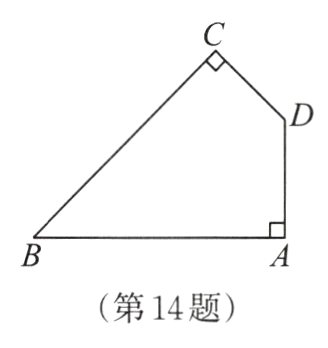
14. 如图,在四边形$ABCD$中,$\angle A = \angle BCD = 90^{\circ}$,$\angle B = 45^{\circ}$,$AB = 2\sqrt{6}$,$CD = \sqrt{3}$。求四边形$ABCD$的面积。
答案:
14.如图,作AD和BC的延长线相交于点E.
$\because\angle A=\angle BCD = 90^{\circ},\angle B = 45^{\circ},\therefore\triangle ABE$和$\triangle CDE$都为等腰直角三角形.
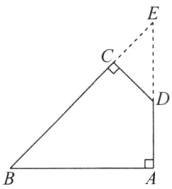
$\therefore S_{\triangle ABE}=\frac{1}{2}AB^{2}=\frac{1}{2}\times(2\sqrt{6})^{2}=12,S_{\triangle CDE}=\frac{1}{2}CD^{2}=\frac{1}{2}\times(\sqrt{3})^{2}=\frac{3}{2}$.
$\therefore$四边形ABCD的面积为$12-\frac{3}{2}=\frac{21}{2}$.
14.如图,作AD和BC的延长线相交于点E.
$\because\angle A=\angle BCD = 90^{\circ},\angle B = 45^{\circ},\therefore\triangle ABE$和$\triangle CDE$都为等腰直角三角形.
$\therefore S_{\triangle ABE}=\frac{1}{2}AB^{2}=\frac{1}{2}\times(2\sqrt{6})^{2}=12,S_{\triangle CDE}=\frac{1}{2}CD^{2}=\frac{1}{2}\times(\sqrt{3})^{2}=\frac{3}{2}$.
$\therefore$四边形ABCD的面积为$12-\frac{3}{2}=\frac{21}{2}$.
15. 请阅读以下材料,并完成相应的任务。
斐波那契是意大利数学家,他研究了一列数,这列数非常奇妙,被称为斐波那契数列(按照一定顺序排列着的一列数称为数列)。后来人们在研究它的过程中,发现了许多意想不到的结果,在实际生活中,很多花朵(如一般的梅花、飞燕草、万寿菊等)的花瓣数恰是斐波那契数列中的数。斐波那契数列还有很多有趣的性质,在实际生活中也有广泛的应用。
斐波那契数列中的第$n$个数可以用$\frac{1}{\sqrt{5}}[(\frac{1 + \sqrt{5}}{2})^{n}-(\frac{1 - \sqrt{5}}{2})^{n}](n\geq1)$表示。这是用无理数表示有理数的一个范例。
任务:请根据以上材料,通过计算求出斐波那契数列中的第1个数和第2个数。
斐波那契是意大利数学家,他研究了一列数,这列数非常奇妙,被称为斐波那契数列(按照一定顺序排列着的一列数称为数列)。后来人们在研究它的过程中,发现了许多意想不到的结果,在实际生活中,很多花朵(如一般的梅花、飞燕草、万寿菊等)的花瓣数恰是斐波那契数列中的数。斐波那契数列还有很多有趣的性质,在实际生活中也有广泛的应用。
斐波那契数列中的第$n$个数可以用$\frac{1}{\sqrt{5}}[(\frac{1 + \sqrt{5}}{2})^{n}-(\frac{1 - \sqrt{5}}{2})^{n}](n\geq1)$表示。这是用无理数表示有理数的一个范例。
任务:请根据以上材料,通过计算求出斐波那契数列中的第1个数和第2个数。
答案:
15.第1个数,当$n = 1$时,
$\frac{1}{\sqrt{5}}[(\frac{1+\sqrt{5}}{2})^{n}-(\frac{1-\sqrt{5}}{2})^{n}]=\frac{1}{\sqrt{5}}(\frac{1+\sqrt{5}}{2}-\frac{1-\sqrt{5}}{2})=\frac{1}{\sqrt{5}}\times\sqrt{5}=1$.
第2个数,当$n = 2$时,
$\frac{1}{\sqrt{5}}[(\frac{1+\sqrt{5}}{2})^{n}-(\frac{1-\sqrt{5}}{2})^{n}]=\frac{1}{\sqrt{5}}[(\frac{1+\sqrt{5}}{2})^{2}-(\frac{1-\sqrt{5}}{2})^{2}]$
$=\frac{1}{\sqrt{5}}\times(\frac{1+\sqrt{5}}{2}+\frac{1-\sqrt{5}}{2})(\frac{1+\sqrt{5}}{2}-\frac{1-\sqrt{5}}{2})=\frac{1}{\sqrt{5}}\times1\times\sqrt{5}=1$.
$\frac{1}{\sqrt{5}}[(\frac{1+\sqrt{5}}{2})^{n}-(\frac{1-\sqrt{5}}{2})^{n}]=\frac{1}{\sqrt{5}}(\frac{1+\sqrt{5}}{2}-\frac{1-\sqrt{5}}{2})=\frac{1}{\sqrt{5}}\times\sqrt{5}=1$.
第2个数,当$n = 2$时,
$\frac{1}{\sqrt{5}}[(\frac{1+\sqrt{5}}{2})^{n}-(\frac{1-\sqrt{5}}{2})^{n}]=\frac{1}{\sqrt{5}}[(\frac{1+\sqrt{5}}{2})^{2}-(\frac{1-\sqrt{5}}{2})^{2}]$
$=\frac{1}{\sqrt{5}}\times(\frac{1+\sqrt{5}}{2}+\frac{1-\sqrt{5}}{2})(\frac{1+\sqrt{5}}{2}-\frac{1-\sqrt{5}}{2})=\frac{1}{\sqrt{5}}\times1\times\sqrt{5}=1$.
查看更多完整答案,请扫码查看

