

 搜索
搜索
第6页
- 第1页
- 第2页
- 第3页
- 第4页
- 第5页
- 第6页
- 第7页
- 第8页
- 第9页
- 第10页
- 第11页
- 第12页
- 第13页
- 第14页
- 第15页
- 第16页
- 第17页
- 第18页
- 第19页
- 第20页
- 第21页
- 第22页
- 第23页
- 第24页
- 第25页
- 第26页
- 第27页
- 第28页
- 第29页
- 第30页
- 第31页
- 第32页
- 第33页
- 第34页
- 第35页
- 第36页
- 第37页
- 第38页
- 第39页
- 第40页
- 第41页
- 第42页
- 第43页
- 第44页
- 第45页
- 第46页
- 第47页
- 第48页
- 第49页
- 第50页
- 第51页
- 第52页
- 第53页
- 第54页
- 第55页
- 第56页
- 第57页
- 第58页
- 第59页
- 第60页
- 第61页
- 第62页
- 第63页
- 第64页
- 第65页
- 第66页
- 第67页
- 第68页
- 第69页
- 第70页
- 第71页
- 第72页
- 第73页
- 第74页
- 第75页
- 第76页
- 第77页
- 第78页
- 第79页
- 第80页
- 第81页
- 第82页
- 第83页
- 第84页
- 第85页
- 第86页
- 第87页
- 第88页
- 第89页
- 第90页
- 第91页
- 第92页
- 第93页
- 第94页
- 第95页
- 第96页
- 第97页
- 第98页
8. 用配方法将代数式$a^{2}+4a-5$进行变形,结果正确的是(
A. $(a+2)^{2}-1$
B. $(a+2)^{2}-5$
C. $(a+2)^{2}+4$
D. $(a+2)^{2}-9$
D
)A. $(a+2)^{2}-1$
B. $(a+2)^{2}-5$
C. $(a+2)^{2}+4$
D. $(a+2)^{2}-9$
答案:
D
9. (2024·山东东营)用配方法解一元二次方程$x^{2}-2x-2023=0$,将它转化为$(x+a)^{2}=b$的形式,则$a^{b}$的值为(
A. -2024
B. 2024
C. -1
D. 1
D
)A. -2024
B. 2024
C. -1
D. 1
答案:
D
10. 某数学兴趣小组四人以接龙的方式用配方法解一元二次方程,每人负责完成一个步骤,如图所示,老师看后,发现有一名同学所负责的步骤是错误的,则这名同学是(
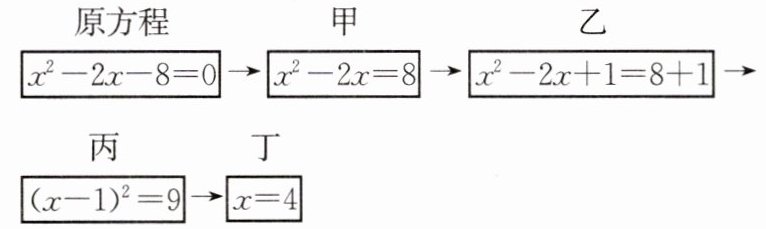
A. 甲
B. 乙
C. 丙
D. 丁
D
)A. 甲
B. 乙
C. 丙
D. 丁
答案:
D
11. 若方程$x^{2}+6x+2=0$能配方成$(x+p)^{2}+q=0$的形式,则直线$y=px+q$不经过第
二
象限.
答案:
二
12. 设$A=2x^{2}-4x-1,B=x^{2}-6x-6$,试比较A与B的大小.
解: $A-B=(2x^{2}-4x-1)-(x^{2}-6x-6)=2x^{2}-4x-1-x^{2}+6x+6=
解: $A-B=(2x^{2}-4x-1)-(x^{2}-6x-6)=2x^{2}-4x-1-x^{2}+6x+6=
x^{2}+2x+5
=(x+1)^{2}+4
$。$\because(x+1)^{2}\geq0$,$\therefore(x+1)^{2}+4>0$,$\therefore A-B>0$,$\therefore A>B
$。
答案:
解: $A-B=(2x^{2}-4x-1)-(x^{2}-6x-6)=2x^{2}-4x-1-x^{2}+6x+6=x^{2}+2x+5=(x+1)^{2}+4$。$\because(x+1)^{2}\geq0$,$\therefore(x+1)^{2}+4>0$,$\therefore A-B>0$,$\therefore A>B$。
13. 阅读以下材料,并解答问题.
已知$m^{2}+2m+n^{2}-6n+10=0$,求m和n的值.
把等式左边的式子变形,得$(m^{2}+2m+1)+(n^{2}-6n+9)=0$,
即$(m+1)^{2}+(n-3)^{2}=0$.
$\because (m+1)^{2}≥0,(n-3)^{2}≥0$,
$\therefore (m+1)^{2}=0,(n-3)^{2}=0$,
$\therefore m+1=0,n-3=0$,
即$m=-1,n=3$.
利用以上方法,解答下列问题:
(1)已知$x^{2}-4x+y^{2}+2y+5=0$,求x和y的值;
解: $\because x^{2}-4x+y^{2}+2y+5=0$,$\therefore x^{2}-4x+4+y^{2}+2y+1=0$,即 $(x-2)^{2}+(y+1)^{2}=0$。$\because(x-2)^{2}\geq0$,$(y+1)^{2}\geq0$,$\therefore(x-2)^{2}=0$,$(y+1)^{2}=0$,$\therefore x-2=0$,$y+1=0$,即 $x=$
(2)若x,y均为实数,则代数式$x^{2}+y^{2}+4x-6y+14$的最小值是____
(3)已知a,b,c是等腰三角形ABC的三边长,满足$a^{2}+b^{2}=12a+8b-52$,求c的值.
解: $\because a^{2}+b^{2}=12a+8b-52$,$\therefore a^{2}+b^{2}-12a-8b+52=0$,$\therefore a^{2}-12a+36+b^{2}-8b+16=0$,即 $(a-6)^{2}+(b-4)^{2}=0$。$\because(a-6)^{2}\geq0$,$(b-4)^{2}\geq0$,$\therefore(a-6)^{2}=0$,$(b-4)^{2}=0$,$\therefore a-6=0$,$b-4=0$,即 $a=6$,$b=4$。$\because\triangle ABC$ 是等腰三角形,$\therefore c$ 的值为
已知$m^{2}+2m+n^{2}-6n+10=0$,求m和n的值.
把等式左边的式子变形,得$(m^{2}+2m+1)+(n^{2}-6n+9)=0$,
即$(m+1)^{2}+(n-3)^{2}=0$.
$\because (m+1)^{2}≥0,(n-3)^{2}≥0$,
$\therefore (m+1)^{2}=0,(n-3)^{2}=0$,
$\therefore m+1=0,n-3=0$,
即$m=-1,n=3$.
利用以上方法,解答下列问题:
(1)已知$x^{2}-4x+y^{2}+2y+5=0$,求x和y的值;
解: $\because x^{2}-4x+y^{2}+2y+5=0$,$\therefore x^{2}-4x+4+y^{2}+2y+1=0$,即 $(x-2)^{2}+(y+1)^{2}=0$。$\because(x-2)^{2}\geq0$,$(y+1)^{2}\geq0$,$\therefore(x-2)^{2}=0$,$(y+1)^{2}=0$,$\therefore x-2=0$,$y+1=0$,即 $x=$
2
,$y=$-1
;(2)若x,y均为实数,则代数式$x^{2}+y^{2}+4x-6y+14$的最小值是____
1
____;(3)已知a,b,c是等腰三角形ABC的三边长,满足$a^{2}+b^{2}=12a+8b-52$,求c的值.
解: $\because a^{2}+b^{2}=12a+8b-52$,$\therefore a^{2}+b^{2}-12a-8b+52=0$,$\therefore a^{2}-12a+36+b^{2}-8b+16=0$,即 $(a-6)^{2}+(b-4)^{2}=0$。$\because(a-6)^{2}\geq0$,$(b-4)^{2}\geq0$,$\therefore(a-6)^{2}=0$,$(b-4)^{2}=0$,$\therefore a-6=0$,$b-4=0$,即 $a=6$,$b=4$。$\because\triangle ABC$ 是等腰三角形,$\therefore c$ 的值为
6或4
。
答案:
解:
(1) $\because x^{2}-4x+y^{2}+2y+5=0$,$\therefore x^{2}-4x+4+y^{2}+2y+1=0$,即 $(x-2)^{2}+(y+1)^{2}=0$。$\because(x-2)^{2}\geq0$,$(y+1)^{2}\geq0$,$\therefore(x-2)^{2}=0$,$(y+1)^{2}=0$,$\therefore x-2=0$,$y+1=0$,即 $x=2$,$y=-1$;
(2) 1
(3) $\because a^{2}+b^{2}=12a+8b-52$,$\therefore a^{2}+b^{2}-12a-8b+52=0$,$\therefore a^{2}-12a+36+b^{2}-8b+16=0$,即 $(a-6)^{2}+(b-4)^{2}=0$。$\because(a-6)^{2}\geq0$,$(b-4)^{2}\geq0$,$\therefore(a-6)^{2}=0$,$(b-4)^{2}=0$,$\therefore a-6=0$,$b-4=0$,即 $a=6$,$b=4$。$\because\triangle ABC$ 是等腰三角形,$\therefore c$ 的值为 6 或 4。
(1) $\because x^{2}-4x+y^{2}+2y+5=0$,$\therefore x^{2}-4x+4+y^{2}+2y+1=0$,即 $(x-2)^{2}+(y+1)^{2}=0$。$\because(x-2)^{2}\geq0$,$(y+1)^{2}\geq0$,$\therefore(x-2)^{2}=0$,$(y+1)^{2}=0$,$\therefore x-2=0$,$y+1=0$,即 $x=2$,$y=-1$;
(2) 1
(3) $\because a^{2}+b^{2}=12a+8b-52$,$\therefore a^{2}+b^{2}-12a-8b+52=0$,$\therefore a^{2}-12a+36+b^{2}-8b+16=0$,即 $(a-6)^{2}+(b-4)^{2}=0$。$\because(a-6)^{2}\geq0$,$(b-4)^{2}\geq0$,$\therefore(a-6)^{2}=0$,$(b-4)^{2}=0$,$\therefore a-6=0$,$b-4=0$,即 $a=6$,$b=4$。$\because\triangle ABC$ 是等腰三角形,$\therefore c$ 的值为 6 或 4。
查看更多完整答案,请扫码查看

