

 搜索
搜索
第4页
- 第1页
- 第2页
- 第3页
- 第4页
- 第5页
- 第6页
- 第7页
- 第8页
- 第9页
- 第10页
- 第11页
- 第12页
- 第13页
- 第14页
- 第15页
- 第16页
- 第17页
- 第18页
- 第19页
- 第20页
- 第21页
- 第22页
- 第23页
- 第24页
- 第25页
- 第26页
- 第27页
- 第28页
- 第29页
- 第30页
- 第31页
- 第32页
- 第33页
- 第34页
- 第35页
- 第36页
- 第37页
- 第38页
- 第39页
- 第40页
- 第41页
- 第42页
- 第43页
- 第44页
- 第45页
- 第46页
- 第47页
- 第48页
- 第49页
- 第50页
- 第51页
- 第52页
- 第53页
- 第54页
- 第55页
- 第56页
- 第57页
- 第58页
- 第59页
- 第60页
- 第61页
- 第62页
- 第63页
- 第64页
- 第65页
- 第66页
- 第67页
- 第68页
- 第69页
- 第70页
- 第71页
- 第72页
- 第73页
- 第74页
- 第75页
- 第76页
- 第77页
- 第78页
- 第79页
- 第80页
- 第81页
- 第82页
- 第83页
- 第84页
- 第85页
- 第86页
- 第87页
- 第88页
- 第89页
- 第90页
- 第91页
- 第92页
- 第93页
- 第94页
- 第95页
- 第96页
- 第97页
- 第98页
- 第99页
- 第100页
- 第101页
- 第102页
- 第103页
- 第104页
- 第105页
- 第106页
- 第107页
- 第108页
- 第109页
- 第110页
- 第111页
- 第112页
9.(2024·通辽)如图,□ABCD的对角线AC,BD交于点O,以下条件不能证明□ABCD是菱形的是 ( )
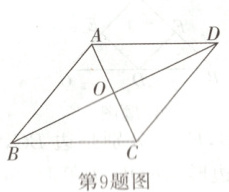
A. ∠BAC = ∠BCA
B. ∠ABD = ∠CBD
C. OA² + OD² = AD²
D. AD² + OA² = OD²
A. ∠BAC = ∠BCA
B. ∠ABD = ∠CBD
C. OA² + OD² = AD²
D. AD² + OA² = OD²
答案:
D
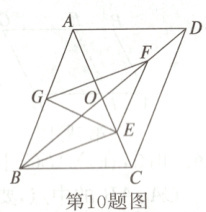
10. 如图,平行四边形ABCD中,对角线AC,BD交于点O,BD = 2AD,E,F,G分别是OC,OD,AB的中点. 下列结论正确的是 ( )
①EG = EF;②△EFG≌△GBE;③FB平分∠EFG;④EA平分∠GEF;⑤四边形BEFG是菱形.
A. ③⑤
B. ①②④
C. ①②③④
D. ①②③④⑤
①EG = EF;②△EFG≌△GBE;③FB平分∠EFG;④EA平分∠GEF;⑤四边形BEFG是菱形.
A. ③⑤
B. ①②④
C. ①②③④
D. ①②③④⑤
答案:
B
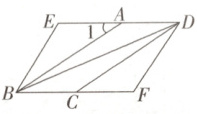
11.(2024·青岛市南区校级模拟)如图,四边形ABCD是平行四边形,延长DA,BC,使得AE = CF,连接BE,DF.
(1)求证:△ABE≌△CDF;
(2)连接BD,若∠1 = 32°,∠ADB = 22°,请直接写出当∠ABE = ________°时,四边形BFDE是菱形.
(1)求证:△ABE≌△CDF;
(2)连接BD,若∠1 = 32°,∠ADB = 22°,请直接写出当∠ABE = ________°时,四边形BFDE是菱形.
答案:
(1)证明:$\because$四边形$ABCD$是平行四边形,
$\therefore AB = CD$,$\angle BAD=\angle BCD$,$\therefore\angle 1=\angle DCF$.
在$\triangle ABE$和$\triangle CDF$中,
$AE = CF$,$\angle 1=\angle DCF$,$AB = CD$,
$\therefore\triangle ABE\cong\triangle CDF(SAS)$.
(2)解:当$\angle ABE = 12^{\circ}$时,四边形$BFDE$是菱形.
理由如下:
$\because\triangle ABE\cong\triangle CDF$,$\therefore BE = DF$,$AE = CF$,$\therefore BF = DE$,
$\therefore$四边形$BFDE$是平行四边形.
$\because\angle 1 = 32^{\circ}$,$\angle ADB = 22^{\circ}$,
$\therefore\angle ABD=\angle 1-\angle ADB = 10^{\circ}$.
$\because\angle ABE = 12^{\circ}$,$\therefore\angle DBE=\angle ABD+\angle ABE = 22^{\circ}$,
$\therefore\angle DBE=\angle ADB = 22^{\circ}$,$\therefore BE = DE$,
$\therefore$平行四边形$BFDE$是菱形.
答案:$12$
(1)证明:$\because$四边形$ABCD$是平行四边形,
$\therefore AB = CD$,$\angle BAD=\angle BCD$,$\therefore\angle 1=\angle DCF$.
在$\triangle ABE$和$\triangle CDF$中,
$AE = CF$,$\angle 1=\angle DCF$,$AB = CD$,
$\therefore\triangle ABE\cong\triangle CDF(SAS)$.
(2)解:当$\angle ABE = 12^{\circ}$时,四边形$BFDE$是菱形.
理由如下:
$\because\triangle ABE\cong\triangle CDF$,$\therefore BE = DF$,$AE = CF$,$\therefore BF = DE$,
$\therefore$四边形$BFDE$是平行四边形.
$\because\angle 1 = 32^{\circ}$,$\angle ADB = 22^{\circ}$,
$\therefore\angle ABD=\angle 1-\angle ADB = 10^{\circ}$.
$\because\angle ABE = 12^{\circ}$,$\therefore\angle DBE=\angle ABD+\angle ABE = 22^{\circ}$,
$\therefore\angle DBE=\angle ADB = 22^{\circ}$,$\therefore BE = DE$,
$\therefore$平行四边形$BFDE$是菱形.
答案:$12$
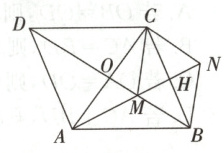
12. 如图,在平行四边形ABCD中,对角线AC,BD相交于点O,M是BD上任意一点,连接AM并延长至点N,使AM = MN,交BC于点H,连接CN,BN.
(1)求证:OM//CN;
(2)连接CM,若AD⊥AN,且AC = AB,求证:四边形BNCM是菱形.
(1)求证:OM//CN;
(2)连接CM,若AD⊥AN,且AC = AB,求证:四边形BNCM是菱形.
答案:
证明:
(1)$\because$四边形$ABCD$是平行四边形,$\therefore OA = OC$.
$\because AM = MN$,$\therefore OM$是$\triangle ACN$的中位线,$\therefore OM// CN$.
(2)$\because$四边形$ABCD$是平行四边形,
$\therefore AD// BC$.$\because AD\perp AN$,$\therefore BC\perp AN$.
$\because AB = AC$,$\therefore BH = CH$.
由
(1)可知$OM// CN$,$\therefore\angle MBH=\angle NCH$.
在$\triangle MBH$和$\triangle NCH$中,$\begin{cases}\angle MBH=\angle NCH,\\BH = CH,\\\angle BHM=\angle CHN,\end{cases}$
$\therefore\triangle MBH\cong\triangle NCH(ASA)$,$\therefore MH = NH$,
$\therefore$四边形$BNCM$是平行四边形.
又$\because BC\perp MN$,$\therefore$平行四边形$BNCM$是菱形.
(1)$\because$四边形$ABCD$是平行四边形,$\therefore OA = OC$.
$\because AM = MN$,$\therefore OM$是$\triangle ACN$的中位线,$\therefore OM// CN$.
(2)$\because$四边形$ABCD$是平行四边形,
$\therefore AD// BC$.$\because AD\perp AN$,$\therefore BC\perp AN$.
$\because AB = AC$,$\therefore BH = CH$.
由
(1)可知$OM// CN$,$\therefore\angle MBH=\angle NCH$.
在$\triangle MBH$和$\triangle NCH$中,$\begin{cases}\angle MBH=\angle NCH,\\BH = CH,\\\angle BHM=\angle CHN,\end{cases}$
$\therefore\triangle MBH\cong\triangle NCH(ASA)$,$\therefore MH = NH$,
$\therefore$四边形$BNCM$是平行四边形.
又$\because BC\perp MN$,$\therefore$平行四边形$BNCM$是菱形.
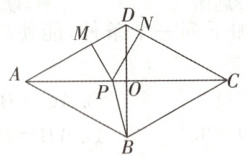
13. 如图所示,四边形ABCD中,AC⊥BD于点O,AO = CO = 4,BO = DO = 3,点P为线段AC上的一个动点. 过点P分别作PM⊥AD于点M,作PN⊥DC于点N. 连接PB,在点P运动过程中,PM + PN + PB的最小值为________.
答案:
$7.8$
解析:$\because AO = CO = 4$,$BO = DO = 3$,
$\therefore AC = 8$,四边形$ABCD$是平行四边形.
$\because AC\perp BD$于点$O$,
$\therefore$平行四边形$ABCD$是菱形,
$AD^{2}=AO^{2}+DO^{2}=4^{2}+3^{2}$,即$AD = 5$,
$\therefore CD = AD = 5$.
连接$PD$,如图所示.
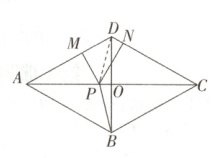
$\because S_{\triangle ADP}+S_{\triangle CDP}=S_{\triangle ADC}$,
$\therefore\frac{1}{2}AD\cdot PM+\frac{1}{2}DC\cdot PN=\frac{1}{2}AC\cdot OD$,
即$\frac{1}{2}\times5\times PM+\frac{1}{2}\times5\times PN=\frac{1}{2}\times8\times3$,
$\therefore 5\times(PM + PN)=8\times3$,
$\therefore PM + PN = 4.8$,
$\therefore$当$PB$最短时,$PM + PN + PB$有最小值.
由垂线段最短可知:当$BP\perp AC$时,$PB$最短,
$\therefore$当点$P$与点$O$重合时,$PM + PN + PB$有最小值,最小值为$4.8 + 3 = 7.8$.
$7.8$
解析:$\because AO = CO = 4$,$BO = DO = 3$,
$\therefore AC = 8$,四边形$ABCD$是平行四边形.
$\because AC\perp BD$于点$O$,
$\therefore$平行四边形$ABCD$是菱形,
$AD^{2}=AO^{2}+DO^{2}=4^{2}+3^{2}$,即$AD = 5$,
$\therefore CD = AD = 5$.
连接$PD$,如图所示.
$\because S_{\triangle ADP}+S_{\triangle CDP}=S_{\triangle ADC}$,
$\therefore\frac{1}{2}AD\cdot PM+\frac{1}{2}DC\cdot PN=\frac{1}{2}AC\cdot OD$,
即$\frac{1}{2}\times5\times PM+\frac{1}{2}\times5\times PN=\frac{1}{2}\times8\times3$,
$\therefore 5\times(PM + PN)=8\times3$,
$\therefore PM + PN = 4.8$,
$\therefore$当$PB$最短时,$PM + PN + PB$有最小值.
由垂线段最短可知:当$BP\perp AC$时,$PB$最短,
$\therefore$当点$P$与点$O$重合时,$PM + PN + PB$有最小值,最小值为$4.8 + 3 = 7.8$.
查看更多完整答案,请扫码查看

