

 搜索
搜索
2025年诚成教育学业评价九年级数学全一册人教版
注:目前有些书本章节名称可能整理的还不是很完善,但都是按照顺序排列的,请同学们按照顺序仔细查找。练习册 2025年诚成教育学业评价九年级数学全一册人教版 答案主要是用来给同学们做完题方便对答案用的,请勿直接抄袭。
第76页
- 第1页
- 第2页
- 第3页
- 第4页
- 第5页
- 第6页
- 第7页
- 第8页
- 第9页
- 第10页
- 第11页
- 第12页
- 第13页
- 第14页
- 第15页
- 第16页
- 第17页
- 第18页
- 第19页
- 第20页
- 第21页
- 第22页
- 第23页
- 第24页
- 第25页
- 第26页
- 第27页
- 第28页
- 第29页
- 第30页
- 第31页
- 第32页
- 第33页
- 第34页
- 第35页
- 第36页
- 第37页
- 第38页
- 第39页
- 第40页
- 第41页
- 第42页
- 第43页
- 第44页
- 第45页
- 第46页
- 第47页
- 第48页
- 第49页
- 第50页
- 第51页
- 第52页
- 第53页
- 第54页
- 第55页
- 第56页
- 第57页
- 第58页
- 第59页
- 第60页
- 第61页
- 第62页
- 第63页
- 第64页
- 第65页
- 第66页
- 第67页
- 第68页
- 第69页
- 第70页
- 第71页
- 第72页
- 第73页
- 第74页
- 第75页
- 第76页
- 第77页
- 第78页
- 第79页
- 第80页
- 第81页
- 第82页
- 第83页
- 第84页
- 第85页
- 第86页
- 第87页
- 第88页
- 第89页
- 第90页
- 第91页
- 第92页
- 第93页
- 第94页
- 第95页
- 第96页
- 第97页
- 第98页
- 第99页
- 第100页
- 第101页
- 第102页
- 第103页
- 第104页
- 第105页
- 第106页
- 第107页
- 第108页
- 第109页
- 第110页
- 第111页
- 第112页
- 第113页
- 第114页
- 第115页
- 第116页
- 第117页
- 第118页
- 第119页
- 第120页
- 第121页
- 第122页
- 第123页
- 第124页
- 第125页
- 第126页
- 第127页
- 第128页
- 第129页
- 第130页
- 第131页
- 第132页
- 第133页
- 第134页
- 第135页
- 第136页
- 第137页
- 第138页
- 第139页
- 第140页
- 第141页
- 第142页
- 第143页
- 第144页
- 第145页
- 第146页
- 第147页
- 第148页
- 第149页
- 第150页
- 第151页
- 第152页
- 第153页
- 第154页
- 第155页
- 第156页
- 第157页
- 第158页
- 第159页
- 第160页
- 第161页
- 第162页
- 第163页
- 第164页
- 第165页
- 第166页
- 第167页
三、解答题(共60分)
21.(6分)如图,在由小正方形组成的网络图中建立一 平面直角坐标系,一条圆弧经过格点
A(0,2),B(4,2),C(6,0).回答下列问题:
(1)请在图中确定该圆弧所在圆的圆心 D的位置,点D的坐标为 ;
(2)求AC的长(结果保留π)
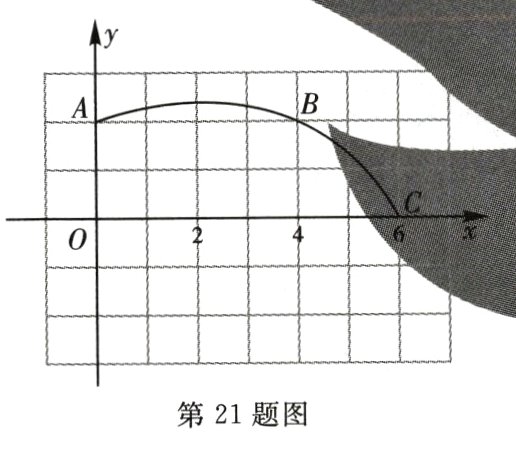
21.(6分)如图,在由小正方形组成的网络图中建立一 平面直角坐标系,一条圆弧经过格点
A(0,2),B(4,2),C(6,0).回答下列问题:
(1)请在图中确定该圆弧所在圆的圆心 D的位置,点D的坐标为 ;
(2)求AC的长(结果保留π)
答案:
21.解:
(1)点D的位置如图所示. $(2, -2)$.
(2)如图,连接AD,CD.
易得 $\odot D$ 的半径为 $\sqrt{2^{2}+4^{2}} = 2\sqrt{5}$,
$\angle ADC = 90^{\circ}$.
所以 $\overset{\frown}{AC}$ 的长为 $\frac{90\pi\times2\sqrt{5}}{180}=\sqrt{5}\pi$.

21.解:
(1)点D的位置如图所示. $(2, -2)$.
(2)如图,连接AD,CD.
易得 $\odot D$ 的半径为 $\sqrt{2^{2}+4^{2}} = 2\sqrt{5}$,
$\angle ADC = 90^{\circ}$.
所以 $\overset{\frown}{AC}$ 的长为 $\frac{90\pi\times2\sqrt{5}}{180}=\sqrt{5}\pi$.
22.(6分)如图,在平面直角坐标系中,⊙C与y轴相切,且点C的坐标为(1,0),直线L过点
A(−1,0),与⊙C相切于点D,求直线L的解析式.
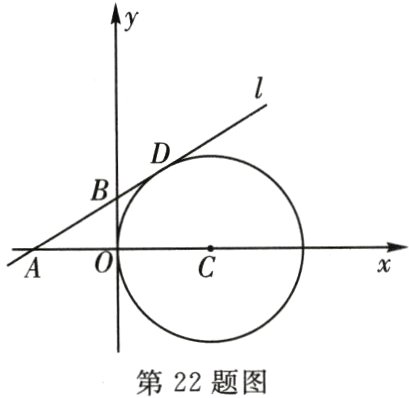
A(−1,0),与⊙C相切于点D,求直线L的解析式.
答案:
22.解:如图所示,连接CD.

$\because$ 直线 $l$ 为 $\odot C$ 的切线,
$\therefore CD\perp AD$.
$\because$ 点C的坐标为 $(1,0)$,
$\therefore OC = 1$.
即 $\odot C$ 的半径为1.
$\therefore CD = OC = 1$.
又点A的坐标为 $(-1,0)$,
$\therefore AC = 2$.
$\therefore\angle CAD = 30^{\circ}$.
在 $Rt\triangle AOB$ 中,$OA = 1$,
$\therefore OB = \frac{\sqrt{3}}{3}$.
$\therefore$ 点B的坐标为 $(0,\frac{\sqrt{3}}{3})$.
设直线 $l$ 的解析式为 $y = kx + b$,
则 $\begin{cases}-k + b = 0 \\ b = \frac{\sqrt{3}}{3} \end{cases}$,解得 $\begin{cases}k = \frac{\sqrt{3}}{3} \\ b = \frac{\sqrt{3}}{3} \end{cases}$.
$\therefore$ 直线 $l$ 的解析式为 $y = \frac{\sqrt{3}}{3}x+\frac{\sqrt{3}}{3}$.
22.解:如图所示,连接CD.
$\because$ 直线 $l$ 为 $\odot C$ 的切线,
$\therefore CD\perp AD$.
$\because$ 点C的坐标为 $(1,0)$,
$\therefore OC = 1$.
即 $\odot C$ 的半径为1.
$\therefore CD = OC = 1$.
又点A的坐标为 $(-1,0)$,
$\therefore AC = 2$.
$\therefore\angle CAD = 30^{\circ}$.
在 $Rt\triangle AOB$ 中,$OA = 1$,
$\therefore OB = \frac{\sqrt{3}}{3}$.
$\therefore$ 点B的坐标为 $(0,\frac{\sqrt{3}}{3})$.
设直线 $l$ 的解析式为 $y = kx + b$,
则 $\begin{cases}-k + b = 0 \\ b = \frac{\sqrt{3}}{3} \end{cases}$,解得 $\begin{cases}k = \frac{\sqrt{3}}{3} \\ b = \frac{\sqrt{3}}{3} \end{cases}$.
$\therefore$ 直线 $l$ 的解析式为 $y = \frac{\sqrt{3}}{3}x+\frac{\sqrt{3}}{3}$.
23.(6分)如图,AB为⊙O的直径,C,D为⊙O上的两个点,AC=CD=DB,连接AD,过点D
作DE⊥AC交AC的延长线于点E.
(1)求证:DE是⊙O的切线;
(2)若直径AB=6,求AD的长.

作DE⊥AC交AC的延长线于点E.
(1)求证:DE是⊙O的切线;
(2)若直径AB=6,求AD的长.
答案:
23.
(1)证明:连接OD.
$\because\overset{\frown}{AC}=\overset{\frown}{CD}=\overset{\frown}{DB}$,$\angle AOB = 180^{\circ}$,
$\therefore\angle BOD = \frac{1}{3}\times180^{\circ}=60^{\circ}$.
$\because\overset{\frown}{CD}=\overset{\frown}{DB}$,
$\therefore\angle EAD = \angle DAB = \frac{1}{2}\angle BOD = 30^{\circ}$.
$\because OA = OD$,
$\therefore\angle ADO = \angle DAB = 30^{\circ}$.
$\because DE\perp AC$ 于点E,
$\therefore\angle E = 90^{\circ}$.
$\therefore\angle EAD+\angle EDA = 90^{\circ}$.
$\therefore\angle EDA = 60^{\circ}$.
$\therefore\angle EDO = \angle EDA+\angle ADO = 90^{\circ}$.
$\therefore OD\perp DE$.
$\therefore DE$ 是 $\odot O$ 的切线.
(2)解:连接BD.
$\because AB$ 是 $\odot O$ 的直径,
$\therefore\angle ADB = 90^{\circ}$.
$\because\angle DAB = 30^{\circ}$,$AB = 6$,
$\therefore BD = \frac{1}{2}AB = 3$.
$\therefore AD = \sqrt{6^{2}-3^{2}} = 3\sqrt{3}$.
(1)证明:连接OD.
$\because\overset{\frown}{AC}=\overset{\frown}{CD}=\overset{\frown}{DB}$,$\angle AOB = 180^{\circ}$,
$\therefore\angle BOD = \frac{1}{3}\times180^{\circ}=60^{\circ}$.
$\because\overset{\frown}{CD}=\overset{\frown}{DB}$,
$\therefore\angle EAD = \angle DAB = \frac{1}{2}\angle BOD = 30^{\circ}$.
$\because OA = OD$,
$\therefore\angle ADO = \angle DAB = 30^{\circ}$.
$\because DE\perp AC$ 于点E,
$\therefore\angle E = 90^{\circ}$.
$\therefore\angle EAD+\angle EDA = 90^{\circ}$.
$\therefore\angle EDA = 60^{\circ}$.
$\therefore\angle EDO = \angle EDA+\angle ADO = 90^{\circ}$.
$\therefore OD\perp DE$.
$\therefore DE$ 是 $\odot O$ 的切线.
(2)解:连接BD.
$\because AB$ 是 $\odot O$ 的直径,
$\therefore\angle ADB = 90^{\circ}$.
$\because\angle DAB = 30^{\circ}$,$AB = 6$,
$\therefore BD = \frac{1}{2}AB = 3$.
$\therefore AD = \sqrt{6^{2}-3^{2}} = 3\sqrt{3}$.
24.(6分)如图,AB是⊙O的切线,B为切点,圆心O在AC上, A=30°,D为BC的中点.
(1)求证AB=BC;
(2)求证:四边形BOC D是菱形
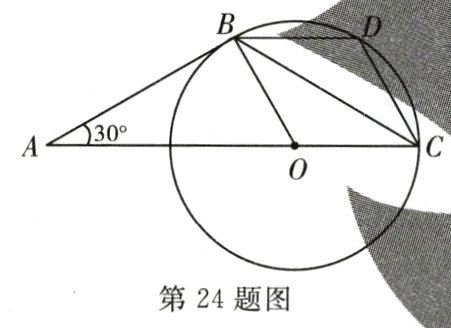
(1)求证AB=BC;
(2)求证:四边形BOC D是菱形
答案:
24.证明:
(1) $\because AB$ 是 $\odot O$ 的切线,
$\angle A = 30^{\circ}$,
$\therefore\angle BOA = 60^{\circ}$.
$\therefore\angle BOC = 120^{\circ}$.
又 $OB = OC$,
$\therefore\angle OBC = \angle BCO = 30^{\circ}$.
$\therefore\angle A = \angle BCA$.
$\therefore AB = BC$.
(2)连接OD.
由
(1) 知 $\angle BOC = 120^{\circ}$.
$\because D$ 是 $\overset{\frown}{BC}$ 的中点,
$\therefore\angle COD = \angle BOD = 60^{\circ}$.
又 $OC = OD$,
$\therefore\triangle OCD$ 是等边三角形.
同理 $\triangle OBD$ 是等边三角形.
$\therefore OB = OC = CD = BD$.
$\therefore$ 四边形BOCD是菱形.
(1) $\because AB$ 是 $\odot O$ 的切线,
$\angle A = 30^{\circ}$,
$\therefore\angle BOA = 60^{\circ}$.
$\therefore\angle BOC = 120^{\circ}$.
又 $OB = OC$,
$\therefore\angle OBC = \angle BCO = 30^{\circ}$.
$\therefore\angle A = \angle BCA$.
$\therefore AB = BC$.
(2)连接OD.
由
(1) 知 $\angle BOC = 120^{\circ}$.
$\because D$ 是 $\overset{\frown}{BC}$ 的中点,
$\therefore\angle COD = \angle BOD = 60^{\circ}$.
又 $OC = OD$,
$\therefore\triangle OCD$ 是等边三角形.
同理 $\triangle OBD$ 是等边三角形.
$\therefore OB = OC = CD = BD$.
$\therefore$ 四边形BOCD是菱形.
25.8分) 如图,AB为OO的直径,PD切OO于点C,与BA的延长线交于点D,DE⊥PO交PO的延长线于点E,连接OC.PB.BE,已知PB=6,DB=8,∠EDB一EPB.

(1)求证:PB是OO的切线:
(2)求◎0的半径
答案:
25.
(1)证明: $\because DE\perp PE$,
$\therefore\angle DEO = 90^{\circ}$.
$\because\angle EDB = \angle EPB$,
$\angle DOE = \angle POB$,
$\therefore\angle OBP = \angle DEO = 90^{\circ}$.
$\therefore OB\perp PB$.
$\because OB$ 是 $\odot O$ 的半径,
$\therefore PB$ 为 $\odot O$ 的切线.
(2)解:在 $Rt\triangle PBD$ 中,$PB = 6$,$DB = 8$,
根据勾股定理,得
$PD = \sqrt{PB^{2}+DB^{2}}=\sqrt{6^{2}+8^{2}} = 10$.
$\because PD$ 与 $PB$ 都为 $\odot O$ 的切线,
$\therefore PC = PB = 6$.
$\therefore DC = PD - PC = 10 - 6 = 4$.
在 $Rt\triangle CDO$ 中,设 $OC = r$,则有 $OD = 8 - r$.
根据勾股定理,得 $OD^{2}=OC^{2}+DC^{2}$.
即 $(8 - r)^{2}=r^{2}+4^{2}$. 解得 $r = 3$.
$\therefore\odot O$ 的半径为3.
(1)证明: $\because DE\perp PE$,
$\therefore\angle DEO = 90^{\circ}$.
$\because\angle EDB = \angle EPB$,
$\angle DOE = \angle POB$,
$\therefore\angle OBP = \angle DEO = 90^{\circ}$.
$\therefore OB\perp PB$.
$\because OB$ 是 $\odot O$ 的半径,
$\therefore PB$ 为 $\odot O$ 的切线.
(2)解:在 $Rt\triangle PBD$ 中,$PB = 6$,$DB = 8$,
根据勾股定理,得
$PD = \sqrt{PB^{2}+DB^{2}}=\sqrt{6^{2}+8^{2}} = 10$.
$\because PD$ 与 $PB$ 都为 $\odot O$ 的切线,
$\therefore PC = PB = 6$.
$\therefore DC = PD - PC = 10 - 6 = 4$.
在 $Rt\triangle CDO$ 中,设 $OC = r$,则有 $OD = 8 - r$.
根据勾股定理,得 $OD^{2}=OC^{2}+DC^{2}$.
即 $(8 - r)^{2}=r^{2}+4^{2}$. 解得 $r = 3$.
$\therefore\odot O$ 的半径为3.
26.(8分)∠AOB=60°,半径为3cm的⊙P沿边OA从右向左水平移动,与边OA相切的切点记为C.
(1)如图,OP移动到与射线OB相切时,切点为D,求劣弧CD的长;
(2)OP移动到与射线OB相交于点E,F,若EF=4$\sqrt{2}$cm,求OC的长.
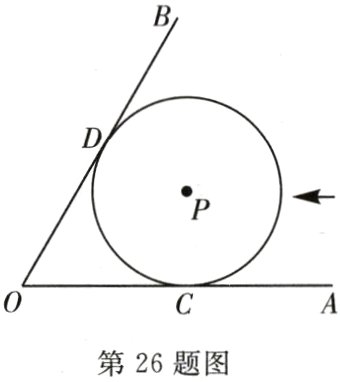
(1)如图,OP移动到与射线OB相切时,切点为D,求劣弧CD的长;
(2)OP移动到与射线OB相交于点E,F,若EF=4$\sqrt{2}$cm,求OC的长.
答案:
26.解:
(1)连接PD,PC,如图①.
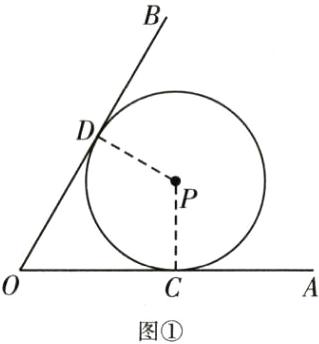
$\because\odot P$ 与 $OA$,$OB$ 分别相切于点C,D,
$\therefore PD\perp OB$,$PC\perp OA$.
$\therefore\angle PCO = \angle PDO = 90^{\circ}$.
$\because\angle AOB = 60^{\circ}$,
$\therefore\angle DPC = 120^{\circ}$.
$\therefore$ 劣弧CD的长为 $\frac{120\times3\pi}{180}=2\pi\ cm$.
(2)可分两种情况:
①如图②,连接PE,PC,过点P作 $PM\perp EF$ 于点M,延长CP交OB于点N.
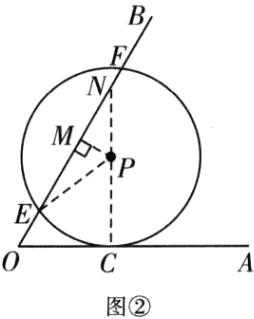
可得 $EM = FM = \frac{1}{2}EF$,$PC\perp OA$.
$\because EF = 4\sqrt{2}\ cm$,$\therefore EM = 2\sqrt{2}\ cm$.
在 $Rt\triangle EPM$ 中,
$PM = \sqrt{PE^{2}-EM^{2}}=\sqrt{3^{2}-(2\sqrt{2})^{2}} = 1\ cm$.
$\because\angle AOB = 60^{\circ}$,
$\therefore\angle PNM = 30^{\circ}$.
$\therefore PN = 2PM = 2\ cm$.
$\therefore NC = PN + PC = 5\ cm$.
在 $Rt\triangle OCN$ 中,
$ON = 2OC$,即 $\sqrt{4OC^{2}-OC^{2}} = CN$.
$\therefore OC = \frac{5}{3}\sqrt{3}\ cm$;
②如图③,连接PF,PC.PC交EF于点N,过点P作 $PM\perp EF$ 于点M.由情况①,同理可求得 $PN = 2\ cm$.
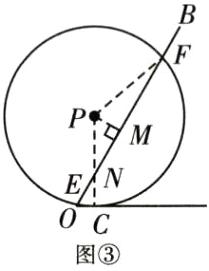
$\therefore NC = PC - PN = 3 - 2 = 1\ cm$.
在 $Rt\triangle OCN$ 中,
$ON = 2OC$,即 $\sqrt{4OC^{2}-OC^{2}} = CN$.
$\therefore OC = \frac{\sqrt{3}}{3}\ cm$.
综上所述,OC的长为 $\frac{5\sqrt{3}}{3}\ cm$ 或 $\frac{\sqrt{3}}{3}\ cm$.
26.解:
(1)连接PD,PC,如图①.
$\because\odot P$ 与 $OA$,$OB$ 分别相切于点C,D,
$\therefore PD\perp OB$,$PC\perp OA$.
$\therefore\angle PCO = \angle PDO = 90^{\circ}$.
$\because\angle AOB = 60^{\circ}$,
$\therefore\angle DPC = 120^{\circ}$.
$\therefore$ 劣弧CD的长为 $\frac{120\times3\pi}{180}=2\pi\ cm$.
(2)可分两种情况:
①如图②,连接PE,PC,过点P作 $PM\perp EF$ 于点M,延长CP交OB于点N.
可得 $EM = FM = \frac{1}{2}EF$,$PC\perp OA$.
$\because EF = 4\sqrt{2}\ cm$,$\therefore EM = 2\sqrt{2}\ cm$.
在 $Rt\triangle EPM$ 中,
$PM = \sqrt{PE^{2}-EM^{2}}=\sqrt{3^{2}-(2\sqrt{2})^{2}} = 1\ cm$.
$\because\angle AOB = 60^{\circ}$,
$\therefore\angle PNM = 30^{\circ}$.
$\therefore PN = 2PM = 2\ cm$.
$\therefore NC = PN + PC = 5\ cm$.
在 $Rt\triangle OCN$ 中,
$ON = 2OC$,即 $\sqrt{4OC^{2}-OC^{2}} = CN$.
$\therefore OC = \frac{5}{3}\sqrt{3}\ cm$;
②如图③,连接PF,PC.PC交EF于点N,过点P作 $PM\perp EF$ 于点M.由情况①,同理可求得 $PN = 2\ cm$.
$\therefore NC = PC - PN = 3 - 2 = 1\ cm$.
在 $Rt\triangle OCN$ 中,
$ON = 2OC$,即 $\sqrt{4OC^{2}-OC^{2}} = CN$.
$\therefore OC = \frac{\sqrt{3}}{3}\ cm$.
综上所述,OC的长为 $\frac{5\sqrt{3}}{3}\ cm$ 或 $\frac{\sqrt{3}}{3}\ cm$.
27.(10分)新理念探究性试题AB为半圆O 的直径C,D为半圆O上任意两点.
(1) 如图①,连接BC,过点O作OE//BC交半圆O于点E,求证AE=CE;
(2)如图②,连接BD.F为BD 的中点,过点F作EG⊥AB手点G,求证 BD=2FG.
(2
答案:
27.证明:
(1)连接OC.
$\because OB = OC$,$\therefore\angle OBC = \angle OCB$.
$\because OE// BC$,
$\therefore\angle AOE = \angle OBC$,$\angle COE = \angle OCB$.
$\therefore\angle AOE = \angle COE$.
$\therefore\overset{\frown}{AE}=\overset{\frown}{CE}$.
(2)连接OF,交BD于点L.
$\because F$ 为 $\overset{\frown}{BD}$ 的中点,
$\therefore OF$ 垂直平分BD.
$\therefore BD = 2BL$.
易证 $\triangle LOB\cong\triangle GOF$.
$\therefore FG = LB$.
$\therefore BD = 2FG$.
(1)连接OC.
$\because OB = OC$,$\therefore\angle OBC = \angle OCB$.
$\because OE// BC$,
$\therefore\angle AOE = \angle OBC$,$\angle COE = \angle OCB$.
$\therefore\angle AOE = \angle COE$.
$\therefore\overset{\frown}{AE}=\overset{\frown}{CE}$.
(2)连接OF,交BD于点L.
$\because F$ 为 $\overset{\frown}{BD}$ 的中点,
$\therefore OF$ 垂直平分BD.
$\therefore BD = 2BL$.
易证 $\triangle LOB\cong\triangle GOF$.
$\therefore FG = LB$.
$\therefore BD = 2FG$.
28.在平面直角坐标系Oy中,已知抛物线y一r²+br十c经过点A(一1,0)和点B(0,3),顶点为C,点D在其对称轴上,且位于点C下方,将线段DO绕点D按顺时针方向旋转90°,点C落在抛物线上的点P处.

(1)求抛物线的解析式;
(2)求点P的坐标.
(2)
答案:
28.解:
(1)把 $A(-1,0)$ 和 $B(0,3)$ 代入 $y = -x^{2}+bx + c$,
得 $\begin{cases}-1 - b + c = 0 \\ c = 3 \end{cases}$,
解得 $\begin{cases}b = 2 \\ c = 3 \end{cases}$.
$\therefore$ 抛物线解析式为 $y = -x^{2}+2x + 3$.
(2) $\because y = -x^{2}+2x + 3 = -(x - 1)^{2}+4$,
$\therefore C(1,4)$.
抛物线的对称轴为 $x = 1$.
如图,设 $CD = t$,则 $D(1,4 - t)$.
$\because$ 线段DC绕点D按顺时针方向旋转 $90^{\circ}$,
点C落在抛物线上的点P处,
$\therefore\angle PDC = 90^{\circ}$,$DP = DC = t$.
$\therefore P(1 + t,4 - t)$.
把 $P(1 + t,4 - t)$ 代入 $y = -x^{2}+2x + 3$,
得 $-(1 + t)^{2}+2(1 + t)+3 = 4 - t$.
整理,得 $t^{2}-t = 0$,
解得 $t_{1}=0$(舍去),$t_{2}=1$.
$\therefore P(2,3)$.

28.解:
(1)把 $A(-1,0)$ 和 $B(0,3)$ 代入 $y = -x^{2}+bx + c$,
得 $\begin{cases}-1 - b + c = 0 \\ c = 3 \end{cases}$,
解得 $\begin{cases}b = 2 \\ c = 3 \end{cases}$.
$\therefore$ 抛物线解析式为 $y = -x^{2}+2x + 3$.
(2) $\because y = -x^{2}+2x + 3 = -(x - 1)^{2}+4$,
$\therefore C(1,4)$.
抛物线的对称轴为 $x = 1$.
如图,设 $CD = t$,则 $D(1,4 - t)$.
$\because$ 线段DC绕点D按顺时针方向旋转 $90^{\circ}$,
点C落在抛物线上的点P处,
$\therefore\angle PDC = 90^{\circ}$,$DP = DC = t$.
$\therefore P(1 + t,4 - t)$.
把 $P(1 + t,4 - t)$ 代入 $y = -x^{2}+2x + 3$,
得 $-(1 + t)^{2}+2(1 + t)+3 = 4 - t$.
整理,得 $t^{2}-t = 0$,
解得 $t_{1}=0$(舍去),$t_{2}=1$.
$\therefore P(2,3)$.
查看更多完整答案,请扫码查看

