

 搜索
搜索
第31页
- 第4页
- 第5页
- 第6页
- 第7页
- 第8页
- 第9页
- 第10页
- 第11页
- 第12页
- 第13页
- 第14页
- 第15页
- 第16页
- 第17页
- 第18页
- 第19页
- 第20页
- 第21页
- 第22页
- 第23页
- 第24页
- 第25页
- 第26页
- 第27页
- 第28页
- 第29页
- 第30页
- 第31页
- 第32页
- 第33页
- 第34页
- 第35页
- 第36页
- 第37页
- 第38页
- 第39页
- 第40页
- 第41页
- 第42页
- 第43页
- 第44页
- 第45页
- 第46页
- 第47页
- 第48页
- 第49页
- 第50页
- 第51页
- 第52页
- 第53页
- 第54页
- 第55页
- 第56页
- 第57页
- 第58页
- 第59页
- 第60页
- 第61页
- 第62页
- 第63页
- 第64页
- 第65页
- 第66页
- 第67页
- 第68页
- 第69页
- 第70页
- 第71页
- 第72页
- 第73页
- 第74页
- 第75页
- 第76页
- 第77页
- 第78页
- 第79页
- 第80页
- 第81页
- 第82页
- 第83页
- 第84页
- 第85页
- 第86页
- 第87页
- 第88页
- 第89页
- 第90页
- 第91页
- 第92页
- 第93页
- 第94页
- 第95页
- 第96页
- 第97页
- 第98页
- 第99页
- 第100页
- 第101页
- 第102页
- 第103页
- 第104页
- 第105页
- 第106页
- 第107页
- 第108页
- 第109页
- 第110页
- 第111页
- 第112页
- 第113页
- 第114页
8.在同一平面直角坐标系中,一次函数$y= ax+2与二次函数y= x^{2}-a$的大致图象是(

A
)
答案:
A
9.已知二次函数$y= x^{2}+3$,当$-1\leqslant x\leqslant 2$时,函数值y的取值范围是(
A.$4\leqslant x\leqslant 7$
B.$3\leqslant x\leqslant 7$
C.$3\leqslant x\leqslant 5$
D.$4\leqslant x\leqslant 5$
B
)A.$4\leqslant x\leqslant 7$
B.$3\leqslant x\leqslant 7$
C.$3\leqslant x\leqslant 5$
D.$4\leqslant x\leqslant 5$
答案:
二次函数$y=x^2 + 3$,其中$a=1>0$,抛物线开口向上,对称轴为$y$轴($x=0$)。
当$x=0$时,$y=0^2 + 3=3$,此为函数的最小值。
当$x=-1$时,$y=(-1)^2 + 3=1 + 3=4$;当$x=2$时,$y=2^2 + 3=4 + 3=7$。
在$-1\leqslant x\leqslant 2$范围内,最大值为$7$,最小值为$3$,所以$y$的取值范围是$3\leqslant y\leqslant 7$。
B
当$x=0$时,$y=0^2 + 3=3$,此为函数的最小值。
当$x=-1$时,$y=(-1)^2 + 3=1 + 3=4$;当$x=2$时,$y=2^2 + 3=4 + 3=7$。
在$-1\leqslant x\leqslant 2$范围内,最大值为$7$,最小值为$3$,所以$y$的取值范围是$3\leqslant y\leqslant 7$。
B
10.已知二次函数$y= 2x^{2}+c的图象上有三个点A(-1,y_{1}),B(-2,y_{2}),C(3,y_{3})$,则(
A.$y_{1}<y_{2}<y_{3}$
B.$y_{2}<y_{3}<y_{1}$
C.$y_{3}<y_{2}<y_{1}$
D.$y_{2}<y_{1}<y_{3}$
A
)A.$y_{1}<y_{2}<y_{3}$
B.$y_{2}<y_{3}<y_{1}$
C.$y_{3}<y_{2}<y_{1}$
D.$y_{2}<y_{1}<y_{3}$
答案:
1. 对于二次函数$y = ax^2 + c$,对称轴为$x = 0$(即$y$轴)。
2. 二次函数$y = 2x^2 + c$的开口方向向上(因为$a = 2 > 0$),在对称轴左侧($x < 0$)函数值随$x$的增大而减小,在对称轴右侧($x > 0$)函数值随$x$的增大而增大。
3. 点$A(-1,y_1)$,$B(-2,y_2)$,$C(3,y_3)$到对称轴$x = 0$的距离分别为:
点$A$:$\vert -1 - 0\vert = 1$;
点$B$:$\vert -2 - 0\vert = 2$;
点$C$:$\vert 3 - 0\vert = 3$。
4. 因为$1\lt 2\lt 3$,且函数开口向上,距离对称轴越远,函数值越大,所以$y_1\lt y_2\lt y_3$。
答案选A。
2. 二次函数$y = 2x^2 + c$的开口方向向上(因为$a = 2 > 0$),在对称轴左侧($x < 0$)函数值随$x$的增大而减小,在对称轴右侧($x > 0$)函数值随$x$的增大而增大。
3. 点$A(-1,y_1)$,$B(-2,y_2)$,$C(3,y_3)$到对称轴$x = 0$的距离分别为:
点$A$:$\vert -1 - 0\vert = 1$;
点$B$:$\vert -2 - 0\vert = 2$;
点$C$:$\vert 3 - 0\vert = 3$。
4. 因为$1\lt 2\lt 3$,且函数开口向上,距离对称轴越远,函数值越大,所以$y_1\lt y_2\lt y_3$。
答案选A。
11.如图,抛物线$y= -\dfrac{1}{2}x^{2}+m$与x轴交于A,B两点,与y轴交于点$C(0,2)$.
(1)求抛物线的解析式,并写出对称轴.
(2)在抛物线上是否存在一点M,使$\triangle MAC\cong \triangle OAC$?若存在,求出点M的坐标;若不存在,请说明理由.
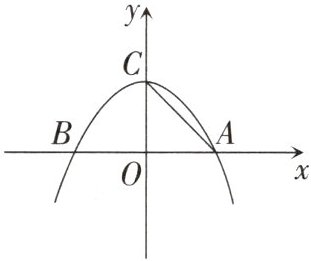
(1)求抛物线的解析式,并写出对称轴.
(2)在抛物线上是否存在一点M,使$\triangle MAC\cong \triangle OAC$?若存在,求出点M的坐标;若不存在,请说明理由.
答案:
(1) $y=-\dfrac{1}{2}x^{2}+2$,对称轴$x=0$;
(2) 不存在。
(1) $y=-\dfrac{1}{2}x^{2}+2$,对称轴$x=0$;
(2) 不存在。
12.如图,抛物线$y= ax^{2}+1经过点P(2,3)$.
(1)抛物线的解析式为______
(2)点$P'$是平面内一点,$OP'= OP,\angle POP'= 45^{\circ}$,求点$P'$的坐标.
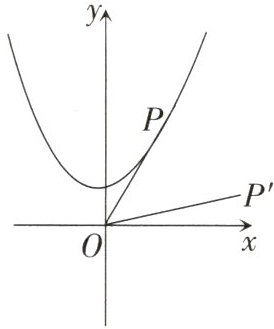
(1)抛物线的解析式为______
$y=\frac{1}{2}x^{2}+1$
;(2)点$P'$是平面内一点,$OP'= OP,\angle POP'= 45^{\circ}$,求点$P'$的坐标.
$P'\left(\frac{5\sqrt{2}}{2},\frac{\sqrt{2}}{2}\right)$或$P'\left(-\frac{\sqrt{2}}{2},\frac{5\sqrt{2}}{2}\right)$
答案:
1. (1)
已知抛物线$y = ax^{2}+1$经过点$P(2,3)$,将$x = 2$,$y = 3$代入抛物线方程:
得$3=a×2^{2}+1$,即$3 = 4a+1$。
移项可得$4a=3 - 1=2$,解得$a=\frac{1}{2}$。
所以抛物线的解析式为$y=\frac{1}{2}x^{2}+1$。
2. (2)
首先求$OP$的长度:
已知$P(2,3)$,根据两点间距离公式$d=\sqrt{(x_2 - x_1)^{2}+(y_2 - y_1)^{2}}$,这里$O(0,0)$,$P(2,3)$,则$OP=\sqrt{(2 - 0)^{2}+(3 - 0)^{2}}=\sqrt{4 + 9}=\sqrt{13}$。
设$P'(x,y)$,因为$OP' = OP=\sqrt{13}$,所以$x^{2}+y^{2}=13$。
又因为$\angle POP' = 45^{\circ}$,根据向量的夹角公式$\cos\angle POP'=\frac{\overrightarrow{OP}\cdot\overrightarrow{OP'}}{\vert\overrightarrow{OP}\vert\vert\overrightarrow{OP'}\vert}$,$\overrightarrow{OP}=(2,3)$,$\overrightarrow{OP'}=(x,y)$,$\cos45^{\circ}=\frac{\sqrt{2}}{2}$,且$\vert\overrightarrow{OP}\vert=\vert\overrightarrow{OP'}\vert=\sqrt{13}$,则$\frac{2x + 3y}{\sqrt{13}×\sqrt{13}}=\frac{\sqrt{2}}{2}$,即$2x + 3y=\frac{13\sqrt{2}}{2}$。
由$x^{2}+y^{2}=13$,$y=\frac{13\sqrt{2}-4x}{6}$,代入$x^{2}+y^{2}=13$得:
$x^{2}+\left(\frac{13\sqrt{2}-4x}{6}\right)^{2}=13$。
$36x^{2}+(13\sqrt{2}-4x)^{2}=13×36$。
$36x^{2}+338-104\sqrt{2}x + 16x^{2}=468$。
$52x^{2}-104\sqrt{2}x - 130 = 0$,两边同时除以$26$得$2x^{2}-4\sqrt{2}x - 5 = 0$。
根据求根公式$x=\frac{4\sqrt{2}\pm\sqrt{32+40}}{4}=\frac{4\sqrt{2}\pm\sqrt{72}}{4}=\frac{4\sqrt{2}\pm6\sqrt{2}}{4}$。
解得$x=\frac{5\sqrt{2}}{2}$,$y=\frac{\sqrt{2}}{2}$或$x =-\frac{\sqrt{2}}{2}$,$y=\frac{5\sqrt{2}}{2}$。
所以$P'\left(\frac{5\sqrt{2}}{2},\frac{\sqrt{2}}{2}\right)$或$P'\left(-\frac{\sqrt{2}}{2},\frac{5\sqrt{2}}{2}\right)$。
综上,(1)$y=\frac{1}{2}x^{2}+1$;(2)$P'\left(\frac{5\sqrt{2}}{2},\frac{\sqrt{2}}{2}\right)$或$P'\left(-\frac{\sqrt{2}}{2},\frac{5\sqrt{2}}{2}\right)$。
已知抛物线$y = ax^{2}+1$经过点$P(2,3)$,将$x = 2$,$y = 3$代入抛物线方程:
得$3=a×2^{2}+1$,即$3 = 4a+1$。
移项可得$4a=3 - 1=2$,解得$a=\frac{1}{2}$。
所以抛物线的解析式为$y=\frac{1}{2}x^{2}+1$。
2. (2)
首先求$OP$的长度:
已知$P(2,3)$,根据两点间距离公式$d=\sqrt{(x_2 - x_1)^{2}+(y_2 - y_1)^{2}}$,这里$O(0,0)$,$P(2,3)$,则$OP=\sqrt{(2 - 0)^{2}+(3 - 0)^{2}}=\sqrt{4 + 9}=\sqrt{13}$。
设$P'(x,y)$,因为$OP' = OP=\sqrt{13}$,所以$x^{2}+y^{2}=13$。
又因为$\angle POP' = 45^{\circ}$,根据向量的夹角公式$\cos\angle POP'=\frac{\overrightarrow{OP}\cdot\overrightarrow{OP'}}{\vert\overrightarrow{OP}\vert\vert\overrightarrow{OP'}\vert}$,$\overrightarrow{OP}=(2,3)$,$\overrightarrow{OP'}=(x,y)$,$\cos45^{\circ}=\frac{\sqrt{2}}{2}$,且$\vert\overrightarrow{OP}\vert=\vert\overrightarrow{OP'}\vert=\sqrt{13}$,则$\frac{2x + 3y}{\sqrt{13}×\sqrt{13}}=\frac{\sqrt{2}}{2}$,即$2x + 3y=\frac{13\sqrt{2}}{2}$。
由$x^{2}+y^{2}=13$,$y=\frac{13\sqrt{2}-4x}{6}$,代入$x^{2}+y^{2}=13$得:
$x^{2}+\left(\frac{13\sqrt{2}-4x}{6}\right)^{2}=13$。
$36x^{2}+(13\sqrt{2}-4x)^{2}=13×36$。
$36x^{2}+338-104\sqrt{2}x + 16x^{2}=468$。
$52x^{2}-104\sqrt{2}x - 130 = 0$,两边同时除以$26$得$2x^{2}-4\sqrt{2}x - 5 = 0$。
根据求根公式$x=\frac{4\sqrt{2}\pm\sqrt{32+40}}{4}=\frac{4\sqrt{2}\pm\sqrt{72}}{4}=\frac{4\sqrt{2}\pm6\sqrt{2}}{4}$。
解得$x=\frac{5\sqrt{2}}{2}$,$y=\frac{\sqrt{2}}{2}$或$x =-\frac{\sqrt{2}}{2}$,$y=\frac{5\sqrt{2}}{2}$。
所以$P'\left(\frac{5\sqrt{2}}{2},\frac{\sqrt{2}}{2}\right)$或$P'\left(-\frac{\sqrt{2}}{2},\frac{5\sqrt{2}}{2}\right)$。
综上,(1)$y=\frac{1}{2}x^{2}+1$;(2)$P'\left(\frac{5\sqrt{2}}{2},\frac{\sqrt{2}}{2}\right)$或$P'\left(-\frac{\sqrt{2}}{2},\frac{5\sqrt{2}}{2}\right)$。
查看更多完整答案,请扫码查看

