

 搜索
搜索
2025年绿色通道45分钟课时作业与单元测评高中数学必修第一册人教版
注:目前有些书本章节名称可能整理的还不是很完善,但都是按照顺序排列的,请同学们按照顺序仔细查找。练习册 2025年绿色通道45分钟课时作业与单元测评高中数学必修第一册人教版 答案主要是用来给同学们做完题方便对答案用的,请勿直接抄袭。
第106页
- 第1页
- 第2页
- 第3页
- 第4页
- 第5页
- 第6页
- 第7页
- 第8页
- 第9页
- 第10页
- 第11页
- 第12页
- 第13页
- 第14页
- 第15页
- 第16页
- 第17页
- 第18页
- 第19页
- 第20页
- 第21页
- 第22页
- 第23页
- 第24页
- 第25页
- 第26页
- 第27页
- 第28页
- 第29页
- 第30页
- 第31页
- 第32页
- 第33页
- 第34页
- 第35页
- 第36页
- 第37页
- 第38页
- 第39页
- 第40页
- 第41页
- 第42页
- 第43页
- 第44页
- 第45页
- 第46页
- 第47页
- 第48页
- 第49页
- 第50页
- 第51页
- 第52页
- 第53页
- 第54页
- 第55页
- 第56页
- 第57页
- 第58页
- 第59页
- 第60页
- 第61页
- 第62页
- 第63页
- 第64页
- 第65页
- 第66页
- 第67页
- 第68页
- 第69页
- 第70页
- 第71页
- 第72页
- 第73页
- 第74页
- 第75页
- 第76页
- 第77页
- 第78页
- 第79页
- 第80页
- 第81页
- 第82页
- 第83页
- 第84页
- 第85页
- 第86页
- 第87页
- 第88页
- 第89页
- 第90页
- 第91页
- 第92页
- 第93页
- 第94页
- 第95页
- 第96页
- 第97页
- 第98页
- 第99页
- 第100页
- 第101页
- 第102页
- 第103页
- 第104页
- 第105页
- 第106页
10. 判断下列函数的奇偶性。
(1)$ f(x) = \lg(\sin x + \sqrt{1 + \sin^2 x}) $;
(2)$ f(x) = \sin(\frac{3x}{4} + \frac{3\pi}{2}) $。
(1)$ f(x) = \lg(\sin x + \sqrt{1 + \sin^2 x}) $;
(2)$ f(x) = \sin(\frac{3x}{4} + \frac{3\pi}{2}) $。
答案:
10.解
(1)$\because 1 + \sin ^2 x > \sin ^2 x$,
$\therefore \sqrt {1 + \sin ^2 x} > | \sin x | \geq - \sin x$,
$\therefore \sin x + \sqrt {1 + \sin ^2 x} > 0$,$\therefore$函数$f(x)$的定义域为$\mathbf{R}$.
$\because f(x) = \lg ( \sin x + \sqrt {1 + \sin ^2 x} )$,
$\therefore f(-x) = \lg [ \sin (-x) + \sqrt {1 + \sin ^2 (-x)} ]$
$= \lg ( - \sin x + \sqrt {1 + \sin ^2 x} )$,
$\therefore f(x) + f(-x) = \lg ( \sin x + \sqrt {1 + \sin ^2 x} ) + \lg ( - \sin x + \sqrt {1 + \sin ^2 x} ) = \lg ( 1 + \sin ^2 x - \sin ^2 x ) = \lg 1 = 0$,
$\therefore f(x) + f(-x) = 0$,$\therefore f(x) = \lg ( \sin x + \sqrt {1 + \sin ^2 x} )$为奇函数.
(2)$\because f(x) = \sin ( \frac {3x} {4} + \frac {3\pi} {2} )$,$\therefore f(x) = - \cos \frac {3x} {4}$,且函数$f(x)$的定义域为$\mathbf{R}$.
又$\because f(-x) = - \cos ( - \frac {3x} {4} ) = - \cos \frac {3x} {4}$,
$\therefore f(-x) = f(x)$,
$\therefore$函数$f(x) = \sin ( \frac {3x} {4} + \frac {3\pi} {2} )$是偶函数.
(1)$\because 1 + \sin ^2 x > \sin ^2 x$,
$\therefore \sqrt {1 + \sin ^2 x} > | \sin x | \geq - \sin x$,
$\therefore \sin x + \sqrt {1 + \sin ^2 x} > 0$,$\therefore$函数$f(x)$的定义域为$\mathbf{R}$.
$\because f(x) = \lg ( \sin x + \sqrt {1 + \sin ^2 x} )$,
$\therefore f(-x) = \lg [ \sin (-x) + \sqrt {1 + \sin ^2 (-x)} ]$
$= \lg ( - \sin x + \sqrt {1 + \sin ^2 x} )$,
$\therefore f(x) + f(-x) = \lg ( \sin x + \sqrt {1 + \sin ^2 x} ) + \lg ( - \sin x + \sqrt {1 + \sin ^2 x} ) = \lg ( 1 + \sin ^2 x - \sin ^2 x ) = \lg 1 = 0$,
$\therefore f(x) + f(-x) = 0$,$\therefore f(x) = \lg ( \sin x + \sqrt {1 + \sin ^2 x} )$为奇函数.
(2)$\because f(x) = \sin ( \frac {3x} {4} + \frac {3\pi} {2} )$,$\therefore f(x) = - \cos \frac {3x} {4}$,且函数$f(x)$的定义域为$\mathbf{R}$.
又$\because f(-x) = - \cos ( - \frac {3x} {4} ) = - \cos \frac {3x} {4}$,
$\therefore f(-x) = f(x)$,
$\therefore$函数$f(x) = \sin ( \frac {3x} {4} + \frac {3\pi} {2} )$是偶函数.
11. 函数$ f(x) = \frac{\sin x + x}{\cos x + x^2} $在$ [-\pi, \pi] $上的图象大致为 (
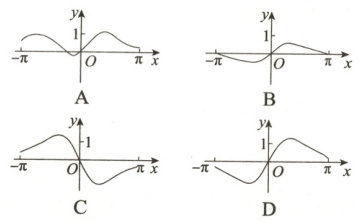
D
)
答案:
11.D 定义域关于原点对称,
$\because f(-x) = \frac {\sin (-x) + (-x)} {\cos (-x) + (-x)^2} = \frac {\sin x + x} {\cos x + x^2} = - f(x)$,
$\therefore f(x)$在$[ - \pi, \pi ]$上为奇函数,故排除A;当$x = \frac {\pi} {2}$时,
$f ( \frac {\pi} {2} ) = \frac {1 + \frac {\pi} {2}} {\frac {\pi^2} {4}} = \frac {4 + 2\pi} {\pi^2} > 1$,故排除B、C,故选D.
$\because f(-x) = \frac {\sin (-x) + (-x)} {\cos (-x) + (-x)^2} = \frac {\sin x + x} {\cos x + x^2} = - f(x)$,
$\therefore f(x)$在$[ - \pi, \pi ]$上为奇函数,故排除A;当$x = \frac {\pi} {2}$时,
$f ( \frac {\pi} {2} ) = \frac {1 + \frac {\pi} {2}} {\frac {\pi^2} {4}} = \frac {4 + 2\pi} {\pi^2} > 1$,故排除B、C,故选D.
12. (2025·山东淄博期中)若函数$ f(x) $的定义域为$ \mathbf{R} $,且函数$ f(x) + \sin x $是偶函数,函数$ f(x) + \cos x $是奇函数,则$ f(\frac{\pi}{3}) = $ (
A.$ -\frac{1 + \sqrt{3}}{2} $
B.$ \frac{1 - \sqrt{3}}{2} $
C.$ \frac{-1 + \sqrt{3}}{2} $
D.$ \frac{1 + \sqrt{3}}{2} $
A
)A.$ -\frac{1 + \sqrt{3}}{2} $
B.$ \frac{1 - \sqrt{3}}{2} $
C.$ \frac{-1 + \sqrt{3}}{2} $
D.$ \frac{1 + \sqrt{3}}{2} $
答案:
12.A $\because$函数$f(x) + \sin x$为偶函数,
$\therefore f ( - \frac {\pi} {3} ) + \sin ( - \frac {\pi} {3} ) = f ( \frac {\pi} {3} ) + \sin \frac {\pi} {3}$,
即$f ( - \frac {\pi} {3} ) - \frac {\sqrt {3}} {2} = f ( \frac {\pi} {3} ) + \frac {\sqrt {3}} {2}$ ①.
$\because$函数$f(x) + \cos x$为奇函数,
$\therefore f ( - \frac {\pi} {3} ) + \cos ( - \frac {\pi} {3} ) = - f ( \frac {\pi} {3} ) - \cos \frac {\pi} {3}$,
即$f ( - \frac {\pi} {3} ) + \frac {1} {2} = - f ( \frac {\pi} {3} ) - \frac {1} {2}$ ②.
由①−②得$- \frac {\sqrt {3} + 1} {2} = 2f ( \frac {\pi} {3} ) + \frac {\sqrt {3} + 1} {2}$,
$\therefore f ( \frac {\pi} {3} ) = - \frac {1 + \sqrt {3}} {2}$.故选A.
$\therefore f ( - \frac {\pi} {3} ) + \sin ( - \frac {\pi} {3} ) = f ( \frac {\pi} {3} ) + \sin \frac {\pi} {3}$,
即$f ( - \frac {\pi} {3} ) - \frac {\sqrt {3}} {2} = f ( \frac {\pi} {3} ) + \frac {\sqrt {3}} {2}$ ①.
$\because$函数$f(x) + \cos x$为奇函数,
$\therefore f ( - \frac {\pi} {3} ) + \cos ( - \frac {\pi} {3} ) = - f ( \frac {\pi} {3} ) - \cos \frac {\pi} {3}$,
即$f ( - \frac {\pi} {3} ) + \frac {1} {2} = - f ( \frac {\pi} {3} ) - \frac {1} {2}$ ②.
由①−②得$- \frac {\sqrt {3} + 1} {2} = 2f ( \frac {\pi} {3} ) + \frac {\sqrt {3} + 1} {2}$,
$\therefore f ( \frac {\pi} {3} ) = - \frac {1 + \sqrt {3}} {2}$.故选A.
13. (2024·河南商丘期末)已知函数$ f(x) = \cos \frac{\pi}{3}x $,则$ f(1) + f(2) + \dots + f(2025) = $
−1
.
答案:
13.−1
解析 $f(x) = \cos \frac {\pi} {3} x$的最小正周期$T = \frac {2\pi} {\frac {\pi} {3}} = 6$.
又$f(1) = \cos \frac {\pi} {3} = \frac {1} {2}$,$f(2) = - \frac {1} {2}$,$f(3) = - 1$,$f(4) = - \frac {1} {2}$,$f(5) = \frac {1} {2}$,$f(6) = 1$,所以$f(1) + f(2) + ·s + f(6) = 0$.又$2025 = 337 × 6 + 3$,所以$f(1) + f(2) + ·s + f(2025) = 337 × 0 + f(1) + f(2) + f(3) = - 1$.
解析 $f(x) = \cos \frac {\pi} {3} x$的最小正周期$T = \frac {2\pi} {\frac {\pi} {3}} = 6$.
又$f(1) = \cos \frac {\pi} {3} = \frac {1} {2}$,$f(2) = - \frac {1} {2}$,$f(3) = - 1$,$f(4) = - \frac {1} {2}$,$f(5) = \frac {1} {2}$,$f(6) = 1$,所以$f(1) + f(2) + ·s + f(6) = 0$.又$2025 = 337 × 6 + 3$,所以$f(1) + f(2) + ·s + f(2025) = 337 × 0 + f(1) + f(2) + f(3) = - 1$.
14. 已知函数$ y = f(x) = |\sin x| + |\cos x| $,试根据下列要求研究函数$ f(x) $的性质。
(1)求证:函数$ f(x) $是偶函数;
(2)求证:$ \frac{\pi}{2} $是函数$ f(x) $的一个周期。
(1)求证:函数$ f(x) $是偶函数;
(2)求证:$ \frac{\pi}{2} $是函数$ f(x) $的一个周期。
答案:
14.证明
(1)函数$f(x)$的定义域为$\mathbf{R}$,
$f(-x) = | \sin (-x) | + | \cos (-x) | = | \sin x | + | \cos x | = f(x)$,
所以函数$f(x)$是偶函数.
(2)$f ( x + \frac {\pi} {2} ) = | \sin ( x + \frac {\pi} {2} ) | + | \cos ( x + \frac {\pi} {2} ) | = | \cos x | + | \sin x | = f(x)$,
所以$f(x)$是周期函数,$\frac {\pi} {2}$是它的一个周期.
(1)函数$f(x)$的定义域为$\mathbf{R}$,
$f(-x) = | \sin (-x) | + | \cos (-x) | = | \sin x | + | \cos x | = f(x)$,
所以函数$f(x)$是偶函数.
(2)$f ( x + \frac {\pi} {2} ) = | \sin ( x + \frac {\pi} {2} ) | + | \cos ( x + \frac {\pi} {2} ) | = | \cos x | + | \sin x | = f(x)$,
所以$f(x)$是周期函数,$\frac {\pi} {2}$是它的一个周期.
15. 已知函数$ f(x) = \sin \omega x $在$ [0, \frac{3\pi}{4}] $上恰有4个零点,则正整数$ \omega $的值为 (
A.2或3
B.3或4
C.4或5
D.5或6
C
)A.2或3
B.3或4
C.4或5
D.5或6
答案:
15.C 因为函数$f(x) = \sin \omega x$在$[ 0, \frac {3\pi} {4} ]$上恰有4个零点且$f(x)$的图象过原点,设$f(x)$的最小正周期为$T$,所以$\frac {3} {2} T \leq \frac {3\pi} {4} < 2T$,又$T = \frac {2\pi} {\omega}$,所以$\frac {3} {2} · \frac {2\pi} {\omega} \leq \frac {3\pi} {4} < 2 · \frac {2\pi} {\omega}$,解得$4 \leq \omega < \frac {16} {3}$,所以正整数$\omega$的值为4或5.
查看更多完整答案,请扫码查看

