

 搜索
搜索
2025年初中毕业升学真题详解八年级数学上册北师大版陕西专版
注:目前有些书本章节名称可能整理的还不是很完善,但都是按照顺序排列的,请同学们按照顺序仔细查找。练习册 2025年初中毕业升学真题详解八年级数学上册北师大版陕西专版 答案主要是用来给同学们做完题方便对答案用的,请勿直接抄袭。
第35页
- 第1页
- 第2页
- 第3页
- 第4页
- 第5页
- 第6页
- 第7页
- 第8页
- 第9页
- 第10页
- 第11页
- 第12页
- 第13页
- 第14页
- 第15页
- 第16页
- 第17页
- 第18页
- 第19页
- 第20页
- 第21页
- 第22页
- 第23页
- 第24页
- 第25页
- 第26页
- 第27页
- 第28页
- 第29页
- 第30页
- 第31页
- 第32页
- 第33页
- 第34页
- 第35页
- 第36页
- 第37页
- 第38页
- 第39页
- 第40页
- 第41页
- 第42页
- 第43页
- 第44页
- 第45页
- 第46页
- 第47页
- 第48页
- 第49页
- 第50页
- 第51页
- 第52页
- 第53页
- 第54页
- 第55页
- 第56页
- 第57页
- 第58页
- 第59页
- 第60页
- 第61页
- 第62页
- 第63页
- 第64页
- 第65页
- 第66页
- 第67页
- 第68页
- 第69页
- 第70页
- 第71页
- 第72页
- 第73页
- 第74页
- 第75页
- 第76页
- 第77页
- 第78页
- 第79页
- 第80页
15. 右侧扫码·视频讲解 在平面直角坐标系中,已知点$P(-1,-3)$和点$Q(3a + 1,3 - 2a)$,且$PQ // x$轴,则点$Q$的坐标为
[视频讲解]
$(10,-3)$
。[视频讲解]
答案:
15.$(10,-3)$ [点拨]本题考查坐标与图形性质,熟知平行于$x$轴的直线上点的坐标特征是解题的关键
[解析]因为点$P(-1,-3)$和点$Q(3a + 1,3 - 2a)$,且$PQ // x$轴,所以$3 - 2a = - 3$,解得$a = 3$,所以$3a + 1 = 10$,所以点$Q$的坐标为$(10,-3)$。故答案为$(10,-3)$。
[解析]因为点$P(-1,-3)$和点$Q(3a + 1,3 - 2a)$,且$PQ // x$轴,所以$3 - 2a = - 3$,解得$a = 3$,所以$3a + 1 = 10$,所以点$Q$的坐标为$(10,-3)$。故答案为$(10,-3)$。
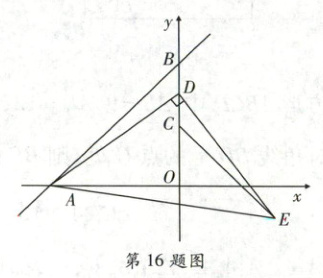
16. 右侧扫码·视频讲解 如图,在平面直角坐标系中,直线$y = x + 4$与$x$轴、$y$轴分别交于点$A$,$B$,$C$是$OB$的中点,$D$为$y$轴正半轴上一动点,连接$AD$,以$AD$为边在$AD$右侧作等腰直角三角形$ADE$,其中$\angle ADE = 90°$,则$CE$的最小值为
[视频讲解]
$3 \sqrt{2}$
。[视频讲解]
答案:
16.$3 \sqrt{2}$ [点拨]本题考查一次函数图象上点的坐标特征,一次函数的性质,全等三角形的判定和性质,等腰直角三角形的性质,表示出点$E$的坐标是解题的关键。
[解析]如图,作$EF \perp y$轴于点$F$,$\because$直线$y = x + 4$与$x$轴,$y$轴分别交于点$A$,$B$,$\therefore A(-4,0)$,$B(0,4)$,
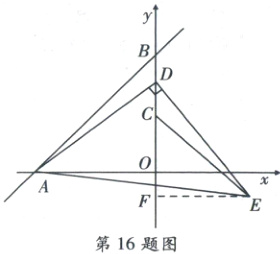
$\therefore OA = OB = 4$。$\because C$是$OB$的中点,$\therefore C(0,2)$。由题意设$D(0,n)(n>0)$,则$OD = n$。$\because \angle ADE = 90^{\circ}$,$\therefore \angle ADO + \angle EDF = 90^{\circ}$。$\because \angle ADO + \angle OAD = 90^{\circ}$,$\therefore \angle EDF = \angle OAD$。$\because$三角形$ADE$是等腰直角三角形,$\angle ADE = 90^{\circ}$,$\therefore AD = DE$,在$\triangle AOD$和$\triangle DFE$中,$\begin{cases} \angle OAD = \angle EDF \\ \angle AOD = \angle DFE = 90^{\circ} \\ AD = DE \end{cases}$,$\therefore \triangle AOD \cong \triangle DFE(AAS)$,$\therefore AO = DF = 4$,$DO = EF = n$,$\therefore E(n,n - 4)$,$\therefore CE^{2}=n^{2}+(n - 4 - 2)^{2}=2(n - 3)^{2}+18$,$\therefore n = 3$时,$CE^{2}$有最小值$18$,$\therefore CE$的最小值为$3 \sqrt{2}$。故答案为$3 \sqrt{2}$。
16.$3 \sqrt{2}$ [点拨]本题考查一次函数图象上点的坐标特征,一次函数的性质,全等三角形的判定和性质,等腰直角三角形的性质,表示出点$E$的坐标是解题的关键。
[解析]如图,作$EF \perp y$轴于点$F$,$\because$直线$y = x + 4$与$x$轴,$y$轴分别交于点$A$,$B$,$\therefore A(-4,0)$,$B(0,4)$,
$\therefore OA = OB = 4$。$\because C$是$OB$的中点,$\therefore C(0,2)$。由题意设$D(0,n)(n>0)$,则$OD = n$。$\because \angle ADE = 90^{\circ}$,$\therefore \angle ADO + \angle EDF = 90^{\circ}$。$\because \angle ADO + \angle OAD = 90^{\circ}$,$\therefore \angle EDF = \angle OAD$。$\because$三角形$ADE$是等腰直角三角形,$\angle ADE = 90^{\circ}$,$\therefore AD = DE$,在$\triangle AOD$和$\triangle DFE$中,$\begin{cases} \angle OAD = \angle EDF \\ \angle AOD = \angle DFE = 90^{\circ} \\ AD = DE \end{cases}$,$\therefore \triangle AOD \cong \triangle DFE(AAS)$,$\therefore AO = DF = 4$,$DO = EF = n$,$\therefore E(n,n - 4)$,$\therefore CE^{2}=n^{2}+(n - 4 - 2)^{2}=2(n - 3)^{2}+18$,$\therefore n = 3$时,$CE^{2}$有最小值$18$,$\therefore CE$的最小值为$3 \sqrt{2}$。故答案为$3 \sqrt{2}$。
17. (15分)计算。
(1) $\frac{\sqrt{20} + \sqrt{5}}{\sqrt{5}} - 2$;
(2) $(\sqrt{13} - 3)(\sqrt{13} + 3)$;
(3) $\sqrt{32} - 3\sqrt{\frac{1}{2}} + \sqrt{2}$;
(4) $\left(-\frac{1}{3}\right)^{-2} + (1 - \sqrt{3})^0 - |2 - \sqrt{5}|$;
(5) $2\sqrt{12} ÷ \sqrt{2} + (\sqrt{2} - \sqrt{3})^2 - 3\sqrt{6}$。
(1) $\frac{\sqrt{20} + \sqrt{5}}{\sqrt{5}} - 2$;
(2) $(\sqrt{13} - 3)(\sqrt{13} + 3)$;
(3) $\sqrt{32} - 3\sqrt{\frac{1}{2}} + \sqrt{2}$;
(4) $\left(-\frac{1}{3}\right)^{-2} + (1 - \sqrt{3})^0 - |2 - \sqrt{5}|$;
(5) $2\sqrt{12} ÷ \sqrt{2} + (\sqrt{2} - \sqrt{3})^2 - 3\sqrt{6}$。
答案:
17.[点拨]本题考查二次根式的混合运算,平方差公式,零指数幂,负整数指数幂,分母有理化,完全平方公式,准确熟练地进行计算是解题的关键。
[解析]$(1)\frac{\sqrt{20}+\sqrt{5}}{\sqrt{5}}-2=\frac{2\sqrt{5}+\sqrt{5}}{\sqrt{5}}-2=\frac{3\sqrt{5}}{\sqrt{5}}-2=3 - 2 = 1$。
$(2)(\sqrt{13}-3)(\sqrt{13}+3)=13 - 9 = 4$。
$(3)\sqrt{32}-3\sqrt{\frac{1}{2}}+\sqrt{2}=4\sqrt{2}-\frac{3\sqrt{2}}{2}+\sqrt{2}=\frac{7\sqrt{2}}{2}$。
$(4)(-\frac{1}{3})^{-2}+(1 - \sqrt{3})^{0}-|2 - \sqrt{5}|=9 + 1-(\sqrt{5}-2)=9 + 1-\sqrt{5}+2=12-\sqrt{5}$。
$(5)2\sqrt{12} ÷ \sqrt{2}+(\sqrt{2}-\sqrt{3})^{2}-3\sqrt{6}=2\sqrt{6}+2-2\sqrt{6}+3-3\sqrt{6}=5 - 3\sqrt{6}$。
[解析]$(1)\frac{\sqrt{20}+\sqrt{5}}{\sqrt{5}}-2=\frac{2\sqrt{5}+\sqrt{5}}{\sqrt{5}}-2=\frac{3\sqrt{5}}{\sqrt{5}}-2=3 - 2 = 1$。
$(2)(\sqrt{13}-3)(\sqrt{13}+3)=13 - 9 = 4$。
$(3)\sqrt{32}-3\sqrt{\frac{1}{2}}+\sqrt{2}=4\sqrt{2}-\frac{3\sqrt{2}}{2}+\sqrt{2}=\frac{7\sqrt{2}}{2}$。
$(4)(-\frac{1}{3})^{-2}+(1 - \sqrt{3})^{0}-|2 - \sqrt{5}|=9 + 1-(\sqrt{5}-2)=9 + 1-\sqrt{5}+2=12-\sqrt{5}$。
$(5)2\sqrt{12} ÷ \sqrt{2}+(\sqrt{2}-\sqrt{3})^{2}-3\sqrt{6}=2\sqrt{6}+2-2\sqrt{6}+3-3\sqrt{6}=5 - 3\sqrt{6}$。
查看更多完整答案,请扫码查看

