

 搜索
搜索
2025年初中毕业升学真题详解八年级数学上册北师大版陕西专版
注:目前有些书本章节名称可能整理的还不是很完善,但都是按照顺序排列的,请同学们按照顺序仔细查找。练习册 2025年初中毕业升学真题详解八年级数学上册北师大版陕西专版 答案主要是用来给同学们做完题方便对答案用的,请勿直接抄袭。
第20页
- 第1页
- 第2页
- 第3页
- 第4页
- 第5页
- 第6页
- 第7页
- 第8页
- 第9页
- 第10页
- 第11页
- 第12页
- 第13页
- 第14页
- 第15页
- 第16页
- 第17页
- 第18页
- 第19页
- 第20页
- 第21页
- 第22页
- 第23页
- 第24页
- 第25页
- 第26页
- 第27页
- 第28页
- 第29页
- 第30页
- 第31页
- 第32页
- 第33页
- 第34页
- 第35页
- 第36页
- 第37页
- 第38页
- 第39页
- 第40页
- 第41页
- 第42页
- 第43页
- 第44页
- 第45页
- 第46页
- 第47页
- 第48页
- 第49页
- 第50页
- 第51页
- 第52页
- 第53页
- 第54页
- 第55页
- 第56页
- 第57页
- 第58页
- 第59页
- 第60页
- 第61页
- 第62页
- 第63页
- 第64页
- 第65页
- 第66页
- 第67页
- 第68页
- 第69页
- 第70页
- 第71页
- 第72页
- 第73页
- 第74页
- 第75页
- 第76页
- 第77页
- 第78页
- 第79页
- 第80页
23. 右侧扫码·视频讲解 (8分)观察下列等式,解答下面的问题:
$\frac{2}{\sqrt{3}+1}=\frac{2(\sqrt{3}-1)}{(\sqrt{3}+1)×(\sqrt{3}-1)}=\sqrt{3}-1$;
$\frac{2}{\sqrt{5}+\sqrt{3}}=\frac{2(\sqrt{5}-\sqrt{3})}{(\sqrt{5}+\sqrt{3})×(\sqrt{5}-\sqrt{3})}=\sqrt{5}-\sqrt{3}$。
(1)化简:$\frac{2}{\sqrt{13}+\sqrt{11}}=$
(2)比较大小:$\sqrt{21}-\sqrt{19}$
(3)计算下列式子的结果。
$\frac{1}{\sqrt{3}+1}+\frac{1}{\sqrt{5}+\sqrt{3}}+\frac{1}{\sqrt{7}+\sqrt{5}}+·s+\frac{1}{\sqrt{2025}+\sqrt{2023}}$
$\frac{2}{\sqrt{3}+1}=\frac{2(\sqrt{3}-1)}{(\sqrt{3}+1)×(\sqrt{3}-1)}=\sqrt{3}-1$;
$\frac{2}{\sqrt{5}+\sqrt{3}}=\frac{2(\sqrt{5}-\sqrt{3})}{(\sqrt{5}+\sqrt{3})×(\sqrt{5}-\sqrt{3})}=\sqrt{5}-\sqrt{3}$。
(1)化简:$\frac{2}{\sqrt{13}+\sqrt{11}}=$
$\sqrt{13}-\sqrt{11}$
,$\frac{2}{\sqrt{n + 2}+\sqrt{n}}=$$\sqrt{n + 2}-\sqrt{n}$
($n$为正整数);(2)比较大小:$\sqrt{21}-\sqrt{19}$
$<$
$\sqrt{19}-\sqrt{17}$;(填“>”“<”或“=”)(3)计算下列式子的结果。
$\frac{1}{\sqrt{3}+1}+\frac{1}{\sqrt{5}+\sqrt{3}}+\frac{1}{\sqrt{7}+\sqrt{5}}+·s+\frac{1}{\sqrt{2025}+\sqrt{2023}}$
答案:
23. 【点拨】本题考查二次根式的分母有理化,二次根式的混合运算。【解析】
(1)$\frac{2}{\sqrt{13}+\sqrt{11}}=\frac{2(\sqrt{13}-\sqrt{11})}{(\sqrt{13}+\sqrt{11})(\sqrt{13}-\sqrt{11})}=\sqrt{13}-\sqrt{11}$;$\frac{2}{\sqrt{n + 2}+\sqrt{n}}=\frac{2(\sqrt{n + 2}-\sqrt{n})}{(\sqrt{n + 2}+\sqrt{n})(\sqrt{n + 2}-\sqrt{n})}=\sqrt{n + 2}-\sqrt{n}$。故答案为$\sqrt{13}-\sqrt{11}$,$\sqrt{n + 2}-\sqrt{n}$。
(2)$\because\frac{1}{\sqrt{21}-\sqrt{19}}=\frac{\sqrt{21}+\sqrt{19}}{(\sqrt{21}-\sqrt{19})(\sqrt{21}+\sqrt{19})}=\frac{1}{2}×(\sqrt{21}+\sqrt{19})$,$\frac{1}{\sqrt{19}-\sqrt{17}}=\frac{\sqrt{19}+\sqrt{17}}{(\sqrt{19}-\sqrt{17})(\sqrt{19}+\sqrt{17})}=\frac{1}{2}×(\sqrt{19}+\sqrt{17})$,且$\sqrt{21}>\sqrt{17}$,$\therefore\frac{1}{2}×(\sqrt{21}+\sqrt{19})>\frac{1}{2}×(\sqrt{19}+\sqrt{17})$,$\therefore\frac{1}{\sqrt{21}-\sqrt{19}}>\frac{1}{\sqrt{19}-\sqrt{17}}$。故答案为$<$。
(3)$\frac{1}{\sqrt{3}+1}+\frac{1}{\sqrt{5}+\sqrt{3}}+\frac{1}{\sqrt{7}+\sqrt{5}}+·s+\frac{1}{\sqrt{2025}+\sqrt{2023}}=\frac{\sqrt{3}-1}{(\sqrt{3}+1)(\sqrt{3}-1)}+\frac{\sqrt{5}-\sqrt{3}}{(\sqrt{5}+\sqrt{3})(\sqrt{5}-\sqrt{3})}+\frac{\sqrt{7}-\sqrt{5}}{(\sqrt{7}+\sqrt{5})(\sqrt{7}-\sqrt{5})}+·s+\frac{\sqrt{2025}-\sqrt{2023}}{(\sqrt{2025}+\sqrt{2023})(\sqrt{2025}-\sqrt{2023})}=\frac{1}{2}×(\sqrt{3}-1)+\frac{1}{2}×(\sqrt{5}-\sqrt{3})+\frac{1}{2}×(\sqrt{7}-\sqrt{5})+·s+\frac{1}{2}×(\sqrt{2025}-\sqrt{2023})=\frac{1}{2}×(\sqrt{3}-1+\sqrt{5}-\sqrt{3}+\sqrt{7}-\sqrt{5}+·s+\sqrt{2025}-\sqrt{2023})=\frac{1}{2}×(\sqrt{2025}-1)=\frac{\sqrt{2025}-1}{2}$。
(1)$\frac{2}{\sqrt{13}+\sqrt{11}}=\frac{2(\sqrt{13}-\sqrt{11})}{(\sqrt{13}+\sqrt{11})(\sqrt{13}-\sqrt{11})}=\sqrt{13}-\sqrt{11}$;$\frac{2}{\sqrt{n + 2}+\sqrt{n}}=\frac{2(\sqrt{n + 2}-\sqrt{n})}{(\sqrt{n + 2}+\sqrt{n})(\sqrt{n + 2}-\sqrt{n})}=\sqrt{n + 2}-\sqrt{n}$。故答案为$\sqrt{13}-\sqrt{11}$,$\sqrt{n + 2}-\sqrt{n}$。
(2)$\because\frac{1}{\sqrt{21}-\sqrt{19}}=\frac{\sqrt{21}+\sqrt{19}}{(\sqrt{21}-\sqrt{19})(\sqrt{21}+\sqrt{19})}=\frac{1}{2}×(\sqrt{21}+\sqrt{19})$,$\frac{1}{\sqrt{19}-\sqrt{17}}=\frac{\sqrt{19}+\sqrt{17}}{(\sqrt{19}-\sqrt{17})(\sqrt{19}+\sqrt{17})}=\frac{1}{2}×(\sqrt{19}+\sqrt{17})$,且$\sqrt{21}>\sqrt{17}$,$\therefore\frac{1}{2}×(\sqrt{21}+\sqrt{19})>\frac{1}{2}×(\sqrt{19}+\sqrt{17})$,$\therefore\frac{1}{\sqrt{21}-\sqrt{19}}>\frac{1}{\sqrt{19}-\sqrt{17}}$。故答案为$<$。
(3)$\frac{1}{\sqrt{3}+1}+\frac{1}{\sqrt{5}+\sqrt{3}}+\frac{1}{\sqrt{7}+\sqrt{5}}+·s+\frac{1}{\sqrt{2025}+\sqrt{2023}}=\frac{\sqrt{3}-1}{(\sqrt{3}+1)(\sqrt{3}-1)}+\frac{\sqrt{5}-\sqrt{3}}{(\sqrt{5}+\sqrt{3})(\sqrt{5}-\sqrt{3})}+\frac{\sqrt{7}-\sqrt{5}}{(\sqrt{7}+\sqrt{5})(\sqrt{7}-\sqrt{5})}+·s+\frac{\sqrt{2025}-\sqrt{2023}}{(\sqrt{2025}+\sqrt{2023})(\sqrt{2025}-\sqrt{2023})}=\frac{1}{2}×(\sqrt{3}-1)+\frac{1}{2}×(\sqrt{5}-\sqrt{3})+\frac{1}{2}×(\sqrt{7}-\sqrt{5})+·s+\frac{1}{2}×(\sqrt{2025}-\sqrt{2023})=\frac{1}{2}×(\sqrt{3}-1+\sqrt{5}-\sqrt{3}+\sqrt{7}-\sqrt{5}+·s+\sqrt{2025}-\sqrt{2023})=\frac{1}{2}×(\sqrt{2025}-1)=\frac{\sqrt{2025}-1}{2}$。
24. 右侧扫码·视频讲解 (12分)【问题发现】
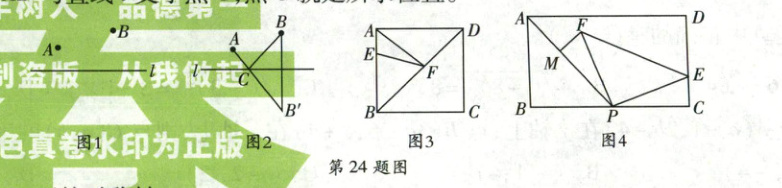
(1)如图1所示,将军每天从军营$A$出发,先到河边$l$饮马,再去河岸同侧的军营$B$开会,为了方便,将军给自己制定了方案,找到了饮马的最佳位置,如图2,作点$B$关于直线$l$的对称点$B'$,连接$AB'$与直线$l$交于点$C$,点$C$就是所求位置。
∵直线$l$是点$B,B'$的对称轴,
$\therefore CB = CB'$,
$\therefore AC + CB = AC + CB'$。
根据“
【问题探究】
(2)如图3,在正方形$ABCD$中,$AB = 8$,$E$是$AB$边上的一点,且$AE = 2$,$F$是$BD$上的一个动点,求$\triangle AEF$周长的最小值;
【问题解决】
(3)如图4,在矩形$ABCD$中,$AB = 120$,$AD = 220$,$P$是$CB$边上一点,且$CP = 100$,$E$是线段$CD$上的任意一点,连接$EP$,以$EP$为直角边在$BC$上方作等腰直角三角形$EPF$,$FE$为斜边。连接$AP$,$AP$边上存在一个点$M$,且$AM = 40\sqrt{2}$,连接$FM$,$\triangle PFM$的周长是否存在最小值?若存在,请求出$\triangle PFM$周长的最小值;若不存在,请说明理由。
(1)如图1所示,将军每天从军营$A$出发,先到河边$l$饮马,再去河岸同侧的军营$B$开会,为了方便,将军给自己制定了方案,找到了饮马的最佳位置,如图2,作点$B$关于直线$l$的对称点$B'$,连接$AB'$与直线$l$交于点$C$,点$C$就是所求位置。
∵直线$l$是点$B,B'$的对称轴,
$\therefore CB = CB'$,
$\therefore AC + CB = AC + CB'$。
根据“
两点之间,线段最短
”可得$AC + CB$的最小值是$AB'$;【问题探究】
(2)如图3,在正方形$ABCD$中,$AB = 8$,$E$是$AB$边上的一点,且$AE = 2$,$F$是$BD$上的一个动点,求$\triangle AEF$周长的最小值;
【问题解决】
(3)如图4,在矩形$ABCD$中,$AB = 120$,$AD = 220$,$P$是$CB$边上一点,且$CP = 100$,$E$是线段$CD$上的任意一点,连接$EP$,以$EP$为直角边在$BC$上方作等腰直角三角形$EPF$,$FE$为斜边。连接$AP$,$AP$边上存在一个点$M$,且$AM = 40\sqrt{2}$,连接$FM$,$\triangle PFM$的周长是否存在最小值?若存在,请求出$\triangle PFM$周长的最小值;若不存在,请说明理由。
答案:
24. 【点拨】本题考查轴对称的性质,正方形的性质,等腰直角三角形的判定与性质,勾股定理,二次根式的化简等知识,作出合适的辅助线是解题的关键。【解析】
(1)根据“两点之间,线段最短”可得$AC + CB$的最小值是$AB'$。故答案为两点之间,线段最短。
(2)如图1,连接$CF$,$CE$。
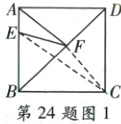
$\because$在正方形$ABCD$中,$AB = 8$,$\therefore BC = AB = 8$,$\angle ABC = 90^{\circ}$,$A,C$关于$BD$对称,$\therefore AF = CF$,$BE = AB - AE = 6$,$\therefore CE = \sqrt{BE^{2}+BC^{2}} = 10$,$\therefore\triangle AEF$周长$= AE + AF + EF = AE + CF + EF\geq AE + CE$。当$E,F,C$三点共线时,$\triangle AEF$的周长最小,最小值为$AE + CE = 2 + 10 = 12$。
(3)存在。如图2,过点$F$作$FG\bot CD$于点$G$,交$AB$于点$K$,作$PH\bot KG$于$H$,交$AD$于点$O$,过点$M$作$MN\bot AD$于点$N$,交$GK$于点$Q$,连接$PN$,$NF$。
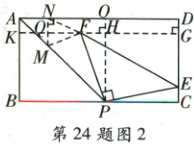
在矩形$ABCD$中,$AB = 120$,$AD = 220$,$\therefore\angle BAD = \angle B = \angle C = \angle D = 90^{\circ}$,$BC = AD = 220$。又$\because CP = 100$,$\therefore BP = BC - CP = 120$,$\therefore AP = \sqrt{AB^{2}+BP^{2}} = 120\sqrt{2}$。又$\because AM = 40\sqrt{2}$,$\therefore PM = AP - AM = 80\sqrt{2}$。$\because PH\bot KG$,$FG\bot CD$,$\angle C = 90^{\circ}$,$\therefore\angle HPC = 90^{\circ}$,$\angle DGH = 90^{\circ}$。又$\because\triangle EPF$是等腰直角三角形,$\therefore EP = FP$,$\angle EPF = 90^{\circ}$,$\therefore\angle FPH = \angle EPC = 90^{\circ}-\angle HPE$。又$\because\angle PHF = \angle C = 90^{\circ}$,$\therefore\triangle PHF\cong\triangle PCE( AAS)$,$\therefore PH = PC = 100$。易得$PO = CD = 120$,$\angle PON = 90^{\circ}$,$OD = PC = 100$,$\therefore OH = PO - PH = 20$。易得$NQ = OH = 20$。$\because AB = BP$,$\angle B = 90^{\circ}$,$\therefore\angle BAP = 45^{\circ}$,$\therefore\angle PAO = 45^{\circ}$,$\therefore\triangle AMN$是等腰直角三角形,$\therefore AN = MN$,$\therefore MN^{2}+AN^{2}=2MN^{2}=AM^{2}=(40\sqrt{2})^{2}$,$\therefore MN = AN = 40$,$\therefore MQ = MN - NQ = 20 = NQ$,$NO = AD - AN - OD = 80$,$\therefore FQ$垂直平分$MN$,$\therefore MF = NF$,$\therefore PF + MF = PF + NF\geq PN$,$\therefore$当$P,F,N$三点共线时,$PF + MF$最小,最小值为$PN = \sqrt{PO^{2}+NO^{2}} = 40\sqrt{13}$。又$\because\triangle PMF$的周长为$PM + MF + PF = PM + NF + PF$,$\therefore\triangle PMF$的周长的最小值为$80\sqrt{2}+40\sqrt{13}$。
24. 【点拨】本题考查轴对称的性质,正方形的性质,等腰直角三角形的判定与性质,勾股定理,二次根式的化简等知识,作出合适的辅助线是解题的关键。【解析】
(1)根据“两点之间,线段最短”可得$AC + CB$的最小值是$AB'$。故答案为两点之间,线段最短。
(2)如图1,连接$CF$,$CE$。
$\because$在正方形$ABCD$中,$AB = 8$,$\therefore BC = AB = 8$,$\angle ABC = 90^{\circ}$,$A,C$关于$BD$对称,$\therefore AF = CF$,$BE = AB - AE = 6$,$\therefore CE = \sqrt{BE^{2}+BC^{2}} = 10$,$\therefore\triangle AEF$周长$= AE + AF + EF = AE + CF + EF\geq AE + CE$。当$E,F,C$三点共线时,$\triangle AEF$的周长最小,最小值为$AE + CE = 2 + 10 = 12$。
(3)存在。如图2,过点$F$作$FG\bot CD$于点$G$,交$AB$于点$K$,作$PH\bot KG$于$H$,交$AD$于点$O$,过点$M$作$MN\bot AD$于点$N$,交$GK$于点$Q$,连接$PN$,$NF$。
在矩形$ABCD$中,$AB = 120$,$AD = 220$,$\therefore\angle BAD = \angle B = \angle C = \angle D = 90^{\circ}$,$BC = AD = 220$。又$\because CP = 100$,$\therefore BP = BC - CP = 120$,$\therefore AP = \sqrt{AB^{2}+BP^{2}} = 120\sqrt{2}$。又$\because AM = 40\sqrt{2}$,$\therefore PM = AP - AM = 80\sqrt{2}$。$\because PH\bot KG$,$FG\bot CD$,$\angle C = 90^{\circ}$,$\therefore\angle HPC = 90^{\circ}$,$\angle DGH = 90^{\circ}$。又$\because\triangle EPF$是等腰直角三角形,$\therefore EP = FP$,$\angle EPF = 90^{\circ}$,$\therefore\angle FPH = \angle EPC = 90^{\circ}-\angle HPE$。又$\because\angle PHF = \angle C = 90^{\circ}$,$\therefore\triangle PHF\cong\triangle PCE( AAS)$,$\therefore PH = PC = 100$。易得$PO = CD = 120$,$\angle PON = 90^{\circ}$,$OD = PC = 100$,$\therefore OH = PO - PH = 20$。易得$NQ = OH = 20$。$\because AB = BP$,$\angle B = 90^{\circ}$,$\therefore\angle BAP = 45^{\circ}$,$\therefore\angle PAO = 45^{\circ}$,$\therefore\triangle AMN$是等腰直角三角形,$\therefore AN = MN$,$\therefore MN^{2}+AN^{2}=2MN^{2}=AM^{2}=(40\sqrt{2})^{2}$,$\therefore MN = AN = 40$,$\therefore MQ = MN - NQ = 20 = NQ$,$NO = AD - AN - OD = 80$,$\therefore FQ$垂直平分$MN$,$\therefore MF = NF$,$\therefore PF + MF = PF + NF\geq PN$,$\therefore$当$P,F,N$三点共线时,$PF + MF$最小,最小值为$PN = \sqrt{PO^{2}+NO^{2}} = 40\sqrt{13}$。又$\because\triangle PMF$的周长为$PM + MF + PF = PM + NF + PF$,$\therefore\triangle PMF$的周长的最小值为$80\sqrt{2}+40\sqrt{13}$。
查看更多完整答案,请扫码查看

