

 搜索
搜索
第34页
- 第1页
- 第2页
- 第3页
- 第4页
- 第5页
- 第6页
- 第7页
- 第8页
- 第9页
- 第10页
- 第11页
- 第12页
- 第13页
- 第14页
- 第15页
- 第16页
- 第17页
- 第18页
- 第19页
- 第20页
- 第21页
- 第22页
- 第23页
- 第24页
- 第25页
- 第26页
- 第27页
- 第28页
- 第29页
- 第30页
- 第31页
- 第32页
- 第33页
- 第34页
- 第35页
- 第36页
- 第37页
- 第38页
- 第39页
- 第40页
- 第41页
- 第42页
- 第43页
- 第44页
- 第45页
- 第46页
- 第47页
- 第48页
- 第49页
- 第50页
- 第51页
- 第52页
- 第53页
- 第54页
- 第55页
- 第56页
- 第57页
- 第58页
- 第59页
- 第60页
- 第61页
- 第62页
- 第63页
- 第64页
- 第65页
- 第66页
- 第67页
- 第68页
- 第69页
- 第70页
- 第71页
- 第72页
- 第73页
14. 求证:无论$x$,$y$为何值,$4x^{2}+12x+9y^{2}+30y+35$的值恒为正。
答案:
证明:$4x^{2}+12x+9y^{2}+30y+35$
$=4x^{2}+12x+9+9y^{2}+30y+25-9-25+35$
$=(2x+3)^{2}+(3y+5)^{2}+1$。
$\because (2x+3)^{2}\geq 0$,$(3y+5)^{2}\geq 0$,
$\therefore (2x+3)^{2}+(3y+5)^{2}+1\geq 1$。
$\therefore$无论$x$,$y$为何值,$4x^{2}+12x+9y^{2}+30y+35$的值恒为正。
$=4x^{2}+12x+9+9y^{2}+30y+25-9-25+35$
$=(2x+3)^{2}+(3y+5)^{2}+1$。
$\because (2x+3)^{2}\geq 0$,$(3y+5)^{2}\geq 0$,
$\therefore (2x+3)^{2}+(3y+5)^{2}+1\geq 1$。
$\therefore$无论$x$,$y$为何值,$4x^{2}+12x+9y^{2}+30y+35$的值恒为正。
15. 先阅读材料,再解决问题:
通过对实数的学习,我们知道$x^{2}\geq 0$,由此可以得出完全平方公式$(a\pm b)^{2}= a^{2}\pm 2ab+b^{2}$的值为非负数,这一性质在数学中有着广泛的应用。如求多项式$2x^{2}+8x-3$的最小值时,我们可以这样处理:
解:原式$=2(x^{2}+4x)-3= 2(x^{2}+2x\cdot 2+2^{2}-2^{2})-3= 2(x+2)^{2}-11$。$\because (x+2)^{2}\geq 0$,$\therefore 2(x+2)^{2}-11\geq -11$。$\therefore当x= -2$时,$2(x+2)^{2}-11$的值最小,为-11。
(1)求多项式$3x^{2}-6x+2$的最小值,并写出对应的$x$的值;
(2)求多项式$8-2x^{2}+4x$的最大值。
通过对实数的学习,我们知道$x^{2}\geq 0$,由此可以得出完全平方公式$(a\pm b)^{2}= a^{2}\pm 2ab+b^{2}$的值为非负数,这一性质在数学中有着广泛的应用。如求多项式$2x^{2}+8x-3$的最小值时,我们可以这样处理:
解:原式$=2(x^{2}+4x)-3= 2(x^{2}+2x\cdot 2+2^{2}-2^{2})-3= 2(x+2)^{2}-11$。$\because (x+2)^{2}\geq 0$,$\therefore 2(x+2)^{2}-11\geq -11$。$\therefore当x= -2$时,$2(x+2)^{2}-11$的值最小,为-11。
(1)求多项式$3x^{2}-6x+2$的最小值,并写出对应的$x$的值;
(2)求多项式$8-2x^{2}+4x$的最大值。
答案:
(1) 解:原式$=3(x^{2}-2x)+2=3(x^{2}-2x+1-1)+2=3(x-1)^{2}-1$。
$\because (x-1)^{2}\geq 0$,$\therefore 3(x-1)^{2}\geq 0$。
$\therefore 3(x-1)^{2}-1\geq -1$。
$\therefore$当$x=1$时,原多项式的值最小,为$-1$。
(2) 解:原式$=-2x^{2}+4x+8=-2(x^{2}-2x)+8=-2(x^{2}-2x+1-1)+8=-2(x-1)^{2}+10$。
$\because (x-1)^{2}\geq 0$,$\therefore -2(x-1)^{2}\leq 0$。
$\therefore -2(x-1)^{2}+10\leq 10$。
$\therefore$当$x=1$时,原多项式的值最大,为$10$。
(1) 解:原式$=3(x^{2}-2x)+2=3(x^{2}-2x+1-1)+2=3(x-1)^{2}-1$。
$\because (x-1)^{2}\geq 0$,$\therefore 3(x-1)^{2}\geq 0$。
$\therefore 3(x-1)^{2}-1\geq -1$。
$\therefore$当$x=1$时,原多项式的值最小,为$-1$。
(2) 解:原式$=-2x^{2}+4x+8=-2(x^{2}-2x)+8=-2(x^{2}-2x+1-1)+8=-2(x-1)^{2}+10$。
$\because (x-1)^{2}\geq 0$,$\therefore -2(x-1)^{2}\leq 0$。
$\therefore -2(x-1)^{2}+10\leq 10$。
$\therefore$当$x=1$时,原多项式的值最大,为$10$。
16. 若代数式$2x^{2}-2kx+7$的最小值为4,求$k$的值。
答案讲解
答案讲解
答案:
解:$\begin{aligned}2x^{2}-2kx+7&=(\sqrt{2}x)^{2}-2×\sqrt{2}x×\frac{\sqrt{2}}{2}k+\left(\frac{\sqrt{2}}{2}k\right)^{2}-\left(\frac{\sqrt{2}}{2}k\right)^{2}+7\\&=\left(\sqrt{2}x - \frac{\sqrt{2}}{2}k\right)^{2}-\frac{1}{2}k^{2}+7\end{aligned}$
因为$\left(\sqrt{2}x - \frac{\sqrt{2}}{2}k\right)^{2}\geq0$,所以代数式的最小值为$-\frac{1}{2}k^{2}+7$。
由题意得$-\frac{1}{2}k^{2}+7 = 4$,
解得$k^{2}=6$,
所以$k = \pm\sqrt{6}$。
因为$\left(\sqrt{2}x - \frac{\sqrt{2}}{2}k\right)^{2}\geq0$,所以代数式的最小值为$-\frac{1}{2}k^{2}+7$。
由题意得$-\frac{1}{2}k^{2}+7 = 4$,
解得$k^{2}=6$,
所以$k = \pm\sqrt{6}$。
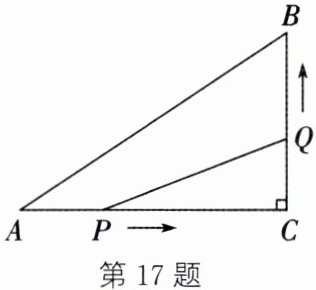
17. 如图,在$Rt\triangle ABC$中,$\angle C= 90^{\circ}$,$AC= 6cm$,$BC= 4cm$,点$P在边AC$上,从点$A$出发,向点$C以2cm/s$的速度移动,点$Q在边CB$上,从点$C$出发,向点$B以\sqrt{3}cm/s$的速度移动。点$P$,$Q$同时出发,且当一点移动到终点时,另一点也随之停止移动。设$\triangle PCQ的面积为Scm^{2}$,运动时间为$ts$,求$S$的最大值。
答案:
解:由题意,得 $ AP = 2t \, \text{cm} $,$ CQ = \sqrt{3}t \, \text{cm} $,则 $ PC = AC - AP = (6 - 2t) \, \text{cm} $。
运动时间 $ t $ 的取值范围:点 $ P $ 到达终点 $ C $ 需 $ \frac{6}{2} = 3 \, \text{s} $,点 $ Q $ 到达终点 $ B $ 需 $ \frac{4}{\sqrt{3}} = \frac{4\sqrt{3}}{3} \, \text{s} $,因 $ \frac{4\sqrt{3}}{3} < 3 $,故 $ 0 < t \leq \frac{4\sqrt{3}}{3} $。
$\triangle PCQ$ 的面积 $ S = \frac{1}{2} × PC × CQ = \frac{1}{2}(6 - 2t)\sqrt{3}t = -\sqrt{3}t^2 + 3\sqrt{3}t$。
配方得:$ S = -\sqrt{3}(t^2 - 3t) = -\sqrt{3}\left(t - \frac{3}{2}\right)^2 + \frac{9\sqrt{3}}{4}$。
$\because -\sqrt{3} < 0$,抛物线开口向下,当 $ t = \frac{3}{2} $ 时($ \frac{3}{2} \leq \frac{4\sqrt{3}}{3} $,符合题意),$ S $ 取最大值。
$\therefore S_{\text{最大值}} = \frac{9\sqrt{3}}{4}$。
答:$ S $ 的最大值为 $ \frac{9\sqrt{3}}{4} \, \text{cm}^2 $。
运动时间 $ t $ 的取值范围:点 $ P $ 到达终点 $ C $ 需 $ \frac{6}{2} = 3 \, \text{s} $,点 $ Q $ 到达终点 $ B $ 需 $ \frac{4}{\sqrt{3}} = \frac{4\sqrt{3}}{3} \, \text{s} $,因 $ \frac{4\sqrt{3}}{3} < 3 $,故 $ 0 < t \leq \frac{4\sqrt{3}}{3} $。
$\triangle PCQ$ 的面积 $ S = \frac{1}{2} × PC × CQ = \frac{1}{2}(6 - 2t)\sqrt{3}t = -\sqrt{3}t^2 + 3\sqrt{3}t$。
配方得:$ S = -\sqrt{3}(t^2 - 3t) = -\sqrt{3}\left(t - \frac{3}{2}\right)^2 + \frac{9\sqrt{3}}{4}$。
$\because -\sqrt{3} < 0$,抛物线开口向下,当 $ t = \frac{3}{2} $ 时($ \frac{3}{2} \leq \frac{4\sqrt{3}}{3} $,符合题意),$ S $ 取最大值。
$\therefore S_{\text{最大值}} = \frac{9\sqrt{3}}{4}$。
答:$ S $ 的最大值为 $ \frac{9\sqrt{3}}{4} \, \text{cm}^2 $。
查看更多完整答案,请扫码查看

